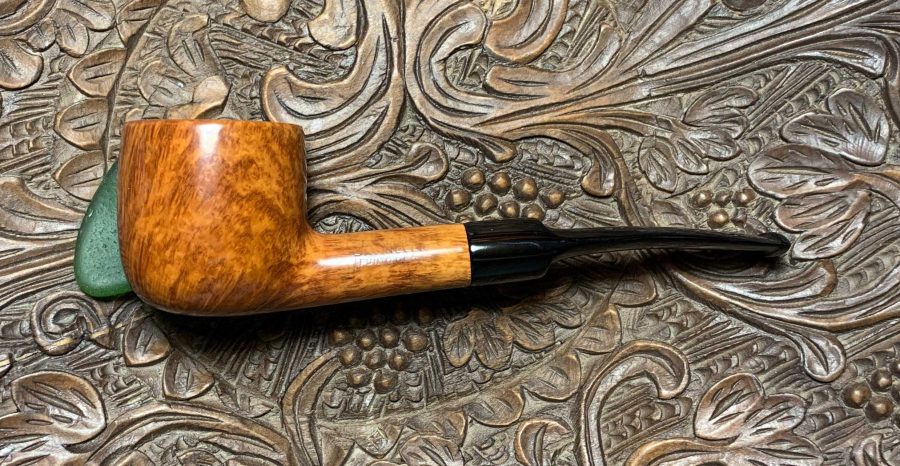
The Savinelli Punto Oro on the table has special sentiment attached to it. It came from a friend and colleague in Bulgaria. Jacob is a husband and father and also a pipe man that knows his tobaccos and pipes. Whenever I have a question about trying a particular blend or brand, he’s the one I can go to for solid information  about the leaves, notes, and tin life. Several years ago, Jacob and his wife, Suzanne visited us in Bulgaria from their church in the US to help with a summer project English Camp that we sponsored to develop relationships with Bulgarians. The ‘Bulgaria bug’ caught them and over time started moving down a path which would change their lives. They moved to Sofia where they desired to help with the effort to plant new and build up existing Bulgarian churches. Suzanne was also drawn to help with the efforts with the Daughters of Bulgaria – developing relationships with women and girls ‘working’ the streets. Today, Jacob and Suzanne continue to serve in Bulgaria even though my wife and my time there has come an end.
On one of the visits to Sofia as Jacob and Suzanne were investigating the path that they would eventually bring them to live in Bulgaria, Jacob and I did some pipe picking at Nevski Pazar, the bazaar ‘flea market’ in the shadows of Nevski Cathedral, the Orthodox church in the background of the picture of Jacob and me catching an afternoon bowl together. I can’t remember if either of us actually bought a pipe, but we had seen the Savinelli Punto Oro. Later, on his own, he did the dealing and took possession of the Punto Oro. Not long after, he opened the old newspaper wrapping and presented it to me to help the Daughters of Bulgaria. I was taken back and surprised at the treasure he was placing in my trust for the Daughters. Since that day when Jacob gave me the pipe, it has been waiting for a steward to hear the whisper from ‘For “Pipe Dreamers” ONLY!’ collection benefitting the Daughters of Bulgaria.
Pipe man Gary from Four Oaks, North Carolina, USA, heard the whisper of the Savinelli Punto Oro as well as the whisper of several other pipes which he has commissioned. After describing the story of how I received the Savinelli from Jacob, I recalled that the picture above with Jacob was taken in September of 2021 – the same trip that took my wife and me to Kyiv, Ukraine, as we were exploring helping there – before the war broke out the following February. On that same trip to Kyiv, I made it to the park for a bowl with my long-time friend and colleague, Mel. I posted this bowl brothers picture on FB and that’s how Gary found The Pipe Steward. Here is what I learned about Gary from the first pipe he commissioned:
 You asked how I heard about The Pipe Steward. I saw a post on Facebook in the Old Codgers Smoking Pipe of you and your friend Mel that looks like it was posted September 16. You and he were having a pipe together in Vladimirska Park in Kiev, Ukraine. You had a wee bit of Hobbit Weed in your bowl. In that post the link to The Pipe Steward was listed. I followed the link and spent about a hour clicking on this pipe then that pipe. I enjoyed looking at all the pipes you have listed. I have your page bookmarked and visit your page about once a week to see if there is something new. I can sit for hours just looking at pipes and looking at tobacco blends.
I smoked a pipe when I was younger, when I was in my 20’s but then I put them aside until about March of last year when on a whim I ordered a pipe and some Captain Black Cherry tobacco. After that the bug bit me again and it has been quite the journey since. I have several briar pipe (several Grabows) and a good collection of corn cob pipes. I thought the corn cob pipe was a novelty but the more I smoked one and the more I read about them the more I enjoyed them. I like collecting the Dr. Grabow’s because they were widely popular during the time I was growing up which was the 60’s and they are made right here in North Carolina.
I am 63 years old. I do smoke one of them every now and then, but I just like having them in the rack on display. I do receive a little bit of grief from my wife about my pipe and tobacco collections but for the most part she tolerates it and lets me play on. I am still a full-time worker and I work for one of the largest electric utility companies in the US. I have been with them now for 36 years. I hope to retire in about 4-5 more years and live the rest of my days here on our farm.
Gary concluded with this which I appreciate:
I am very pleased that I will be getting some truly amazing looking pipes but also will be is a small way helping out the Daughters of Bulgaria. I look forward to hearing from you and again and looking at your amazing talent of restoring pipes. Until then my friend be well and keep piping.
We continue to ‘keep piping’! Here are pictures of Jacob’s Savinelli Punto Oro Pot with some beautiful grain that got Gary’s attention.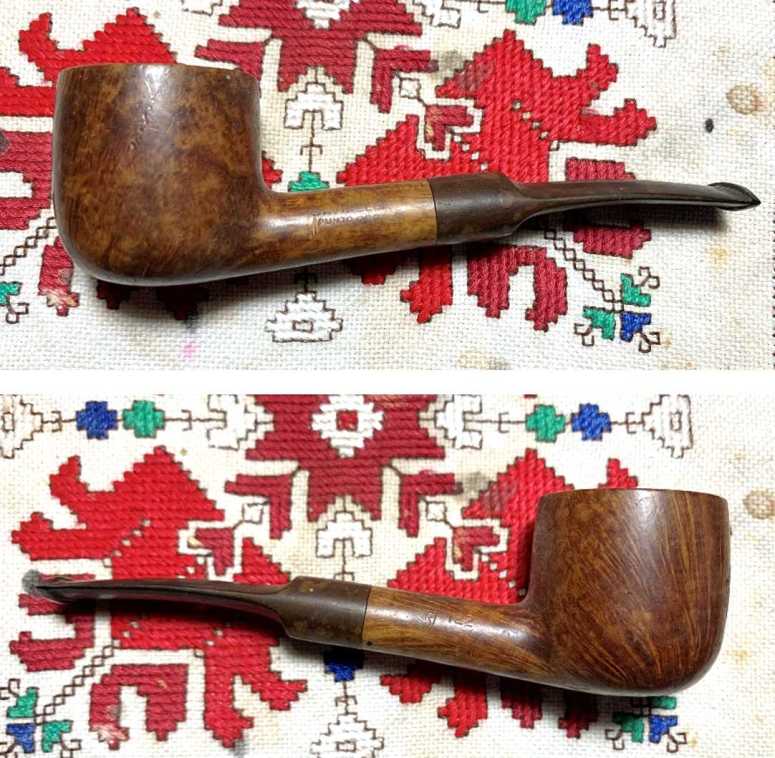

 The nomenclature on the left shank flank is thinning and some scratches are close to the lettering. The shank is stamped with SAVINELLI [over] PUNTO ORO [over] ITALY. The COM is almost invisible.
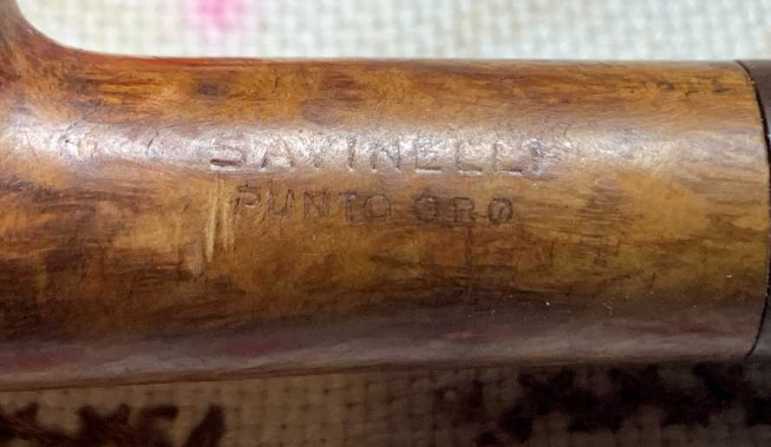 The right side is stamped with the Savinelli logo and to the right of this, the shape number 122. The COM ‘ITALY’ is below this.
 The stem also has the unique Punto Oro ‘dot’ but it’s almost invisible. The removal of oxidation and cleaning of the stem will be needed to see it more clearly.
 Savinelli’s shape charts are usually fairly consistent. The shape 122 lines up with shape number on Savinelli’s site (LINK).
 Savinelli is a well-known Italian pipe manufacture and I always enjoy having another look at the colorful history. Before and after WW II, when Italian pipe production was known more for volume than for quality, and not considered by many in the same league with other European pipe makers, Achille Savinelli Jr.’s ambition took shape to make Savinelli one of the premier names in pipe making today. This Pipedia Savinelli article summarizes this well:
 Savinelli Pipes began production in 1948 and, although the pipes were of a superior quality and unique in their aesthetic, the brand wasn’t an immediate success. Few new brands are. It takes time for the public to catch on. Retailers were skeptical of placing Italian pipes alongside their best sellers from England or France, and customers, in turn, were hesitant to purchase a Savinelli over pipes by already established, foreign brands. Achille Jr. stood by his product, however; he knew it was only a matter of time before the world realized that these pipes were of a far superior quality, capable of competing with even the most well-established pipe manufacturers in the world. As it turns out, he was right. In less than a year, Savinelli pipes gained prestige in markets all across the world—heralded for their delicate balance of innovation and tradition, of form and function. Savinelli pipes were placed alongside the likes of Dunhill and Comoy’s in tobacconists from the United States to Europe, and, in time, this exposure modified Italy’s reputation; it was not only the premier exporter of briar, but now a premium source of fine briar pipes.
I have worked on another Punto Oro and this line has been considered as one of Savinelli’s ‘top shelf’ productions. The first Punto Oro I worked on was a gift to my good friend in India, Paresh, who also contributes to Rebornpipes. In that research, I reached out to Rebornpipes contributor, Al Jones, who provided very helpful information that not only applied to that Wood Stock, but to the Punto Oro now on the worktable. Al sent a note that I include again here:
 Dal:
Dal:
I’m sorry to say that I have very little expertise in the Savinelli world, save the Guibileo d’Oro or Autograph lines (and only cursory in those).
Here’s an interesting thread about that line on the Pipesmagazine.com forums (I’m a moderator there) http://pipesmagazine.com/forums/topic/opinions-sought-savinelli-punto-oro. Older ones, like yours appears to be, were a pretty high grade, from what I can gather.
If your stem is vulcanite and non-filter, it should have been made before 1981 (looks that way to me). In ’81, they switched to filter pipes.
I’ll look forward to your restoration!
Al
The thread from PipesMagazine.com Forum was helpful. The general impression from the thread was that the older Punto Oro pipes were on the upper shelves of Savinelli offerings, just under the Guibileo D’Oro.
A later contribution to the Punto Oro thread dated July of 2017 came from F. Sykes Wilford of www.smokingpipes.com. His knowledge of the Punto Oro line was both impressive and helpful. I include it here in its entirety because he gives a ‘macro assessment’ of the line and a description of the different nuances or ‘mini-lines’ of the Punto Oro line:
There’s a fair bit of confusion on Punto Oro, in part because they’ve varied a whole lot over the years. I’ve seen older Punto Oro pipes from the 1970s and 1980s that would never make the cut today. I’ve also seen older Punto Oros that are just jaw dropping and would maybe be Giubileo d’Oro today. So, it’s not a better then or better now situation, so much as what the series means (from a grading perspective) is narrower now than it was thirty years ago. So you see a whole range of prices for Punto Oros on the estate market (hell, there’s a huge range just on SPC) since there’s a lot of variety in what Punto Oro meant over the decades. Presently, the Punto Oros made are as follows:
Punto Oro — two stems (one vulcanite, one acrylic), 6mm, generally no longer available in the US. Very good quality; fairly expensive; occasional problems with fit on second stem (it’s almost impossible to get stem fit right without making the pipe and stem together; since you can’t do that for two stems, one of them will fit less well almost by definition).
Punto Oro Classic — slightly less expensive than Punto Oro, with one stem. Non-filter. Same wood grade and whatnot as above. Available in ‘Natural’ (a sort of very light brown contrast) and Bordeaux.
Punto Oro Petite — See Classic, but for the smaller shapes like the 202 and 402. Available in finishes for Classic, plus sandblast.
Punto Oro Churchwarden — See Classic, but for churchwarden length stems.
Punto Oro Gold — A notch below the rest of the Punto Oro line, but really nice and significantly less expensive. 6mm filter. Available in an orange/brown smooth and a sandblast.
You’ll see other grades available new from time to time: Corallo, EX blasts, Mr. G, and blasts with silver army mounts. These are all not in current production, but there are some new from factory pipes still out there (Savinelli did some reorganization of space and clean up and found a bunch of old bits and pieces in the past three years).  So, how does Punto Oro fit into the line:
Savinelli grades the classic shape bowls into six groups to start, ranging from unusable bowls at the bottom, through bowls used for Vittoria, through the mainline Savinelli lines, up to top quality. This top quality bucket (which is pretty tiny) gets sorted again into three different groups to become various Punto Oro and Giubileo d’Oro grades.
Savinelli Autographs have a different path completely. They’re freehand shapes instead of predefined shapes, so they have their own grading and progression: things like Rossi Free at the bottom, moving up to things like Artisan, into the Sandblasted Autographs, then to the smooth Autographs. It’s more complicated than that (because smaller ones become Sigla or Mignon) and wilder ones become Autograph Freestyle or Mr. A, but that’s the general pattern).
So, you can’t really compare Punto Oro or Giubileo d’Oro to Autograph: they’re yielded by two totally different processes, and both sit atop their respective group.
As a collector, I’m kind of a huge fan of Punto Oro and Giubileo d’Oro. I have maybe five 105 shapes and a couple 202 shapes in a number of Punto and Giubileo finishes. I personally really like classic shapes and I really like the stains and quality of the work present on both series. They are more pricey than much of the Savinelli line, but I definitely think they’re worth it.
As for Estella, they were quasi-Autograph seconds in the 1970s and 1980s, filling a spot that Rossi Free does now. They’re cool and have their following, but comparisons to Punto Oro are pretty much impossible to make since they’re just too different.
Best,
Sykes
Above I marked in bold the category of Punto Oro that I believe is on the worktable – the Punto Oro Classic which has the general same quality of wood as the Punto Oro but it has a non-filtered stem as a natural or light brown contrast finish. That seems to fit. Taking the Sykes information and Al’s assessment that the stem gives a dating of before 1981, gives a pretty good idea what the story is with this Punto Oro.
Also, in the PipesMagazine thread, a few contributors included pictures of their Punto Oros. One caught my attention because the grain structure and coloring resemble the Punto Oro Pot on the table. Not a bad looking pipe 😊.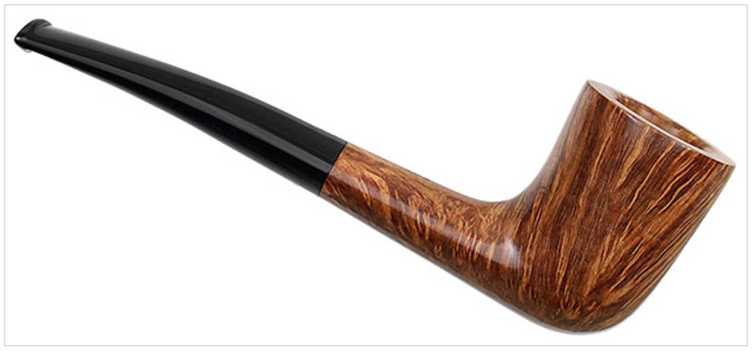 With a better understanding of the Punto Oro line, I take a closer look at the pipe on the worktable. The stummel has normal grime which needs to be addressed. The chamber has a good amount of cake, but this will be removed to allow a new steward to develop a cake on fresh briar. The rim has scratches and dents – normal wear.
 The stummel also has some dents and skin pitting.
 The heel also has trauma pits and scratches that need addressing.
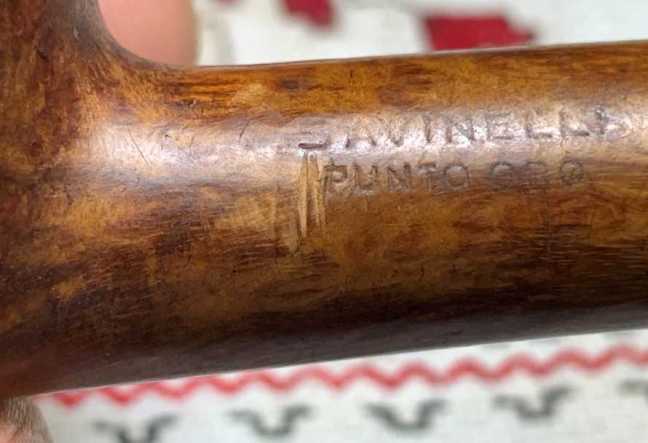
 There is a dangerously close set of cuts very near the nomenclature stamping. Care needs to be given to guard against damaging the already thinning stamping to address these cuts. I saw no fills in my inspection.
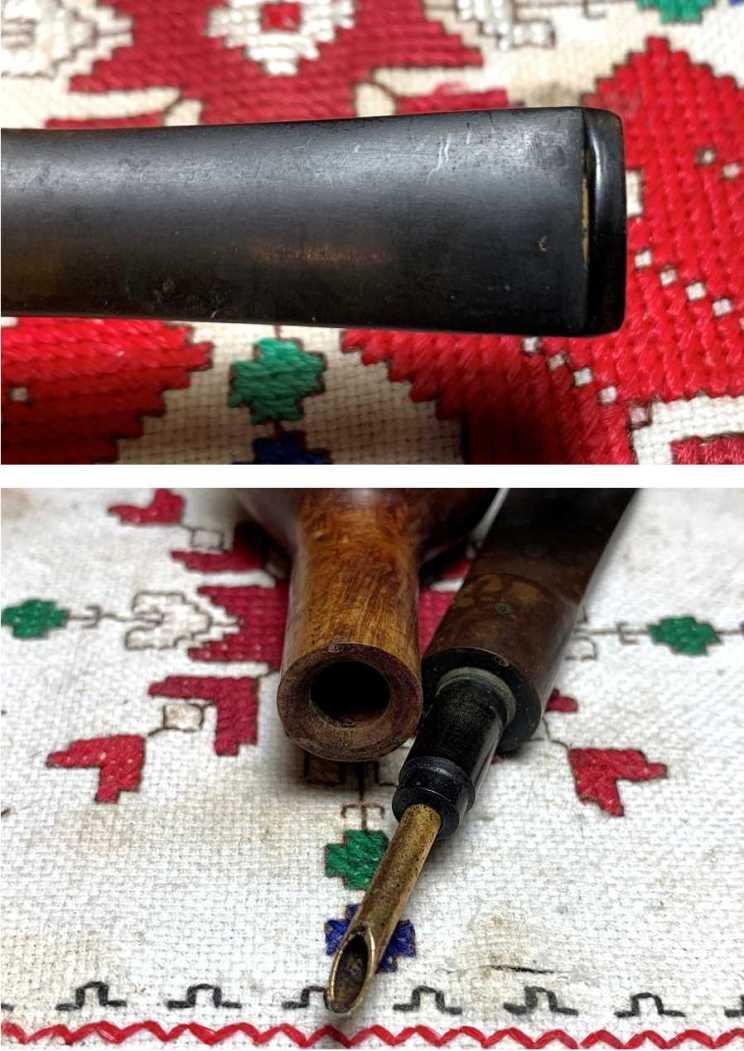
 The stem has very little tooth chatter on the bit, but it does have a sharp compression on top and underside. There is oxidation and the stem as a rough texture.
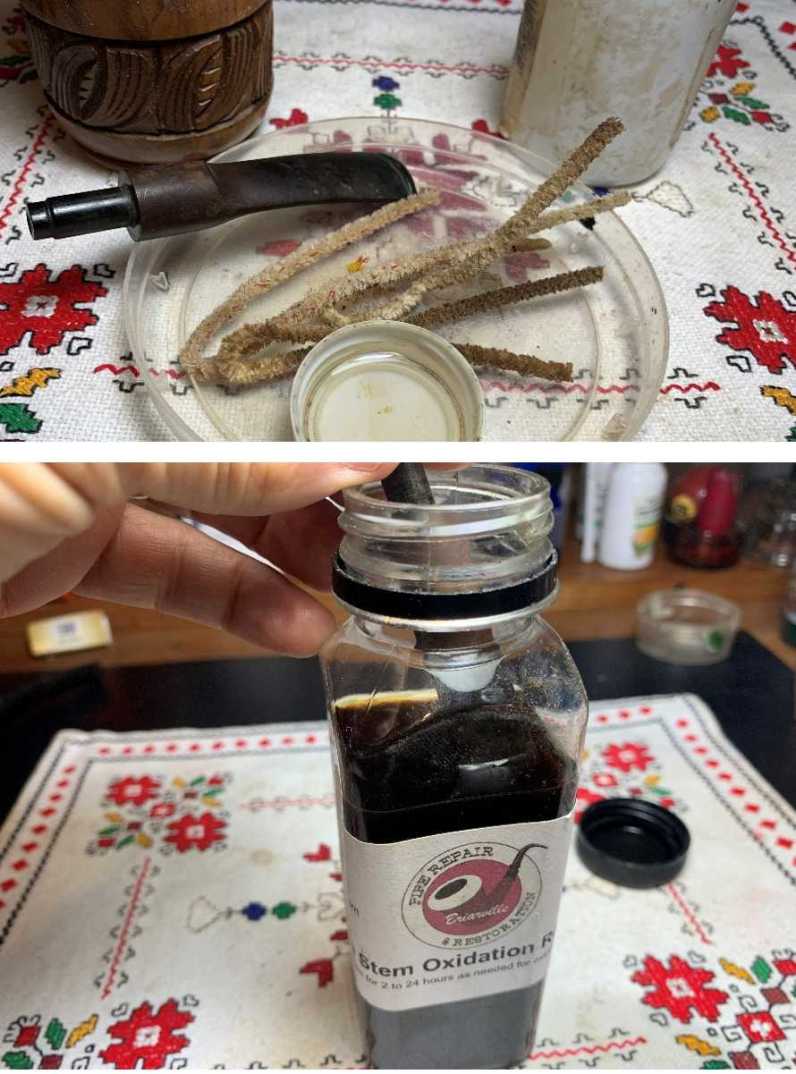
 To begin the restoration, the airway of the stem is cleaned using pipe cleaners and isopropyl 99%. After the airway is cleaned, to address the oxidation, the stem is placed in a soak of Briarville’s Pipe Stem Oxidation Remover for several hours. In this case, it is soaked overnight.
 The next day the stem is fished out of the Oxidation Remover and the raised oxidation is quite striking.
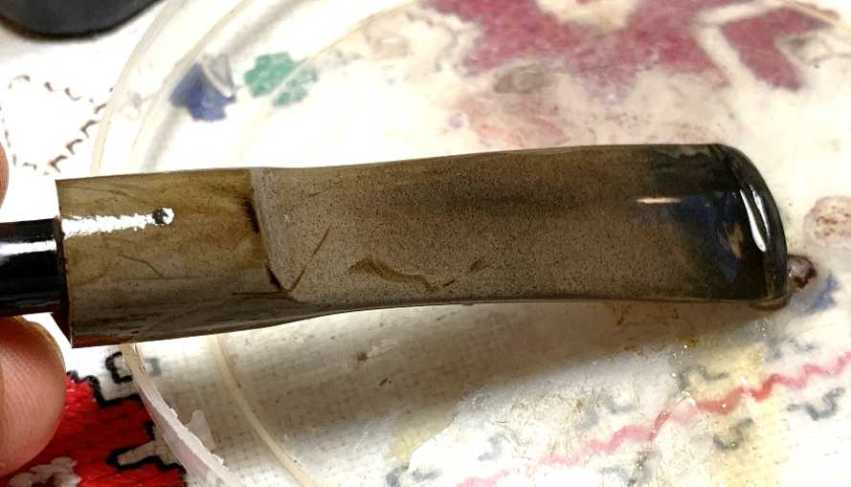 Using a cotton cloth, the stem is rigorously rubbed to remove the oxidation. It takes a bit of time and elbow grease and a little help from a 0000 grade steel wool, but the change is a nice thing to see.
 To condition the vulcanite stem, Paraffin Oil is liberally applied to the stem and the stem seems to drink it up! The stem is put aside to allow the oil to be absorbed.
 Turning now to the stummel, a starting picture is taken to mark the progress.
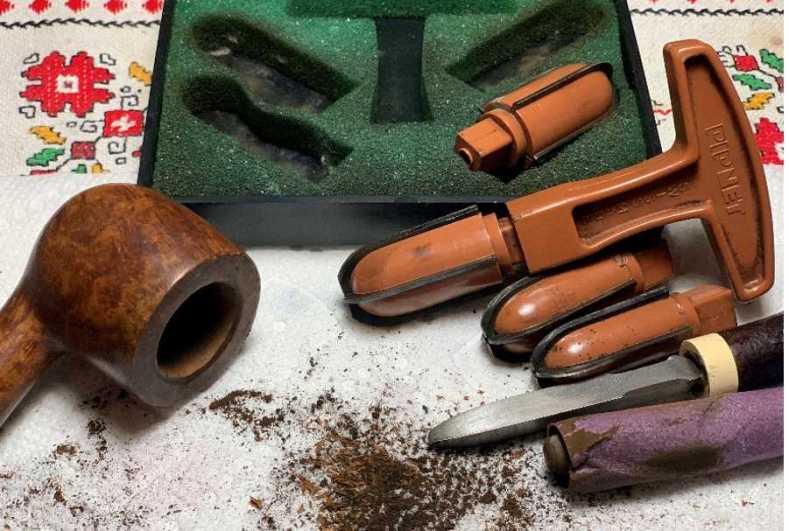
 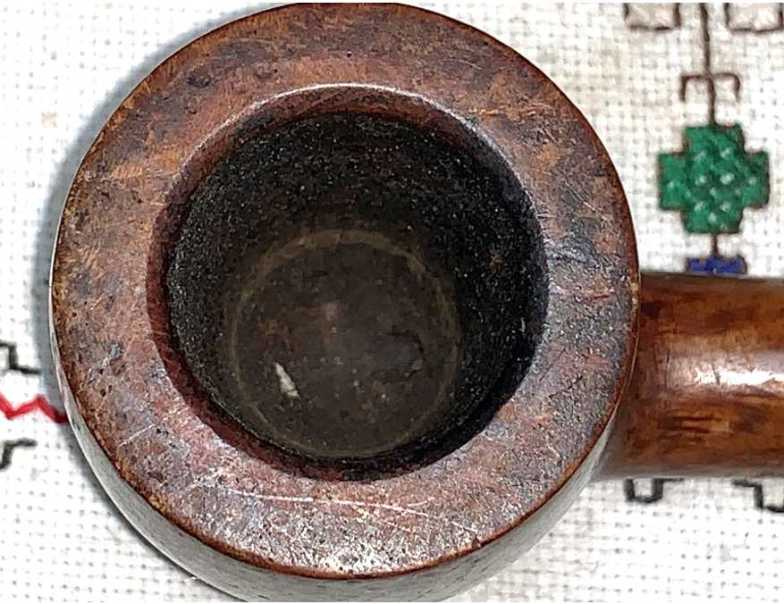 The chamber is reamed using the Pipnet Reaming Kit. Of the 4 blade heads available, 3 are used to ream the chamber. Following the reaming, the Savinelli Fitsall Tool is used to scrape the walls and then the chamber walls are sanded with 220 grade paper wrapped around a Sharpie Pen. Overall, there was very little cake buildup.
 After the chamber was wiped, a quick inspection confirmed that there are no heating problems in the chamber.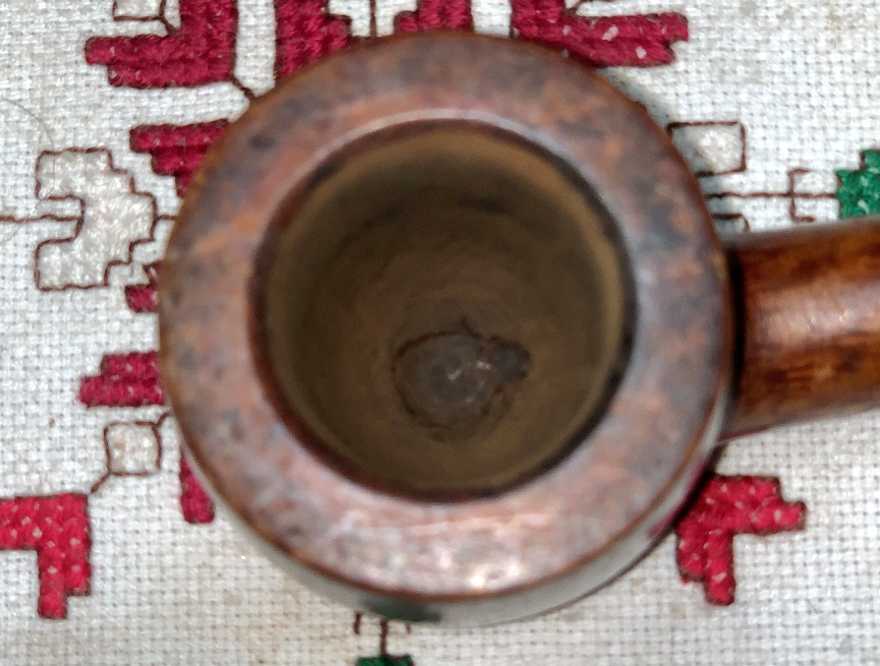
Moving now to the external briar cleaning, a few pictures show the stummel before cleaning. 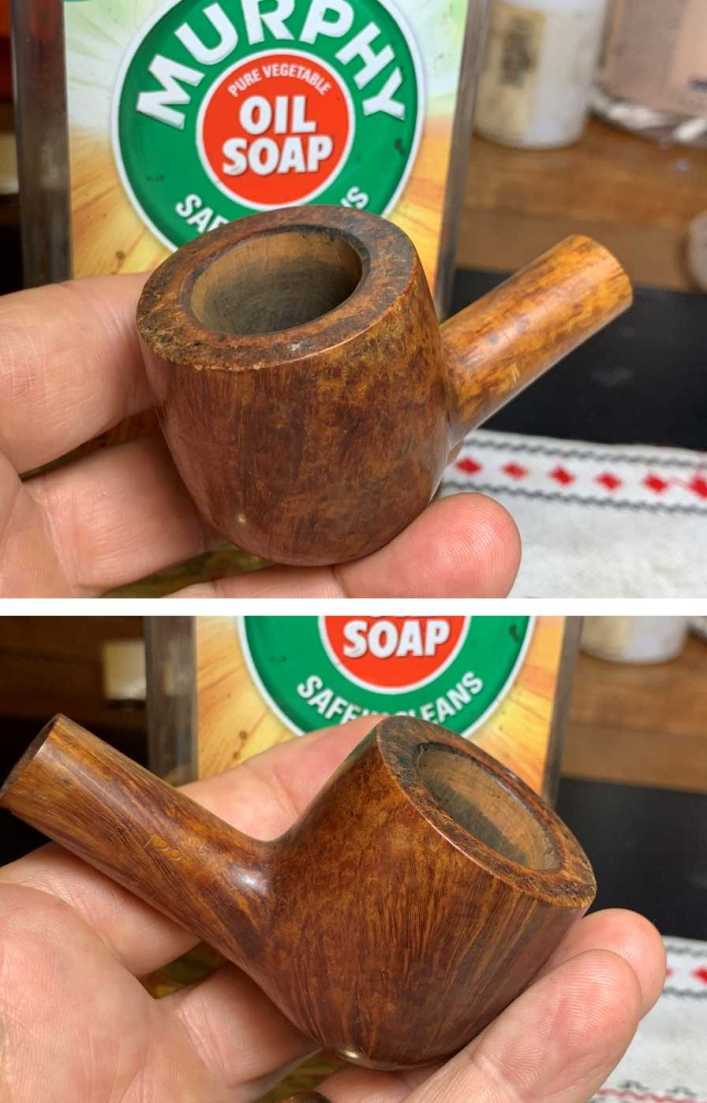
 Next, undiluted Murphy’s Oil Soap is used with a cotton pad to scrub the surface. The grain is looking great.
 Next, the stummel is transferred to the sink and the internals are scrubbed using hot water and liquid anti-oil dishwashing soap with shank brushes. After the internals were scrubbed, the stummel was thoroughly rinsed and brought back to the worktable.
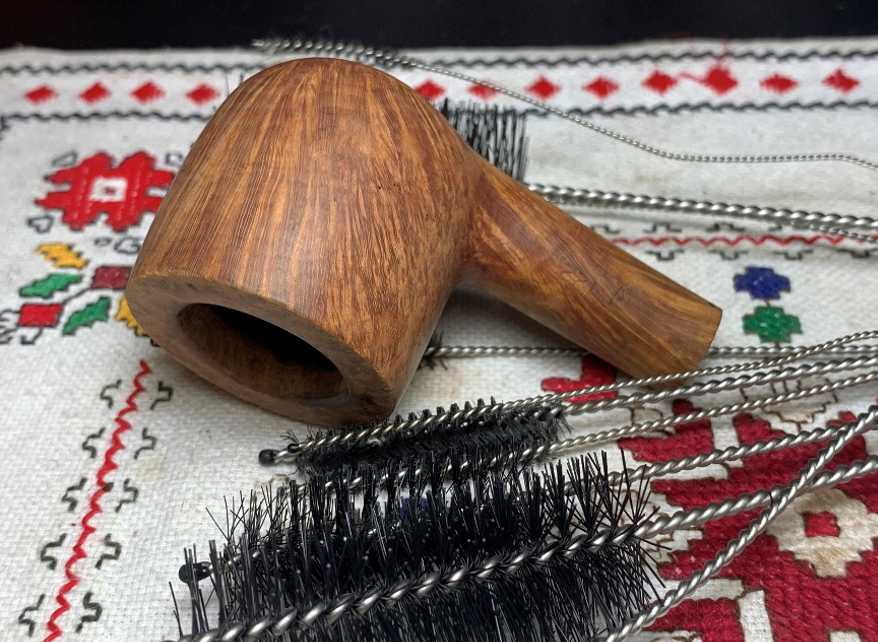 The internal cleaning continues with cotton buds and isopropyl 99% alcohol. It didn’t take a lot of buds before they began to lighten.
  The cleaning did wonders in clearing the grime and allowing the grain to come through. The rim is going to be a showcase of bird’s eye grain with the vertical grain pushing up for a cross section perspective. The aft inner rim still shows darkened briar from lighting practices. The rim has a smart bevel already in place and this will be refreshed as well and in so doing, address the dark briar.
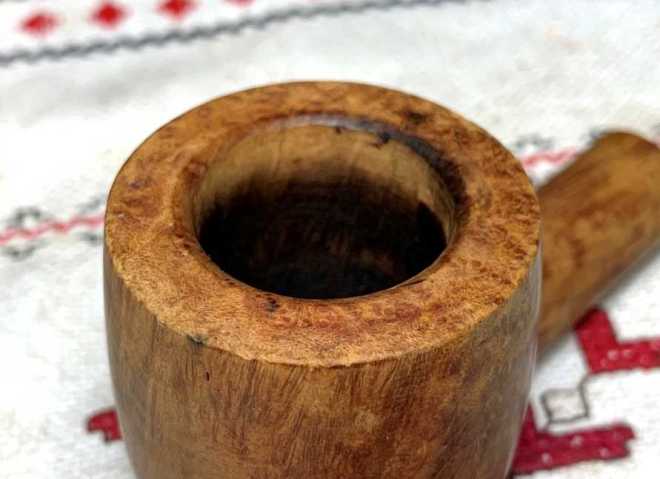 The rim needs overall sanding to address scratches and to reestablish lines. To accomplish this, only a minor abrasiveness is needed – 600 grade paper is used on the chopping block to top the stummel. With the stummel inverted on the paper, it is rotated several times.
 It doesn’t take a lot of topping to clean the rim briar. It looks good with the grain peeking out.
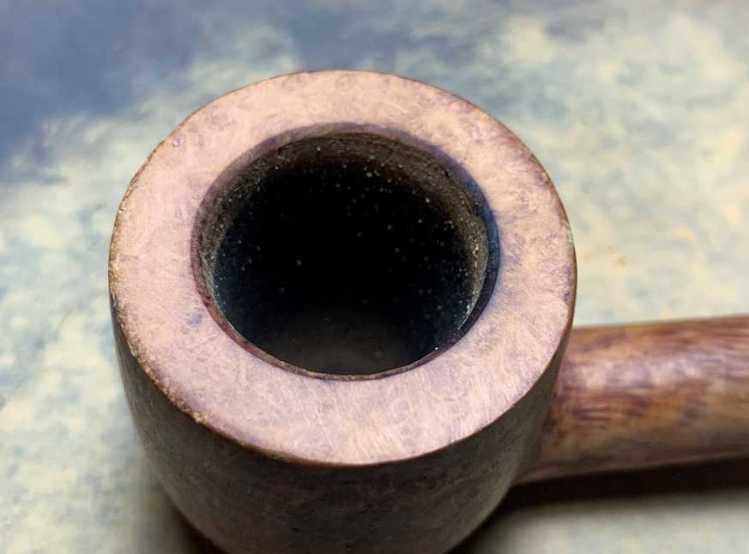 Next, the bevel is refreshed to remove the darkened area and to improve the internal lines of the rim.
 To do this, a wooden orb is used which cradles in the chamber mouth. Pinched between the orb and inner rim is a strip of 220 paper.
 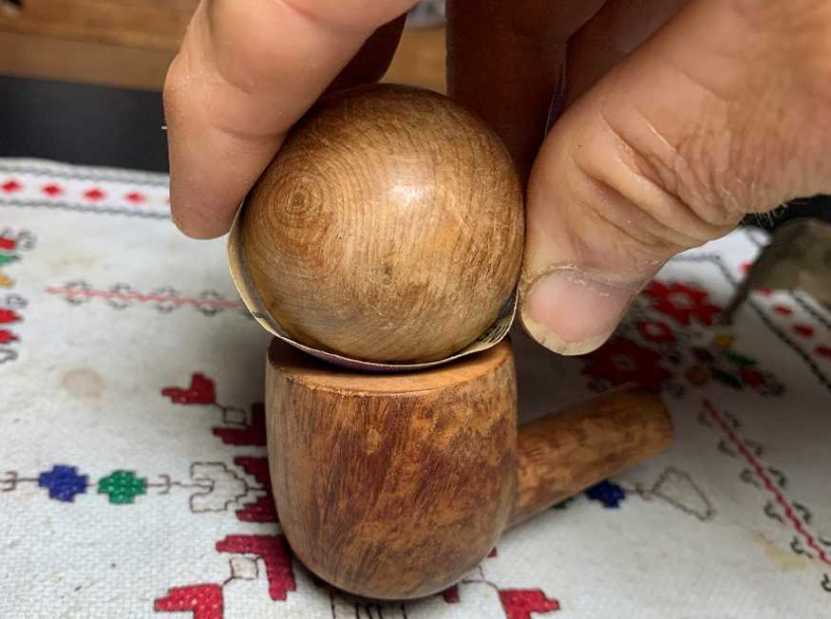 The orb is rotated around the inner rim to refresh the bevel. The same is done using 600 grade paper. I like what I see! The rim has a nice new look. The outer rim nicks and dents will be addressed with sanding later.
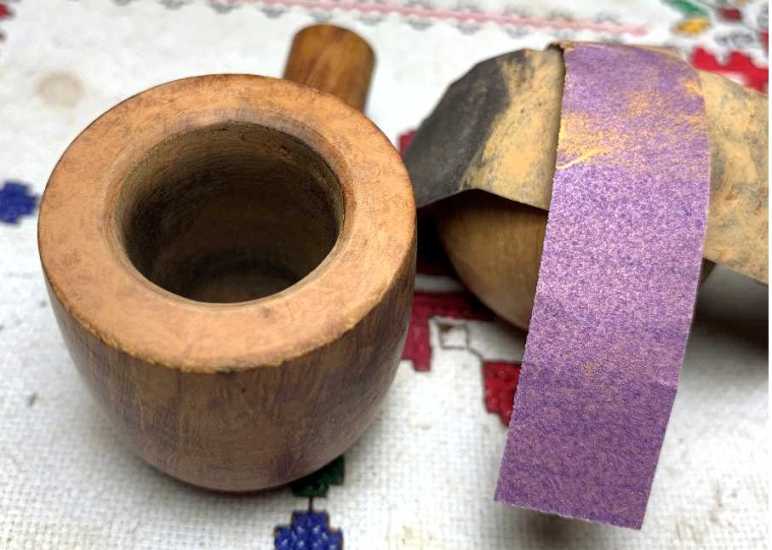 Next, the entire surface is sanded with sanding sponges to clean up minor dings and pits. The 2 vertical cuts I pointed out earlier are right next to the P and below the S in the nomenclature – too close to be careless.
 To protect the stampings on both sides of the shank, painter’s tape is cut and placed over the lettering. I needed a magnifying glass to see the lettering clearly. I was able to angle the cut of the tape on the lower left side in the picture directly below to expose the 2 cuts for safe sanding.
 Four sanding sponges were used to sand the stummel – coarse, medium, light, and fine. I like using sanding sponges at this point because they hug the contours and are broader in their paths and therefore do not leave sanding spots.
 After the sanding sponges, micromesh pads transition from sanding to more of a polishing of the wood. All nine pads are used, 1500 to 12000 and between each pad, the stummel is wiped with a wet cotton cloth to clear the sanding dust and to improve the traction of each pad. The tape was removed from the shank for the last 3 pads helping to blend the areas that were covered.
 Next, Mark Hoover’s Restoration Balm is used after the micromesh pads. The Balm does a great job of conditioning and deeply cleaning the wood bringing out the richness of the natural hues. After placing some Balm on the finger, the Balm is worked into the briar. I find the texture of the Balm is initially like a cream but then thickens into a wax-like consistency after it is worked into the briar. After the Balm is applied, the stummel is set aside for about 15 or so minutes for the Balm to be absorbed and do its magic.
  After the elapsed time, the stummel is buffed with a microfiber cloth only used for removal of the Balm. I do this to have a cloth full of the Balm residue to share with pipes in my own collection. The gift that keeps on giving!
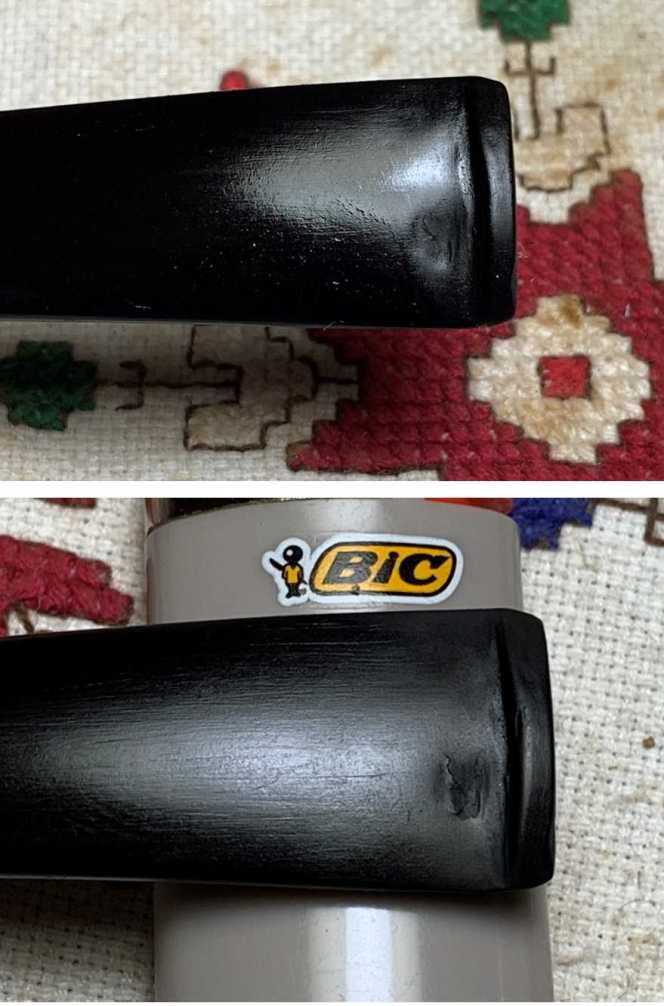
 The stummel is put to the side and the stem is waiting for attention. The oxidation removal did a great job and now the pictures below show the tooth compressions in the bit – upper and lower. The heating method is used to try to erase or minimize the compressions so that hopefully only sanding is needed. Using a Bic lighter, both sides of the bit are painted with flame. Heating the vulcanite rubber causes the rubber to expand and often this method results in the compressions disappearing. The before and after pictures are shown and unfortunately, the heating did not remove the need for patching. First upper – before and after:
 Then, lower – before and after:
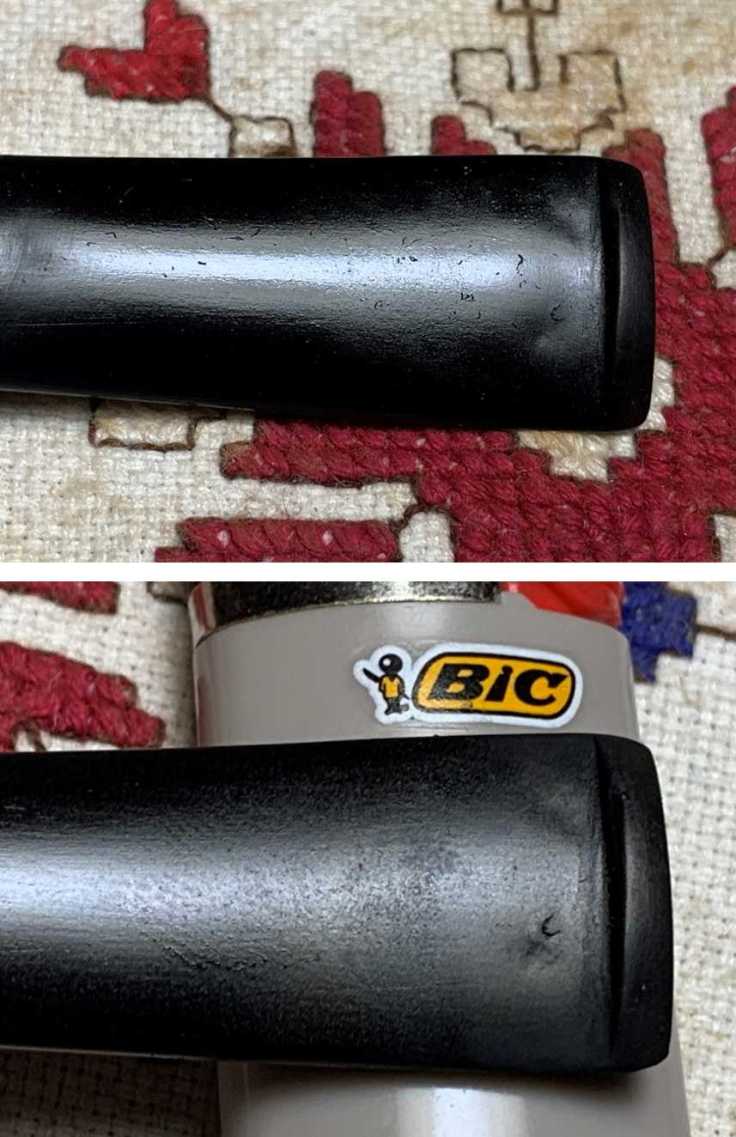 Both compressions point to the former steward clamping down on the bit with eye teeth. To fill the compressions, black CA is used and then set aside to cure.
 After the patches are cured, flat and square needle files go to work filing the patches as well as refreshing the button.
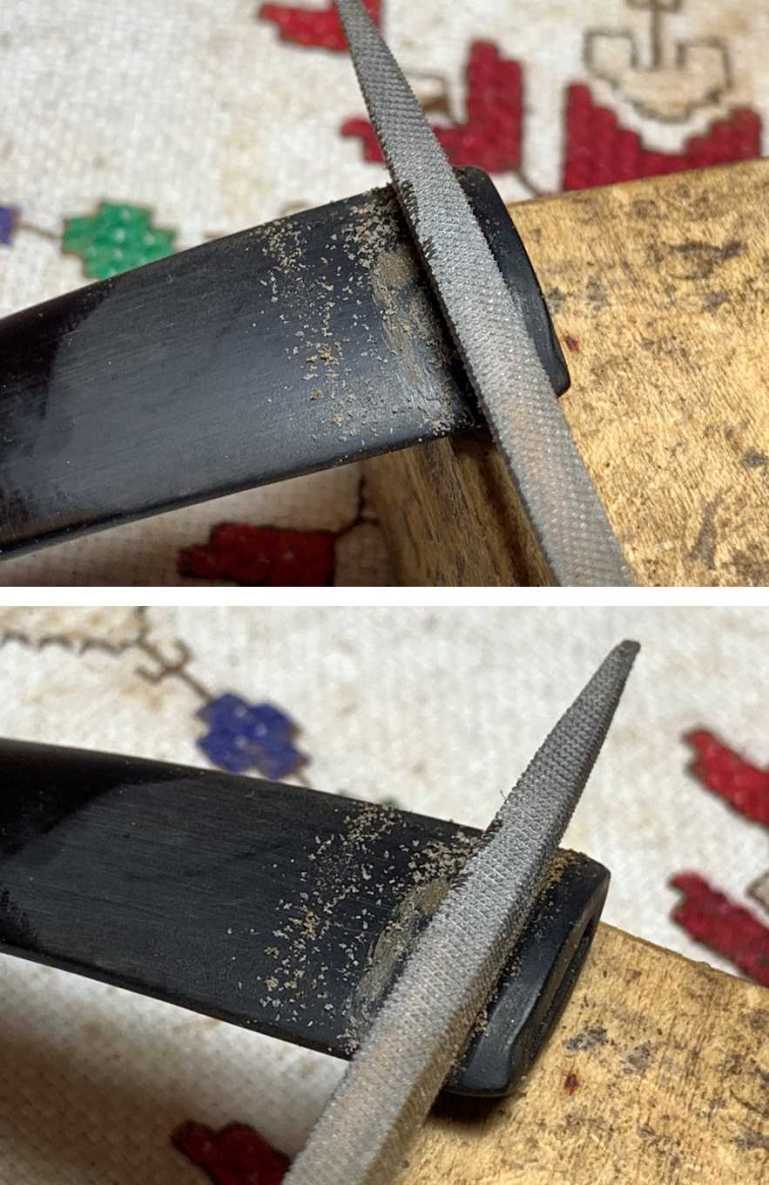 The basic filing is completed – upper and lower:
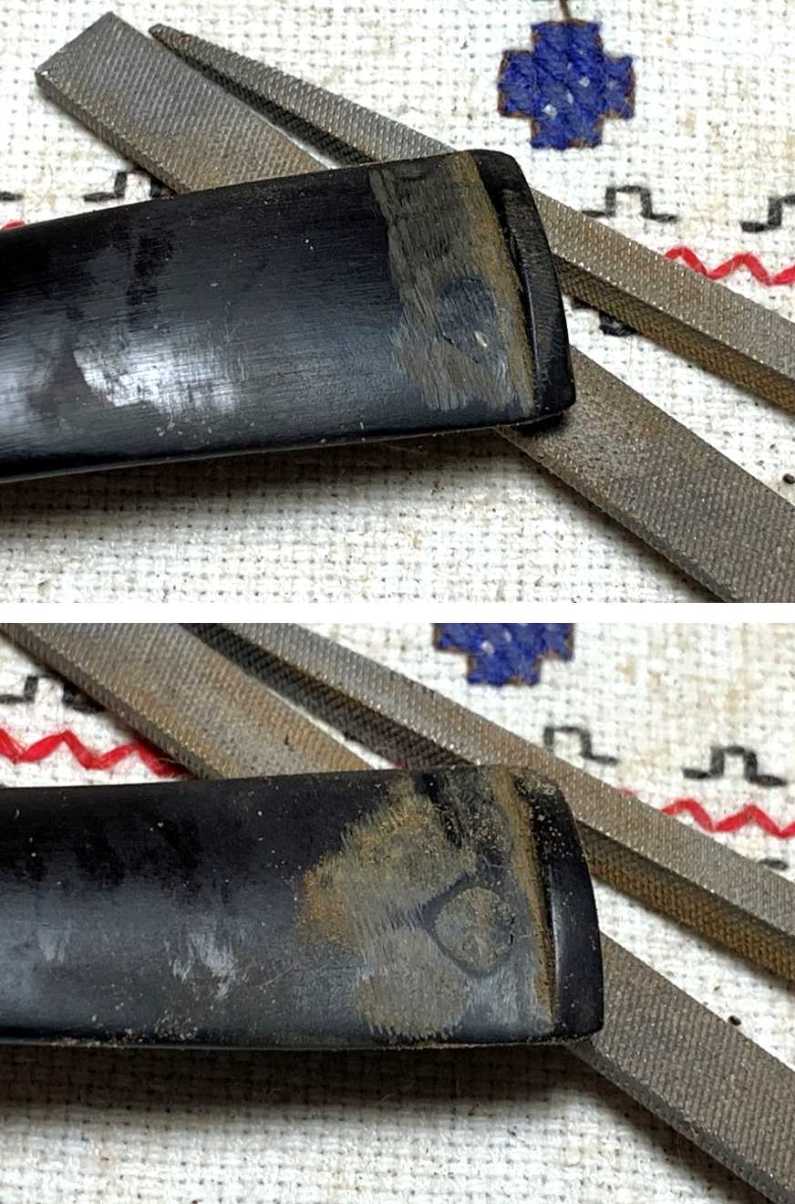 Next, the bit is sanded with 220 grade paper to erase the filing marks – upper and lower.
 Sanding is expanded to the entire stem with 220 paper. A sanding guard is used to prevent sanding over the shank facing which can result in ‘shouldering’.
 The 220 paper is replaced with 470 grade paper and again the stem is sanded with the guard.
 Using 600 grade paper next, the stem is wet sanded. This is followed by the application of 0000 grade steel wool.
 Following the steel wool, micromesh pads are applied to the stem from 1500 to 12000. After each pad, Obsidian Oil is applied to the stem to help condition it and give it UV protection.
 Mark Hoover’s Before & After Fine and Extra Fine Polish continues the process of conditioning the vulcanite. First, the Fine Polish is placed on a finger and then worked into the stem. After a few minutes of massaging the Fine Polish into the rubber, it is wiped off with a paper towel. Then, in the same way, Extra Fine Polish is placed on the finger and then thoroughly worked into the vulcanite rubber. After a few minutes a paper towel is used to clear away the excess polish.
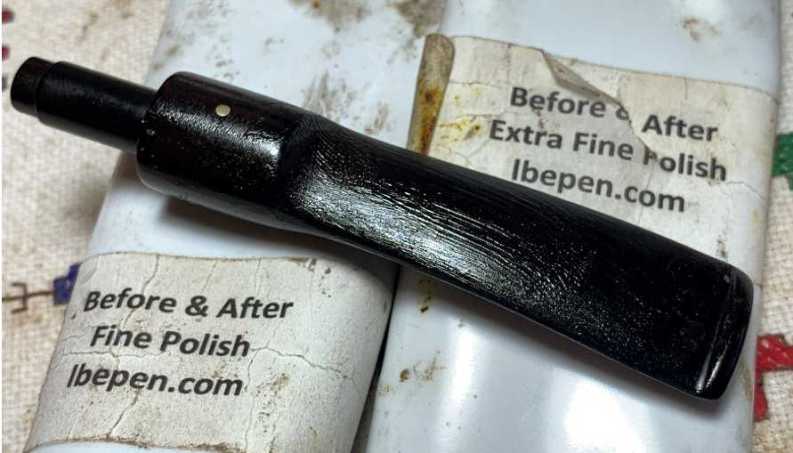 With the stem and stummel reunited, Blue Diamond compound is applied to the pipe with a cotton cloth buffing wheel. The rotary tool is set at about 40% full power. The compound is the final abrasive applied to the stem and stummel and it brings out the glossy pop of the stem and glow for the briar.
 After application of the compound, compound dust accumulates on the surface. A felt cloth is used to clear the dust away in preparation for the application of the wax.
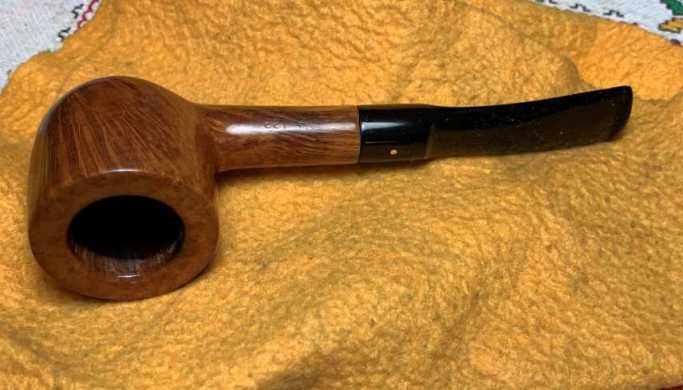 With another cotton cloth buffing wheel mounted on the rotary tool at the same speed, carnauba wax is next applied to the pipe. After application of the wax, the pipe receives a rigorous hand buffing with a microfiber cloth to clear away excess wax and to raise the shine.
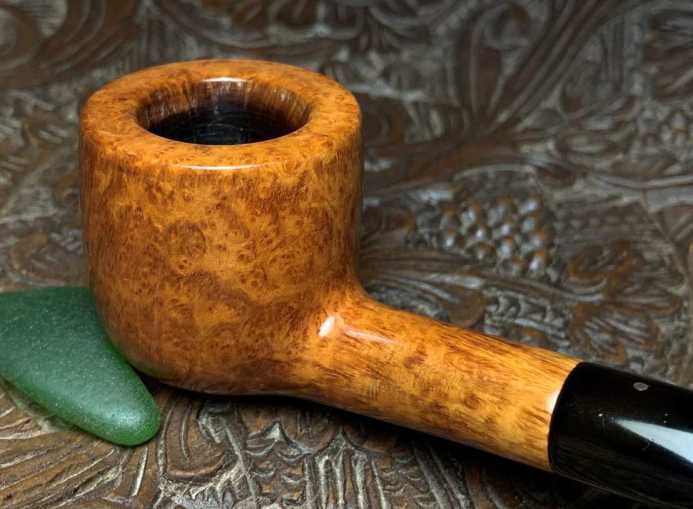
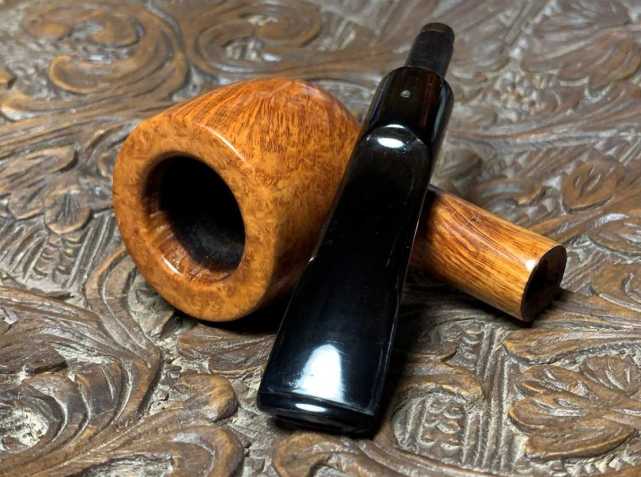
 This pre-1981 Punto Oro definitely ranks up there on the upper shelves of Savinelli. The grain came out nicely with much to appreciate. The vertical grain breaks through the rim with bird’s eye grain which is the cross-section perspective of the grain. The Pot shape, being a squatter version of the Billiard, has a workhorse feel to it and the stout bowl has plenty of room for one’s favorite blend to enjoy. The dimensions are Length: 5 1/2 inches, Height: 1 1/2 inches, Rim width: 1 7/16 inches, Chamber width: 15/16 inches Chamber depth: 1 3/8 inches. I appreciate Jacob’s contribution of this Savinelli to benefit the Daughters of Bulgaria. This pipe has come a long way from Nevski Pazar in downtown Sofia. Gary commissioned the Savinelli Punto Oro and will have the first opportunity to claim him in the Pipe Steward Store. ‘Before & After’ to start to remind us how far we have come. Thanks for joining me!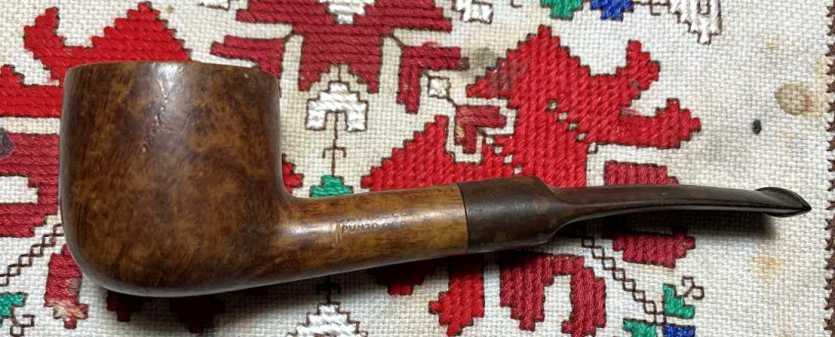



 The Pipe Steward