
The next pipe on the work table came out of the box with some obvious issues. The Chap Ecume had tape wrapped around the shank which is a sure sign of a crack or fracture of some sort. It came with the ‘French lot of 50’ I acquired from a seller in Paris, France, in August of 2018. The picture below I have shown many times over the years as pipes have been restored one-by-one and have found homes with new stewards benefiting the Daughters of Bulgaria. The Daughters of Bulgaria is an effort my wife and I co-founded when we lived in Bulgaria which focused on reaching out to trafficked and prostituted women and girls and seeking to help them find a new path. This Chap Ecume I’m assuming is a Meerschaum lined pipe based upon the word, ‘Ecume’ in its nomenclature, which means ‘foam’ in French. However, like the tape around the shank, the thick lava buildup on the rim hides any Meerschaum beneath and having a good idea of its condition. With the thickness of the cake (which is detrimental to Meerschaum) my concerns are that the integrity of the Meer-lining might be in serious question.
Notwithstanding all this negative vibe, Bradley saw the Chap in the For “Pipe Dreamers” Only! collection and reached out to me about it. In communicating with Bradley, I found out that Bradley owns an ice cream company and to manage this endeavor, lives between Miami Beach and Charleston, SC. I also found out that Bradley is on the hunt for Bartlet pipes which he feels are good to have when hunting and fishing. I’m keeping my eye out!
After talking with Bradley about the issues of the Chap – with full disclosure of the challenges, Bradley, showing the spirit of a true ‘pipe dreamer’ saw the potential and commissioned the Chap Ecume. Here are pictures of the ‘tape-clad’ Chap Ecume as he limps to the worktable!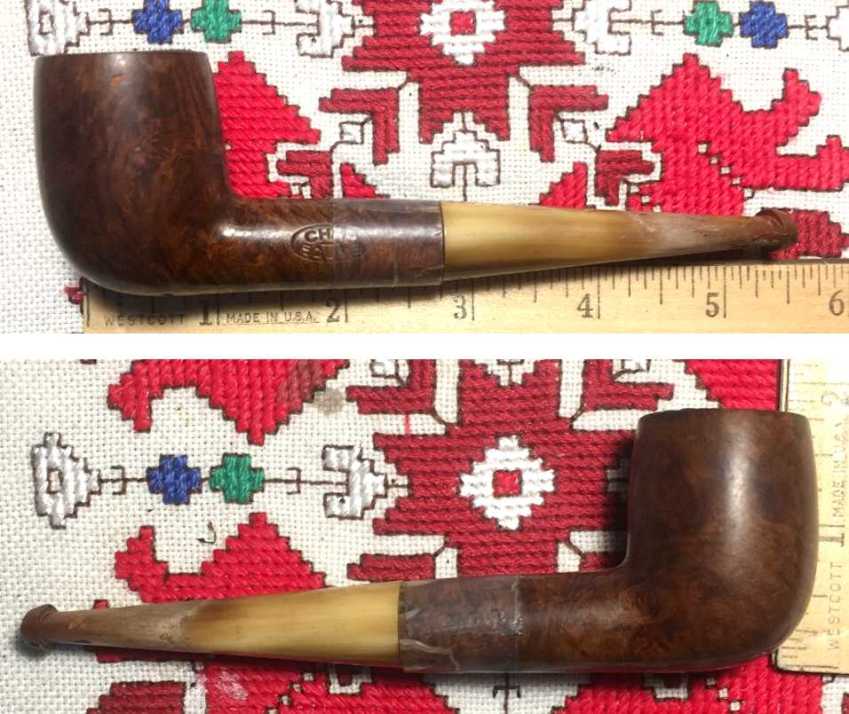

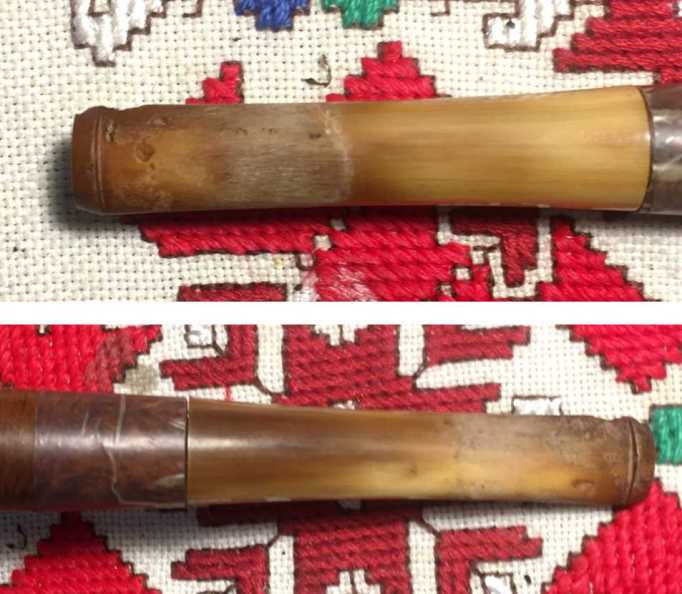
 The nomenclature stamped on the left side of the shank is crisp. Encased in a flattened oval is CHAP [over] ECUME. I’m not able to make out if there is anything on the right side because of the tape. When I first saw the tape when the pipe was unpacked after arriving from Paris, I wasn’t inclined to remove the tape until I was ready to do something about the shank – “leave well enough alone” was the guiding principle.
 There is precious little about the Chap name from my research except for the basics. Here is Pipedia’s brief Chap entry:
Chap
From Pipes, Artisans and Trademarks, by Jose Manuel Lopés’
French brand created in the 1920s by the Chapel Frés factory, founded in 1904 in Saint-Claude. The brand later belonged to Gefapip and, since 1988, has been part of the Berrod-Regad group.
From this we learn that the French made pipe was manufactured in Saint-Claude – the birthplace of briar pipe production. The Chap name has its genesis in the 1920s and is subsequently owned by Gefapip and then most recently, the Berrod-Regad group.
The following ad was also included in the Pipedia page showing examples of pipes with vulcanite stems with various available shapes. The horn stem of the Chap on the table I believe, would point to an earlier vintage of Chap than what this page shows. There is no date or source associated with the page ad, but my guess is that the ad is from the Berrod-Regad iteration of Chap which began in 1988.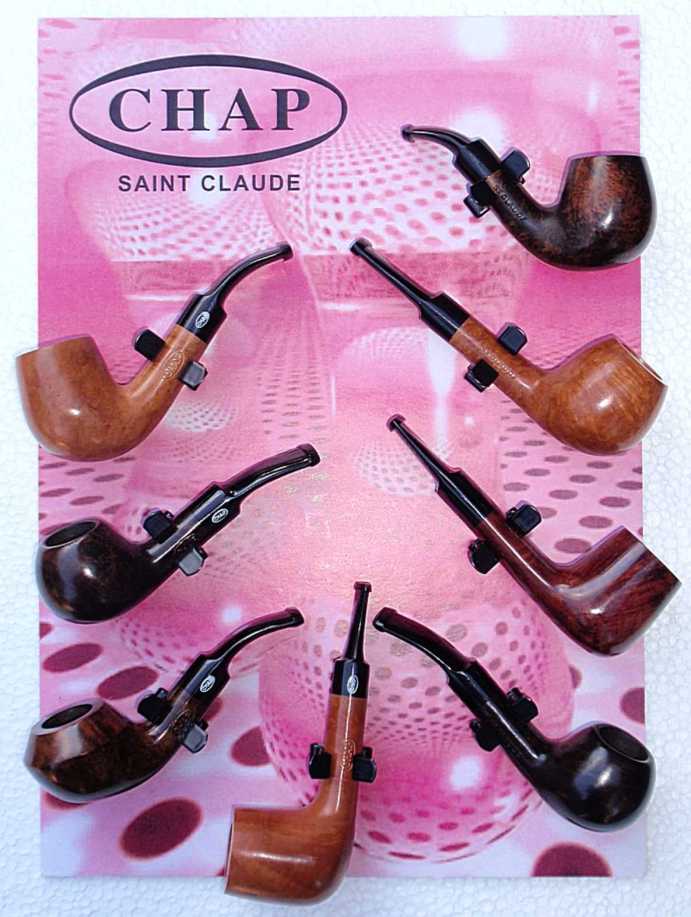 Pipephil.eu adds a bit more information narrowing the start up of Chap in 1920 by the Chapel brothers. The panel below provides more examples of Chap branded pipes and the various stem logos and stampings. Still yet, the Chap Ecume on the worktable has an older feel to it than the examples give. The horn stem for me is what takes this pipe to the earlier 1900s. One of the good things about Pipephil is that it often provides links to ancillary information about the name in view. There is a link at the bottom of the panel referencing the ‘Chapel Frés factory’ which the Pipedia article had also referenced as the place Chap had been created.
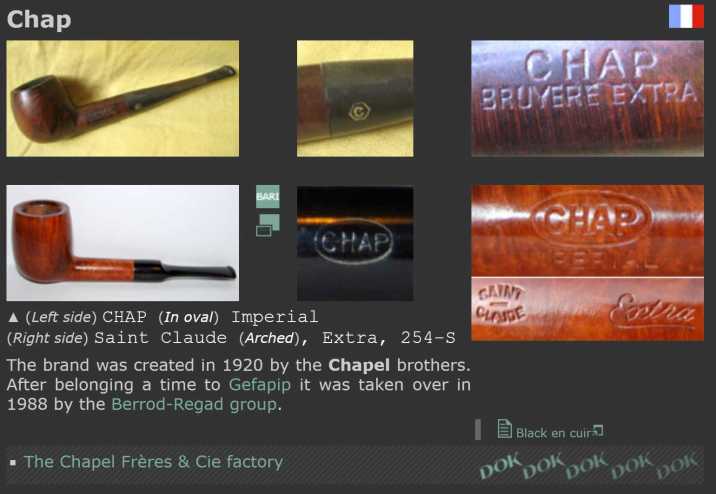 Following the link revealed some great period pictures and a timeline of the Chapel Frères & Cie factory. The first entry was in 1904:
1904 – The brothers Gustave, Désiré, Joseph and Jules Chapel convert a former post-relay inn into a pipe factory.
The pipe factory would have been in Saint-Claude, but there is no indication what pipes were produced at this early stage. A picture of the Chapel brothers was included on the page, and it is marked as 1904 as well. I look at the details in the picture that captures this moment in time – each workman along with the brothers, each have a pipe hanging from their overalls. The pipes look like facades and not actual pipes. I also noticed the little pipe man sitting at the bottom. He isn’t left out.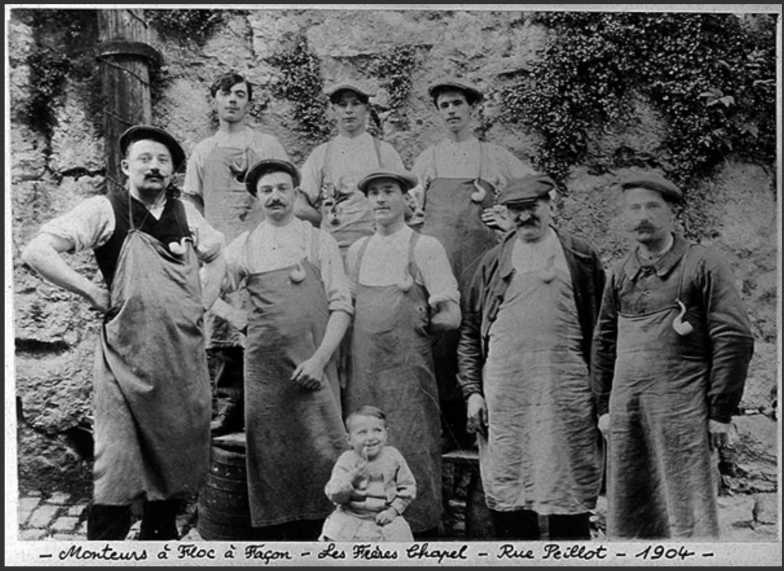 The timeline continued with these entries which do not reference the above creation of Chap in 1920. What I find very interesting is that there is a distinction made between the 1925 entry of a ‘Gitana’ brand with the special marker that this brand was fitted with horn stems. Then in 1955 a specific marker of Chap production is described as being fitted with vulcanite stems. This is interesting that stem materials are specifically named for the two Chapel brother lines described in production – Gitana and Chap.
1921 – Désiré, Joseph et Jules go into partnership and establish the Chapel Frères & Cie corporate.
1925 – Marketing of the Gitana brand (horn stem).
1955 – Marketing of the Chap brand (vulcanite stem).
1979 – Acquisition of the Jima brand.
1988 – Chapel Frères & Cie is taken over by the Berrod-Regad group and the premises of the rue François Peillot are abandoned and fitted out for flats.
Curious to know if I could find more information about the Gitana brand which was in the same era as the Chap. I was pleased to find a reference in Pipedia as ‘La Gitana’, which Google Translates as ‘The Gypsy’ in Spanish. The Pipedia entry is brief and from Pipes, Artisans and Trademarks, by José Manuel Lopes:
La Gitana was created in 1925 by Chapel Frés. Thirty years later, it launched a model with a meerschaum bowl, which in 1968, was one of the best-selling pipes in France.
What is interesting to me about this additional information from Lopes is that the creation of the brand lines up with the timeline (1925) but with the additional information that 30 years later -1955- the brand was launched with a Meerschaum bowl and then 13 years after this, 1968, it was a best-seller in France. The Chap and La Gitana lines intersect in interesting ways within the time frame of 1925 to 1955 when the factory was putting out pipes with horn stems then in 1955 – Chap is described as being marketed with a vulcanite stem. This designation to me indicates a transition. It only makes sense that Chap was produced before 1955 with a horn stem otherwise the announcement of the introduction of Chap with a vulcanite stem has no teeth or gravitas. Then, added to this, La Gianna was launched with a Meerschaum bowl in 1955…. There are a few loose pieces of a puzzle and I’m doing as much logical guess work to put together a picture as possible!One last thread I decided to follow. I did a search of ‘La Gitana Pipes’ and discovered there are quite a few references, including one by Steve on Rebornpipes. As usual, Steve did a great job restoring this vintage pipe on his worktable (pictured below). The horn stem and bowl are very reminiscent of the Chap on my worktable. Steve’s research overlapped with some of my own, but his research added an interesting Smoking Pipes.com reference about La Gitana which was interesting (LINK) but did not add any information helping me to piece together the puzzle for the Chap Ecume. With an educated guess based upon the pieces of the puzzle I’ve found; I would say that this Chap on the worktable is dated between 1925 and 1955. The horn stem is the main piece of the puzzle, but I’m also intrigued by the potential interwoven characteristics of the Chap and La Gitana lines.
ADDENDUM: After the initial publication of this write up, Steve of Rebornpipes reached out to tell me that the aluminum tenon was a key indicator for a later dating. Earlier pipes had bone tenons. With WW2, there was a shortage of both rubber and quality briar, hence fills and such. An dating might more accurately be 1945 to 1955. Thanks Steve!
Now, with a greater appreciation for the Chap name and the thin history I have of the Chapel brothers’ productions, I take a closer look at the pipe on the worktable.
The first step is to remove the scotch tape holding the shank together. Through the tape the shank fracture is obvious – ugh. As the tape is removed, the pieces fall apart with no resistance. I had wondered if the fractured piece had received a piecemeal glue job and was relieved that this was not the case.
 The good news is that the former steward carefully preserved the break so that the pieces could be rejoined at a later date…which never came under this steward’s watch.
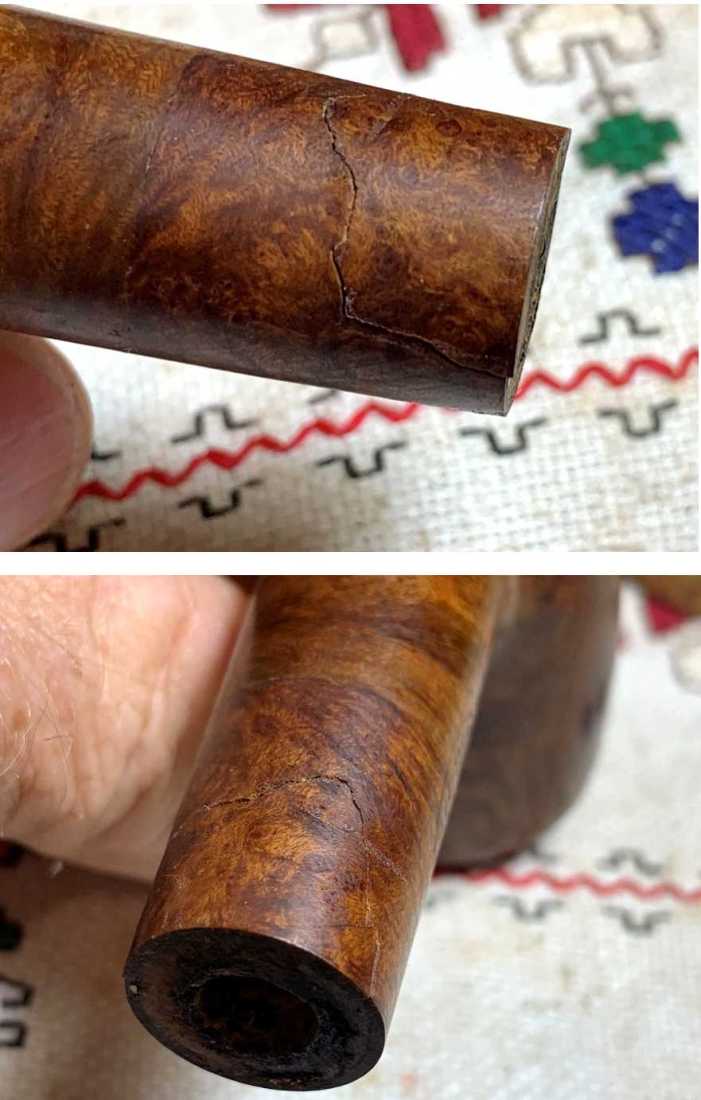 The shank can be repaired with a tight glue bonding the two pieces and then reinforced with a band. Before proceeding any further with the stummel, before reaming or cleaning, the shank pieces need to be re-glued. The reason for this is that the break at this juncture is clean and fits nicely together. If I were to clean the shank, introducing water into the environment, it could upset this equilibrium with expanding wood, etc. Using regular clear CA glue spread over the exposed briar, the pieces are matched and held in place firmly allowing the bond to cure.
 With the stummel on the sideline, attention is next turned to the horn stem. The horn bit has been mauled, to say the least. It will take some repairs to bring this stem back up to snuff.
 Before addressing the bit repair, the airway is cleaned using pipe cleaners and isopropyl 99% alcohol. The airway was loaded with grime and took some effort to clean with both smooth and bristled pipe cleaners. The metal tenon was also in need of cleaning. This was done with a pocket knife to scrape out the impacted grime and 0000 grade steel wool moistened with alcohol.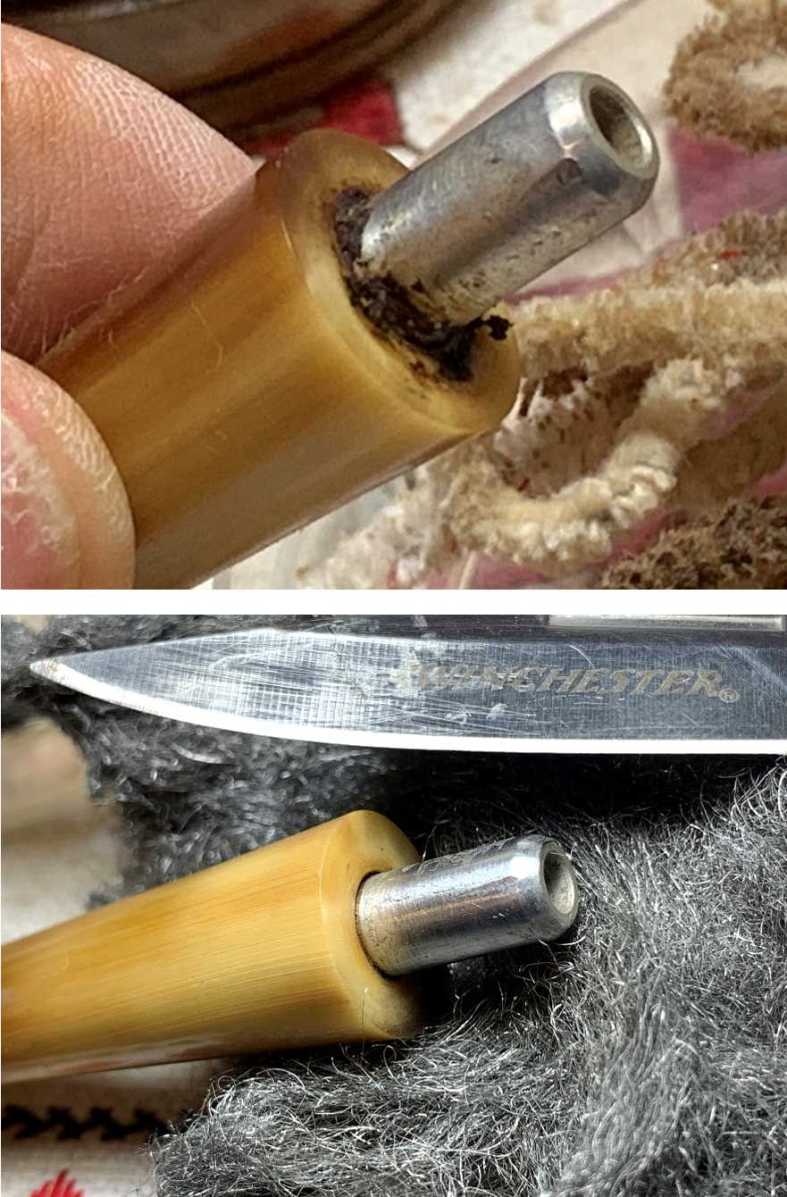
 The stem is clean, and the bit/button is ready to be rebuilt. Looking again at the close up of the button and bit. The first picture is looking at the upper side of the stem. The deep tooth compressions need to be filled. The upper side of the bit (in the picture) has eroded away including the end of the button. This area needs to be rebuilt with CA glue. The red marks show all the damaged areas needing to be addressed.
 The lower side also needs plenty of attention. The good news is horn is a resilient material and takes a lot of punishment and is able to bounce back.
 The bit is cleaned with alcohol to prepare for the patching.
 With horn, I use medium grade amber CA glue to do the patching. The amber blends nicely with the natural horn hues. The first patch builds out the area which was missing. The CA is applied and immediately sprayed with an accelerator to hold in place and to cure more rapidly.
 More craters are filled with the CA as well as button compressions and sprayed with the accelerator.
 The same is done for the underside of the stem.
 After the patches are thoroughly cured, flat and square needle files go to work to file down the patches on the upper and lower bit.
 The patches are filed down till flush with the horn surface.
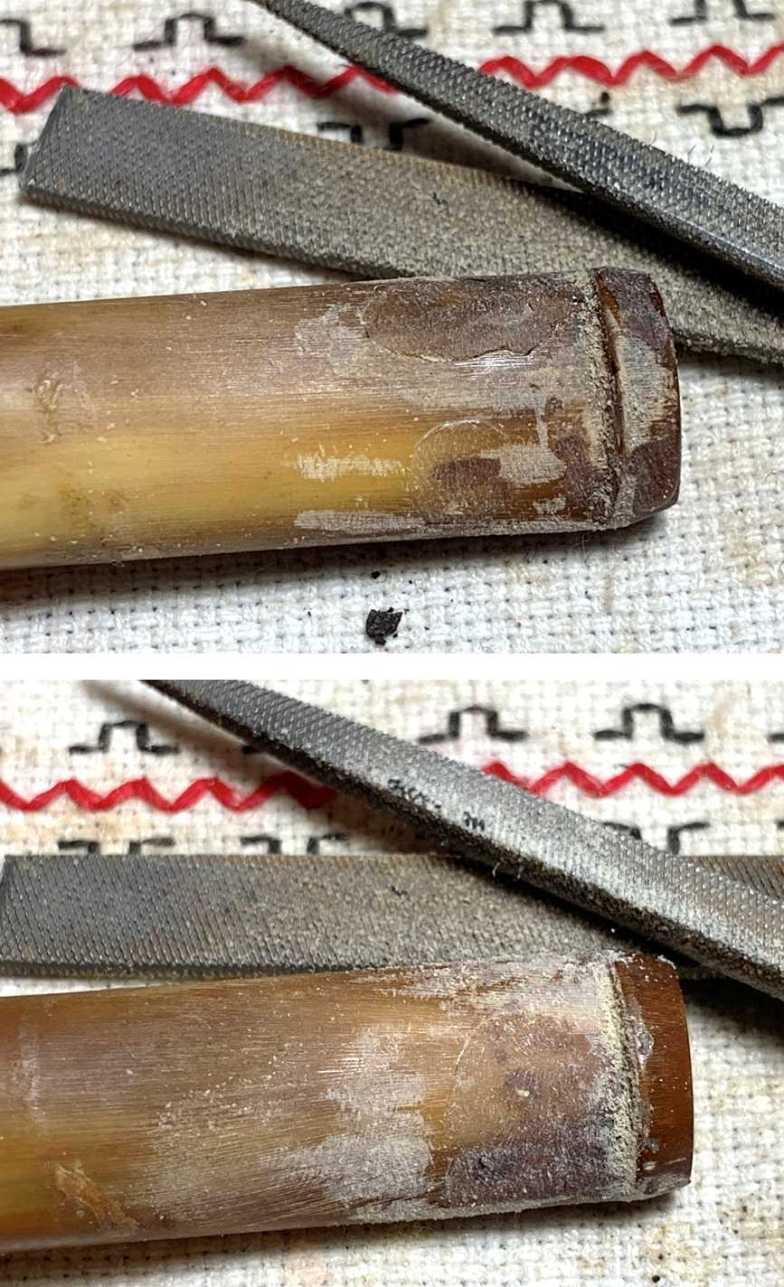 Next, 220 grade paper sands away the file marks and continues to smooth out the patches and shape the button.
 Using the shoulder guard, the 220 sanding is expanded to the entire stem to remove scratches and blemishes on the stem.
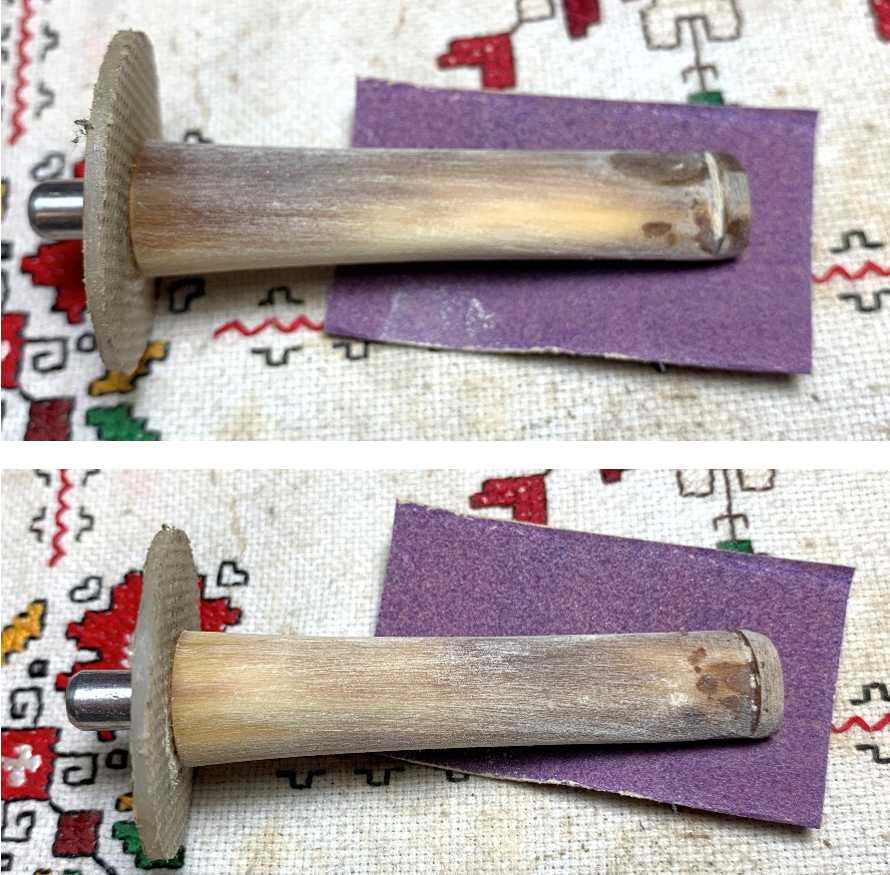 The 220 paper is followed by 470 paper – upper and lower with the shouldering guard.
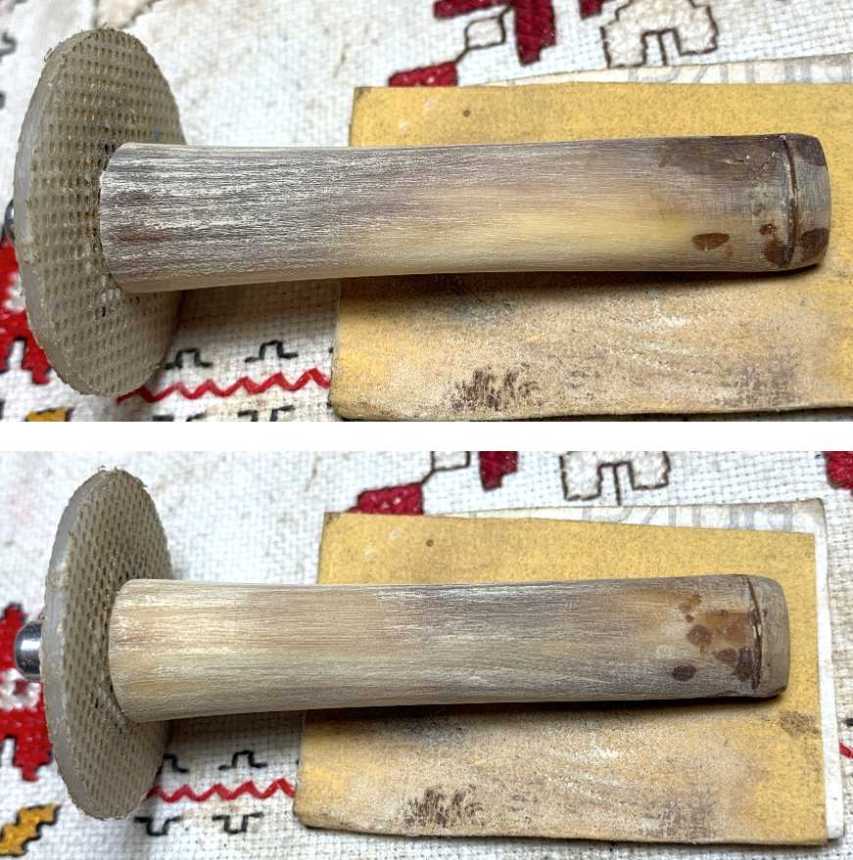 Next, using 600 grade paper the stem is wet sanded. This is followed by applying 0000 grade steel wool. The natural sheen of the horn starts to make an appearance – nice.
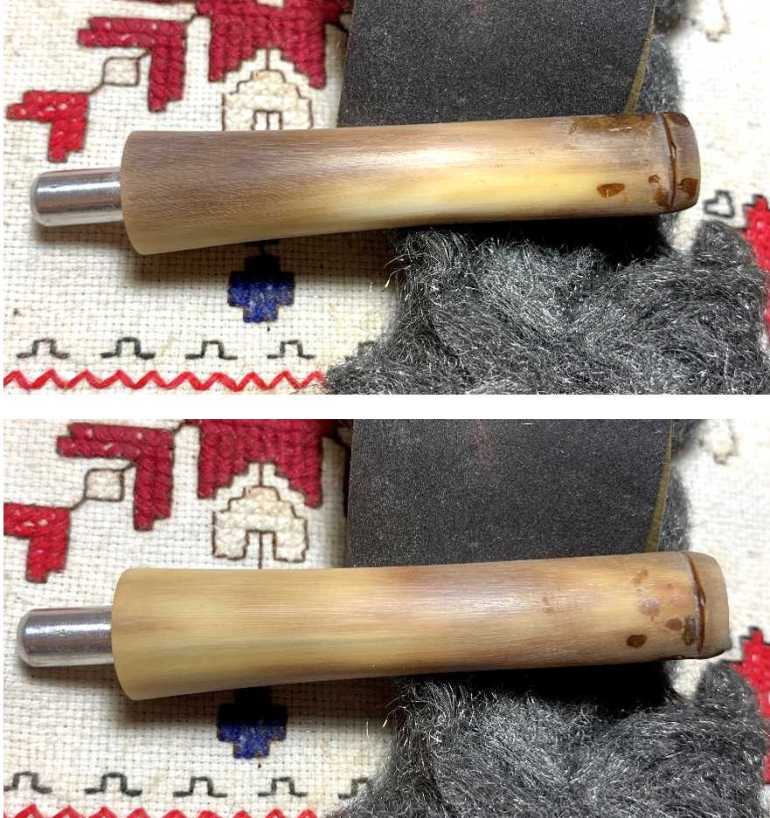 Moving next to applying the full regimen of micromesh pads from 1500 to 12000 to the stem, to help condition the horn material, between each pad, Paraffin Oil is applied. The horn literally drinks the oil. Generally, I do not use live oils on pipes (animal or plant) but mineral oils which will not become rancid.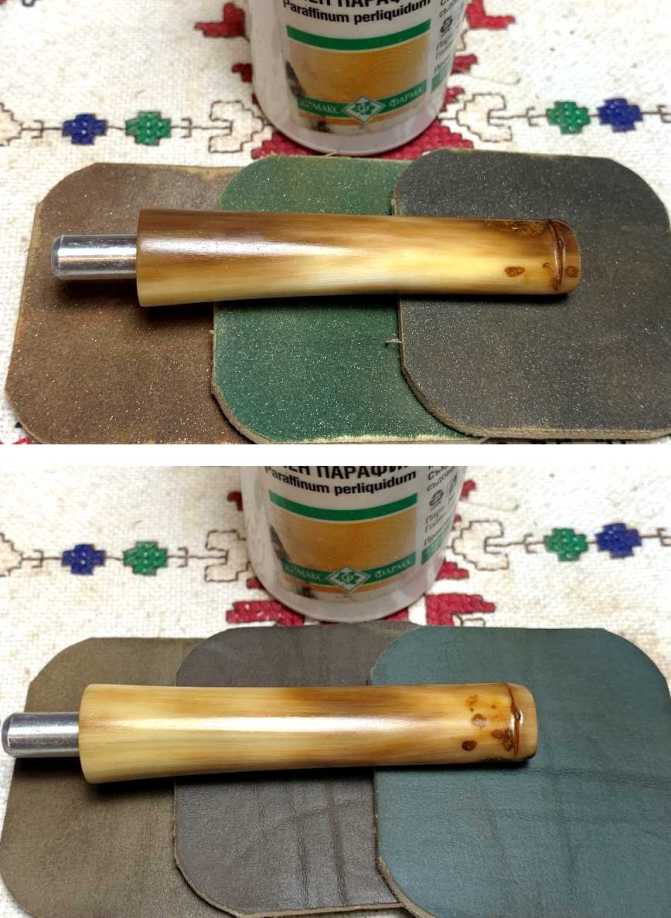
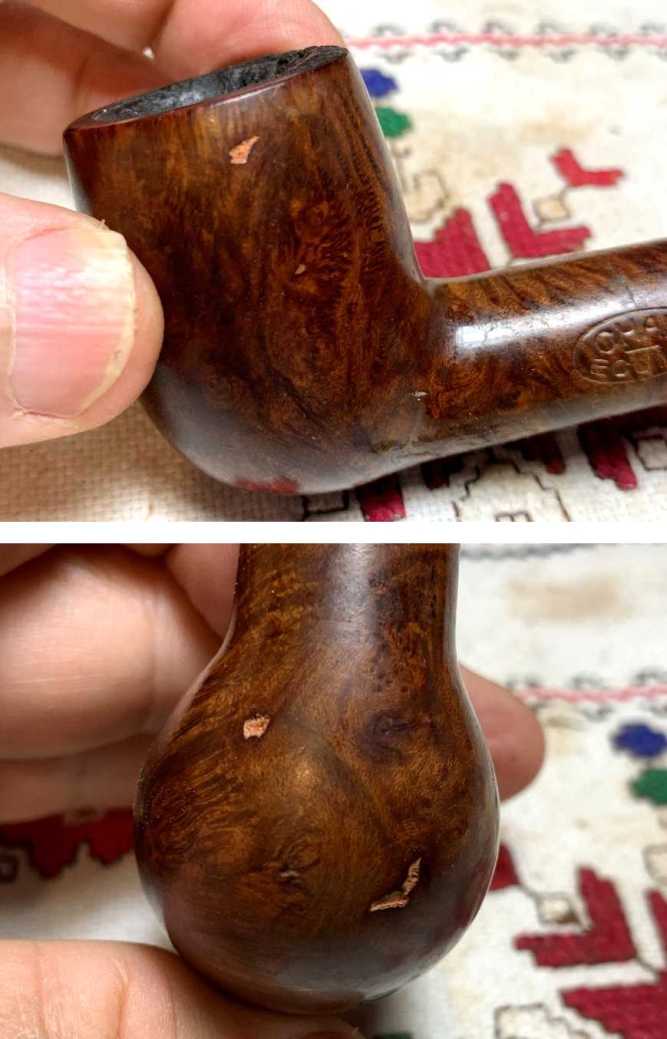
 The stem is put aside, and the shank glue has had time to cure. The stummel can now be cleaned without worrying about the pieces not fitting together. Looking at the general condition of the stummel, there are some fills that will need to be addressed.
 The chamber has thick carbon build up. I believe the chamber is Meer-lined (Ecume) so care is given to clear away the carbon from the chamber and rim. Starting pictures are taken to mark the progress.
 With the assumption of a Meer-lining underneath, I do not use the regular reaming blade heads as this could put too much pressure on the Meerschaum which could crack it. The Savinelli Fitsall Tool is used to scrape the carbon to reveal the surface.
 The chamber is also sanded with 220 grade paper wrapped around a Sharpie Pen. The chamber is definitely Meer-lined as the lighter hue starts peeking out.
 The Fitsall Tool also is helpful scraping the rim to remove the black lava and revealing the boundary between the briar and Meerschaum.
 The dark Meerschaum in the chamber will not lighten much emulating the original Meerschaum whiteness having been tempered by the fire. However, the goal is to remove the black from the rim. This is not only cleaning it, but cosmetically, the contrast between the briar and Meerschaum on the rim is nice. A rolled piece of 220 paper goes to work on clearing the stain off the Meerschaum.
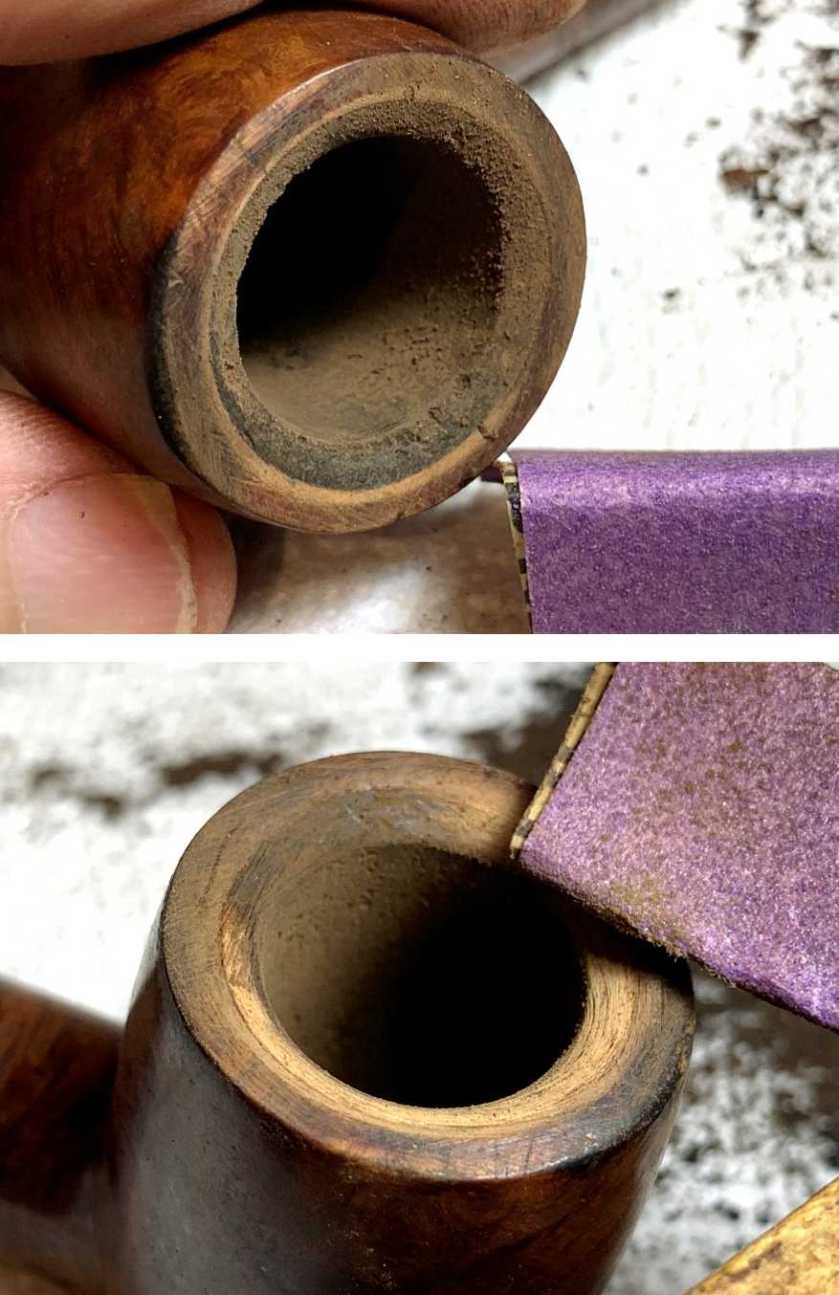 The chamber cleaning goes well.
 The rim looks great after cleaning.
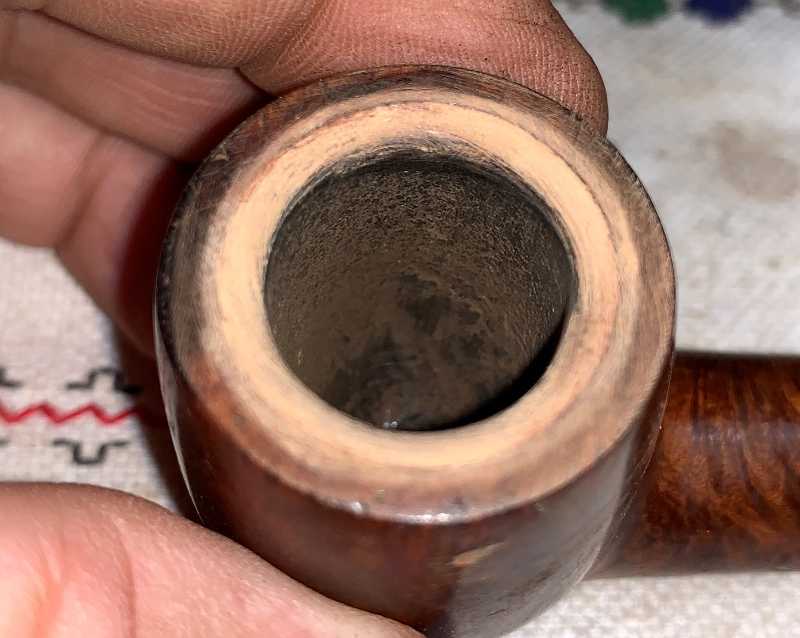 One of the concerns about cleaning a Meer-lining is uncovering potential problems. A carbon cake is not needed for a Meer-line or Meerschaum block pipe. In fact, it’s not good for Meerschaum because the carbon cake heats and expands and contracts with its own characteristics and this can cause problems with the Meer – often causing cracks. An inspection of the chamber does reveal an indentation or ‘divot’ in the Meerschaum about half-way down the chamber. This is something that needs to be addressed after the stummel cleaning is completed.
 The cleaning of the internals took some time and a lot of effort. The Meerschaum lining cleaning can’t go as usual as with briar pipes. So, using many, many pipe cleaners and cotton buds moistened with isopropyl 99%, I dug into a really grunged up pipe!! Collaborating with the effort were some drill bits that were used to drill and scrape the airway to pull out tars and oils. The small dental spoon was also used to scrape the mortise walls.
 In the end, the buds emerged lighter, and the cleaning came to an end! Moving on.
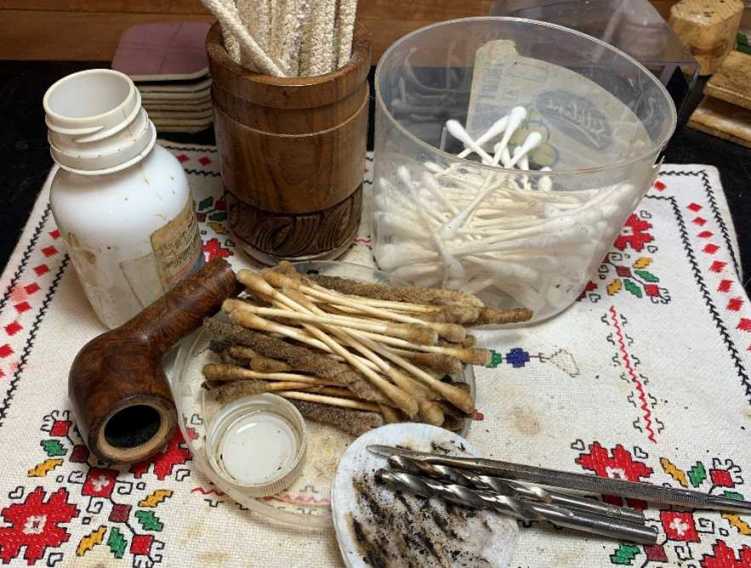 There are several mini projects lined up to get the stummel up and running. At this point, time is taken to see there is a brass band that will work to reinforce the shank. If there isn’t a band that will work in the supplies, I’ll need to order another band and that will be a delay.
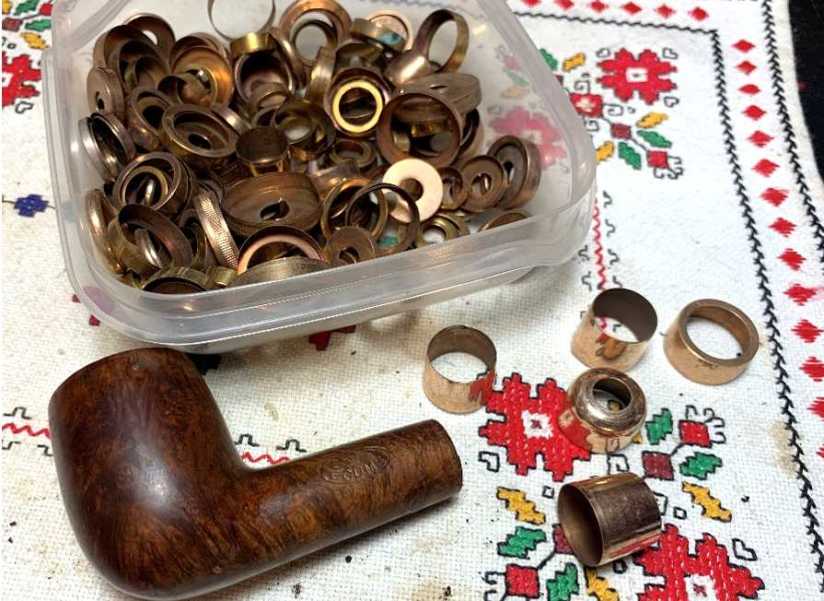 After going through likely candidates, a band is chosen that should work with a combination of sanding and heating to stretch the band. Later….
 Next, the external surface is cleaned using undiluted Murphy’s Oil Soap. The surface is scrubbed with a cotton pad and then taken to the sink to be thoroughly rinsed – keeping the water out of the Meerschaum chamber.
 Earlier an indentation was identified in the Meerschaum about half way down the chamber. There doesn’t appear to be cracks, but just a divot. The following picture has been lightened up some to be able to see the problem area.
 An old recipe is used for Meerschaum repair using egg white and white chalk. When mixed, the chalk and whites create a Meer-like compound that sets up hard.
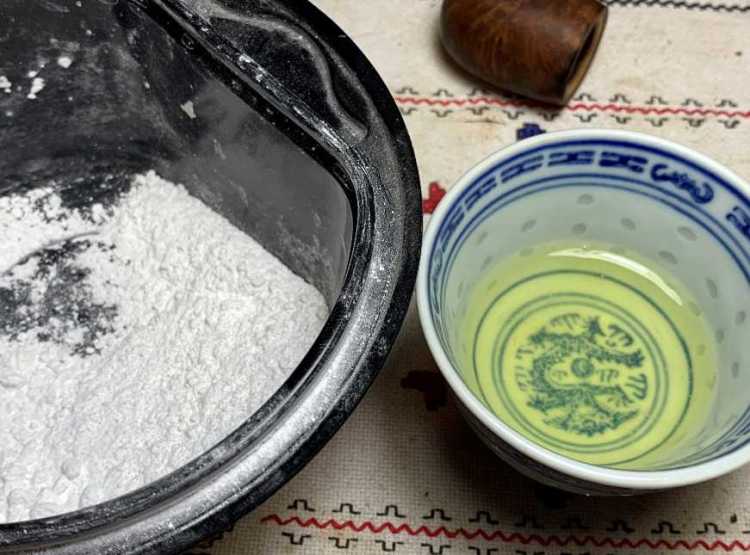 A small amount of egg white is placed in the plastic lid, chalk and mixed.
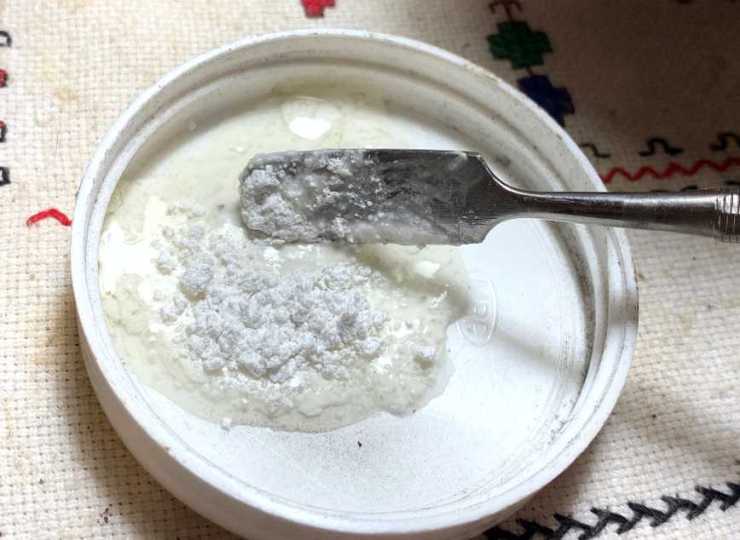 When the consistency of the mixture is like pancake batter, it’s ready to go. If it is too thin, the mixture will be runny. If it is too thick, it will harden too soon.
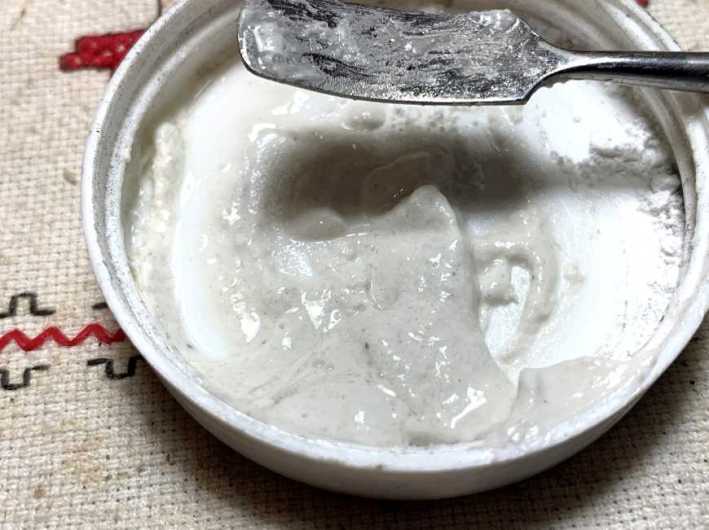 When the consistency is reached, a small amount of the Meer recipe is placed on the finger and then spread over the divot. After it cures, the chamber will be sanded to smooth the patch and blend.
 While the Meerschaum recipe is curing, there isn’t a problem to continue working on the other projects. The fills on the stummel surface are cleaned out and refilled. A sharp dental probe digs out the old fill material.
 A small batch of briar putty is made to fill the pits. After placing a puddle of regular CA glue and small amount of briar dust on the scotch tape (for ease of cleaning), they are mixed.
 The approach is to use a toothpick and pull in only a small amount of the briar dust into the CA glue while mixing. More is pulled in and mixed causing the mixture to thicken. When it reaches the consistency of molasses, it’s good to go – not runny nor too dry and it solidifies quickly, the toothpick is used to trowel the putty to the pits.
 After applying, the patches are given time to cure.
 The fill patches have set up enough to handle the stummel. The next mini project is to clean up the rim. There are some dents and scratches over the rim. The front side of the rim is darkened from lighting practices.
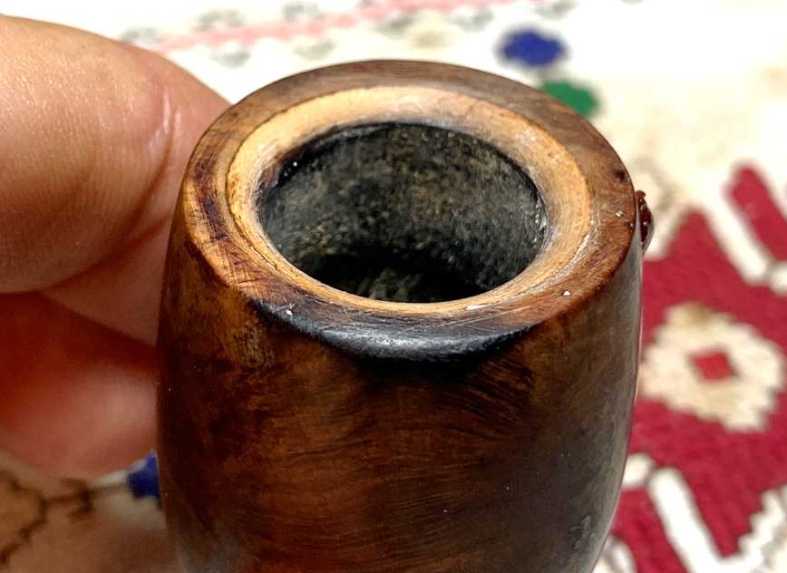 The following picture provides a starting point to measure the progress.
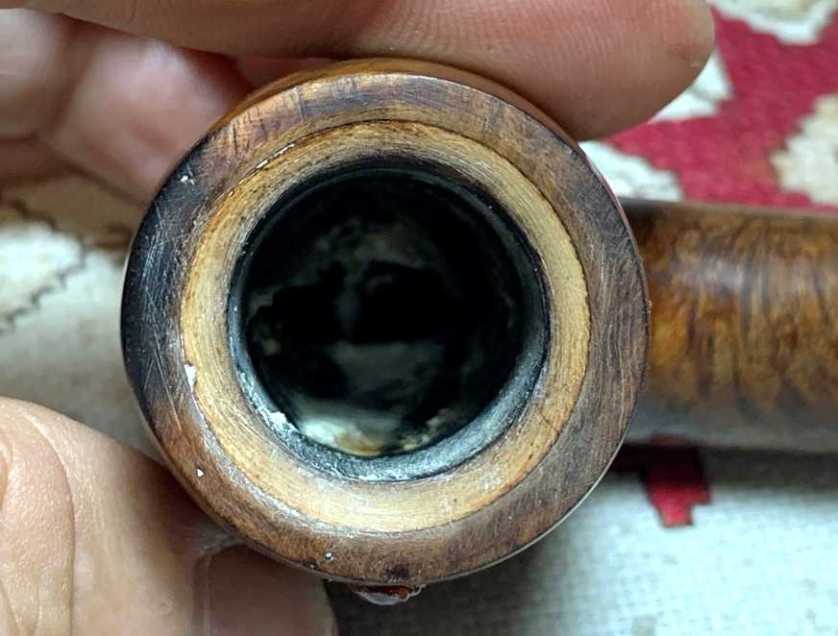 The approach to clean the rim’s briar as well as to improve the lines of the Meerschaum. To do this the stummel will be topped. Starting first with 240 grade paper on the chopping board, the stummel is rotated over the paper several times.
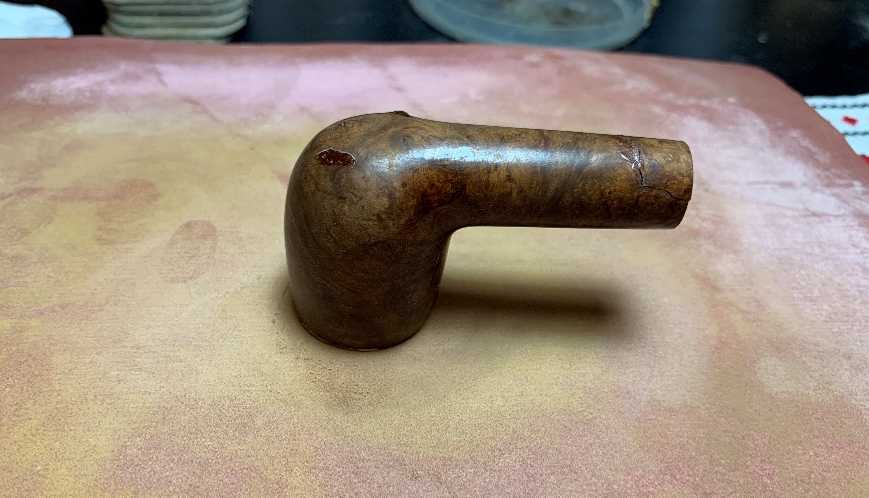 Enough rim has been removed and the lined border between the briar and Meerschaum is now crisper.
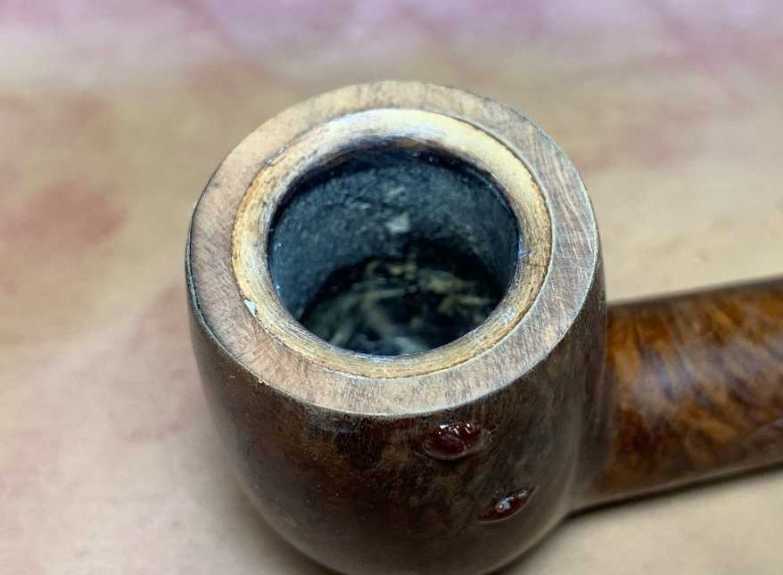 Switching to 600 grade paper on the board, the stummel is rotated several more times. I like the results.
 Moving down the stummel, the fill patches using briar putty are fully cured. I counted a total of 4 patches. The fill patch mounds are addressed by using a flat needle file to bring the mounds flush with the briar surface.
 Next, 220 paper is used to further smooth the patch area and erase the larger filing tracks.
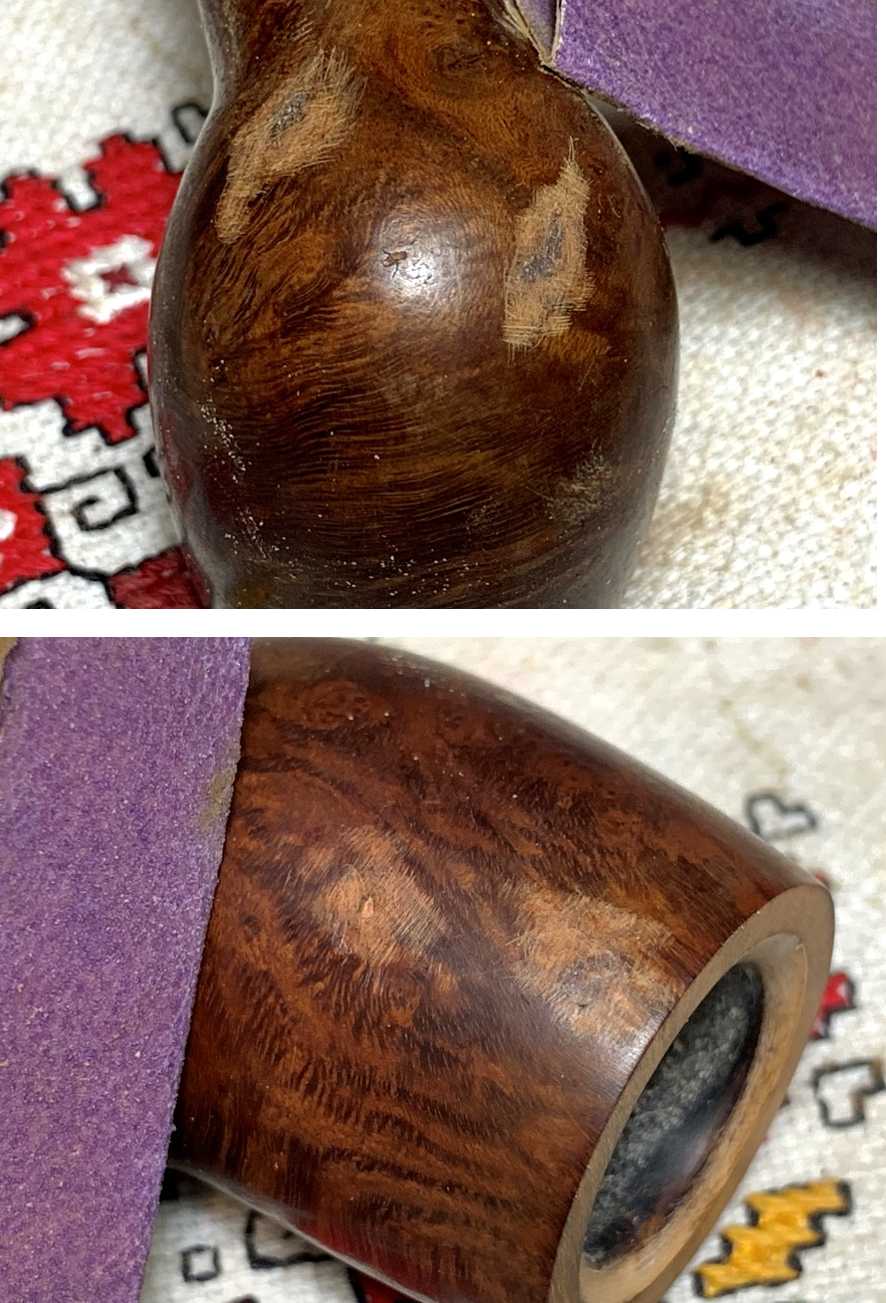 After using 220 paper, a finer 470 paper continues the process for each patch area.
 Finally, 600 grade paper is used to put the final sanding on the patches which helps to darken and blend the areas.
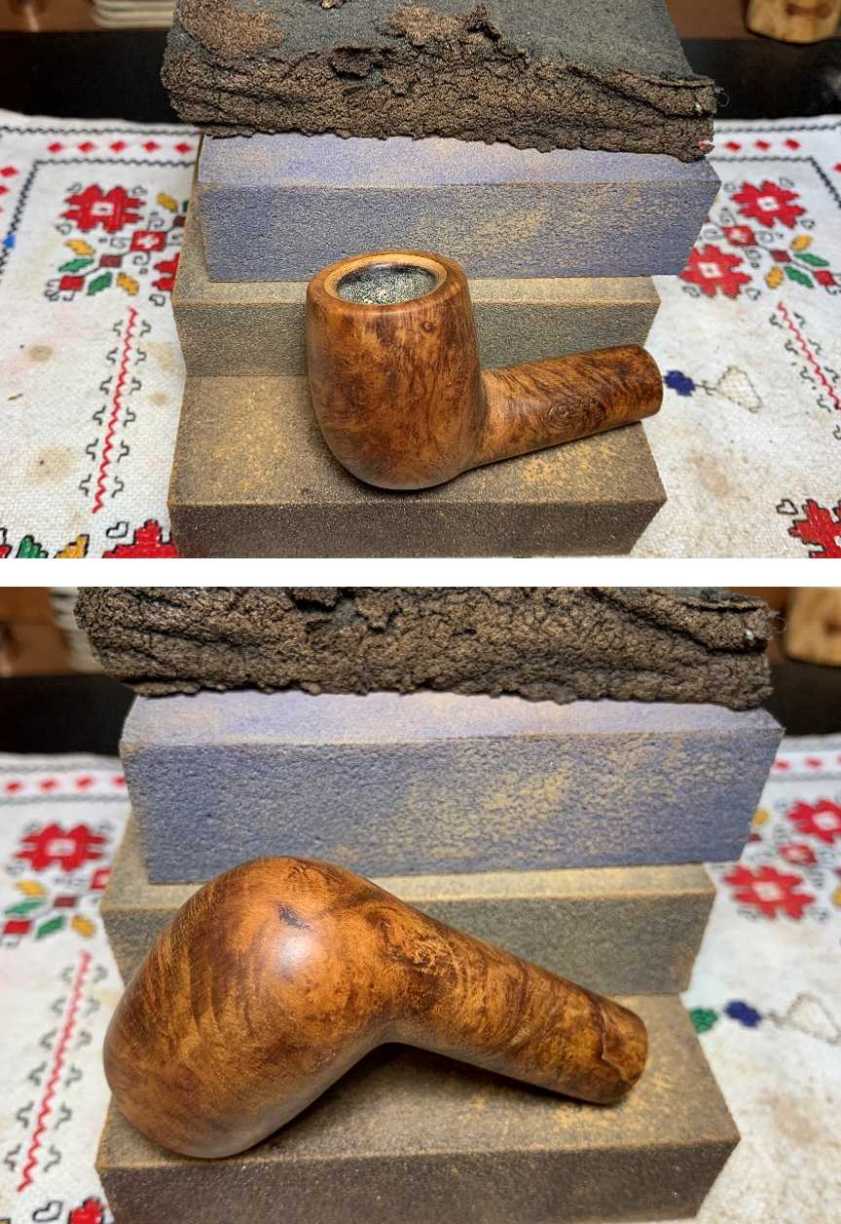
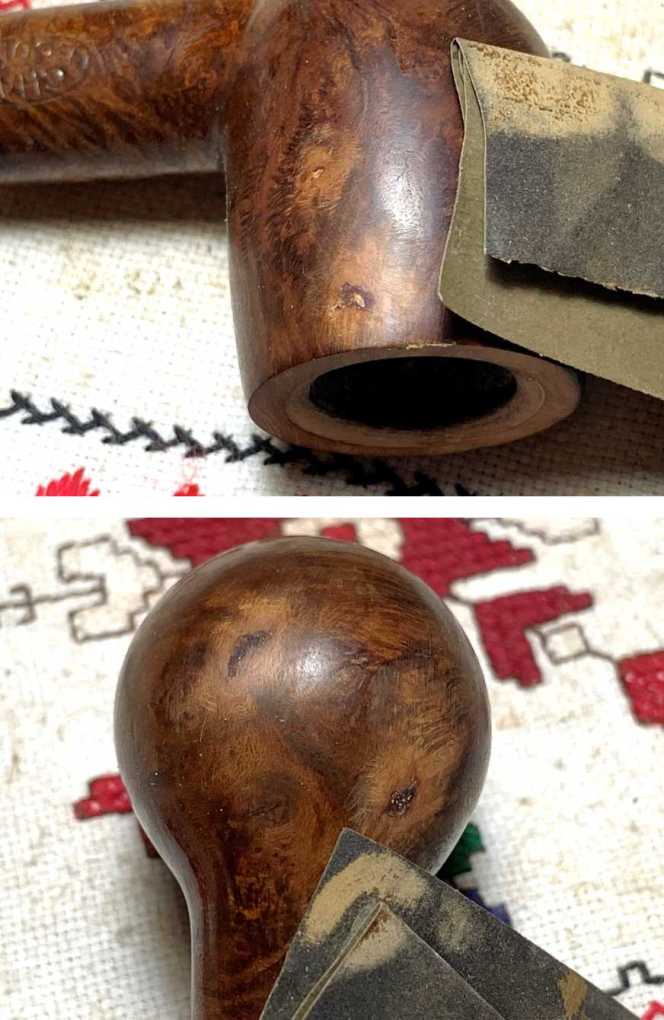 The entire stummel has small scratches and dents which are addressed with sanding sponges. Four sponges are used starting with coarser grades and then finer grades until all are used. Sanding sponges do a good job forming around the contours of the briar.
 Pressing on with the sanding/polishing, 9 micromesh pads are used from 1500 to 2400, 3200 to 4000, and 6000 to 12000. To remove briar dust and to give each pad traction, after each pad the stummel is wiped with a wet cloth.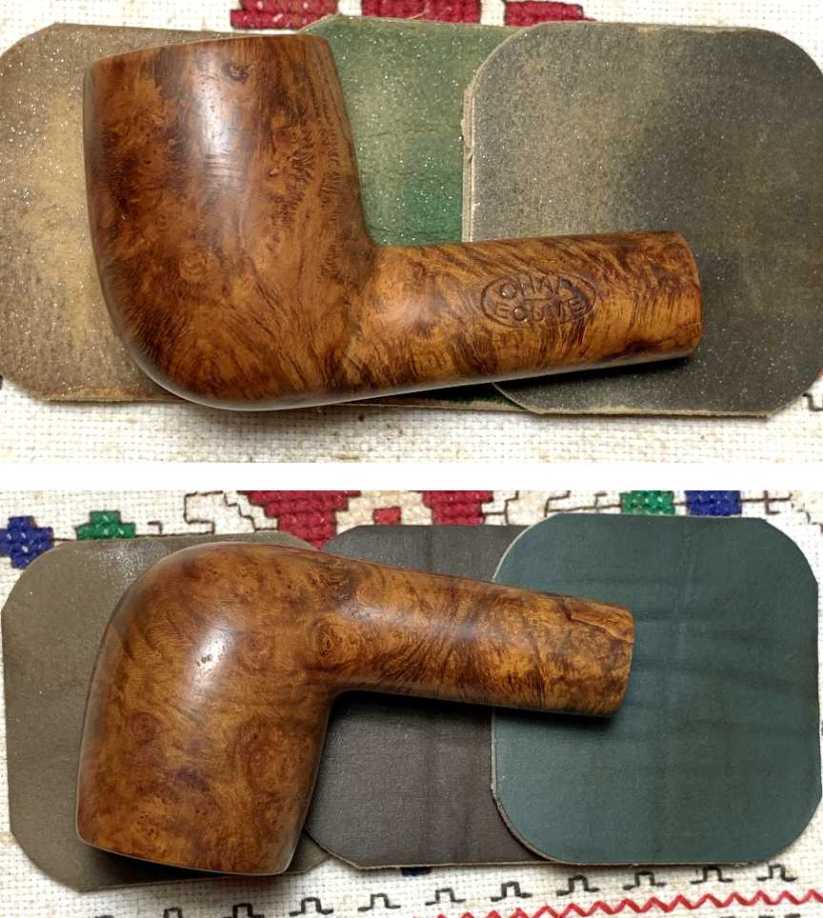
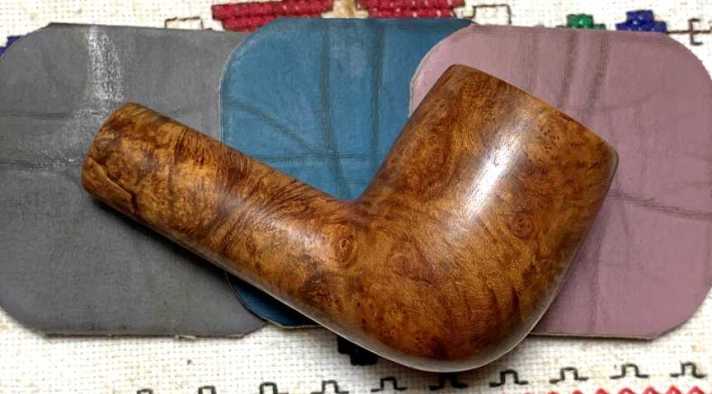 Before proceeding further with the polishing process, the brass band chosen to provide reinforcement for the shank needs to be mounted. The challenge is mounting the band without it tearing. The band is thin and forcing it too quickly can tear it. The normal approach is to heat the band with an air gun and the heating allows the metal to be expanded ever so slightly. With each heating, the band is moved over the shank a small bit. This is the theoretical approach. The band at the starting post, pictured below, fits over the shank only a few millimeters. The band will look good mounted on the pipe. The brass will blend nicely with the hues of the ‘olde world’ feel of the horn stem.
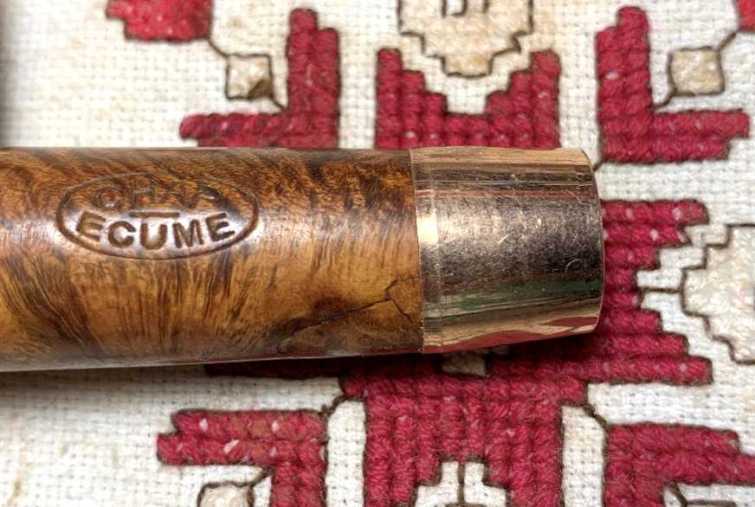 As I’ve thought about this phase of the project, one additional idea is to sand the shank to decrease its girth some making for an easier mounting process. This should help with the tight fit. However, before this, the shank facing needs to be flattened. The reattached briar piece protrudes out a small amount.
 A flat needle file is used to file off the high spot on the shank facing.
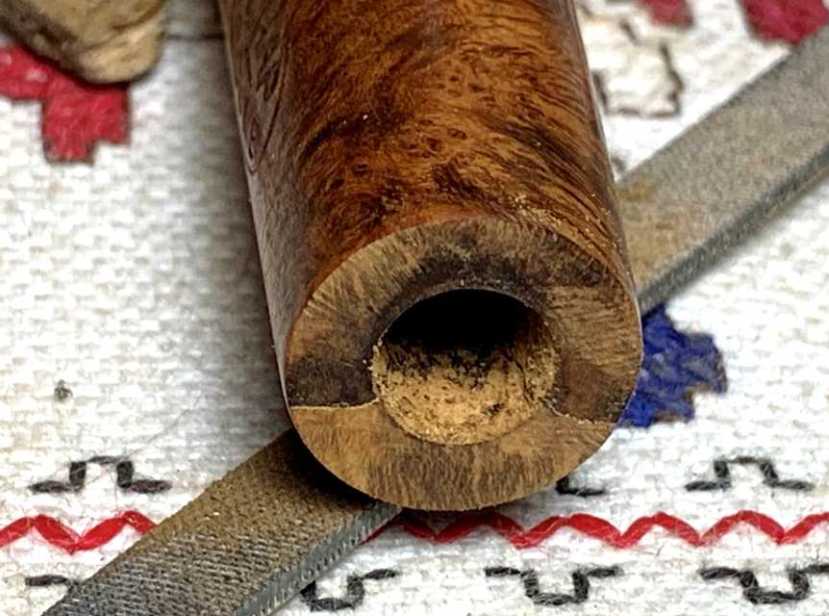 The stem is mounted for the first time since the shank was reassembled. The facings are flush, but there is a small lip on the lower side of the stem/shank fit. A band should cover this lip. I notice too, that the metal nickel tenon has a loose fit in the mortise. I recall from Steve’s restoration of the La Gitana, that the mortise was originally lined with cork to create a snug grip. It is possible that this was the case with this Chap. Later, the looseness will need to be addressed after the band is mounted.
 Next, painters tape is used to wrap the shank to form a boundary during the sanding.
 Initially, 220 and 600 grade papers are used to sand around the shank.
 While sanding, it became clear that more sanding needed to happen up the shank to create more taper. After removing the tape, sanding continued with 220, 470 and 600 paper. The sanding avoided the Chap stamping on the other side of the shank.
 To smooth the briar more for smoother mounting and to darken the briar again after the rougher sanding, the shank was again sanded with the full regimen of micromesh pads.
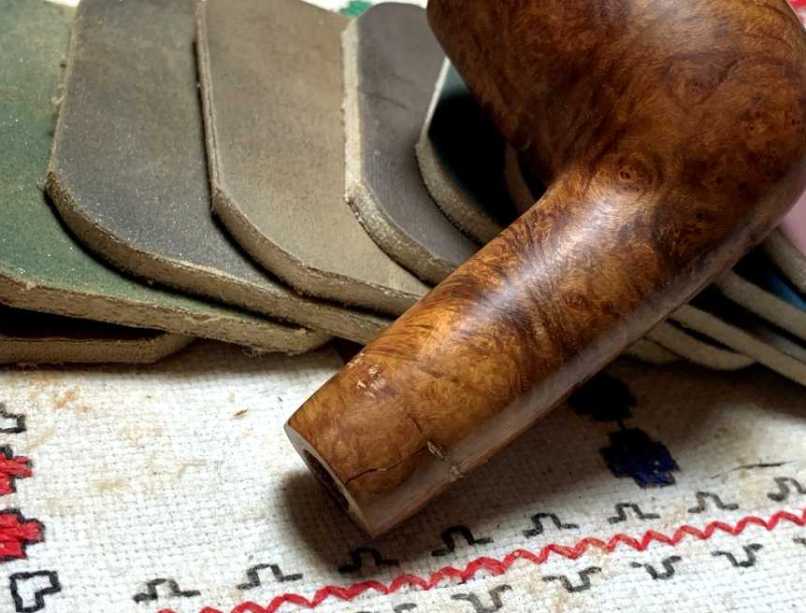 Next, the band is heated with a hot air gun to allow the heated brass to expand as it is mounted with the expansion of the shank. This part makes me nervous…. The heating process requires several cycles.
 After each cycle of applying the hot air and heating the metal, the stummel is placed on the work cloth with the shank down and a small amount of downward pressure is applied causing the band to move a millimeter or so onto the shank. Too much pressure can rip the soft metal and/or it can crimp the end of the band that’s contacting the work cloth.
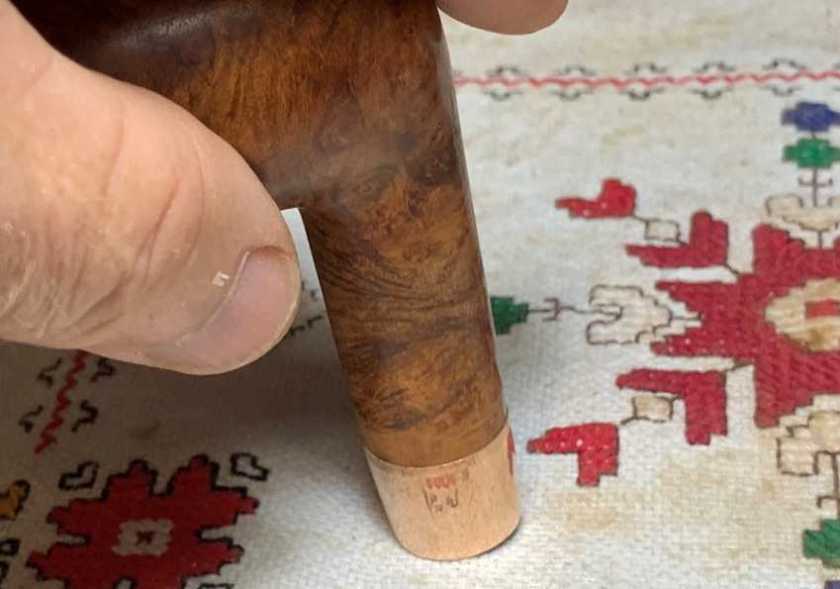 In the next picture the progress is revealed on the inside of the band. The shank facing is close to the end of the band but at this point, after a few more heating cycles, it becomes very precarious, and I’m concerned that the band will rip and/or the protruding part of the band will collapse on itself with the downward torque.
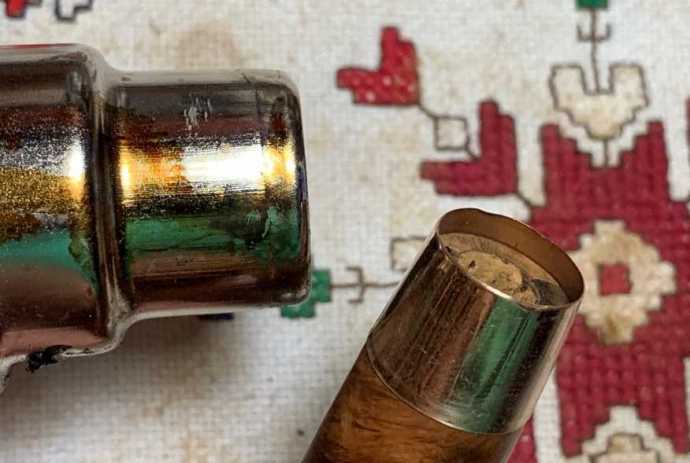 After considering the situation, the decision is made to crimp the end of the protruding band with a table vice/anvil. The tricky part of finishing like this is to make sure there is a smooth bend of the band around the entire shank facing – and not to be able to see the crimping. To accomplish this the shank/band edge is first rolled on the edge bending the protruding brass metal toward the center (first picture). After this is done, the stummel is forcefully pressed down into the anvil to finish the bend (second picture).
 The crimped part of the band is hidden from view being tucked into the shank facing. Thankfully, brass is a pretty cooperative metal.
 I was sweating this decision, but the mounted band looks great!
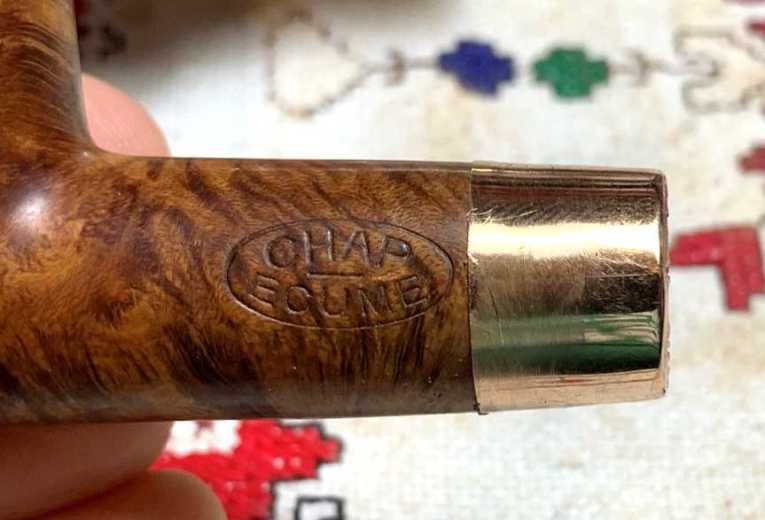 Wanting to get a bird’s eye view of the project, the horn stem is rejoined with the stummel. The metal tenon has snugged up considerably with the band mounted and thankfully this is no longer an issue.
 However, what IS an issue (thanks to my tendency toward OCD perfection) is the stem’s fit. The picture below shows the orientation of the stem shifted upwardly. The band and stem on the underside are flush, but the upper side reveals the stem above the band.
 Looking downward at the upper side, the stem edges are also visible beyond the band. This will not do.
 To protect the band, painters tape is wrapped around the circumference.
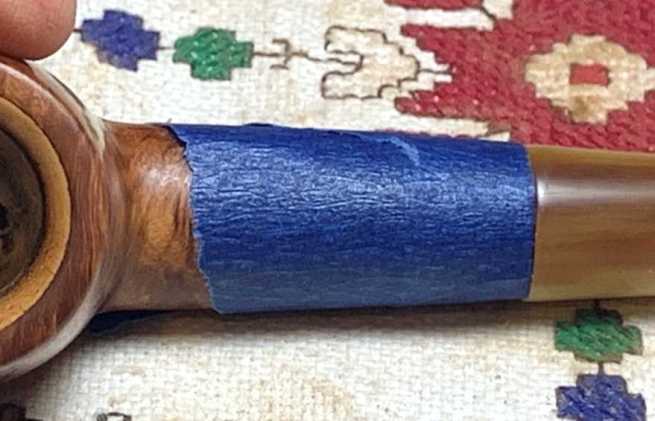 I go to work with 220 paper to reduce the edges of the stem facing to bring the stem and the band into alignment.
 After a good bit of sanding, the tape is removed to check the progress. The lip around the stem is greatly reduced, but an edge can still be felt by rubbing my finger over the band. I do not replace the tape but ‘freehand’ sand the high spots on the stem facing with the stem removed from the stummel. The stem is remounted several times to test the edge-reducing progress.
 After a good bit of 220 sanding, I like the results. The next two pictures show the side view and then the downward perspective. What a difference…I can live with this. The edges are smooth and the taper down the stem looks good.
 As before, after the 220 paper is used, this is followed by 470 paper and then wet sanding with 600 grade paper.
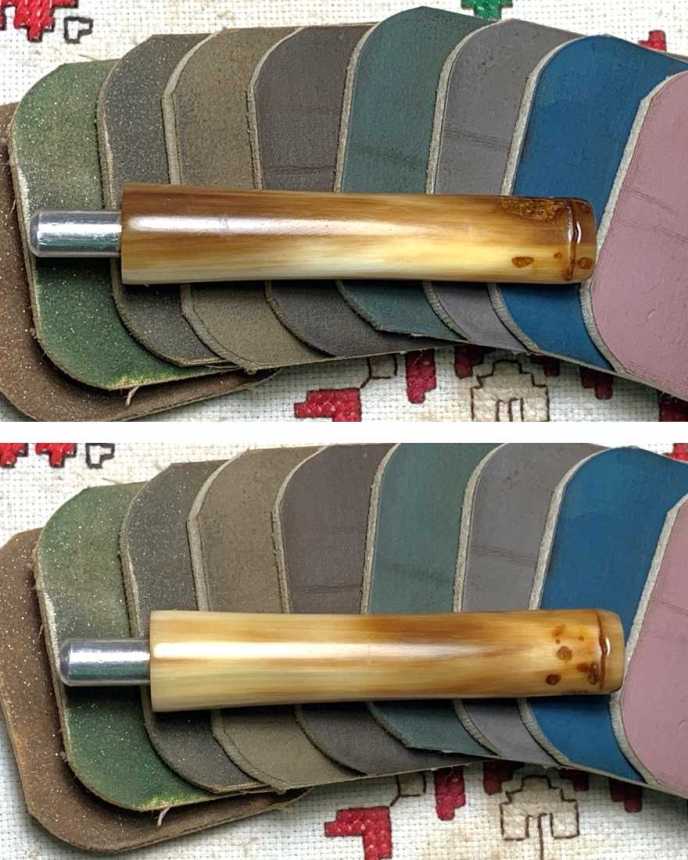
 Again, the entire stem is sanded/polished with 9 micromesh pads from 1500 to 12000. Between each pad, Paraffin Oil is applied to condition the horn stem.
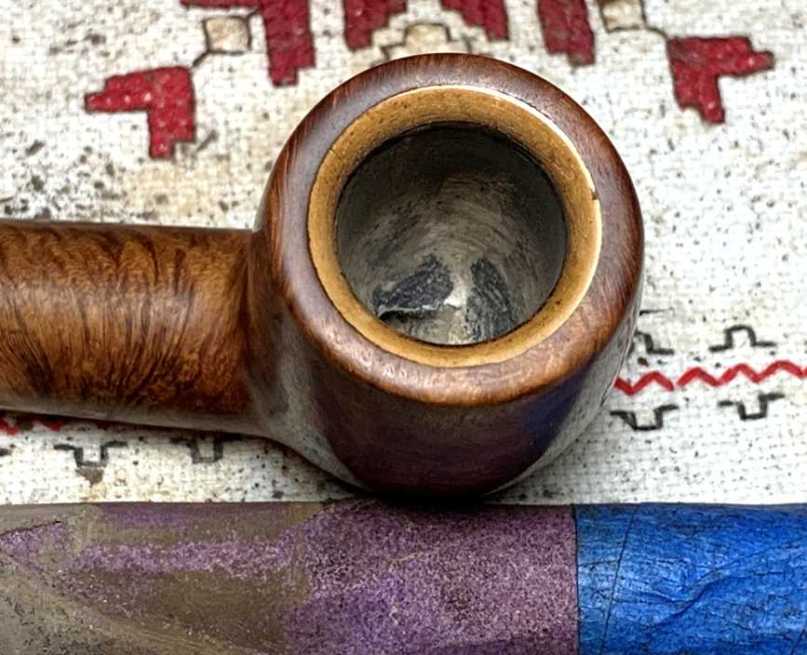
 The egg white recipe has fully cured filling the divot in the Meer-lining.
 Using 220 paper wrapped around the Sharpie Pen, the chamber is sanded removing the excess recipe. The texture of the Meer-lining feels good. The difference in the coloration in the chamber will go away when a new steward puts the Chap into service. A reminder to a new steward: Meerschaum needs no cake build up. Clean the chamber with a folded pipe cleaner after each use and things should be good.
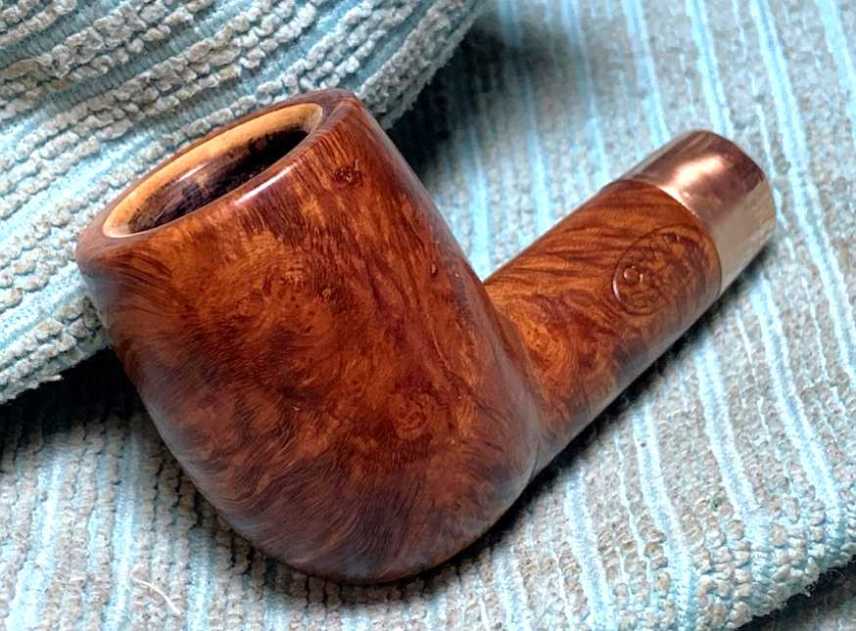
 Getting down to the final steps – Mark Hoover’s Before & After Restoration Balm does a great job bringing out the natural hues in the briar and conditions the wood. After putting some of the Balm on my finger, the Balm is worked into the briar surface. After this is done, the stummel is set aside for about 15 minutes while the Balm does its thing.
 A dedicated microfiber cloth wipes off the excess Balm and buffs up to a shine. I like what I see!
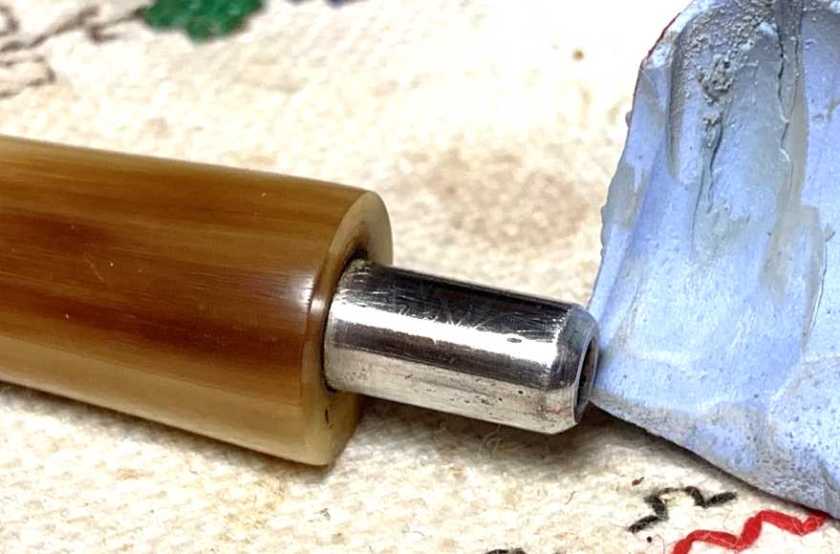
 To bring the shine on the brass band to the next level, a cotton cloth dedicated to application of Blue Diamond compound on metal is mounted on the rotary tool. As the picture shows, the residue produced by polishing metal is a black substance on the buffing wheel and on the compound block. Care is taken to guard the black residue from getting on the briar while the brass band is buffed with the compound.
 The results are great. Now the band is not just shiny, but reflective.
 While the compound wheel is still mounted, the nickel tenon is also buffed up.
 After changing to another cotton cloth buffing wheel, Blue Diamond compound is applied to the horn stem and stummel – minus the band.
 After application of the compound, a felt cloth is used to wipe/buff the surface to remove compound dust that collects on the surface. This is done in preparation for the application of the wax.
 After changing the buffing wheel again, carnauba wax is applied to the entire pipe (minus the band). After application of the wax, the pipe is given a rigorous hand buffing with a microfiber cloth to clear away excess wax and to raise the shine.
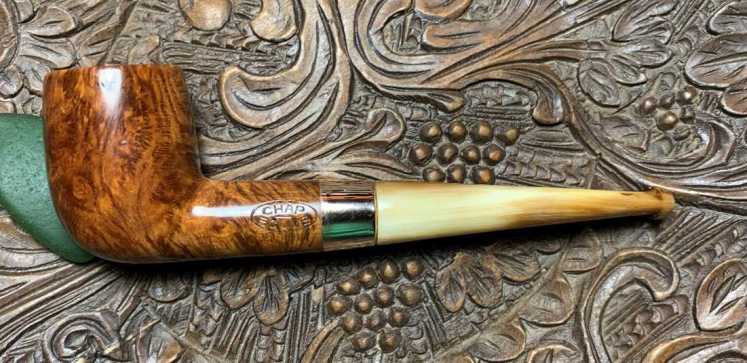
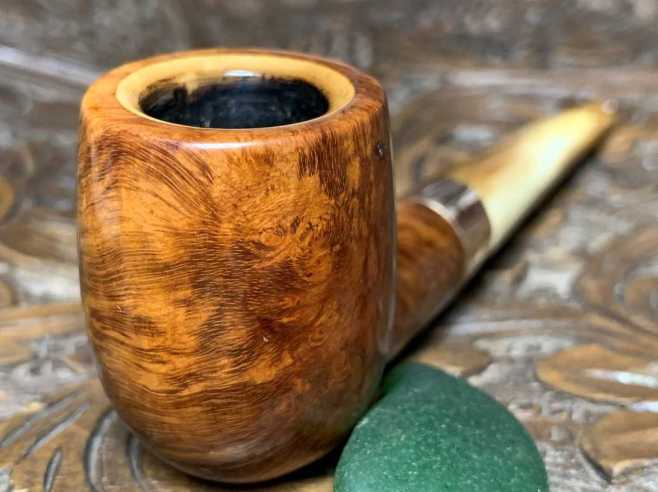
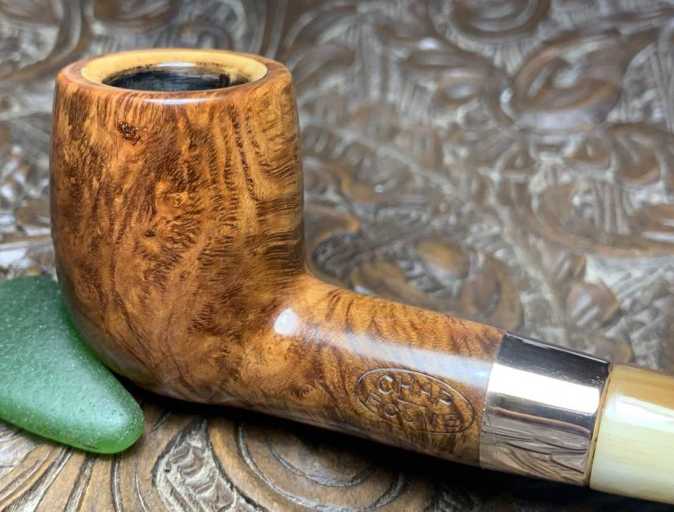
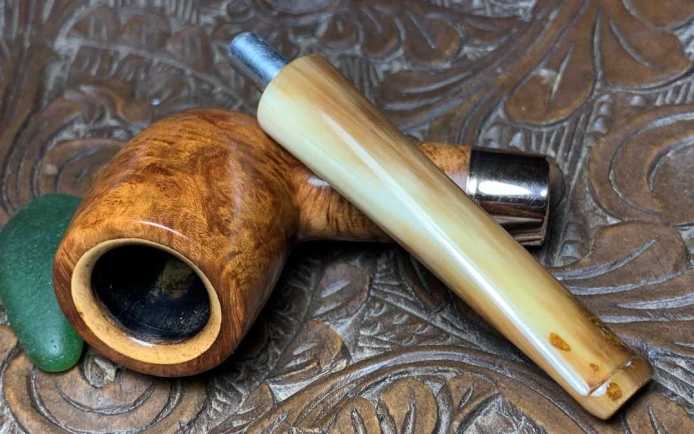
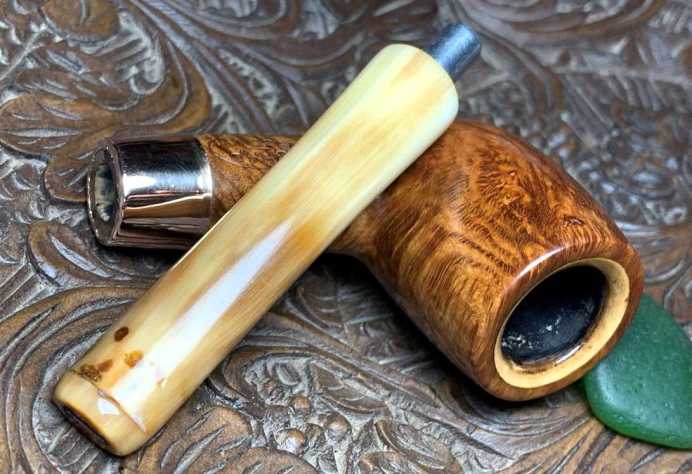
 What a challenge this Saint-Claude-made Chap Ecume presented when I first started! This was a technically challenging pipe and my, oh my, it was worth the effort. The Chapel Frères & Cie Chap on the worktable is dated between 1925 and 1955. The horn stem was chewed up pretty bad but looks good now. Horn gives a homey, organic feel with the waves of brown and creamy grains flowing to the button. The broken shank was a deal breaker. The brass band now reinforces the shank with the added perk of the band adding a touch of class. The brass blends well as the band transitions between the horn and briar. The briar of this bowl is the color of rich honey, and the cream color Meerschaum lining on the rim provides a striking contrast. Bradley commissioned the Chap Ecume and will have the first opportunity to claim him from the Pipe Steward Store benefiting the Daughters of Bulgaria – an effort helping women and girls who were trafficked and sexually exploited. Thanks for joining me!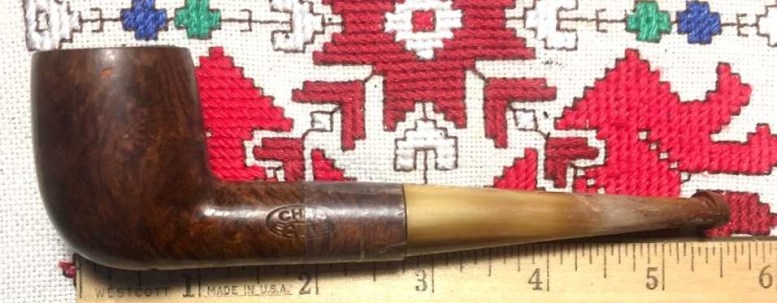



 The Pipe Steward
Dal, what an amazing job you did. I’d have tossed it into the fireplace! Now it’s gorgeous. Bradley, if you don’t want it, I have first dibs. Todd
LikeLiked by 1 person
Thanks, Todd! Duly noted. I did add an addendum in the post at the end of the research section that the dating is more likely within the window of 1946-1955.
LikeLike