
I love the Season of Christmas when most of the world celebrates the fact that Christ was born. When I consider the shape of the world, and our prayers for the people of Ukraine, I am thankful for a reason to celebrate something that is good news. The next pipe on the worktable was commissioned by a daughter as a Christmas gift for her dad. Sadie sent me a note asking to commission a sharp looking Dr. Grabow Starfire Zulu. What is special about Sadie’s commission is that her dad has commissioned pipes from me before and 2 of those commissions were for his kids! Sadie was the recipient of a beautiful pipe for her birthday (See: A Special Gift: A French Châtel Sculpted Edelweiss Horn Stem Billiard):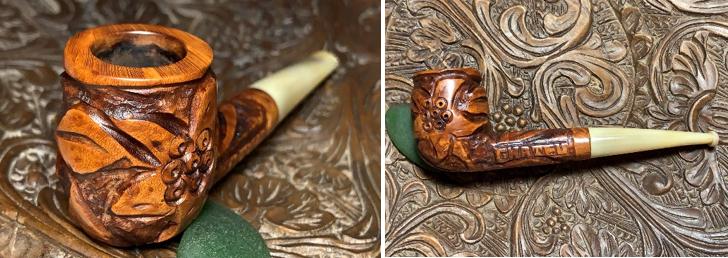 In subsequent communications with Sadie, I discovered that after studying in college for a time, she is in the process of applying to go on staff with a Christian ministry called YWAM. She said that she had previously worked with this organization in Scotland but is hopeful of basing in Amsterdam for a few years on a team focusing on the creative arts, community, and city projects around Amsterdam. After sharing with Sadie our experiences with the Daughters of Bulgaria in Bulgaria, she said that she may have the opportunity to participate in YWAM’s activities in Amsterdam’s red-light district. Sadie is a remarkable young lady and her commission as a gift for her dad, Stacy, will also benefit the Daughters of Bulgaria – helping women and girls who have been trafficked and sexually exploited.
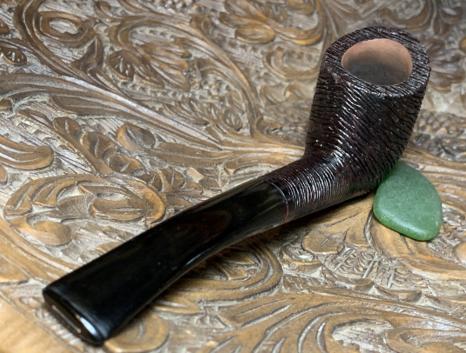
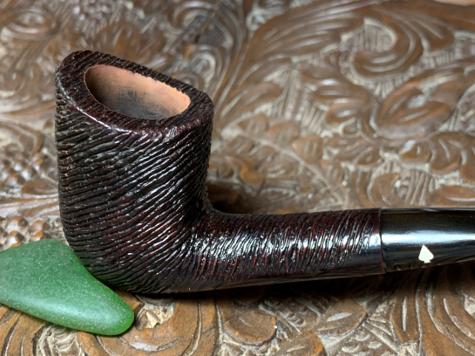
The Dr. Grabow Starfire Zulu came to me in January of 2017 on the online auction block from a seller in Monrovia, Maryland. My bid was sufficient and the Dr. Grabow made its way to the For “Pipe Dreamers” ONLY! online collection where pipe men and women can commission pipes that whisper to them😊. Here is the Dr. Grabow Sadie commissioned.
 The nomenclature is stamped on the smooth panel on the underside of the shank: STARFIRE [over] DR. GRABOW.
 What attracted me to this Dr. Grabow was when I was trolling the online auction block was the tight, intricate wire rustication and the Zulu shape – yet not just a straight Zulu shape, but the added touch of a curved sloping ‘ski jump’ rim. Bill Burney’s description of the Zulu shape on Pipedia (LINK) is helpful.
 I’ve worked on several of Dr. Grabow’s previously and it is always great to recount the story of how Dr. Grabow became Dr. Grabow. I repeat in its entirety a Pipedia article written by the grandson of the ‘original’ Dr. Grabow, entitled, The Legend of Dr. Grabow (Written October, 2005, by Paul W. Grabow, and courtesy of DrGrabow-pipe-info.com [now defunct]):
 Dr. Grabow Pipes are named after Dr. Paul E. Grabow (my deceased Grandfather), a general-practitioner physician formerly with an office on the northeast corner of Fullerton and Halsted in Chicago. His youngest son was Mr. Milford P. Grabow (my Uncle) who passed away January, 2005 in Chicago. Dr. Grabow’s other son (my Father, deceased in 1979) was Dr. William S. Grabow, a dentist who practiced in Chicago and Evanston, IL.
Milford Grabow recently recounted details of the Dr. Grabow Pipe legend in a letter to me as follows:
“To start from the beginning, the old homestead was on 2348 Seminary Ave. (Chicago) before the De Paul University bought and tore down the whole area to expand the campus. Three doors north on 2400 Seminary Ave. (corner of Fullerton) was Brown’s Drug Store, one of the old fashion community Drug stores that was popular of that area and was owned by Brown the Druggist. It had the usual ice cream counter and wire chairs and tables to serve sodas and sundaes. My Father became fast friends with his fishing buddy the Druggist. Most every weeknight after dinner, while Mom did the dishes, Pop would visit Mr. Brown in the back room of the store and they would have weighty discussions about world events, fishing, politics, sports, etc. while smoking their pipes. One block west on Fullerton on the corner of Racine was the large pipe factory owned by Mr. Linkman. Mr. Linkman, when he wasn’t too busy, would join the other two in their bull sessions and the three became fast friends.
It was during one of their nightly sessions that Mr. Linkman mentioned that he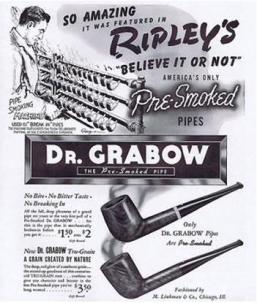 was coming out with a new pipe containing some innovative improvements and was looking for a name for it. He thought if it contained a Doctor’s name it would probably sell well so he asked my Father if he would mind if he could use the Dr. Grabow name as he liked the sound of it. My Father liked the idea and was flattered to have a pipe named after him. So, Mr. Linkman used the Dr. Grabow name without any formal agreement but just a “friendly understanding.”
As a child in the 1940’s and 1950’s, I remember how Grandpa loved to smoke his Dr. Grabow pipes. The pipes were generously provided to him at no cost by Mr. Linkman, apparently part of the friendly understanding. Dr. Paul E. Grabow died of natural causes in 1965 at the ripe age of 97. He had a very rich and full life and I believe pipe smoking was good to him. Through the years I’ve enjoyed watching the growth of the Dr. Grabow Pipes and sharing Grandpa’s legend with the curious.
Anyone personally familiar with additional details of this legend is requested to forward input to the undersigned.
Paul W. Grabow
The Dr. Grabow Pipedia article (LINK) is interesting to read to understand more about the history of the company, period ads and many examples of Dr. Grabow pipes which are ‘Old’ or ‘New’ pipe names. It’s worth taking a look. There are a few references on Pipedia giving more information about the ‘Starfire’ line. Another helpful section was Grabow models, series and lines through the years that was put together by Russell McKay. He puts Dr. Grabow pipe production in two broad categories – Old and New, which corresponds roughly to pipes made in Chicago (Linkman Co.) and pipes made in Sparta, North Carolina area after the sale and move of the pipe production (1952-53). This grouping would place the Starfire among the ‘New’. The Starfire shows up in the ‘New’ list with this information:
STARFIRE (c1956) — First appears in a magazine ad for $3.50 as early as December 1956. “E” selection of briar was used on both the Starfire and Westbrook.
I wish I could get a copy of this ad! This initial listing would place the introduction of the line 67 years ago this month! Another interesting bit of information about Dr. Grabow pipes comes from the was Grabow models, series and lines Pipedia article:
“NEW” Pipe Names: Before I get started in this section here is a great piece of trivia that I learned from a devoted and caring Dr. Grabow employee recently. You have probably wondered, as I have, just where these names originated or what inspired them. Maybe you have even guessed the connection, but I sure didn’t! When this employee mentioned this to me, he brought it up like a riddle: “THINK CARS!” Now, see if you came up with what I did:
- Eldorado— Cadillac
- Viscount— Dodge (Car built by Chrysler Corporation of Canada Ltd, for Canadian Markets only ca1959.)
- Starfire— Oldsmobile (The original Oldsmobile Ninety-Eight Starfire, named after the Lockheed F9413 Starfire fighter jet, was first introduced as a show car in 1953 at GM’s Motorama along with the Buick Skylark and the Cadillac Eldorado.)
- Regal— Buick
- Savoy— Plymouth (by the way, my friend at Dr. Grabow didn’t say, but there was also a Plymouth BELVEDERE!)
- Riviera— Buick, I think first produced for model year 1963, which would have made it known in 1962. The pipe name precedes that, but maybe I missed something.
- Lark— Studebaker
I think it’s great that lines of pipes were named after lines of cars. I did a quick search to find an example of a 1956 Oldsmobile Starfire and the Lockheed F9413 Starfire fighter jet compared to the picture I saw on the eBay auction block. Wouldn’t you say there’s an amazing resemblance?! 😊. I was about to wrap up my research on the Dr. Grabow Starfire when I happened to find another lead adding significant new information. RebornPipes.com is a usual place I go to when doing research. Steve has worked on many, many pipes and I discovered he had restored a Dr. Grabow Starfire Tomahawk shape (LINK) which belonged to our good friend in India, Paresh. Paresh inherited a treasure trove of pipes from his grandfather who received many pipes from British military officers when India was still under British rule. His Starfire also had a wire carved finish.
 Steve’s research uncovered a 2017 thread in a PipesMagazine.com Forums with the title: 3 Year Journey: Complete Set of Continental X-Series (LINK). The originator of the thread was ‘danielplainvew’ whose name is actually Dave, had accomplished a 3-year effort to put together a 12-pipe set of Dr. Grabow Continental X-Series which were released in 1959. Dave described the series in this way:
2 unique shapes were released in 1959. These were mail order coupon pipes only. Not sold in stores. A coupon pipe was only available for sale after a customer collected up to 25 coupons from various tobacco tin/tubs. 10 of the 12 Continentals I have are smooth finishes. I’m still on the hunt to replace the 2 wire carved finishes.
He then included the following Dr. Grabow ad showing the Continental collection which has our Dr. Grabow Starfire the third pipe down on the left marked X01 #48. After reaching out to Steve to ask him some questions about the Continental line, I asked him why it was called, ‘Continental’? He explained that this Dr. Grabow collection specialized in unique shapes which were associated with European or Continental shapes. The curves are most reminiscent of Danish Freehand styled pipes to me. As I look at the collection together, I can see why Dave celebrated his accomplishment – these are nice looking pipes that are unique. Following the ‘official’ Dr. Grabow Continental advertisement, Dave included a picture of his own collection corresponding to the ad.
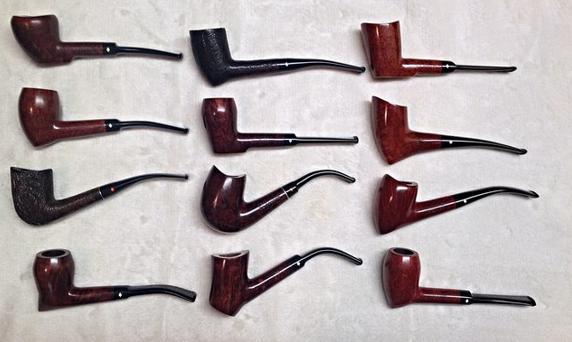 Following this, Dave provided closeup pictures of each collection specimen. I include only the Zulu Starfire.
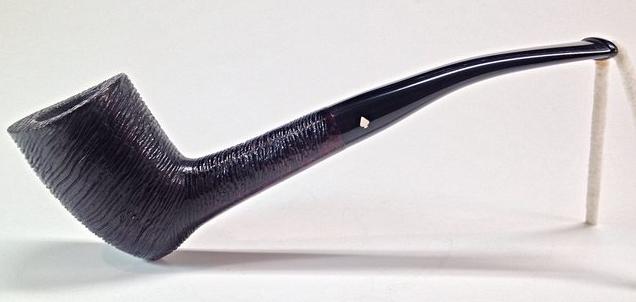 Wow! This is what the Starfire on the worktable should aspire to! The thread also had one additional contributor who added significant information, Ed James (‘ejames’). From Steve’s post on RebornPipes and from comments in the Pipes Magazine thread, this highly respected and knowledgeable Dr. Grabow enthusiast, had passed. ejames added this information about the Continental line:
Congrats Dave! I’m glad to see you were finally able to put a 12-piece set together! The Continentals were however not just available through mail order– maybe at first when those shapes were put into production, they were available only by coupon in the Westbrook, Emperor and Sculptura lines, but they were available in the regular production–non coupon lines such as Viscount, Starfire and Eldorado. They were even made in some lines that-according to the shape and availability charts–they were not available in– Color Viscount, Silver Duke, Regal and others.
Over the years Grabow made a lot of pipes that supposedly were not available–according to the charts– such as saddle bit 81’s, Golden Duke 85, Commodore Oom Paul and many other “odd ball” pipes.
The coupon pipes were given XO shape numbers while the regular production lines (meaning sold in retail stores) were given standard shape numbers. The XO numbers were never stamped on the pipes, but the regular production pipes will sometimes have a stamped shape number. Now, you know what I’d like to see Dave? 12-piece sets in the Westbrook, Emperor and Sculptura lines. Might not be too hard to find the Westbrooks but the Emperor and especially the Sculptura would be.
What we can say with certainty is that the Starfire was first sold as a set of 12 pipes called the X-Series – Continental line. This special collection was introduced in 1959, but the Starfire line was first introduced in 1956. I found no information describing how long the sets were produced. My guess is that special series sets, as this was, did not run as long, but a good guess is that they ran through the 1960s.
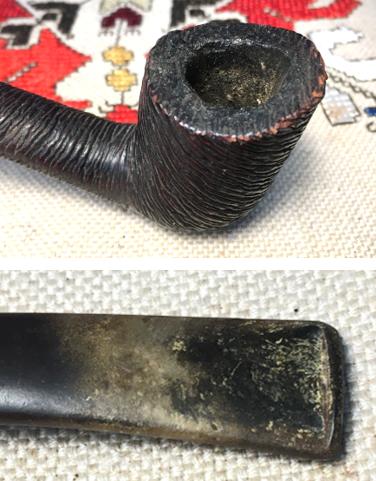
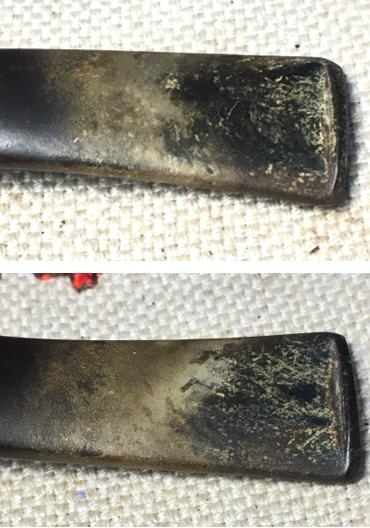
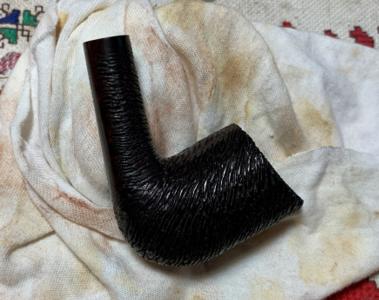
With a better understanding of the pipe on the worktable and a renewed appreciation for the Dr. Grabow story, I take a closer look at the Starfire that Sadie commissioned. The chamber has some cake that will be removed to give the briar a fresh start. The stummel has seen better days. It needs scrubbing, but the main issue is the chips and nicks on the rim’s outer edge – front and aft. The wire rustication shows the wear that one would expect and needs to be refreshed with a fresh application of dye. Here are some pictures showing what I see. The stem has significant oxidation, some tooth compressions and the bit has calcification that needs to be addressed.
 Starting first with the stem, to clean the airway, the ‘spoon’ stinger is removed and placed in a jar of alcohol to soak to break up the grunge.
 Using pipe cleaners moistened with isopropyl 99% alcohol, the airway is scrubbed.
 Next, to address the oxidation and calcification, the stem is placed in Briarville’s Stem Oxidation Remover for several hours.
 After the soak, the stem is removed and rigorously scrubbed with a cotton cloth to remove the raised oxidation.
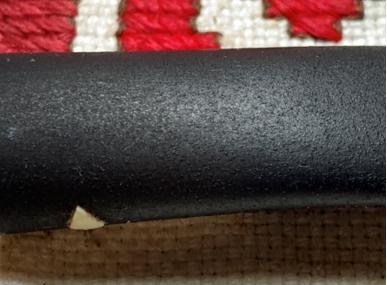
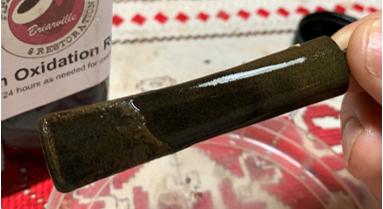 After scrubbing for some time with a cloth, it is evident that oxidation remains on the stem.
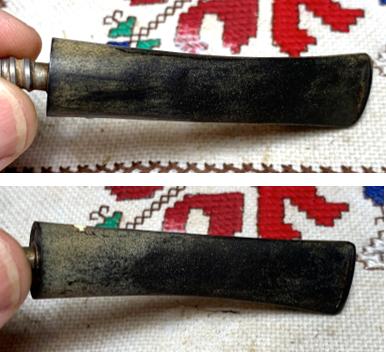 Next, the stem is rigorously scrubbed with Mr. Clean Majic Eraser. The results this time are much better.
 The interesting thing about the vulcanite rubber is that it is very rough and with a charcoal-like feel to it. I’ve seen this before in older stems. After the cleaning is done, the stem will need to be sanded to remove the rough surface.
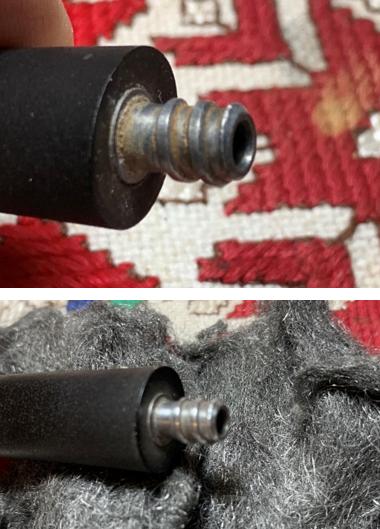
 Before putting the stem aside, the grime and corrosion on the threaded tenon needs to be addressed. Using 0000 grade steel wool, this shines up pretty nicely.
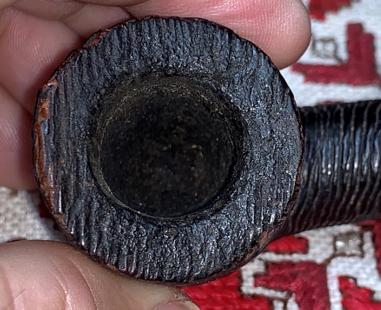
 Turning now to the stummel, the carbon cake in the chamber is thick. A picture shows the starting point.
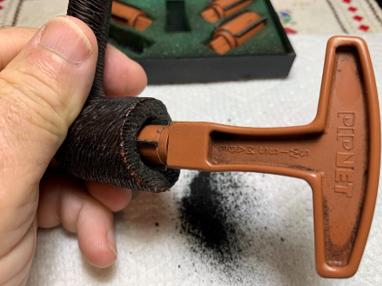
 The reaming starts using 2 of the 4 blade heads from the Pipnet Reaming Kit.
 Next, I switch to using the Kleen Reem Pipe Tool which can follow the contours of the chamber as it widens toward the top. As the knob is turned on the top of the tool, the jaws expand to stay flush on the chamber wall. The result is a better cutting action removing the cake.
 The chamber walls are then scraped with the Savinelli Fitsall Tool which can reach into the hard-to-get places on the floor of the chamber.
 Finally, to remove the last vestiges of carbon, the chamber is sanded with 220 paper wrapped around a Sharpie Pen to provide leverage.
 The full arsenal of tools to clean the chamber are shown. A quick examination of the chamber shows healthy briar. Moving on.
 Moving next to cleaning the external briar, the picture above shows well the grime lodged in the wire rusticated rim. Undiluted Murphy’s Oil Soap begins the cleaning using cotton pads.
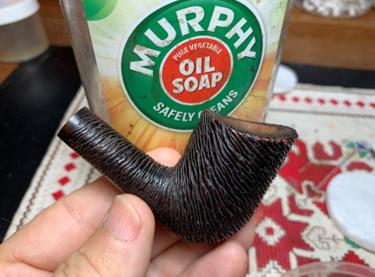 As I scrubbed the surface with a cotton pad, I discovered that the finish has red hues. Up to this point, I was thinking the finish was a straight black. This is not the case.
 Both a bristled toothbrush and a brass wire brush join in. The toothbrush does a good job cleaning the grooves of the wire rustication. The brass brush helps to clean the thick lava buildup on the rim.
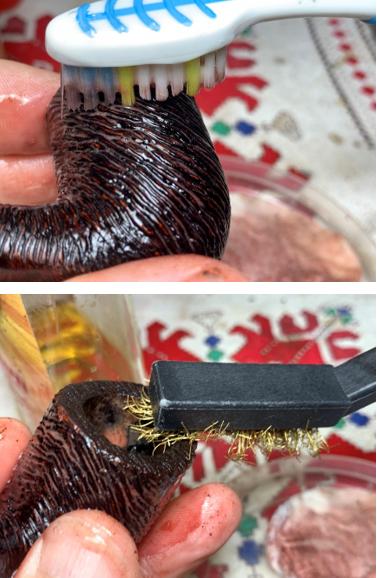 At this point, in my regular cleaning process, the stummel is taken to the sink where using hot water and liquid anti-oil dishwashing soap continues the cleaning process focusing on the internals. However, I was unable to run the shank brush through the mortise out the draft hole at the floor of the chamber. I attempted to blow through the mortise and there was an obstruction – the airway was plugged. Returning to the worktable after rinsing the stummel, I finally was able to push a straight sharp dental probe through the obstruction.
 From this point, using a smaller diameter drill bit, I was able to tunnel and excavate gunk out of the airway.
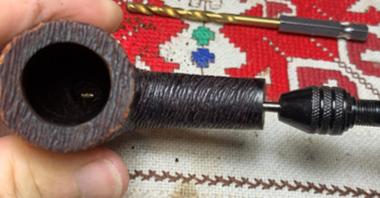 Next, the larger diameter drill bit was used – about the size of the airway, tunneled through as well.
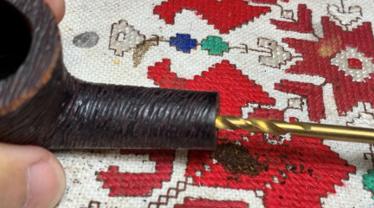 Finally, a pipe cleaner was successfully able then to navigate the mortise and through the draft hole.
 The cleaning continues by returning to the sink to scrub the internals. This is done using shank brushes with hot water and liquid anti-oil dishwashing soap. I don’t usually take a picture from the sink, but decided to show the process engaged.
 After scrubbing and thoroughly rinsing, the stummel returns to the worktable.
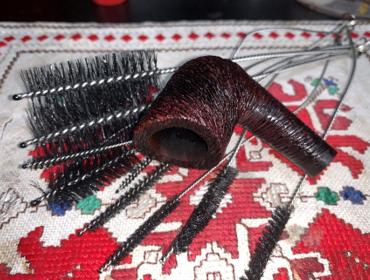 The internal cleaning continues next by using cotton buds and pipe cleaners moistened with isopropyl 99%. Using a small dental spoon also helps to excavate the tar and oils by scraping the mortise walls.
 After some effort, the buds and cleaners emerge lighter. I call the cleaning complete.
 After the cleaning, to show the original stain color, a cotton pad dampened with alcohol rubs the smooth briar panel on the shank underside. The hue appears to have an Oxblood influence, but the briar has a darker tone. To emulate this stain color, an undercoat of Oxblood aniline dye is applied and then after a buffing, will be followed by application of a medium brown topcoat.
 Before starting the stain process, I take another look at the edge of the rim that shows rough briar. The good news is that a rusticated surface is very forgiving because imperfections are more easily masked than with smooth briar. I think that will be the case here. The picture on the left shows the front of the rim. There is a sharper wood shard sticking out. I’ll sand that down a bit first. The right picture shows the rough briar on the back side as well. For both the back and front sides, simply applying the dye should be sufficient to remove the eye-catching blemishes.
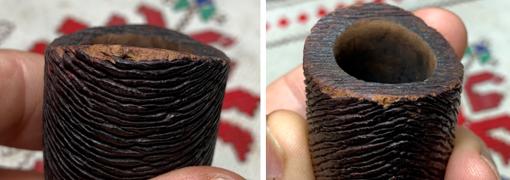 Using a 1500 grade micromesh pad, the front edge of the rim is smoothed.
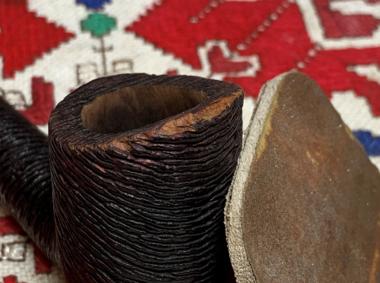 To prepare for the application of dye, the entire stummel is wiped down with a cotton pad moistened with alcohol to clean.
 The lone patch of smooth briar on the underside of the shank holds the nomenclature stamping. Before applying dye it is sanded to remove any small scratches.
 All 9 micromesh pads are used beginning with 1500 grade to 12000. The panel will look much better after all is done.
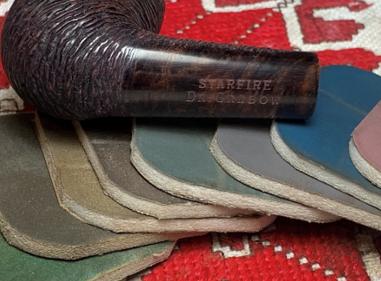 Next, Fiebing’s Oxblood Leather Dye, an aniline dye, is applied with a folded pipe cleaner to the entire surface and the stummel is then set aside for the fresh dye to settle in.
 After several hours, a new, clean cotton cloth buffing wheel is mounted onto the rotary tool. With the speed set to about 50% full power, a little faster than usual, the wire carved surface is buffed. This is done to remove the excess dye in preparation for the top-coat application of dye.
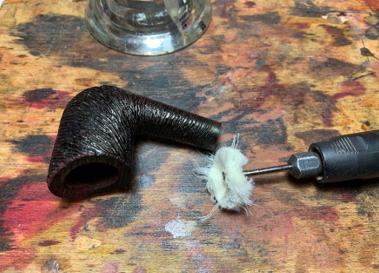 The top-coat application of dye is Fiebing’s Dark Brown Leather Dye. After a thorough application of dye using a folded pipe cleaner, the stummel is set aside through the night giving the dye time to settle in.
 The stem has been waiting in the wings. The oxidation appears to have been eradicated for the most part, but the surface of the stem is rough.
 After the cleaning, there appears to be no tooth chatter which is nice, but the lower bit has a slight bite compression which sanding should erase.
 To address the surface issues, 220 paper is used on the entire stem, upper and lower. But first, the upper and lower button is refreshed using a flat needle file.
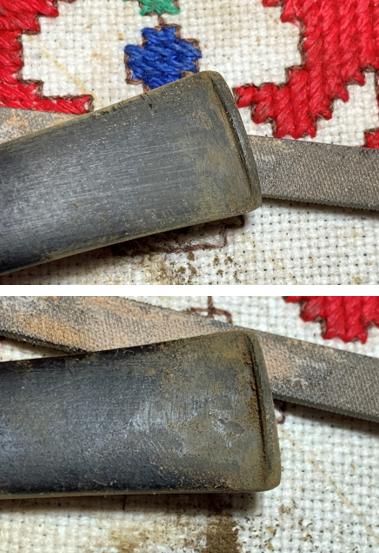 Sanding commences with 220 sanding paper over the entire stem. A plastic disk is used to protect the edges of the stem facing from shouldering.
 Following 220 paper, 320 grade paper is used also with the shoulder guard.
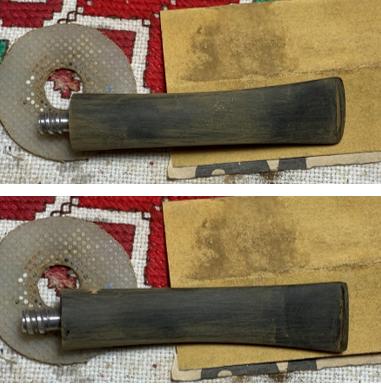 After 320 paper, the stem is wet sanded using the finer 600 grade paper.
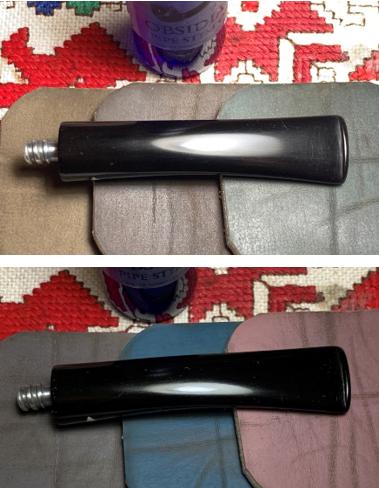
 The sanding process concludes with the application of 9 micromesh pads. Starting with wet sanding, pads 1500, 1800 and 2400 are used. Following the wet sanding, dry sanding continues with pads 3200, 3600, and 4000, then with pads 6000, 8000 and finishing with 12000 grades. Between each set of 3 pads, Obsidian Oil is applied to condition the vulcanite stem and to protect from oxidation. I am amazed at the transformation of this stem. The Oil was almost syphoned into the rubber and that glassy, glossy pop is now restored to this venerable Dr. Grabow.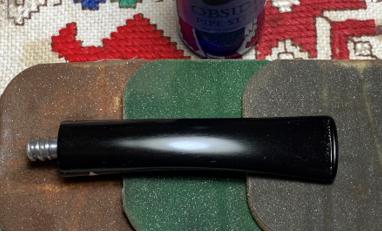
 The stummel has been resting through the night to allow the new dye to settle in. To remove excess dye, a cotton cloth wheel is mounted on the rotary tool dedicated to Blue Diamond compound – a fine polishing abrasive. With the speed set at about 40% full power, the nomenclature smooth briar panel on the shank underside receives the compound.
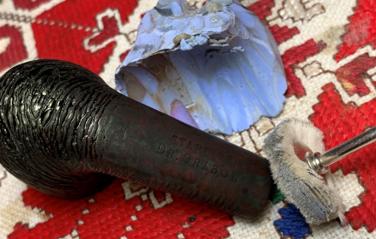 The results are great. The grain beneath is emerging very nicely.
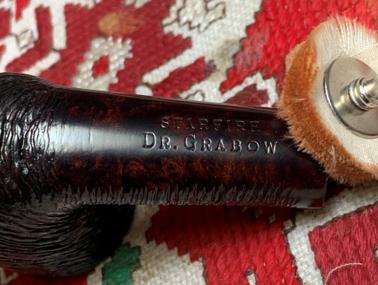 I had only planned to apply the compound on the stummel to the smooth briar panel and not to the rustication. The reason for this is since the compound is dry, it leaves dust behind. Usually, with a rusticated finish, the compound dust residue gets caught up in the rough surface and is a bear to clear out. However, while applying Blue Diamond to the panel, I watched the deep Oxblood undertones emerge which to me, is the cat’s meow in two layered dye applications. Therefore, I tested applying the compound on the wire carved area around the panel and discovered that the wire furrows did not catch the compound. I moved out from the panel gradually, building confidence and in the end, applied the compound to the entire stummel. The picture below shows the technique I used. The application stayed in line with the wire rusticated furrows. I like the results.
 The stem is remounted for the first time and Blue Diamond is also applied to the stem.
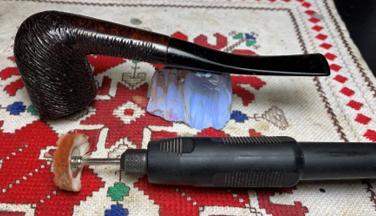 A felt cloth is then used to wipe the pipe of any residue compound dust in preparation for the wax.
 Before applying wax, to minimize dye leeching onto the fingers, the stummel is heated. This can happen when a newly stained stummel is put into service by the new steward, the inaugural heating of the stummel can cause some dye to leech out onto the fingers. To minimize this from happening, the stummel is heated up with the hot air gun to emulate the inaugural service.
 After heated, the stummel is then given a robust hand buffing with a cotton cloth to remove leeching dye. The cloth in the picture has been put into service previously so not all the soiling is leeching from the Starfire, but I do detect some dye being removed.
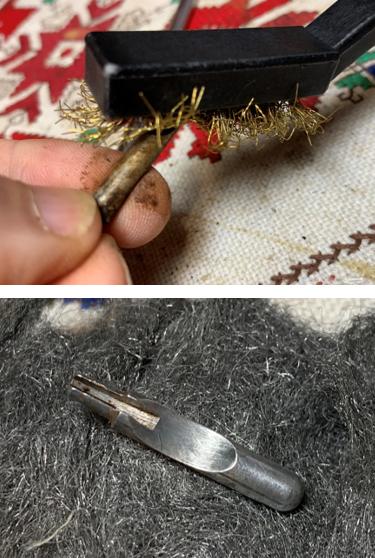
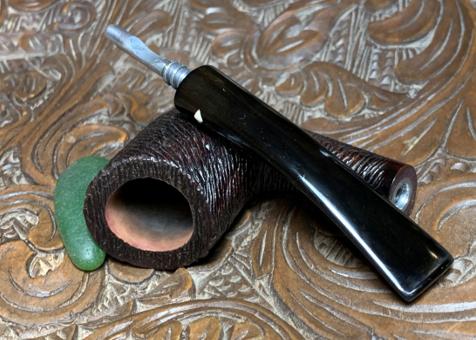
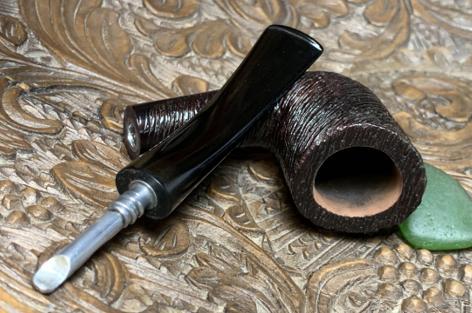
 Another mini project is to clean up the stinger which has been soaking in alcohol. A brass wire brush is used to clean the hard stuff, and this is followed by buffing the stinger with 0000 steel wool.
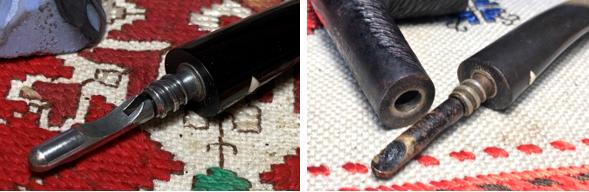
 The stinger is remounted into the threaded tenon and buffed with a metal dedicated cotton cloth wheel. Buffing metals with compound produces black residue.
 Blue Diamond is applied to both the threaded tenon, and stinger and they look great compared to the picture on the right – the starting blocks!
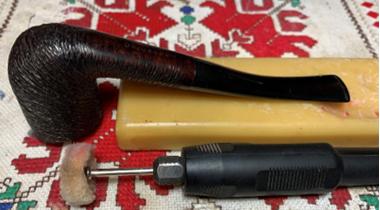
 After reuniting stem and stummel, another cotton cloth wheel is mounted onto the rotary tool dedicated to applying wax. With the speed at about 40% full power, carnauba wax is applied to the pipe. After completing the wax, the pipe is giving a rigorous hand buffing with a microfiber cloth to remove excess wax and to raise the shine.
 I’m extremely pleased to have restored this 1956/1959 Dr. Grabow Continental series set. The Wire Carved Zulu was sold in a set of 12 pipes as a collector’s trove. What a beautiful pipe to add to the collection. The wire carved rustication is neat, tight, and unique. The ski jump sloped rim is reminiscent of Danish Freehand creativity and the deep rich Oxblood finish is pleasing and classy. The Zulu shape also comes with a touch of attitude and will pack a goodly amount of one’s favorite blend. Sadie commissioned this Dr. Grabow Starfire as a Christmas gift for her father, Stacy. As the commissioner, she will have the first opportunity to claim the Dr. Grabow in the Pipe Store benefiting the Daughters of Bulgaria. Thanks for joining me!





 The Pipe Steward