
One of the things that I have had to learn is that I can’t keep them all. When I go on the hunt searching for pipes and then find a pipe of great value, I’m ever faced with the dilemma: ‘Should I keep this one for my personal collection?’ Most of the time, I would guess 99% of the time, the answer I give to myself is, ‘No, you can’t keep them all.’ When I work through the sorrow, the pipe I drooled over for a time makes its way to the ‘For “Pipe Dreamers” ONLY!’ collection for others to eventually drool over and commission for a very good cause – the Daughters of Bulgaria. The Søren Hand-Carved Made in Denmark Freehand now on the worktable was one of those pipes. Arguably, one of the most attractive pipes I have collected with a spiraling rough/smooth briar coiled to form the stummel. The interesting and bonus of this Freehand is that it was fashioned to sit as well. The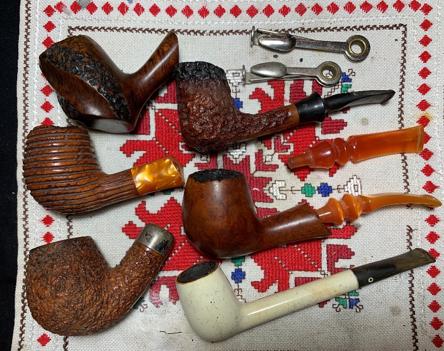 pipe came to me in June of 2021 in what I have called the Lakewood Lot of 6. I met Ron in Lakewood, not far from Golden, Colorado, when I went to his house to purchase a zero-gravity chair that was on Facebook Marketplace. When I pulled into the driveway, Ron was sitting outside smoking a pipe. Of course, conversation ensued, and I found out that Ron was selling off his personal collection. That day, he brought out these 6 to look at. I purchased those on the spot after we struck a mutually agreeable deal.
I ended up coming back and purchasing many more of his pipes, but this lot was the first. I discovered that Ron had many Freehands, and he wasn’t particularly mindful of which stem went with which stummel. The Søren is on the upper left – stemless. The rogue stem pictured did not fit and I was hopeful that in the other boxes other rogue stems would be secured. The other treasure in the Lot of 6 was the Ser Jacopo on the bottom left. It took months to secure a genuine SJ stem from Italy, but it is now with his new steward pipe man Jeff (A Five-Month Adventure restoring an Exquisite Ser Jacopo Spongia R2 of Italy).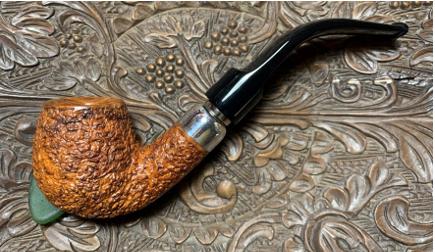 Alas, pipe man James, from Xenia, Ohio, made the Søren his third commission. I met James at South Dayton Presbyterian Church where my wife and I were speaking on a road trip last fall. James is a family man and what I appreciate about him is not only that he is a man of faith, but he is also a man who has served his country and is a disabled vet. By the time James saw the Søren displayed on the table last fall, I had found and fashioned a stem – the process to be shown later. Here are pictures of the Søren when I brought the stummel home.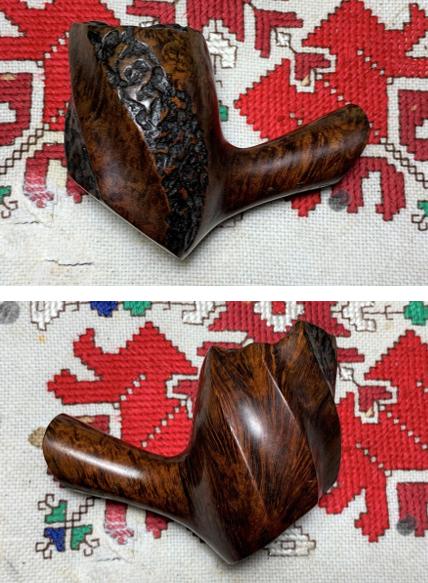
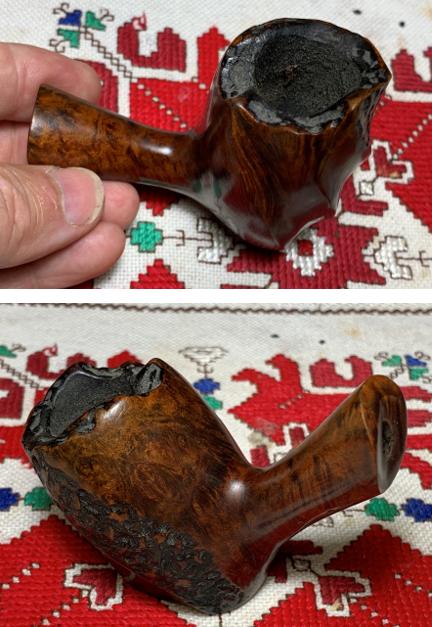 Now you understand how I struggled…😊. The nomenclature is stamped crisply on the back side of the Freehand shank: Søren [over] HAND-CARVED [over] MADE IN DENMARK.
  The Søren name comes from the late Danish master, Søren Refbjerg Rasmussen. I enjoy understanding the provenance of a pipe and the man who fashioned it. Below is repeated in full the information from Pipedia’s article (See: LINK):
Note: Rich Esserman reported in his article appearing in the October, 2021 edition of The Pipe Collector that Søren Refbjerg Rasmussen has passed away.
Søren Refbjerg Rasmussen founded a company in 1969, which employed an average of 8 – 12 craftsmen in the 1970’s. The semi-freehands they produced were traded under his prename Søren. Rasmussen himself finished only the very best pipes. So his way of pipemaking closely resembled the ways of Preben Holm, Karl Erik Ottendahl or Erik Nørding. Altogether more than 1,000,000 pipes were sold.
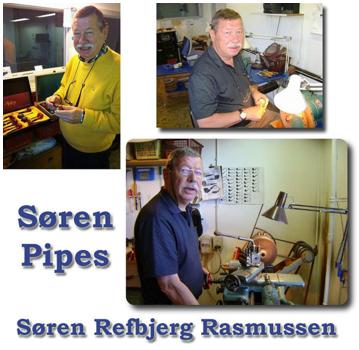 Today he works alone as Refbjerg and manufactures only a small number of pipes in his workshop in DK-2860 Søborg, which are considered to be tremendously precisely executed. The dimensions mostly range from small to medium sized, corresponding to his personal preferences. The shapes adhere to the classical models, but often he gives them a touch of Danish flair. Refbjerg accepts minor faults but never uses any fillings. “Straight Grain” is the only grading, used for his very best pieces. He likes stem decorations made of exotic woods or metal rings.
As Rainer Barbi once stated, Refbjerg uses only briar from Corsica, and, more than that, he’s the one and only to import it from there. At least in Europe. He’s supplier to the vaste majority of the Danish makers.
Seconds: Danbark, Soborg
Obviously the Danbark line was restarted some time ago. To be found at Frenchy’s Pipes and we quote from there:
“A note from the carver:
I am very proud to introduce my new (!) series of hand-carved Danbark Pipes by Søren. These pipes are crafted from the finest Corsican and Grecian briars. I take a great deal of pride in crafting the Danbark Pipes to be highly functional and so they will provide the smoker with many years of dedicated service. The Danbark Pipes by Søren are available in several different styles and finishes with my personal touch and inspirations.
At this time, I favor making classic shaped pipes with a slight touch of my own hands and feelings. I do not produce many pipes today but the pipes that I do make available are individually crafted from the finest Corsican and Grecian Briars available to me. I still make free-hand pipes but not as many as I once made.
For the past 35 years I have always tried to make good smoking pipes in my workshop located near Copenhagen, Denmark. I have always tried to craft my pipes in such a way as they will be long lasting and best friends with the owners. I take great pride in the shape of my pipes, the drilling of the pipes, and the overall dimensions of the pipes.
I enjoy spending my spare time on the very long, rugged coasts of Denmark. I derive much relaxation from being on the coast while angling for Sea Trout with my own hand-tied flies. I find this environment is a great inspiration to me for making pipes. Many times, I think to myself, “Inspired by nature, made by me”.
Happy puffing, Søren”
I especially appreciated the “A note from the carver” where Søren, since deceased, reflects on life and how he found satisfaction and inspiration for the pipes he produced. Fly fishing also marked the pipe man and master carver in a special way…. The text describes what appears to be several phases that Søren went through in his business – he had several craftsmen working producing many pipes to where he was alone in his workshop. It’s difficult to say, based on what was written, from which phase the Søren on the worktable came. The Pipedia article also had several examples of Søren pipes (Courtesy of Doug Valitchka) which have a quality and nomenclature that match the pipe on the table. One more bit of information is added by PipePhil’s (LINK) Søren panel. The pipes that were manufactured for the US market were stamped with “Søren” whereas those pipes destined for the European market were stamped, “Refbjerg”. With a better understanding of the Søren name and the man behind the name, I take a closer look at the Søren on the worktable. Before the pipe was commissioned, I identified an acrylic stem that would work from the rogue stems from Ron’s collection. The orange acrylic stem had the right bend orienting well with the Freehand stummel. What needed adjustment was to decrease the diameter of the tenon. To decrease the diameter the Tenon Turning Tool (TTT) was used. The first step in the process was to drill and enlarge the airway to enable the stem to be mounted on the guide pin of the cutter.
 With the stem mounted on the guide pin, the carbide cutter was adjusted to cut a few millimeters off the diameter of the tenon.
  The tenon was left with some ‘fat’ so that it could be custom sanded and filed to fit well in the mortise of the Freehand.
 After patiently sanding with coarse 120 grit paper and filing with a flat needle file, and with several test fits along the way, the tenon was gradually customized for a good fit.
 Next, the acrylic tenon was further smoothed with 230 grit paper, 600 grit and finally 0000 grade steel wool.
 The tenon fits snugly in the mortise and has a good orientation to the stummel that sits nicely with the stem in place.
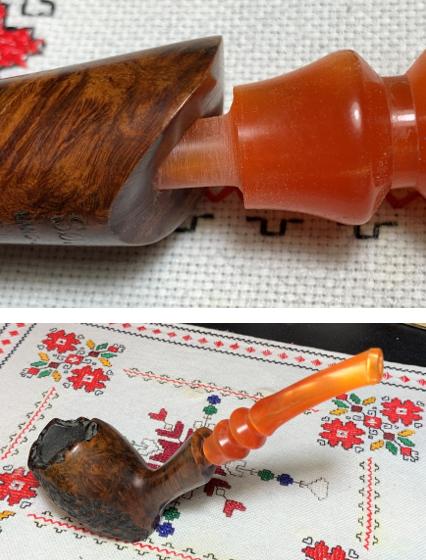 With the stem fitted, I take a closer look at the condition of the pipe. The acrylic stem has tooth chatter on both sides of the bit.
 The chamber has moderate cake build up which tightens toward the floor. The plateau needs cleaning as lava flow has filled the sculpted divots.
 The finish on this Freehand is stellar – a rich patina that needs to be cleaned and refreshed and not removed.
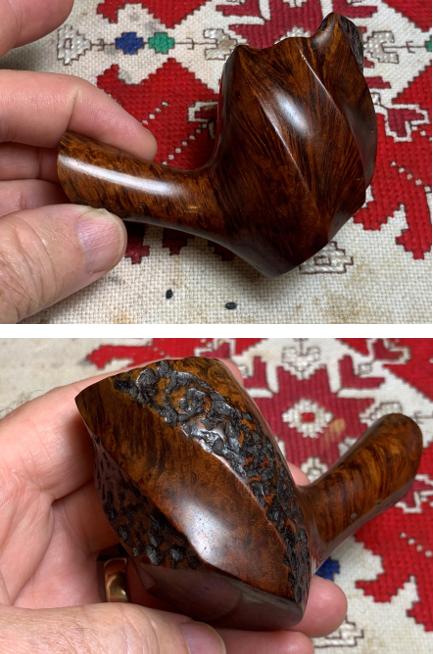 There are minor nicks here and there which are normal wear issues.
 The heel of the sitter Freehand has been used. One noticeable wood compression is seen along with normal wear marks.
 To start with the cleaning and refreshing, the airway of the stem is cleaned using pipe cleaners and isopropyl 99% alcohol. Only one cleaner was needed to make sure it was clean.
 Turning now to the stummel, the chamber is reamed using the Pipnet Reaming kit. 3 of the 4 blade heads available in the kit are used to ream the chamber. This was followed by scraping the chamber with the Savinelli Fitsall Tool. The final step in the process was to sand the chamber using 220 grit paper wrapped around a Sharpie Pen.
 An inspection of the chamber looks good – a lot of real estate to pack one’s favorite blend! A quick measurement is 2 inches to the peak of the plateau.
  Switching now to the external briar cleaning, undiluted Murphy’s Oil Soap is used with a cotton pad. The plateau was also scrubbed with a toothbrush.
  The stummel was then taken to the sink and with warm tap water the internals were scrubbed with liquid anti-oil dishwashing soap and shank brushes. After a thorough rinsing the stummel was brought back to the worktable. It appears at this point that the finish that was on the stummel was washed off and the stummel is now a lighter shade. I’ll hold off looking into this until after the cleaning is completed.
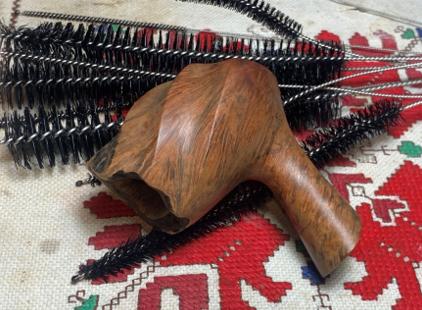 The cleaning on the internals continues with pipe cleaners and cotton buds moistened with isopropyl 99% alcohol. A small dental spoon also helps to scrape the sides of the mortise.
 Earlier, I noticed a small compression on the heel. It’s small but noticeable. To address this, steaming the wood with a clothes iron can help to mitigate the compression.
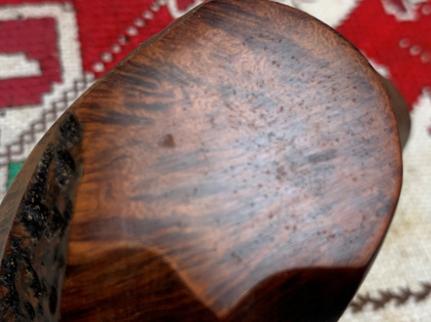 To do this, a cotton cloth is moistened with water and a point of the wet cloth is placed over the compression. With the iron heated, the front of the iron presses on the cloth which ‘steams’ the water into the briar. Wood is a porous substance and heating and steaming the compression causes the wood to absorb the moisture and expand. Hopefully, this erases or lessens the compression.
 I can still see the compression, but it is very much reduced. It’s good to go.
 Taking a closer look at the stummel surface, the finish was removed during the cleaning process – ugh. We’ll continue with the process and decide if dye will be reapplied or not. During the micromesh process, the briar will naturally darken. We’ll see how it goes. Next, using micromesh pads, the stummel is sanded/polished using pads 1500 to 24000, 3200 to 4000, and 6000 to 12000. Between each pad, the stummel is wiped with a damp cotton cloth to remove the briar dust and to give each pad more traction.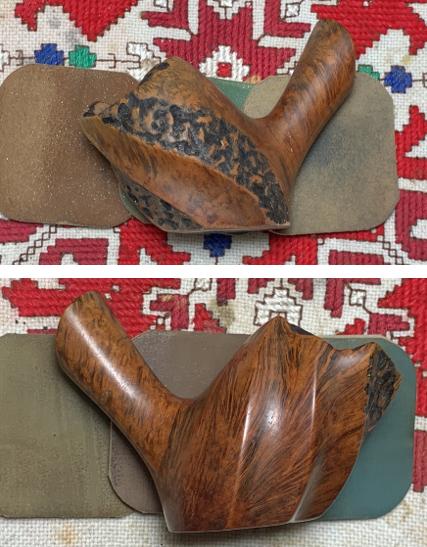
 We’ve come to the place of decision regarding the finish. The before and after comparison in the pictures below show the change in the hue. The ‘before’ cleaning picture is darker with a reddish hue. The ‘after’ is lighter and basically a brown hue.
 I’m not pleased with the hue as it is and even though it’s a very subjective exercise to replicate a hue with dye, I’m going to give it a shot. The mixture of dyes that I settled on to replicate the darker brown with a reddish hue is mahogany and red – both are aniline dyes of Fiebing’s Leather Dyes. Using a cotton bud, and doing test strips on the board, I settle on the mixture.
 The stummel is heated with the hot air gun in preparation for applying the dye. Heating the briar serves to expand the grain helping it to be more receptive to the dye pigment.
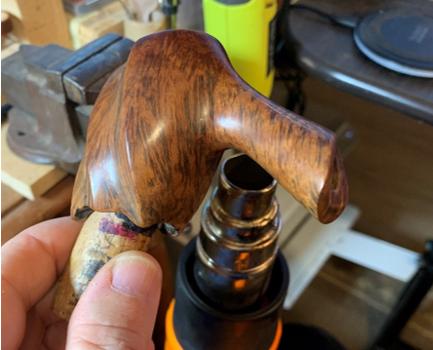 The aniline dye mixture is then painted onto the surface and ‘flamed’ with the lit candle. This immediately combusts the alcohol in the dye and sets the pigment in the grain. The dye is applied very lightly over the rough, sculpted patches which have black crevasses – the dye hitting the peaks. When the dye has been thoroughly applied, the stummel is set aside for several hours to allow the dye to settle in.
 Turning the attention back to the stem, some fresh pictures show the minor tooth chatter on the upper and lower bit.
 To address the tooth chatter, 220 grit paper is used to sand the bit – upper and lower.
 Following the 220 grit paper, 320 grit paper is used – upper and lower.
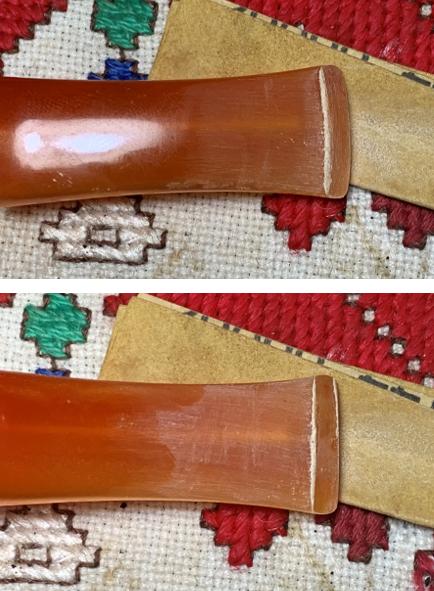 Next, the stem is wet sanded using 600 grit paper and this is followed by applying 0000 grade steel wool.
 The full regimen of micromesh pads is applied to the stem beginning the polishing phase. First, the stem is wet sanded with pads 1500 to 2400, then dry sanded with pads 3200 to 4000 and 6000 to 12000. Even though Obsidian Oil does not condition acrylic, I like to apply it between each set of 3 pads to give the pads more traction.
 With the stem on the side, it is time to ‘unwrap’ the newly dyed stummel. I hoped for a good match to the former finish with a mixture of mahogany and red aniline dyes – only a touch of the red was used. The crusted flamed surface is unwrapped using a coarser felt buffing wheel and a coarser compound – Brown Tripoli. The speed of the rotary tool is at about 40% full power.
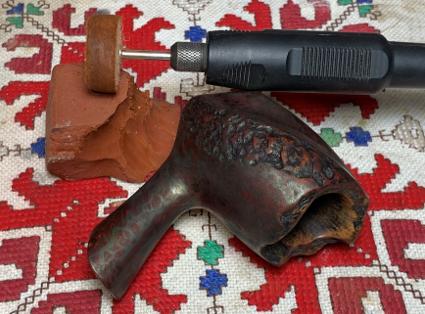 It takes time to methodically remove the flamed dye. This picture shows the briar as it is revealed with the removal of the crust.
 The process of using the coarser compound serves to remove excess dye from the surface and sharpen the grain presentation. After using the coarse felt wheel with Brown Tripoli, Tripoli is again applied to the entire stummel with a softer cotton buffing wheel. I like applying the Tripoli a second time with the cotton wheel to again sharpen the grain presentation and to get in the crook of the shank and bowl that the felt wheel is not able to reach.
 After the application of Brown Tripoli, the stummel is wiped down with a cotton pad moistened with alcohol. This is done to help blend the new dye and to remove excess dye. It also is able to lighten the finish somewhat, but I’m not trying to lighten it – it looks good as it is.
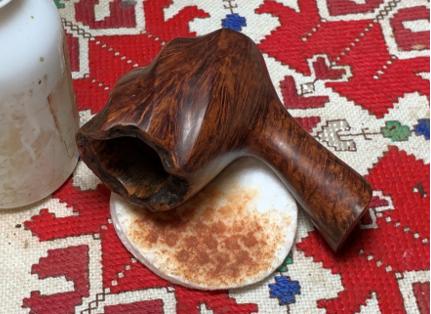 Next, another dedicated cotton buffing wheel is mounted on the rotary tool at the same speed and finer Blue Diamond compound is applied to the acrylic stem and to the stummel.
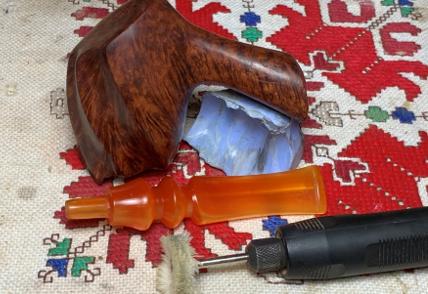 A felt cloth is next used to wipe the stem and stummel removing the compound dust. This is done in preparation for the application of the wax.
 One mini project is left before application of the wax – the chiseled or sculpted patches of rough briar are highlighted with black dye. The black has faded and most of the carvings have lightened.
 A black dye stick is used to refresh the patches of rough, sculpted briar. The contrast looks great.
 Finally, with stem and stummel reunited, Carnauba wax is applied with a cotton cloth buffing wheel. After the application of the wax, the pipe is given a rigorous hand buffing to remove excess wax and to raise the shine.
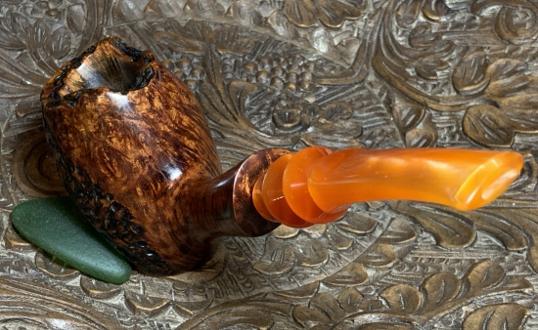
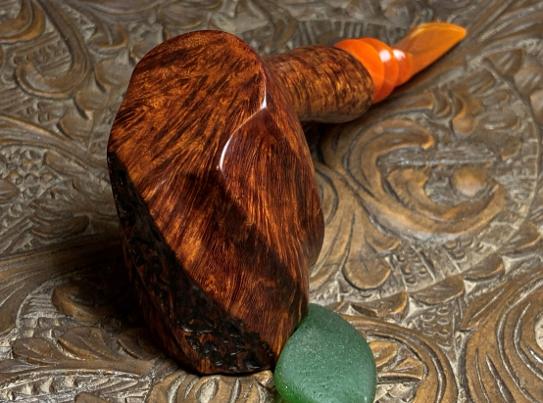
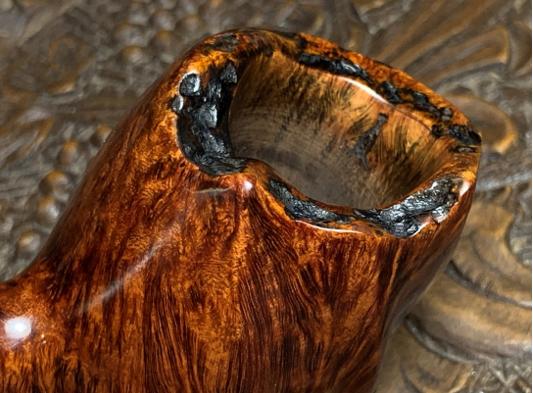
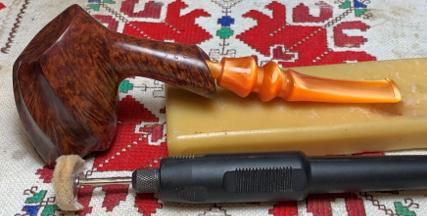 My, oh my! I hit a home run with the dye mixture. The grain on this Søren Hand-Carved Made in Denmark Freehand is beautiful. The shaping and fashioning of the stummel with spirals of smooth and sculpted panels of shaped briar is classic Danish Freehand style – ‘Follow the grain’. The hue of the briar ties in nicely with the marmalade acrylic stem. The bonus is that the Freehand also serves as a sitter. The dimensions are Length: 6 3/8 inches, Height: 2 1/2 inches, Plateau width: 1 1/4 inches, Chamber width: 7/8 inches, Chamber depth: 1 7/8 inches. As the commissioner, James will have the first opportunity to acquire the Søren from the Pipe Steward Store. A large percentage of the proceeds of each pipe restoration help to support the work of the Daughters of Bulgaria – a ministry helping women and girls who have been trafficked and sexually exploited. Thanks for joining me!






 The Pipe Steward
Pingback: Road Trip Restoration #2: Replacing the Shattered Shank Extension for an Heirloom Sixten Ivarsson Stanwell 62 – The Pipe Steward