
The next pipe on the worktable is a beautifully grained GBD. It was commissioned from the For “Pipe Dreamers” ONLY! online collection by pipeman, Doug, who lives just north of Philadelphia, PA. He found The Pipe Steward seeing my posts on www.RebornPipes.com thanks to Steve Laug. Doug stays busy with family, sharing a bowl with his son-in-law and works in environmental services for a Fortune 200 company. In my communications with Doug, I also discovered that we are from the same Presbyterian church affiliation and as an elder in his local church, he is deeply involved in and leads an Addiction Recovery ministry in is community. It was for this reason he shared that he appreciated and valued our past work with the Daughters of Bulgaria (now called, Spring of Hope) and that the pipes restored help to benefit that work today.
The GBD that got Doug’s attention is part of a Lot of 14 pipes that I acquired from a pipe man who I met when I went to his house to purchase a Zero Gravity recliner chair posted on FB Marketplace. When I pulled into driveway to inspect my hopeful purchase, Ron was sitting in a chair in front of the garage, puffing reflectively (is there any other way?) on his pipe. Well, you know what happens when two pipe men meet in the wild 😊. Conversations led not only to my purchase of the zero-gravity recliner, but I also discovered Ron was selling his collection of pipes due to health reasons. Since the pipes were ‘somewhere’ in his house, he would give me a call to come back and have a proper look at his pipes. My wife came with me on that return trip, and it was a joy getting to know the man behind the pipes. During the conversation at his home, we discovered that Ron’s background was in the intelligence world – in the Airforce then with NSA. His family was in the east U.S., but he settled in the Denver area after another government job brought him west. We also discovered that he goes to a Baptist church nearby after Beth saw his well-worn NIV Bible on the end table and devotionals. I was also pleased to hear that Ron loves single malts – Glenmorangie is his favorite (as mine) and he also has an occasional dirty martini – like me! The final straw was his collection of Clancy books on the shelves in his living room :-). Ron brought out the first batch of pipes (I ended up purchasing others he hadn’t yet found in storage) and laid them out.
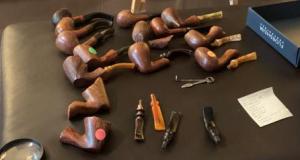 I discovered that Ron had a soft place in his heart for Freehands but was not too careful keeping the acrylic stems with the proper stummels. I acquired these pipes and others from Ron, but I appreciated meeting him more. The GBD that Doug commissioned is near the top in the picture above. Here are pictures of the GBD when I brought it to the worktable.

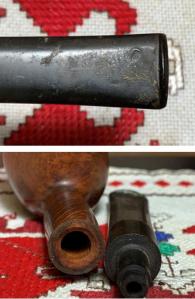 The nomenclature is stamped crisply on the left side of the shank. GBD is stamped on the top encircled with an oval. Beneath this is stamped: INTERNATIONAL [over] LONDON MADE.
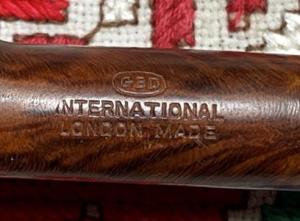 The right side of the shank is stamped: LONDON, ENGLAND [over] 9456 – which I assume is the GBD shape number. A quick look in Pipedia and I found Jerry Hanna’s GBD Shapes Chart (GBD Shapes/Numbers – Pipedia) which gives this information for our shape number:
9436 billiard straight round
 Below is an extensive Shape Chart that shows our pipe if you have good eyesight! (Billiard Shapes from 1961 GBD Flyer, courtesy the now defunct Chris Keene’s Pipe Pages).
 The classic GBD logo embedded in the saddle stem is the brass oval rondel: GBD.
 What we know straight away from the nomenclature is that the brass rondel (https://rebornpipes.com/2017/01/21/oddball-9438-legacy/) and the straight line, “LONDON, ENGLAND” stamping identify this GBD as being made prior to the merger with Comoy’s in 1982 (or 1981 depending on who you read).
What is also helpful is the is a ‘List of GBD’ Models in Jerry Hanna’s article in Pipedia (GBD Model Information – Pipedia). INTERNATIONAL is a model or line of GBD pipes with this information:
International — France and England made: medium brown smooth, carved top rim, rim stained black. -TH: Matt take off finish “with just a hint of surface waxing” -catalog (1976)
What is interesting about our GBD nomenclature is that beneath INTERNATIONAL is another ‘model’ listed on Jerry Hanna’s list: LONDON MADE. Here is the information provided:
London Made — Factory unknown: Some might not be marked with GBD logo and some with additional “house” stampings. Introduced in 1978(?) plain wax finished branded pipes” available in at least six stains. -catalog (1981)
What strikes me as odd is that a single pipe would have two model designations. I don’t think that is the case and I would guess that the LONDON MADE is a simple extension of INTERNATIONAL. What we can deduce for certain is that the INTERNATIONAL described has a unique characteristic – ‘carved top rim, rim stained black’. That’s our GBD without any hesitation.
From this information, we have a pretty good idea of the dating bracket for the GBD INTERNATIONAL on the worktable. It was manufactured from 1976 (based on catalog date) and 1981/82 before the Comoy’s merger.
The GBD history reaches back and is one of the interesting companies that is at the center of the complex discussion of English/French pipe manufacturing connections. Here is a very brief history of GBD from Jerry Hanna in Pipedia (GBD Model Information – Pipedia):
The company was founded in Paris France in the 19th century by Ganeval, Boundier and Donninger who were no longer associated with the company by the turn of the century. By the time they left the GBD name was well established and thus retained. In 1903 an additional factory was built in England and ran by Oppenheimer. The Paris factory moved to Saint-Claude in 1952. Since 1981 the majority of GBD pipes come from the English factory. At about that same time GBD merged with Comoys, since then all production for both GBD and Comoy comes from a single factory. (I wasn’t kidding when I said it was brief!)
To drill down into GBD history, stories and memorabilia, the main GBD Pipedia article is a good place to start. The article also has many GBD period ads which I enjoy looking at. Here’s one example to whet the appetite – there are many more: With a better understanding of GBD INTERNATIONAL LONDON MADE on the table, it’s time to look at its issues. The stummel has grime from normal wear. I also see small scratches and nicks from wear visible in the glare.
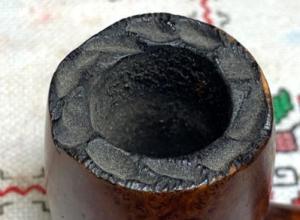
 The chamber has a very light cake build up and the sculpted, black rim needs cleaning and refreshing.
 The stem has visible oxidation, and the bit has been chewed a bit. Overall, this GBD is a beauty. The grain is stellar, and the sculpted rim is unique.
 To begin the restoration of this GBD, we start with cleaning the stem airway with a single pipe cleaner moistened with isopropyl 99% alcohol.
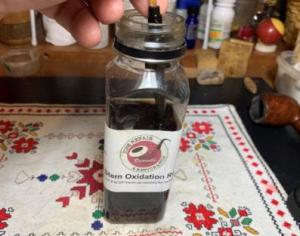
 Next, to address the oxidation, the stem is placed in a soak of Briarville’s Pipe Stem Oxidation Remover for several hours.
 Turning next to the stummel, the cake build-up in the chamber is minimal. A picture marks the starting point.
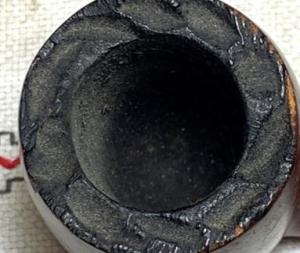 The bowl is first reamed using the Pipnet Reaming Kit using 3 of the 4 blade heads available.
 Following the reaming, the chamber walls are scraped with the Savinelli Fitsall Tool to fine tune the reaming.
 Finally, to remove any vestiges of carbon cake, the chamber is sanded with 220 grit paper wrapped around a dowel rod.
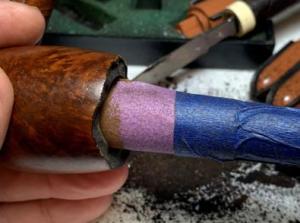 The full set of tools are used to clean the chamber, and the cake removed.With the chamber now clean, a quick inspection reveals healthy briar with no heating issues.
  With fresh briar now in the chamber, a new steward can start his own protective cake which should be maintained at about the width of a U.S. dime.
 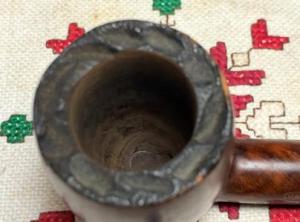 Next, the external briar is cleaned using undiluted Murphy Oil Soap and a cotton pad.
 A toothbrush is used to scrub the sculpted rim.
 After the stummel is thoroughly scrubbed, it is taken to the sink where the internals are cleaned using warm water along with anti-oil liquid dishwashing soap. Shank brushes do the job of scrubbing.
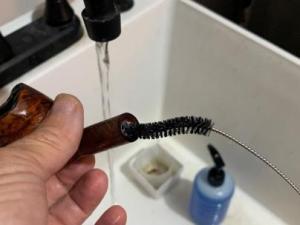 After a thorough rinsing, the stummel returns to the worktable.
 Man, I’ll take it! It doesn’t happen very often that a pipe is so clean. Only a few cotton buds and pipe cleaners moistened with isopropyl 99% are needed to do the job.
 Looking now at the briar surface, there are some minor nicks and scratches from normal wear. A few of these are shown.
 To clean up the surface sanding sponges are used. Only the medium, light and fine are used over the surface. The coarser sponges are not needed.
 Continuing the sanding and transitioning into polishing the briar, all nine micromesh pads are used to dry sand the stummel. After each individual pad, the stummel is wiped with a moist cotton cloth to clear away briar dust and to give the next pad more traction. First, pads 1500, 1800 and 2400.
 Next, pads 3200, 3600, and 4000.
 Finally, pads 6000, 80000, and 12000 finish the job. During the process there is a natural darkening of the wood as it is polished by the pads.
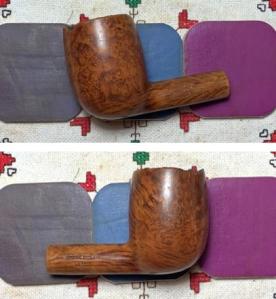 To bring out the natural hues of the briar, Mark Hoover’s ‘Before & After’ Restoration Balm is applied. Putting a small amount on the finger, the Balm is worked into the briar rigorously. The Balm starts out with a cream-like texture and then thickens as the Balm is worked. After thoroughly applied, the stummel is set aside for about 10 minutes to allow the Balm to do its thing.
 After the time has passed, a dedicated microfiber cloth is used to wipe off the excess Balm and to buff up the shine. Wow, the grain of this GBD INTERNATIONAL is exquisite.
 The stem has been soaking for several hours in Briarville’s Oxidation Remover. After it is fished out of the fluid, the stem is rubbed vigorously with a cotton cloth to remove the oxidation that was raised during the soak. To remove the fluid from the airway, a pipe cleaner moistened with isopropyl 99% cleaned the airway.
 Taking a fresh look at the bit, the sheen on the vulcanite allows us to see the tooth chatter on the bit. The upper side is better off than the lower. The lower side has chatter and 3 tooth compressions that need to be addressed. The heating method is used on the both sides to minimize the damage. The flame of a Bic lighter is used to paint the sides of the bit. I say, ‘paint’ because if one lingers too long in one place it is possible to ‘char’ the rubber. I’ve learned this the hard way. As the vulcanite rubber heats, the physics takes over and it expands, reaching its original orientation – or closer to it. The goal is to minimize the compressions so that only sanding is needed to erase the blemishes to avoid having to patch the area. The before and after pictures show the result. First the upper:
 Next, the lower bit:
 The good news it that I believe the compressions have been minimized enough so that only sanding is needed to erase the chatter and compressions. 220 grit paper is used on the bit to do this. While working on the bit, squared and flat needle files are also used to refresh the button lips – upper and lower.
 After the bit sanding and filing is completed, the entire stem is sanded with the finer, 320 grit paper to erase small scratches and nicks. A disk is used during the sanding to protect the shank facing from shouldering – upper and lower.
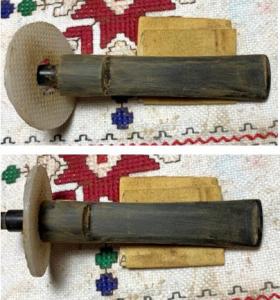 Next, the stem is wet sanded with 600 grit paper and then 0000 steel wool is applied.
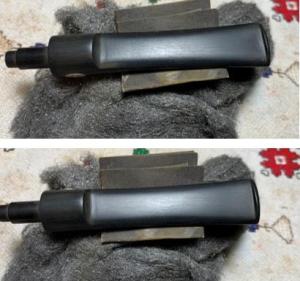 Next, micromesh pads transition from sanding to more of a polishing process with the very fine grit abrasion of each pad. I’ve been trying a new (to me) approach that I learned from Steve Laug at www.RebornPipes.com. My past practice was to wet sand with the first 3 pads and dry sand the following 2 sets of 3 pads and applying Obsidian Oil between each set of 3 pads. Steve’s method is to dry sand throughout the process and to apply Obsidian Oil to the stem after each pad. This is what I have done. Obsidian Oil helps condition the stem and to protect it from oxidation. First, pads 1500, 1800 and 2400 are used and this is followed by pads 3200, 3600, and 4000. Finally, pads 6000, 8000 and 12000. I enjoy watching the gloss emerge during the process.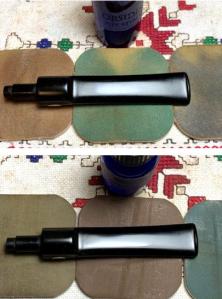
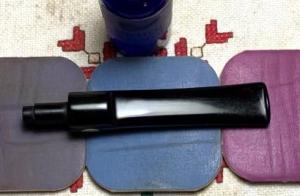 Next, the stem and stummel are reunited. The next mini project before the homestretch is touching up the sculpted rim. A black dye stick is used to do the job.
 I like the results.
 This is now the homestretch. A dedicated cotton cloth buffing wheel is mounted on the rotary tool and Blue Diamond compound is applied to the entire pipe.
 During the compound application, a bunch of dust is created that covers the pipe. A felt cloth wipes the dust away in preparation for the application of the wax.
 With another dedicated cotton cloth buffing wheel mounted, with speed at about 40% full power, carnauba wax is applied to the pipe. After the application, the pipe is given a rigorous hand buffing to remove excess wax and to raise the shine.
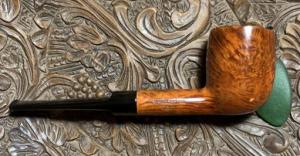
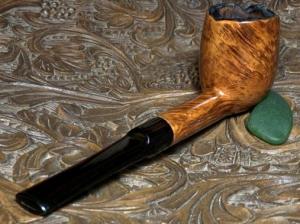
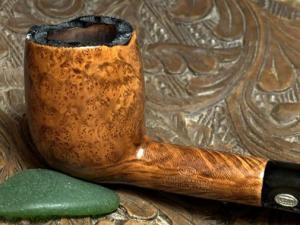
 This 1976 to 1981 GBD International London Made Billiard is a striking pipe. The grain is exceptional. It generally runs laterally, and the left side of the bowl is full of bird’s eye pattern. Also, what catches my eye is what I describe as ‘tiger grain’ running over and through the shank and cupping the heel of the pipe. Wow. This workhorse billiard came out nicely. The dimensions are Length 5 7/8 inches, Height: 1 7/8 inches, Rim width: 1 3/8 inches, Chamber width: 7/8 inches, Chamber depth: 1 11/16 inches. Doug commissioned this GBD and will have the first opportunity to claim him from the Pipe Steward Store. A portion of the proceeds of each pipe restored helps The Daughters of Bulgaria (now called, Spring of Hope), a work my wife and I co-founded in Bulgaria helping trafficked and sexually exploited women and girls. Thanks for joining me!






 The Pipe Steward
What’s super-cool about this pipe is it’s going to pair with another of the same exact model and bowl rim design but in a square shank! I’ve really grown fond of GBDs. Great little smokers and generally reasonably priced.
LikeLiked by 1 person
Doug, so you are Screwtape 316 :-).
LikeLiked by 1 person