
The next pipe on the worktable is a spiffy Peterson’s System Standard 314. I acquired him in February 2019 in what I have called the Lot of 68 which came from a seller in West Hartford, Connecticut. The Lot was listed as an Estate Auction and the seller provided a great deal of information. When the time ran out, my bid was sufficient to bring this Lot of 68 home to Sofia, Bulgaria, where we lived at the time. I was impressed by the quality of the collection, and it gradually made its way to the ‘For “Pipe Dreamers” ONLY!’ collection for pipe men and women to commission. A large amount of the proceeds of pipes restored help benefit the Daughters of Bulgaria, now called, Spring of Hope. My wife and I, along with other courageous people, founded this work in 2010/11 when we saw women and girls on the streets selling themselves. The ministry began organically simply seeking to reach out to these women and girls to build relationships and to show them a better path in life. The Pipe Steward was my way of not only seeking to raise funds through this beloved hobby, but also to raise awareness of the issues of human trafficking through the pipe community, a community primarily comprised of men. Here is a picture of the Lot of 68 that I saw online, and the Peterson marked between the two Meerschaums.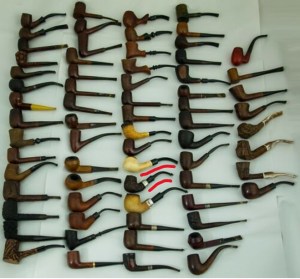 Gary heard the whisper of the Peterson and added him to his robust queue of commissions. Gary has commissioned many pipes benefiting the Daughters of Bulgaria and he live in Four Oaks, North Carolina. Like me, Gary is nearing retirement and looking forward to filling bowls and living life to its fullest.
As I was thinking about Gary’s commissions, I thought about the many pipe men that I have met, mostly virtually, who have commissioned pipes. I always ask commissioners to share something about themselves that I can add to the write up of their pipes which for me, adds to the story of the pipe as they pass on to a new steward. I found Gary’s first response to my question when he commissioned his first pipes in September 2021. I really enjoyed rereading his response and repeat it here:
You asked how did I hear about The Pipe Steward? I saw a post on Facebook in the Old Codgers Smoking Pipe of you and your friend Mel that looks like it was posted September 16. You and he were having a pipe together in Vladimirska Park in Kiev, Ukraine. You had a wee bit of Hobbit Weed in your bowl. In that post the link to The Pipe Steward was listed. I followed the link and spent about a hour clicking on this pipe then that pipe. I enjoyed looking at all the pipes you have listed. I have your page bookmarked and visit your page about once a week to see if there is something new. I can sit for hours just looking at pipes and looking at tobacco blends. I smoked a pipe when I was younger, when I was in my 20’s but then I put them aside until about March of last year when on a whim I ordered a pipe and some Captain Black Cherry tobacco. After that the bug bit me again and it has been quite the journey since. I have several briar pipes (several Grabows) and a good collection of corn cob pipes. I thought the corn cob pipe was a novelty but the more I smoked one and the more I read about them more I enjoyed them. I like collecting the Dr. Grabow’s because they were widely popular during the time I was growing up, which was the 60’s, and they are made right here in North Carolina. I am 63 years old. I do smoke one of them every now and then, but I just like having them in the rack on display. I do receive a little bit of grief from my wife about my pipe and tobacco collections but for the most part she tolerates it and lets me play on. I am still a full-time worker, and I work for one of the largest electric utility companies in the US. I have been with them now for 36 years. I hope to retire in about 4-5 more years and live the rest of my days here on our farm. You asked about my email address, that is just an old story about a father liking one team and the son liking that team’s biggest rival. I have been a Red Sox fan since I was eight or nine years old. The always friendly ribbing that my dad and I did about the Yankees and Red Sox was something that we enjoyed up to the time of his passing. I am very pleased that I will be getting some truly amazing looking pipes but also will be in a small way helping out the Daughters of Bulgaria. I look forward to hearing from you and again and looking at your  amazing talent of restoring pipes. Until then my friend be well and keep piping. Gary
Gary mentioned seeing a post I did when my wife and I were in Kyiv, Ukraine, in September of 2021. This was a preparatory trip to plan for our relocation to work again in Kyiv in February of 2022. Well, Russia’s bombs and missiles started that month, and our plans changed. Here is the picture Gary saw with my colleague and fellow pipe man, Mel, when we were enjoying a bowl in the park in Kyiv.
When Gary commissioned the Peterson, this was his only remark: I thought that this Peterson had something special going for it. Here are pictures of the Peterson that got his attention.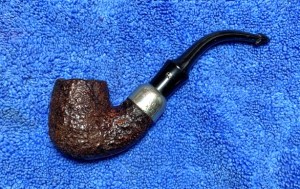

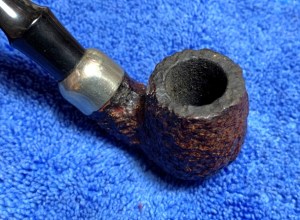


 The nomenclature is ‘squished’ on the smooth briar underside of the pipe. An arched, PETERSON’S [is stamped over] SYSTEM [over] STANDARD.
 To the right of this is stamped MADE IN THE [over] REPUBLIC [over] OF IRELAND. As a ‘Republic’ Peterson, this indicates that the pipe was produced after Ireland changed its status to a republic in 1950. This is the COM of Peterson pipes to the present. Above the COM is stamped the shape number, 314.
 The nickel shank cap or ferrule has the ‘Maker’s Mark’: K&P – and to the right of this, PETERSON’S K&P is Kapp & Peterson. The history of Peterson is expansive, and a brief, meat and potato accounting is provided by Pipephil (Peterson: historical pipes — Pipes: Logos & Markings):
The Peterson brand is issued from the association of the brothers Friedrich and Heinrich Kapp with Charles Peterson. The Dublin tobacco shop first named “Kapp Brothers” (1865) became the “Kapp & Peterson” Company.
To drill down further, Peterson’s own accounting, ‘About Kapp & Peterson – How The Story Begins’ is a good read with period pictures (Peterson Pipes and Accessories).
Mark Irwin’s article on dating the markings (Peterson nickel markings – Peterson Pipe Notes) describes the Makers Mark in more detail:
Pipe smokers new to Peterson sometimes wonder what the “K&P” stamp is all about, not realizing the company was known as “Kapp & Peterson” until the 1970s and is still referred to as “Kapps” by the old hands who work in the shop. Most Peterson pipes with metal mounts (and all nickel-mount Systems) have a “K & P” Maker’s Mark, also called a Sponsor’s Hallmark, which is used by The Company of Goldsmiths of Dublin (est. 1637) to identify the silversmith or goldsmith responsible for making the article. The “K & P” maker’s mark was registered at the assay office shortly after Kapp & Peterson’s incorporation and appears either in capital letters (on early sterling and later nickel mounts) or capital letters in shields (on sterling). The picture of our 314 also has stamped beneath the Marker’s Mark three ‘faux’ marks seen on Peterson metal mounts other than on sterling silver. Mark Irwin’s article continues focusing on ‘Nickel Mount Marks’:
Dealers and pipe smokers unfamiliar with Peterson often confuse the three nickel-mount markings of Shamrock, Wolf Hound and Round Tower with assay marks. They are instead multivalent symbols chosen by Charles Peterson and Alfred Kapp to represent Ireland. They’re so rich that I encourage you to search them out for yourself as I think you’ll be fascinated by what you discover.
The marks appeared on every single nickel mount ferrule and most nickel mount bands from 1891 to 1963, when they disappeared–the three marks, not nickel bands (which were, by the way, actually brass-plated nickel plate until the advent of alloy base metal under nickel plate in the last 40 years or so). The three stamps resurfaced on the copper-plated 2019 and 2020 Christmas pipe mounts but have not made their way to general production. I hope at some point that Peterson will be able to return to this important historical practice.
According to this information, the marks were discontinued generally in 1963 which places brackets for dating from 1950 to 1963 for the Peterson on the worktable. The vulcanite P-lip has the classic ‘P’ stem logo.
 The Peterson System Pipe was considered a technological marvel when Charles Peterson applied for a patent in 1890. Here is a brief accounting of this from Pipedia (Peterson – Pipedia):
Charles Peterson applied for a patent for an improved tobacco pipe on the 8th of August 1890. He was awarded patent number 12393 on the 16th of June 1891 for Great Britain and Ireland. This came to be known as the famous ‘System Pipe’ patent. The French patent, No. 210944 was issued to them on January 1891. The USA issued patent No. 519,135 on May 1st, 1894.
In later years they went on to be successful in being awarded additional patents associated with their innovative pipes and pipe stems, including the famous P-lip patent in 1898.
1895 Kapp & Peterson moved to bigger premises at 111 Grafton Street Dublin and also opened a new depot in Broad Street London. 1900 K & P exhibited with great success at the Paris International exhibition, winning several gold medals and accolades for the quality of their pipes. Fredrick Henry Kapp, son of Alfred and known as Harry, joined his father’s business in 1914 at the outbreak of the First World War.
The design of the ‘system’ seems simple enough to us but in that day, it was an innovation that propelled Peterson pipes into international recognition. This period ad is from Peterson Pipe Notes (146. A Guide to System Shapes, 1896 – 2019, Part 1 (The 300 Shape Group) – Peterson Pipe Notes) that I found when I was digging more into the shape 314. The genius of the ‘system’ is shown in the cut out. The reservoir is drilled to collect moisture, and the airway drilling is placed above and next to the tenon in the mortise so that it draws clearly and dryly. The P-lip patent also contributes to the overall functionality of the system with its tapered fit in the mortise, its bend and button, or Peterson Lip. The ad makes these promises, “Smokes Dry, Smokes Cool, Smokes Sweet” which seems to be answered by the System Pipe if one were to measure the popularity of these pipes over the years. In the same article (146. A Guide to System Shapes, 1896 – 2019, Part 1 (The 300 Shape Group) – Peterson Pipe Notes), Mark Irwin provides an excellent summation of what a System Pipe is:
Insofar as the P-Lip System is concerned, the book contains detailed analyses on what makes a Peterson a System pipe (it must have a P-Lip graduated bore mouthpiece and a reservoir in the stummel)….
When I first looked at this Peterson’s System Standard and held it in my hand, it struck me as superbly small and with the P-lip, a perfect hands-free option. This ad comes from a 1955 Tri-Fold Brochure included in Mark Irwin’s essay on shapes. The 314 is described in the upper left as a ‘(Full-Bent), Medium size, Billiard shape.’ Later, Mark describes the 314 specifically and gives an example of a 314 smooth briar:
The 314 is an original Patent System shape, pictured in the 1896 catalog as shape 20, next-to-smallest of eight “round or ball-shaped bowls.” It is not seen as a System pipe in the 1937 catalog, in favor of its Classic Range counterpart, the 221. Its first appearance in the De Luxe System, as shape 20S, is seen in the 1945 catalog. It was also included in the Dunmore System line in the late 1970s as the 74. There is so much information about Peterson pipes in Mark Irwin’s Peterson Pipe Notes that it’s hard to distill the information! I would recommend one additional article Mark wrote (357. The 125th Anniversary of the System Pipe & A History of Shape 12.5 (“Good Things Come in Small Packages”) – Peterson Pipe Notes) that drills down into the history of the patent origins which not only includes an interesting accounting of the lives of the people involved in the beginning of the Peterson story, but also looks more closely at the 314 which finds it genesis in the early patent era of Peterson.
One more ‘must’ read – I have read that when one is a novice Peterson System pipe smoker, one can often apply ‘regular’ pipe smoking principles to the Peterson and be disappointed with the experience. Mark Irwin provides a guide to how to smoke a Peterson System: 358. The Thinking Man’s Guide to Smoking the System Pipe – Peterson Pipe Notes. I enjoyed reading this essay and learned a lot. 😊
With a better understanding and appreciation of the Peterson’s System Standard 314 on the worktable, it’s time to take a closer look at the pipe itself. The rusticated finish is nice but needs to be cleaned. The chamber has some cake, but not too much. It will be cleared to allow the new steward to develop a fresh protective cake.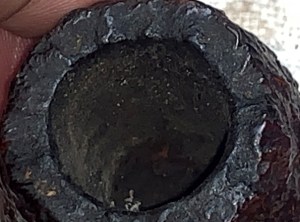 The nickel ferrule needs to be shined to restore its bling.
 The P-lip mouthpiece is in good condition overall. I detect no oxidation, but I still will give it a soak to raise oxidation I cannot see. The bit has tooth chatter, but overall, in good shape.
 To begin, the P-lip stem is cleaned using pipe cleaners moistened with isopropyl 99% alcohol.
 After breaking open a new bottle of Briarville’s Pipe Stem Oxidation Remover, the P-lip is soaked for several hours.
 Next, turning to the stummel, the cake is not thick, but will be cleaned to allow fresh briar to surface and to allow the new steward to form a new cake. Another reason to ream the carbon cake is to inspect the chamber wall to make sure there are no heating issues.
 The chamber diameter is small and only the smallest Pipnet blade head is used to ream the chamber.
 The Savinelli Fitsall Tool is used next to scrape the chamber wall and to get down in the angles of the floor.
 Finally, the chamber is sanded with 220 paper wrapped around a dowel rod to remove the last vestiges of cake.
 The full arsenal is shown with the carbon cake that was removed.
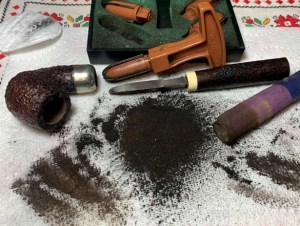 An inspection of the chamber reveals healthy briar.
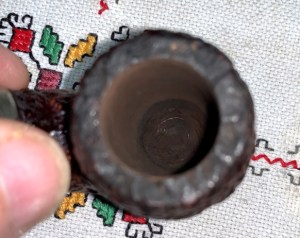 Next, the external rusticated briar is cleaned using undiluted Murphy Oil Soap. A few pictures show the grime on the rim and the stummel.
 A cotton pad is first used to scrub the surface.
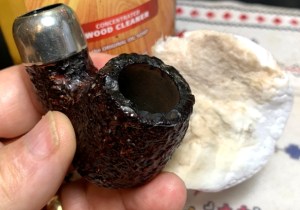 This is followed by a toothbrush which gets into the rough surface well.
 A soft brass brush is also used to break up and clean away the lava crust on the rim. A brass brush adds some cleaning muscle without damaging the briar.
 The stummel is next taken to the utility sink where the internals are scrubbed using an anti-oil liquid dishwashing soap. Dawn is my soap of choice. The shank brushes and warm water scrubs the mortise down into the reservoir and the airway.
 After the scrubbing the stummel is given a thorough rinsing and brought back to the worktable.
 The internal cleaning continues with pipe cleaners and cotton buds moistened with isopropyl 99% alcohol. I get isopropyl 99% on Amazon and the reason for the high percentage is that it evaporates more thoroughly leaving behind no taste ghosting in. A small dental spoon is also used to scrape the mortise walls and to reach down into the reservoir to remove tars and oils.
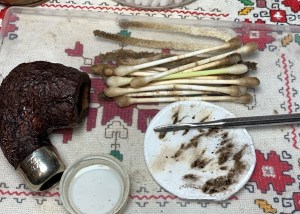 The stummel cleaned up well but I noticed light spots on both sides of the shank and the smooth briar nomenclature panel which I don’t like.
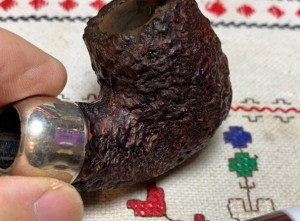
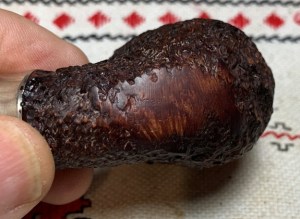 A mahogany dye stick is chosen to blend in the light areas. I start by testing a small section to see if the blending is good. The mahogany did the job and it looks better.

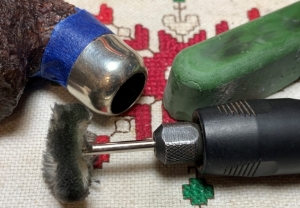
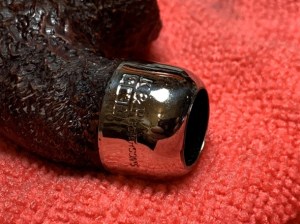
 Next, the nickel ferrule needs to be blinged up by polishing it with green compound. The picture below shows the dullness of the nickel surface. A cotton cloth buffing wheel is mounted on the rotary tool to do the job. As you can see, the wheel is black. It is dedicated to use only with applying compound to metals. This process creates a black residue that can stain the briar if not careful. This is why the shank is protected with painters tape before polishing.
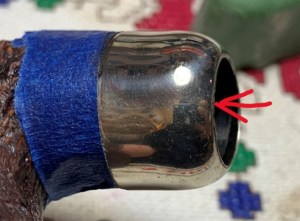
 I’m amazed at how the nickel-plated surface responds to the green compound. The picture below tries to show the border between the polished and unpolished metal. The naked eye sees it more clearly than I’m able to reproduce in the photo. The arrow shows the border – above the arrow is polished and below is not.
 After the compound is applied the ferrule is given a hand buffing with a microfiber cloth. Now that’s a ‘re-blinged’ nickel ferrule and probably more polished than the factory provided.
 Now its time for the magic to happen applying Mark Hoover’s ‘Before & After’ Restoration Balm (www.Lbepen.com). It does a great job conditioning the briar and bringing out the natural deep hues. With some Balm on the fingers, the Balm is worked into the rusticated surface thoroughly and then set aside for about 10 minutes for the Balm to be absorbed.
 After the time has passed, a dedicated microfiber cloth is used to wipe off the excess Balm and to buff up the briar. I like it.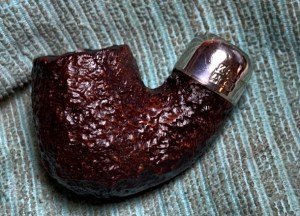
 The stem has been in a soak of Briarville’s Pipe Stem Oxidation Remover for several hours. When it’s fished out it is aggressively rubbed and buffed with a cotton cloth to remove the raise oxidation. I like the results. A pipe cleaner moistened with isopropyl 99% is also used to clear the airway of Oxidation Remover liquid.
 The button is in good shape with only minor tooth damage. On the upper side is a bite compression and the lower side is general tooth chatter next to the P-lip lip. The P-lip button also has scratches.
 The bit, upper and lower, is sanded with 220 grit paper to remove the damage.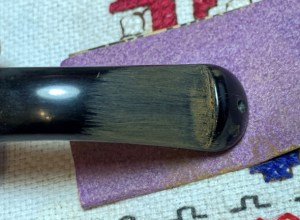
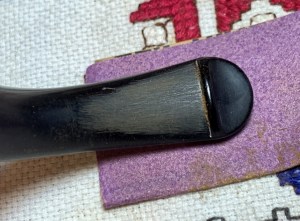 The sloped base of the stem has a ridge that circles it from the pressure of seating it into the mortise. This is sanded with 220 paper while guarding the Peterson ‘P’ stem logo.
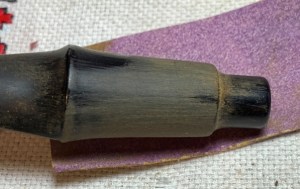 The sanding is next expanded to the whole stem using finer 320 grit paper.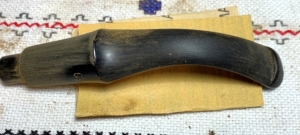
 The 320 grit paper is followed by wet sanding with 600 grit then applying 0000 steel wool.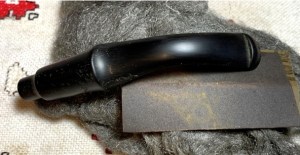
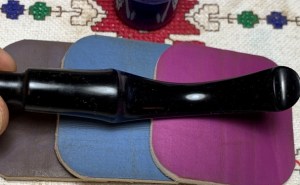
 The full set of 9 micromesh pads are applied next. Between each pad, Obsidian Oil is applied to condition the stem and protect it from oxidation and to give the next pad more traction. First, pads 1500, 1800 and 2400 are used.
 Next, pads 3200, 3600 and 4000 are used.
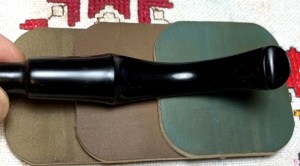 Finally, pads 6000, 8000, and 12000 are used. I love the way the gloss of the vulcanite P-lip emerges. It has a nice pop now.
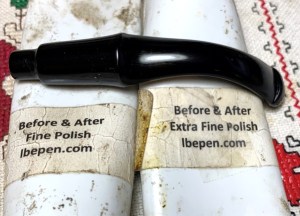
 To further condition the stem, Mark Hoover’s ‘Before & After’ Fine and Extra Fine Polishes are used. Starting first with the Fine Polish, some is placed on the finger and then worked into the vulcanite surface. The polish sits for a few minutes then is wiped off with a paper towel.
 Next, the Extra Fine Polish is applied in the same way and then wiped off after a few minutes with a paper towel. The stem looks great.
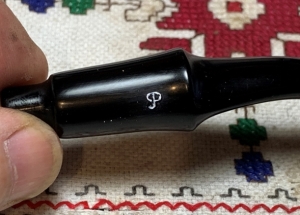
 The Peterson ‘P’ stem logo needs refreshing. It doesn’t happen often in restoring pipes and refreshing the original logos that the logo imprint is as deep and distinctive as this Peterson’s is.
 White acrylic paint is placed over the logo first.
 The wet paint is then daubed with a cotton pad to remove the excess and dry the paint quickly.
 A toothpick is then used to clean the excess paint by taking the side of the toothpick and running it over the surface of the logo. The sharp tip of the toothpick is used to clean the logo more closely leaving a nicely refreshed logo.
 Blue Diamond compound is applied only to the vulcanite stem. Applying compound to the rough rusticated surface would be almost impossible to clean of compound dust. After a dedicated cotton cloth buffing wheel is mounted on the rotary tool with the speed at about 40% full power, the compound is applied.
 A lot of compound dust is created during the application and in preparation of applying wax, a felt cloth is used to wipe the stem.
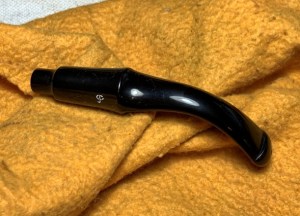 With another dedicated buffing wheel mounted on the rotary tool set to the same speed, carnauba wax is applied to the stem and stummel – minus the nickel ferrule. After wax has been applied, the pipe is given a rigorous hand buffing to remove excess wax and to raise the shine.
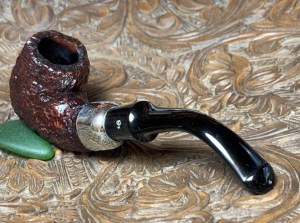
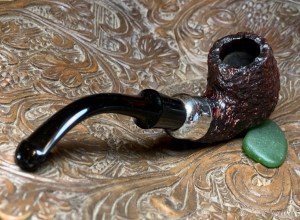
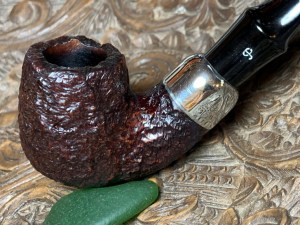
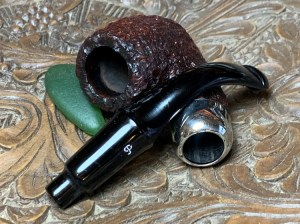
 I enjoyed revisiting the information about the Peterson System pipe and this Peterson’s System Standard 314 is a nice example with a dating between 1950 and 1963. The 314 is on the smaller side and as I mentioned earlier, this size makes it possible to smoke this Peterson hands-free. The rustication is stellar, and the nickel ferrule gives this pipe a touch of class transitioning to the P-lip. The dimensions are Length: 5.11 inches, Height: 1.71 inches, Rim width: 1.42 inches, Chamber width: .71 inches, Chamber depth: 1.52 inches. Gary commissioned this Peterson’s System Standard 314 and will have the first opportunity to acquire him from the Pipe Store. A large percentage of the proceeds of all restorations benefit the Daughters of Bulgaria, now called Spring of Hope – helping women and girls who have been trafficked and sexually exploited. Thanks for joining me!





 The Pipe Steward