
The next pipe on the worktable came to me in February 2019 in what I call the Lot of 68 from a seller in West Hartford, Connecticut. This lot has produced a trove of treasures for the For “Pipe Dreamers” ONLY! online collection where pipemen and women commission pipes that whisper their names. The Rusticated Volcano now on the table is the last of 3 that came from the same Italian unbranded collection which are marked in the photo from the West Hartford seller. The other two have found homes with new stewards and pipeman Gary from Four Oaks, North Carolina, has commissioned the third. Gary’s Volcano is between the other two.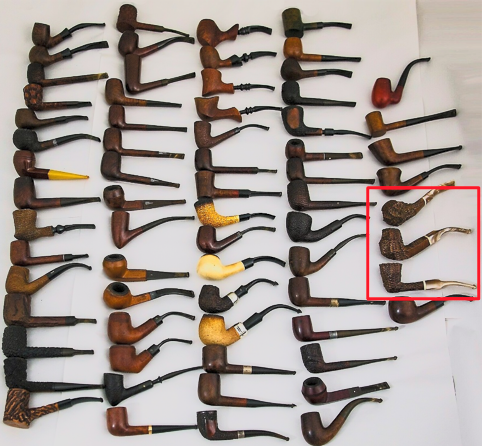 Gary has commissioned many pipes since he first communicated with me in September 2021 when he saw a FB post of me enjoying a bowl with my good friend and colleague, Mel. I was in Kyiv, Ukraine, where my wife and I, with our family of 5 children, lived in the 1990s and early 2000s. When the picture was taken in the park in Kyiv, we had no idea what was to happen in a few short months. My wife and I were to return to Kyiv to live and to help with the churches in Kyiv the following February – the month that the full scale invasion commenced. We continue to pray for the people of Ukraine and for a soon and just end to this war.
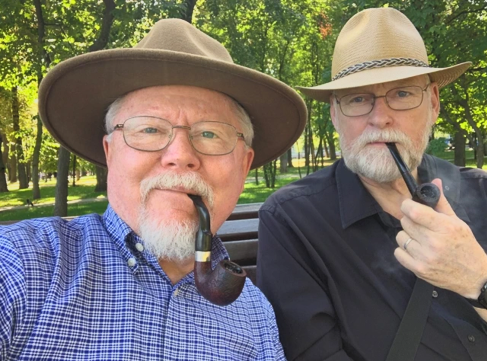 Yes, others have told me that my hat was slightly cattywampus…. What I appreciate about the many pipes that I have restored for Gary is that he understands that a portion of the proceeds go to help the Daughters of Bulgaria (now, called Spring of Hope) a work that seeks to help trafficked and sexually exploited women and girls. Here is the Unbranded Rusticated Volcano next in Gary’s queue.
 The only marking on the pipe is the COM, stamped on the underside smooth briar panel: ITALY.
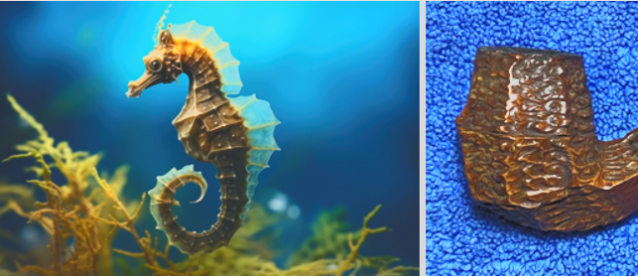
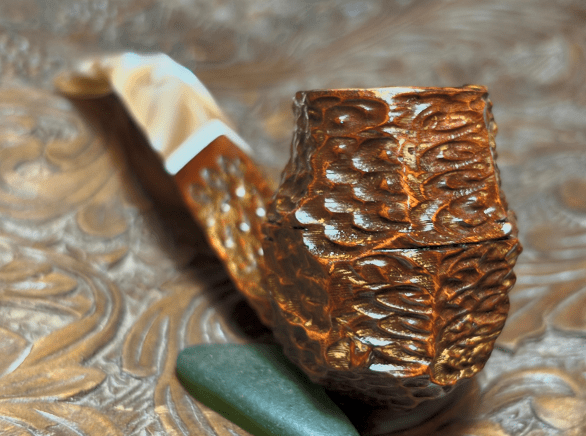
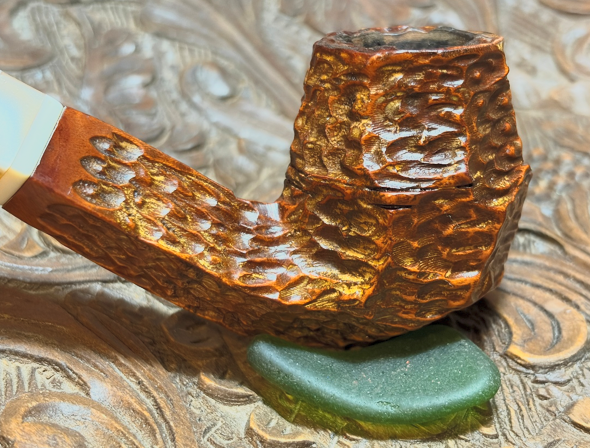
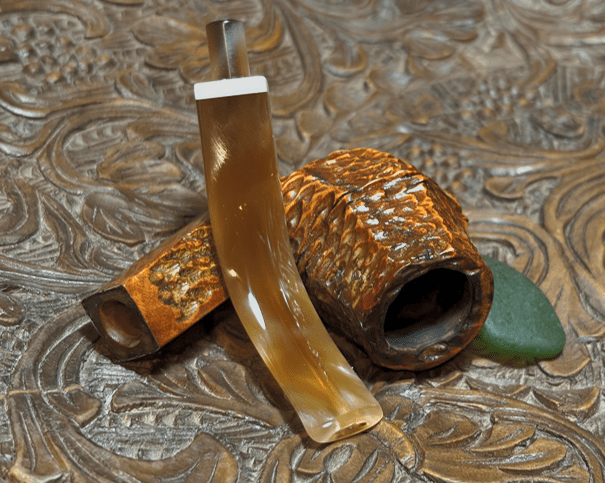
 What is attractive about this pipe and his 2 other brothers is the strong rustication that reminded me of a seahorse when I first saw the 3 pipes. Not only is the pipe attractive for the eyes, but it also provides a nice tactile experience for the steward.
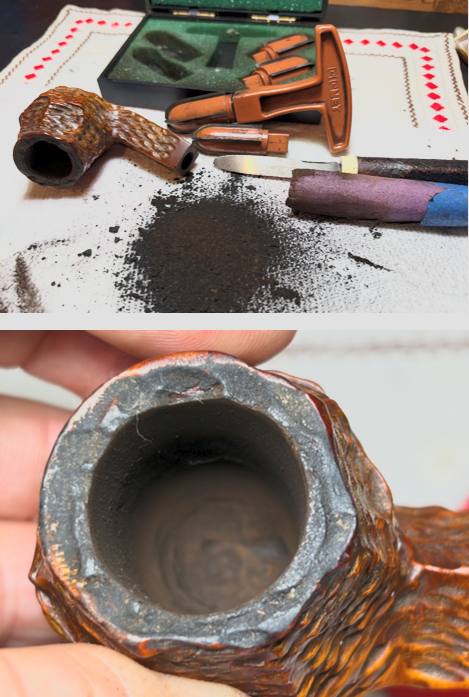
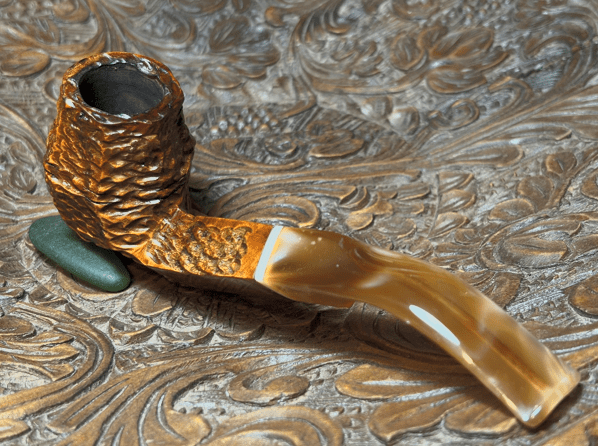
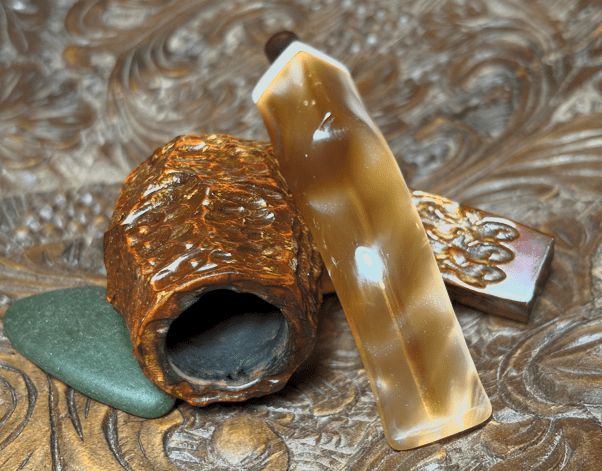
 The acrylic stem also adds a nice contrast to the rough rustication with the slender white acrylic stem extension dividing the acrylic stem and stummel. Looking at the pipe itself, it is in solid condition with a need for basic cleaning. The chamber has a moderate build up of carbon cake. This will be removed to allow fresh briar to form a new protective cake and to inspect the condition of the chamber wall.
 The rusticated rim is covered with a crust of lava flow which needs cleaning.
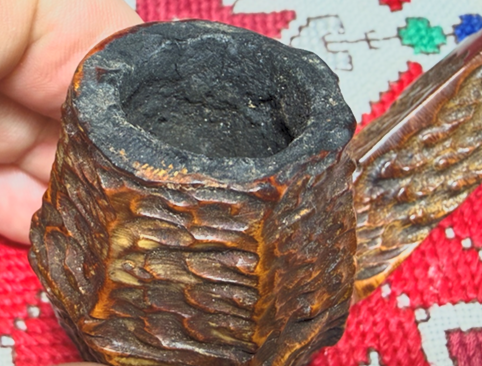 The rusticated stummel needs cleaning and conditioning. The lighter flecks of briar appear to be where the finish has worn. The good news is that the rustic multi-hued expression of the rusticated briar doesn’t care. It all blends in nicely.
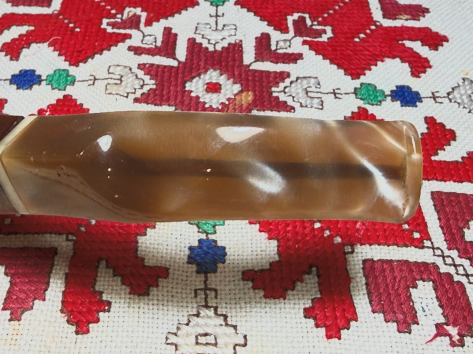
 The brown marbled hues of the acrylic stem are attractive. The saddle has some pits that need sanding out.
 The upper bit has minor tooth chatter, but the lower bit has more.
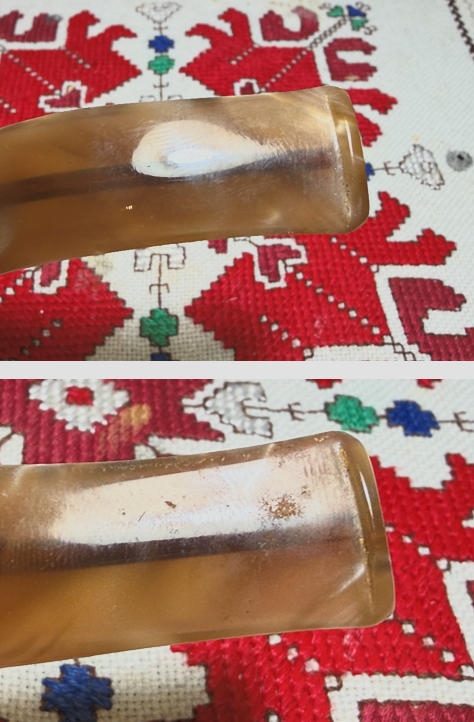 The airway has stain from the oils, and we’ll do our best to clean this.
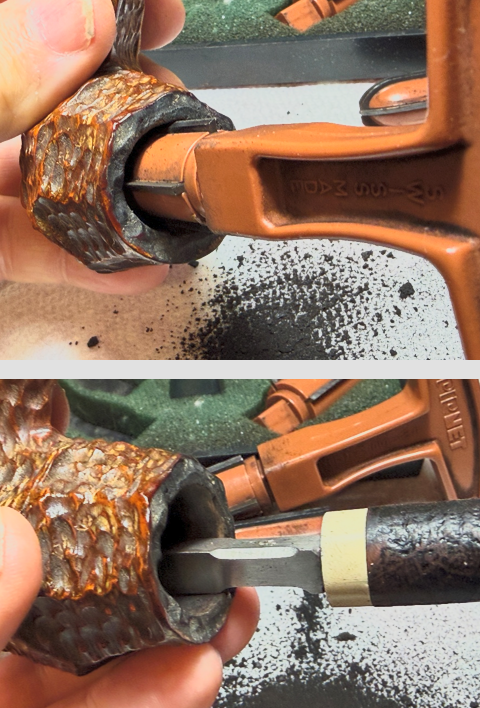
 To begin, the chamber is reamed to clear away the carbon cake. Using the Pipnet Reaming Kit, 2 of the 4 available blades are used to ream the chamber. This is followed by scraping the chamber wall with the Savinelli Fitsall Tool which does great reaching down to the chamber floor to clean.
 The cleaning is finished up by sanding the chamber using 220 paper wrapped around the dowel rod.
 The tools used to clear the chamber and the pile left behind are shown. After an inspection of the chamber there are no heating problems found – all is healthy and ready to go again.
 The cleaning continues with the external rusticated surface. Undiluted Murphy Oil Soap is used. A bristled toothbrush is used to clean the rough surface and a brass brush to scrub the rim. The brass brush adds a bit of torque to the cleaning without being too invasive with the briar.
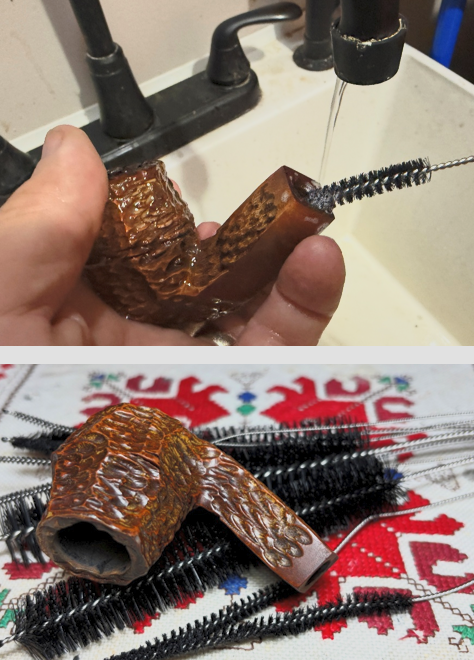
 Next, the stummel is taken to the sink and using warm water, the internals are scrubbed using shank brushes and anti-oil liquid dishwashing soap. Dawn is my choice of soaps. After the scrubbing, the stummel is rinsed thoroughly and then taken back to the worktable.
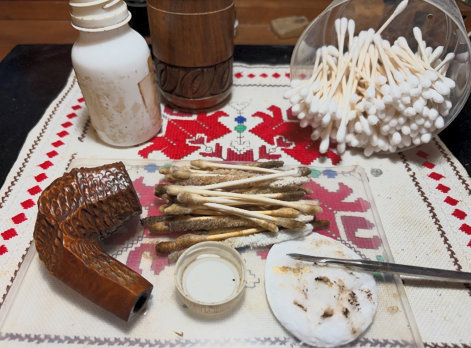
 The cleaning of the internals continues. Pipe cleaners and cotton buds are moistened with isopropyl 99% to do the heavy lifting. A small amount of crud is scraped out of the mortise using a small dental spoon. After a time, the buds and cleaners started to emerge lighter, and I put a halt to this phase.
 The cleaning continues next by giving the internals a salt and alcohol soak using isopropyl 99%. This is a more passive way of cleaning which helps to refresh the internals and remove any ghosting from tobaccos past. First, a cotton ball is pulled and twisted to form a wick that helps to draw tars and oils out of the internal briar.
 With the help of a stiff wire the wick is then guided through the mortise, airway and out the draft hole at the floor of the chamber.
 The chamber is then filled with kosher salt. Kosher salt is used rather than regular iodized table salt because it does not leave an aftertaste. After settling the stummel in the egg carton to stabilize it and to orient the angle so that the rim and shank facing are level, isopropyl 99% alcohol is used to fill the chamber with the large eyedropper. When the alcohol surfaces over the salt, that tells me to stop filling the chamber.
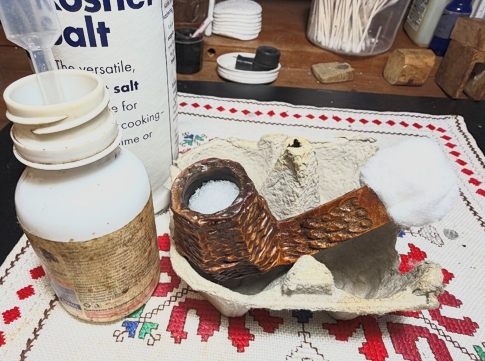 After about 10 minutes or so, the alcohol has been absorbed into the salt and cotton wick and is topped off once more. The stummel is then set aside to soak for several hours.
 Turning back to the acrylic stem, I’m hoping to put a dent in the stained airway. This is always the bane of transparent acrylic stems – the airway stains. The cleaning starts first with pipe cleaners – bristled and smooth – moistened with isopropyl 99%.
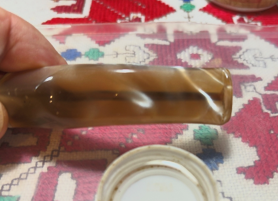 Not long after, the alcohol is exchanged for using Soft Scrub which has a bleach base. The scrubbing continues with Soft Scrub and pipe cleaners.
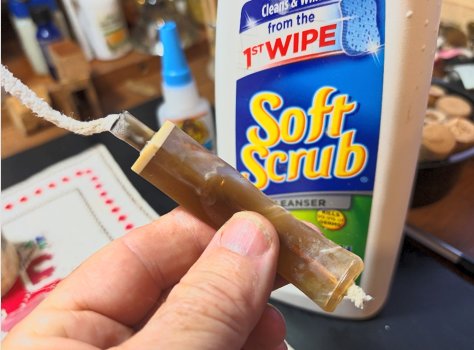 The hour is getting late, and my wife and I are transitioning to watching a Hallmark Christmas movie – yep, we know how its going to end! I decide to use the Soft Scrub to soak the airway through the night. It took a little effort to slowly fill the airway with Soft Scrub while holding my finger at the button to keep it from leaking out.
 After filling the airway, the airway is corked with a pipe cleaner, and the stem is placed so that the bend is down allowing the fluid to pool in the airway. The lights go out and on to the movie!
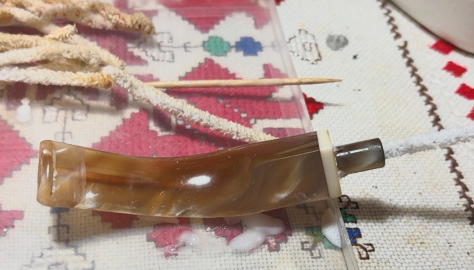 The next morning, more bristled and smooth pipe cleaners are employed using isopropyl 99% alcohol.
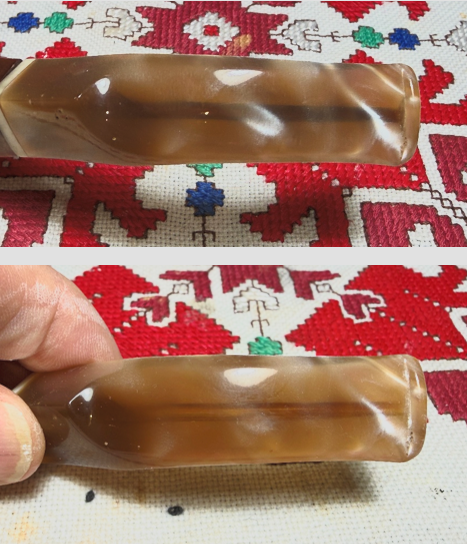
 The pictures below show the before and after pictures. The stain is still there but much improved from the starting point. I call this a win.
 The stummel also soaked through the night with kosher salt and isopropyl 99% alcohol. The salt and wick show signs of soiling from drawing the oils from the internal briar.
 To make sure the internals are clean, pipe cleaners and cotton buds moistened with isopropyl 99% alcohol discover that there remains some crud in the airway. I’m able to determine that the dirty area is at the bottom of the airway. Finally, buds start emerging lighter and time to move on.
 To condition the rusticated surface, Mark Hoover’s ‘Before & After’ Restoration Balm (www.Lbpen.com) does a great job conditioning the briar and bringing out the natural hues. After some Balm is placed on the fingers it’s worked into the rusticated surface. I make sure to work the Balm into the nooks and crannies. The stummel is then set aside for about 15 or so minutes allowing the Balm to be absorbed.
 After the time has passed, a dedicated microfiber cloth is used to wipe away the excess Balm and to buff up the shine. Not bad.
 Turning again to the stem, there are some blemishes on the acrylic surface. The cleaning erased much of what I saw earlier as tooth chatter. The upper and lower bit look good and simple light sanding is all that will be needed.
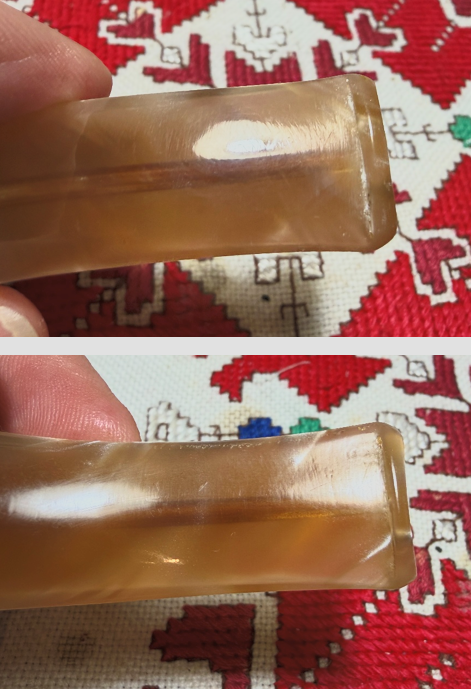 The saddle is a different story. There are pits on the surface and below the acrylic surface. What these appear to be are air bubbles in the acrylic that came from the factory.
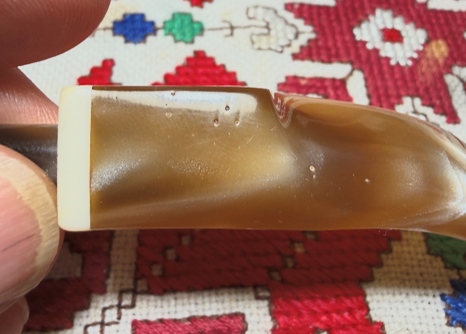 I first tried sanding off the two larger pits that were above the surface using 220 grit paper. They weren’t going away easily. I decided to fill the pits with CA glue. The sharp dental probe is used to first clean out the pits before applying the patch.
 After the surface was cleaned with alcohol, a small drop of clear CA glue covers both pits.
 After the patch was fully cured, the patch mound was filed down with a needle file bringing the patch flush with the acrylic surface.
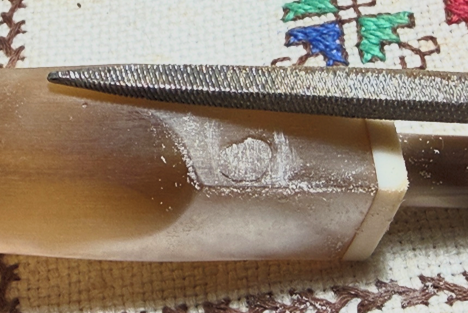 Next, the saddle is sanded with 220 grit paper.
 Following the 220 grit paper, 320 grit paper is applied to the entire stem.
 Next, the stem is taken to the sink and wet sanded with 600 grit paper. This is followed by applying 0000 grade steel wool. The saddle still reveals bubbles beneath the surface of the acrylic – not much to do about this but press forward.
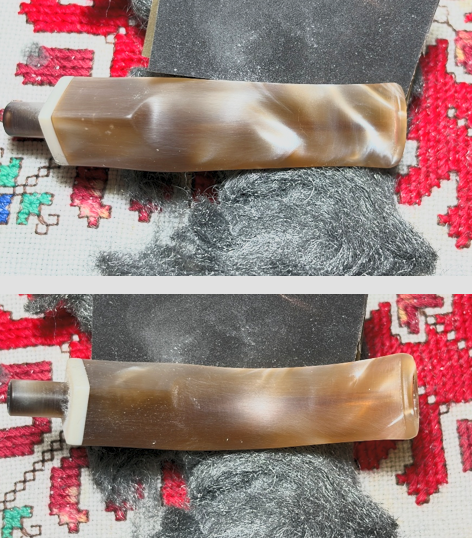 Following the general sanding, the full set of 9 micromesh pads are used. To condition the stem, between each pad Obsidian Oil is applied to the stem. First, grades 1500, 1800 and 2400 are used.
 Next, grades 3200, 3600 and 4000 are used.
 Finally, grades 6000, 8000 and 12000 are used.
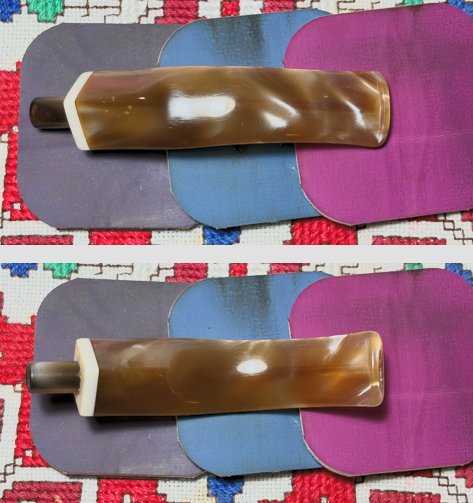 On the home stretch. A dedicated cotton cloth buffing wheel is mounted with the speed at about 40% full power. Blue Diamond is applied to the smooth COM briar panel and to the stem.
 A felt cloth is used to wipe off the compound dust in preparation for application of the wax.
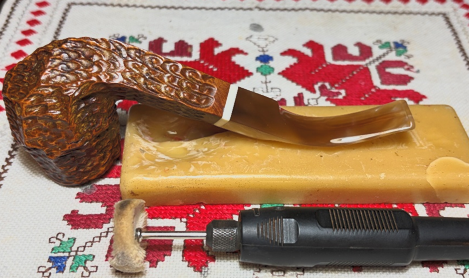
 With another dedicated wheel mounted at the same speed, carnauba wax is applied to the entire pipe. The Seahorse rustication also receives wax but a light application. After applying the wax, the pipe is given a rigorous hand buffing with a microfiber cloth to remove excess wax and to raise the shine.
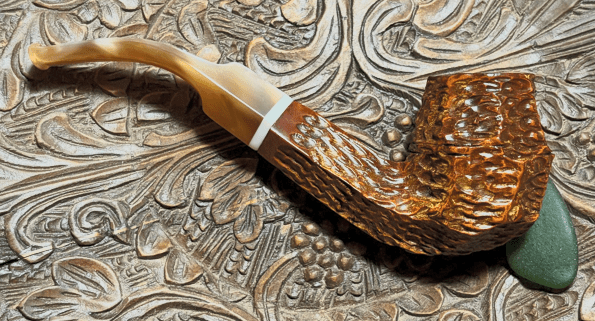
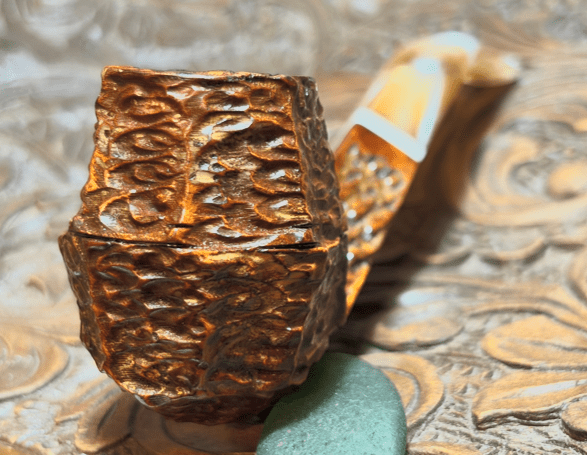
 This Italian made Seahorse Rusticated Volcano gives off a rustic vibe. The Volcano is a unique shape and shows off well the Seahorse rustication. The panels of rusticated briar provide not only a tactile experience but also a nice visual. The marbled acrylic stem matches well the briar. The dimensions are Length: 6 inches, Height: 2 inches, Rim width: 1 1/8 inches, Chamber width: 3/4 inches, Chamber depth: 1 3/4 inches. Gary commissioned this pipe and will have the first opportunity to claim him from the Pipe Store. A portion of all the proceeds go to help support the Daughters of Bulgaria (now called, Spring of Hope) – helping trafficked and sexually exploited women and girls. Thanks for joining me!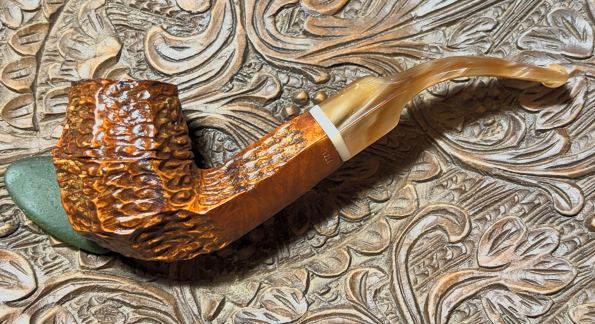



 The Pipe Steward