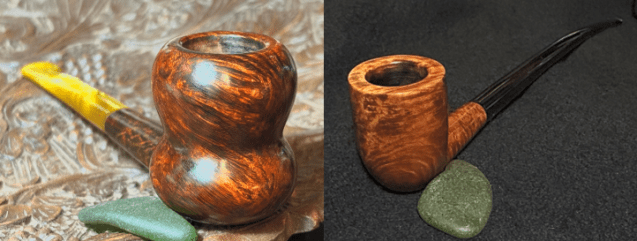
The next pipe on the worktable came to me as a donation from a pipeman in the Kansas City area. I appreciate that his hope was that the pipes he sent would help to benefit the Daughters of Bulgaria, now called Spring of Hope. One day in our travels, I hope to take him up on the invite to drop by and share a bowl. Perhaps one of our discussions will dance around his undying devotion to the Kansas City Chiefs and mine to the Miami Dolphins! We’ll see. Here are the beautiful pipes that he sent that were placed in the For “Pipe Dreamers” ONLY! online collection and some have already made it to their new stewards. The Comoy’s Golden Grain that is now on the worktable is on the bottom row next to the end.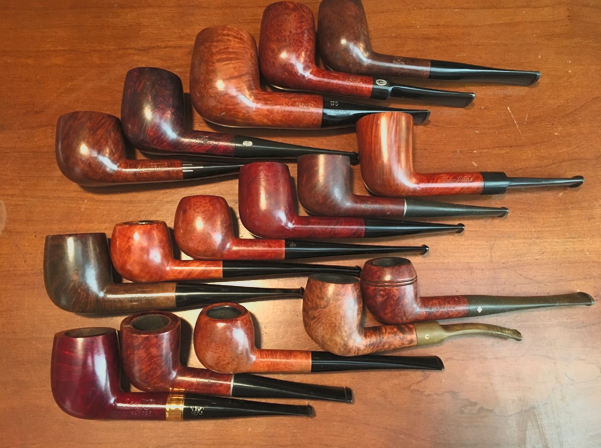 The Comoy’s Golden Grain whispered to pipeman Doug along with 2 other pipes that have already been restored and claimed by Doug. A whimsical Lorenzo Matera Studio and HLT “Rest-Rite” Churchwarden came out very nicely.
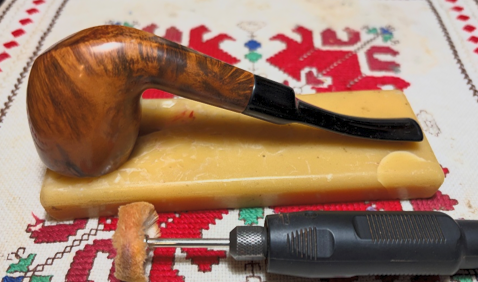
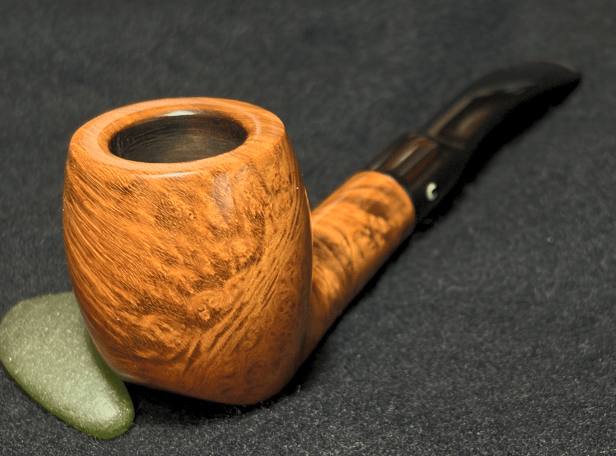
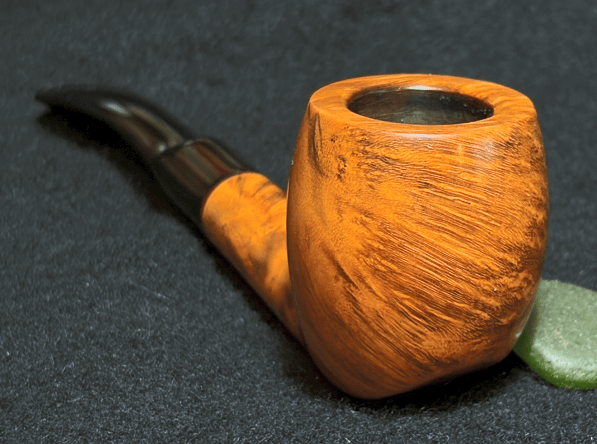
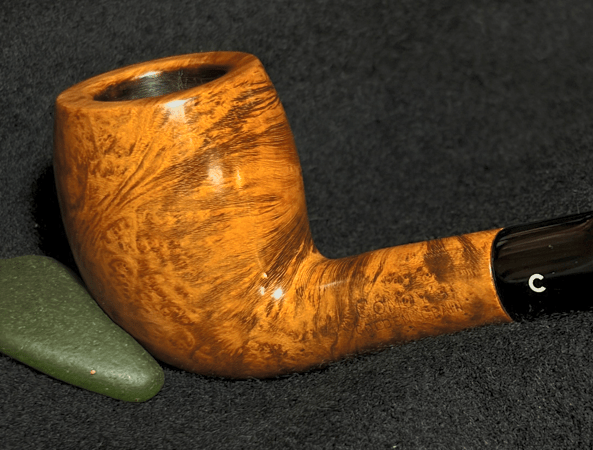
 The Comoy’s has striking grain and is unique with a curved heel to sit. Here are the pictures.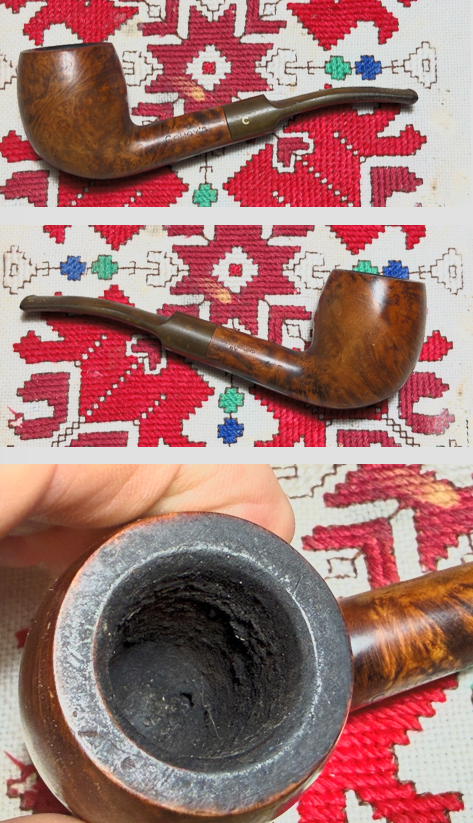
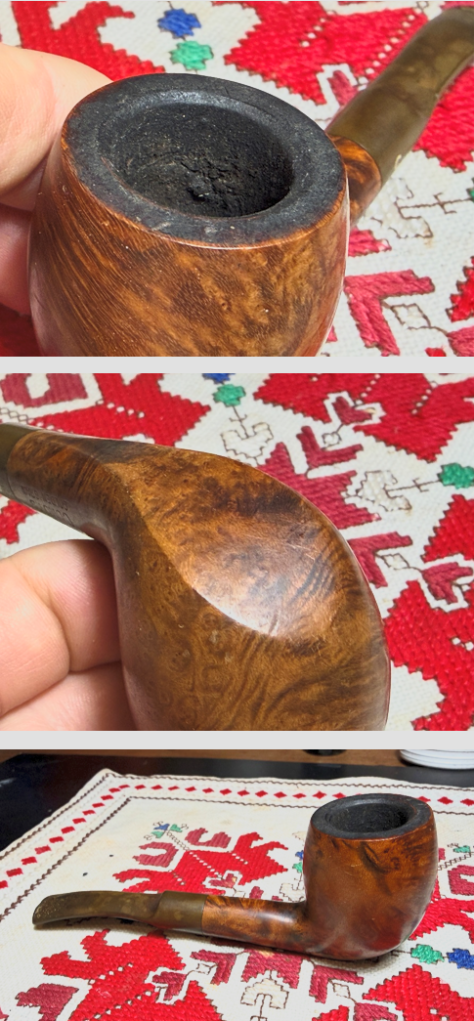
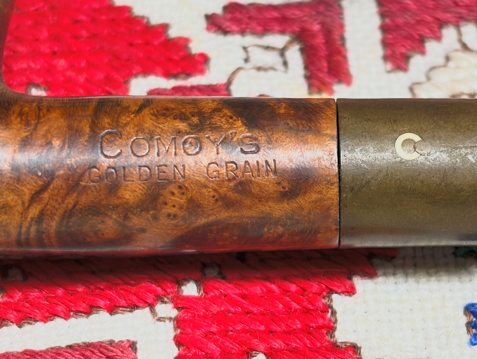
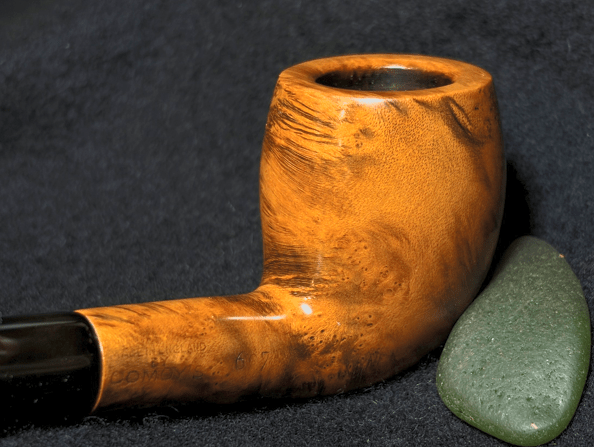
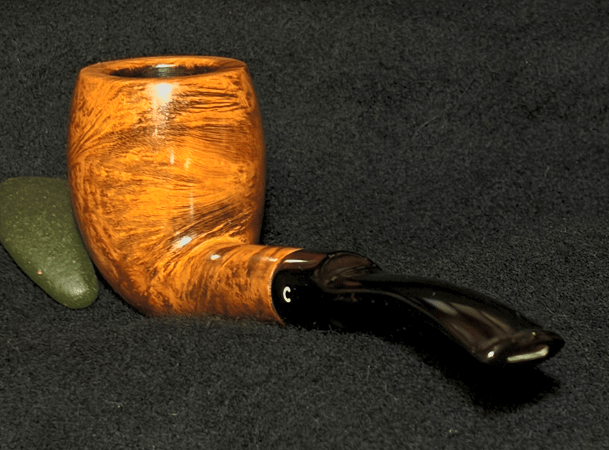
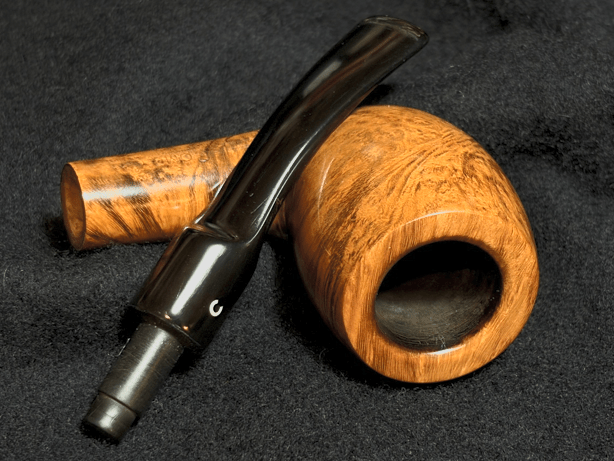
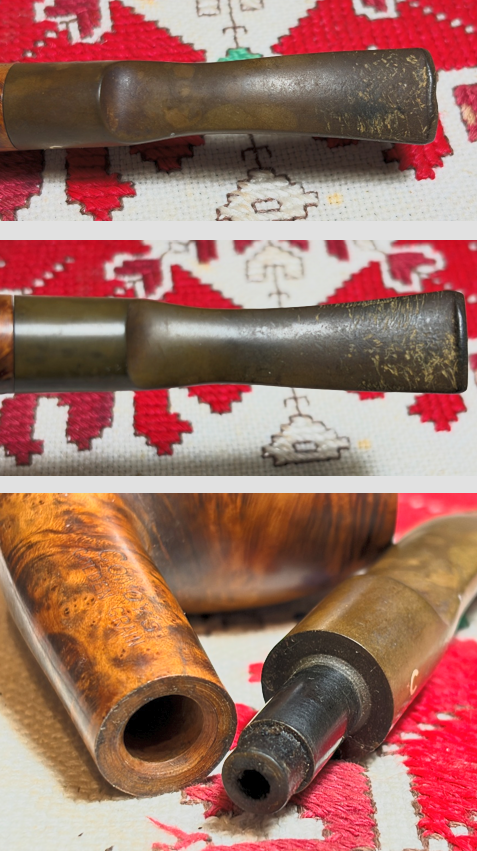 The nomenclature is stamped on both sides of the shank. On the left side is stamped, COMOY’S [over] GOLDEN GRAIN. The stem has the classic Comoy’s inlaid drilled ‘C’ logo.
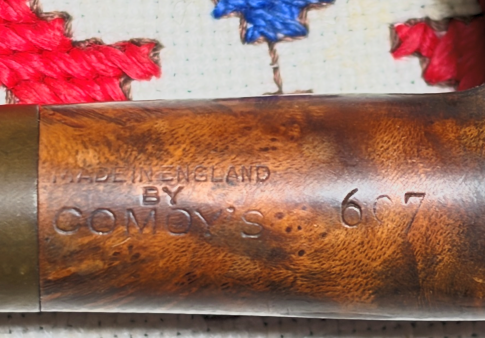
 The right side of the shank is stamped, MADE IN ENGLAND [over] BY [over] COMOY’S. To the left of this is stamped the shape number: 607.
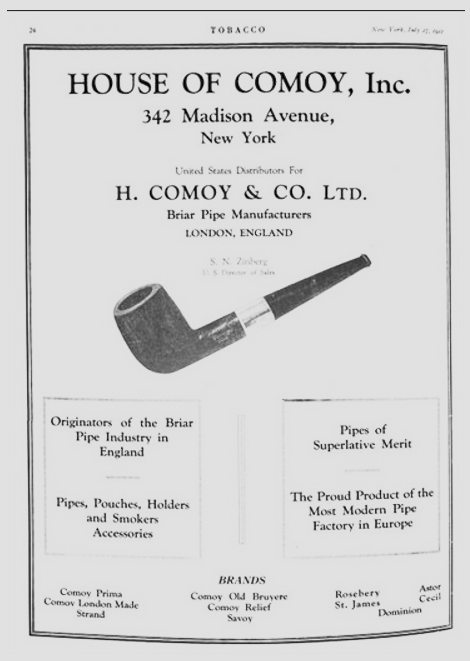
 The history of Comoy’s is full and well recorded in the Pipedia Comoy’s article (Comoy’s – Pipedia) and for anyone wanting to do the ‘deep dive’ on the history this is where you should go. The story of French pipe makers and the cross over into the UK can be a bit confusing. With the Comoy’s story, the Chapuis and Comoy families are bound together. The Comoy family moved a good bit after originating in Saint Claude, France. The founder of the pipe making legacy belongs to Henri Comoy who was born in 1850 – his father was a long-time wood worker. This section of the LONG article in Pipedia stands out:
In the 1901 census, ten years later, we find Henri Comoy, his wife, children and Chapuis nephews at 4 Newcastle Place. The Chapuis family originally came from Lausanne, Switzerland. Their father, Charles Pierre Chapuis, was a watchmaker and their mother, Fanny Beausire, was the elder sister of Henri Comoy’s wife, Anna Beausire. They had seven children: Julien, Léon, Amélie, Emile, Louis, Alice and Charles. Orphaned in 1896, Louis and Charles (Louis is 19, Charles 15) moved to London to live with their aunt, Anna Comoy, and their uncle by marriage, Henri, who taught them and his sons Adrien and Paul the craft.
The 1901 London census records the Comoy family at 4 Newcastle Square, where Henri Comoy, his wife Anna, sons Paul and Adrien and daughter Jeanne lived. Also living there were Louis and Charles Chapuis, as well as a Swiss pipe maker, Louis Mayland, and a wood turner from Saint-Claude, Henri Guyon-Messager, who joined Henri Comoy in London after 1896 with his wife and daughter, all making pipes at 4 Newcastle Square. Henri Comoy is credited with being the author of the appellation “London Made”.
 The legend of the two piper families, Chapuis and Comoy, combining their talents remains a legend. Henri Comoy was unable to meet his nephews when he was interned in Switzerland in 1871, for the simple reason that they were not yet born, and they did not become his nephews until he married in 1890. Henri Comoy, the first real pipe maker in the family and founder of the company, took in his wife’s nephews, who were orphans at the time (Louis was 19 in 1896, Charles 15), taught them the craft and later involved them in the business, as they would become directors of the company in the same capacity as his sons.
In 1914, Henri Comoy set up H.Comoy & Co. Ltd with his nephews Louis and Charles and his sons Adrien and Paul.
Henri’s brothers continued to make pipes on their own account in the United Kingdom. There is a record of the death in London in September 1893 of a Daniel Comoy, born in 1855. It is highly likely that he was Henri’s brother. As for Samuel, he is listed in the 1901 Edinburgh electoral register as a briar pipe maker at 4 Greenside Place in Edinburgh, and Jules Comoy can be found as a self-employed pipe maker around 1900 in Walthamstow, on the outskirts of London. Emile Chapuis, an older brother of Louis and Charles, was 21 when his father died. He did not join his brothers in London, but settled in Paris, where he sold Saint-Claude pipes wholesale after the First World War, but the brothers kept in touch.
Jumping to the future, the major date in the development of the Comoy’s name was the Cadogan merger in 1979/early 80s. Looking at the dating of the Comoy’s on the table, the first marker is the shape number 607. The 607 is listed in the Comoy’s Shape chart (Comoy’s Shape Number Chart – Pipedia) in this way:
| 607 | billiard | 1/4 | (S), modern |
The 1/4 refers to the bend and S refers to the saddle stem. According the opening introduction in the Comoy’s Shape Number Chart article, Comoy’s had 3 digit shape numbers up until the Cadogan merger started introducing 4 digit shape numbers. The shape number 607 is also pictured in this ‘Circa 1975 (Pre-Cadogan) Shape Chart, courtesy of Doug Valitchka (Comoy’s Shape Number Chart – Pipedia).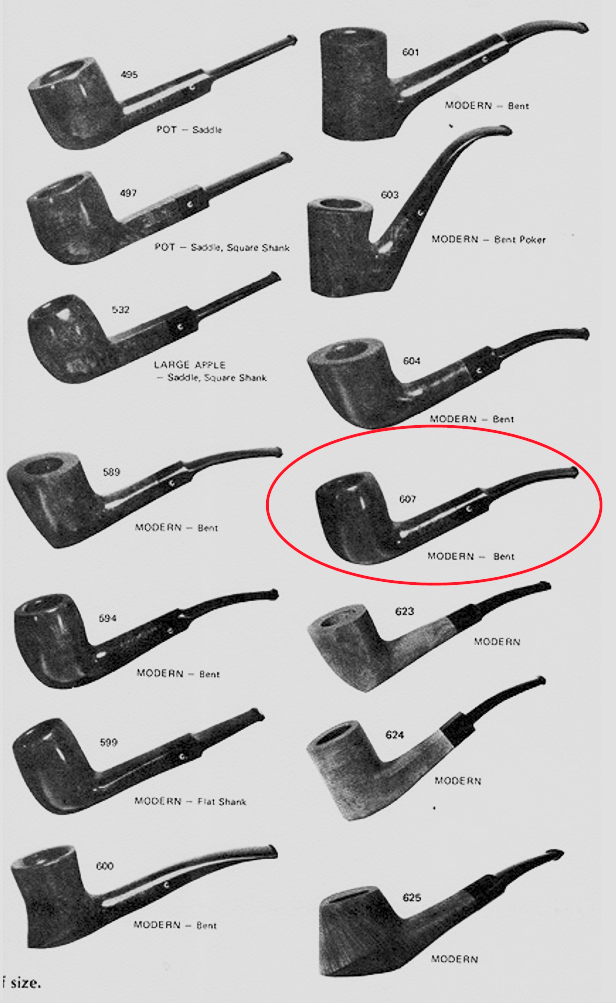 The shape number gives us an outside bracket for the dating of our pipe – pre-Cadogan would place its production before 1979/early 80s. Another marker is the inlaid drilled C stem logo. Pipedia describes the ‘three-piece C’ which is what we see in our logo:
“C” was first inlaid in the side of the mouthpiece around 1919. This was a complex inlay needing three drillings. First, a round white inlay was inserted, then the centre of the white was drilled out, and a smaller round black inlay was inserted. Finally, another drilling was made to remove the open part of the “C,” and an even smaller black inlay was inserted. This inlaid “C,” known as the “three-piece C,” was continued until the Cadogan era in the 1980s. However, the “C” in the 1920s and early 30s is much thinner and more delicate than the one post-WW II.
Cadogan first changed the “C” to a single drilling with an inlay that had the “C” in the centre, and more recently it became a laser imprint.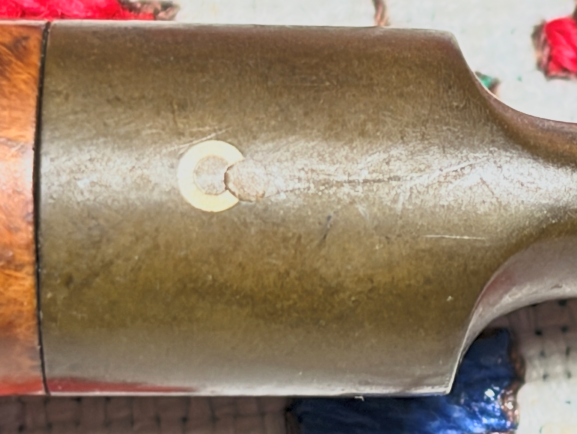 The Comoy’s name stamped is also noted in the Comoy’s Dating Guide (Comoy’s Dating Guide – Pipedia) as one of possible variants in the period from the 1950s moving forward.
- A simple block-letter style without serifs but with the C larger than the other letters and the apostrophe before the “S”.
- A return to the slightly more fancy block letters with serifs and the apostrophe. (It seems that some grades carried different stamps, or at least that the stamping changed in different years for some grades.)
- A simple block-letter style without serifs and without the apostrophe and with the “C” the same size as the rest of the letters. This stamp was probably not used very long.
- A simple block-letter style without serifs but with the apostrophe before the “S” and with the “C” the same size as the rest of the letters.
Description #1 fits our nomenclature. Based upon these markers, we can place the Comoy’s Golden Grain from the 1950 to the Cadogan merger in 1979/early 1980s. There is one interesting anomaly that I’ve discovered for which I have no answer. I could find no information about the specific ‘Golden Grain’ line which could help with more information. However, I did find another example of a Comoy’s Golden Grain at Pipephil (Comoy — Pipes : Logos & Markings). The ‘anomaly’ question is concerning the COM. In the Pipephil frame the nomenclature is the same as ours except for the Country of Manufacturing stamp. The stamp in the picture below is the top arched, MADE [over] IN [over under arched] LONDON [over straight block] ENGLAND.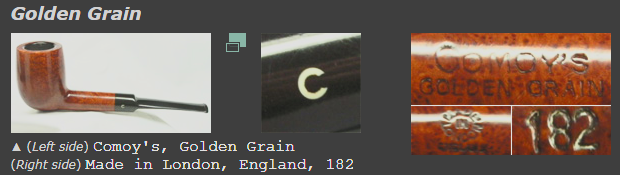 According to the Pipedia Dating Guide (Comoy’s Dating Guide – Pipedia):
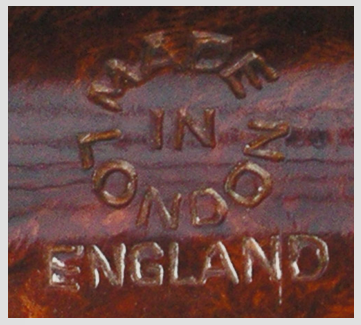 Made in London England
Appears in two versions. This is again stamped in a circle with “MADE” at the top, “IN” in the middle, and “LONDON” at the bottom, with “ENGLAND” in a straight line beneath. It can be assumed that this stamp was first used in the export drive in the early 1950s. On a Bulldog Sandblast from the early 50s the Comoy name no. 2 above was used together with “MADE IN LONDON” over “ENGLAND”. There are no known examples of pre-WW II Comoy’s stamped in this way. The second version is the same as above but in a “rugby ball ” shape. This shape is verified on Comoy´s “Extraordinaire” pipes.
The COM stamping on our Golden Grain does not match what is described above and does not fit any of the COM descriptions in the Pipedia Dating Guide.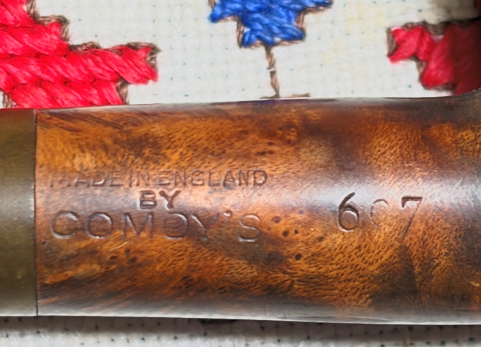 Two questions are floating in my head now – can I find more information about the Golden Grain Comoy’s line, and can I find more examples of Comoy’s Golden Grain pipes that might match up with the odd bird COM on the worktable. Well, my first stop hit pay dirt on both counts. I discovered on Steve Laug’s Rebornpipes several Golden Grain restorations done by regular contributor, Al Jones. Al is an avid collector, and I consider him an expert when he talks about pipes. I’ve been fortunate to have received his help when I have been stumped on a particular research project. Al posted a number of Golden Grains that I looked at – searching specifically at the COMs of each and NONE matched my Golden Grain and ALL matched the prototypical Comoy’s COM in Pipedia. One post in particular got my attention with information about the Golden Grain line that I had not seen (Comoy’s Golden Grain Apple (483) Restoration | rebornpipes). Apparently, Al had also been searching for more information about the Golden Grain line, and this is what he said and found:
In searching for information about the Golden Grain finish, I had previously posted the following, from an old eBay ad posted by Tony Soderman (aka Mr. Can).
Exactly when the “GOLDEN GRAIN” was first introduced is not clear, but it became one of COMOY’s most popular lines. By 1977 it was the Company’s third highest grade beneath the “Designer” and “London Pride” and ranked ahead of other favorites including the “Royal Comoy,” “Guildhall,” “Everyman” and so on! The GOLDEN GRAIN was offered as a “new look” with what COMOY called an “antique patina” and later called a “golden hue.” It was advertised as “finished in golden hues to highlight the gorgeous grains in the ‘Classical’ Comoy’s of London tradition.” As you can see, there is some truth to their claim that the GOLDEN GRAIN’s “warm seductive beauty will win your heart.” The GOLDEN GRAIN was dropped from the COMOY line in 1980.
Tony Soderman’s (aka Mr. Can) information confirms the dating with the added outside bracket of 1980 as the end of the Golden Grain production and that it was a nice quality line of Comoy’s. He adds information that the line was quite popular as well. He also confirmed that the beginning of the line is unclear. This was welcomed information regarding the Golden Grain line but the question regarding the COM was still hanging out there. As I’ve done in the past, I decided to send Al a note with pictures of the Golden Grain with the question of whether he had seen this COM before. Al got back to me with this response:
Dal:
It’s good to hear from you! You are right, that is a COM that I’ve never seen. It doesn’t match any of the 100 plus Comoy’s that I’ve owned/restored.
I could post the pictures up to the PipesMagazine British section and see if anyone else has an answer?
Thanks,
Al
Of course my response was, “Yes!” Al is one of the moderators for Pipesmagazine and always a good source of information. We’ll see if Al’s post (Odd Comoys COM :: British Pipes :: Pipe Smokers Forums of PipesMagazine.com) will uncover more information.
Well, after Al posted the question about the Comoy COM and pictures, no helpful information surfaced at this point. Perhaps someone who has information will post on the thread, but for now, it is a mystery. I asked Al if he had any guesses about the rogue COM and this is how we will end this endeavor:
I can’t explain that at all. I guess just chalk it up to vagaries of British Pipe making. Maybe someone was having fun on a Friday afternoon!
After this interchange with Al I received another note from Al that he remembered another Comoy’s line that had the COM stamping as the Golden Grain. The Guildhall line of Comoy’s. Guildhall is also described as a Comoy’s Second with attractive stakes embedded on the side of the stem. Here are some of the pictures that Al posted of his Guildhall Bulldog in the thread (Odd Comoys COM :: British Pipes :: Pipe Smokers Forums of PipesMagazine.com):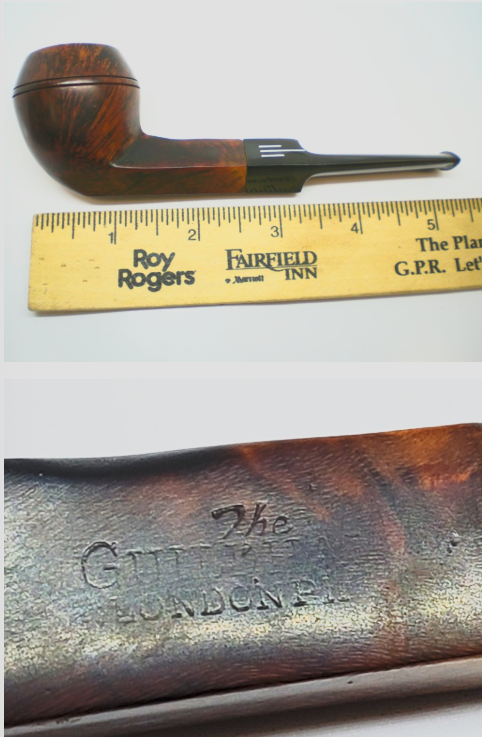 This final picture from Al is the match for our COM. Our Golden Grain has the Guildhall COM stamping, and one can only guess how this happened. In the thread, Al commented that “perhaps a line worker was too lazy to change the stamp?” Tartanphantom, another participant in the thread, concluded the subject with, “I suppose that when one is also making and stamping over 30 different sub-marques, this sort of thing is bound to happen eventually.”
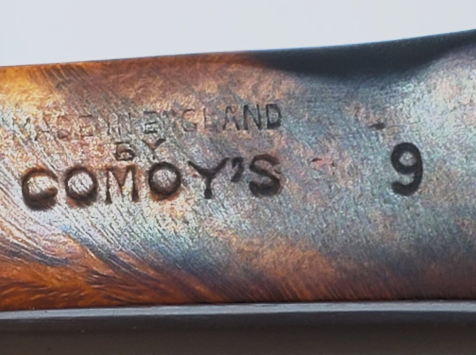 With a better understanding and appreciation for the Comoy’s Golden Grain on the worktable and my thanks to Al, it’s time to look more closely at the pipe itself. Looking first at the stem – the oxidation is pretty heavy. When the black rubber turns to that olive green, it time to deal with the oxidation! The bit was severely chewed, and the button shows some disfiguration from biting.
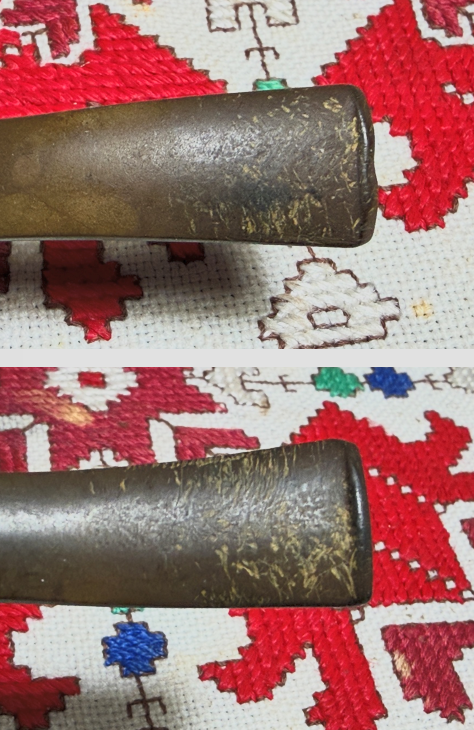 The button view does not look any better.
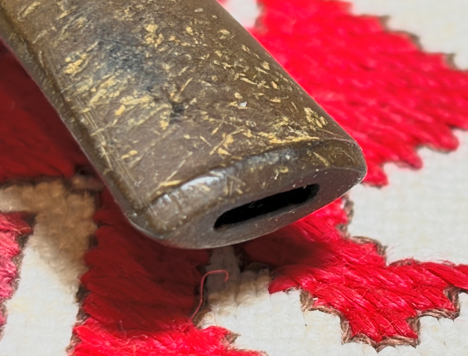 To begin, the stem airway is cleaned with pipe cleaners moistened with isopropyl 99%.
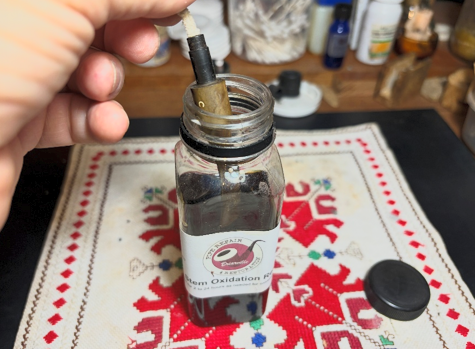
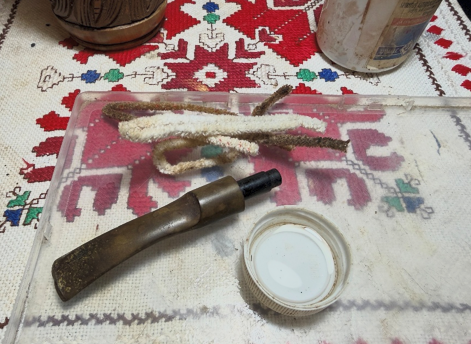 Conquering the olive green oxidation begins with placing the saddle stem in a soak of Briarville’s Pipe Stem Oxidation Remover (www.briarville.com) for several hours.
 With the stem in the soak, I take a closer look at the stummel. There are some very small fills or perhaps pits on the left side just above the sitter heel.
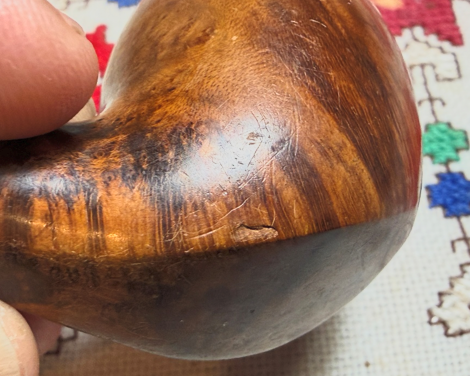
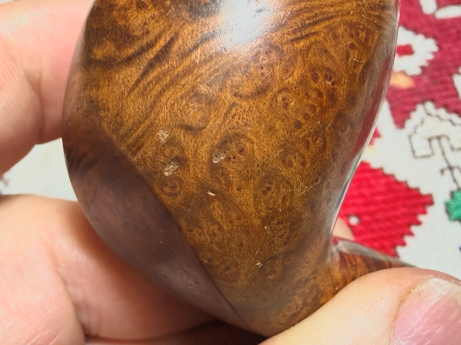 The right side just above the heel edge has a good size chip that needs to be addressed. Above this is scratching and blemishes. There are small scratches over the entire stummel from normal wear.
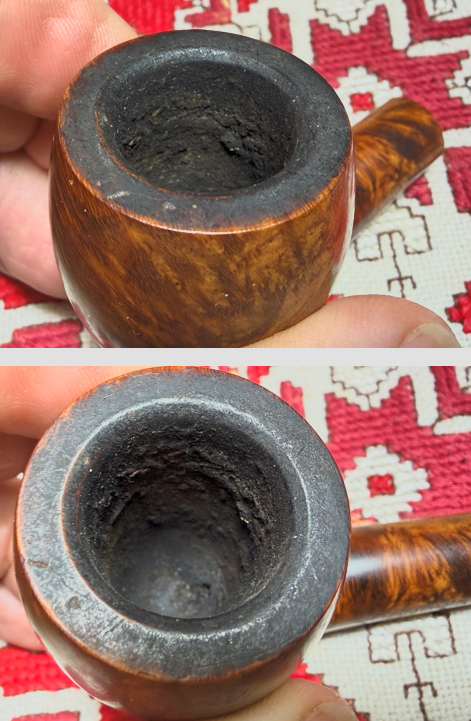
 The rim has very thick lava crusting over it and the chamber has a moderate amount of cake build up that will be removed to allow the new steward to develop a fresh protective cake.
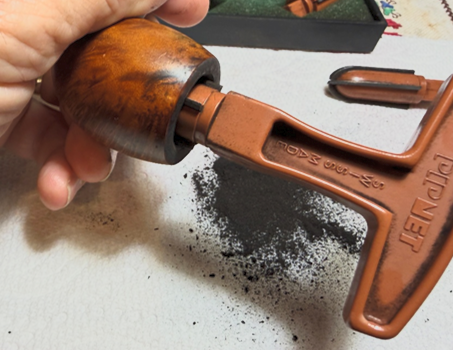
 To address the cake, the chamber is reamed with the Pipnet Reaming Kit. Two of the 4 available blades are used.
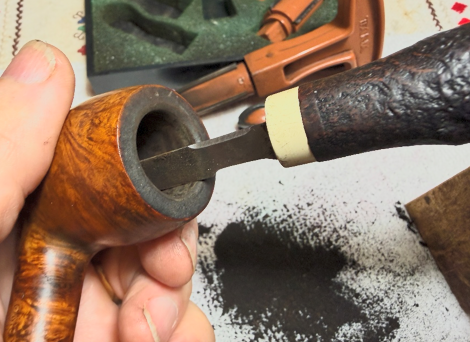
 The chamber is then scraped with the Savinelli Fitsall Tool which does a good job of getting down into the floor with the curves.
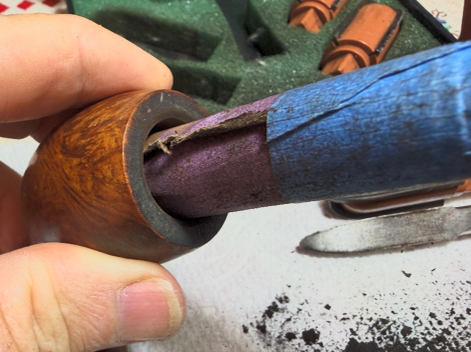
 Finally, the chamber is sanded with 220 grit paper to remove the last vestiges of carbon cake.
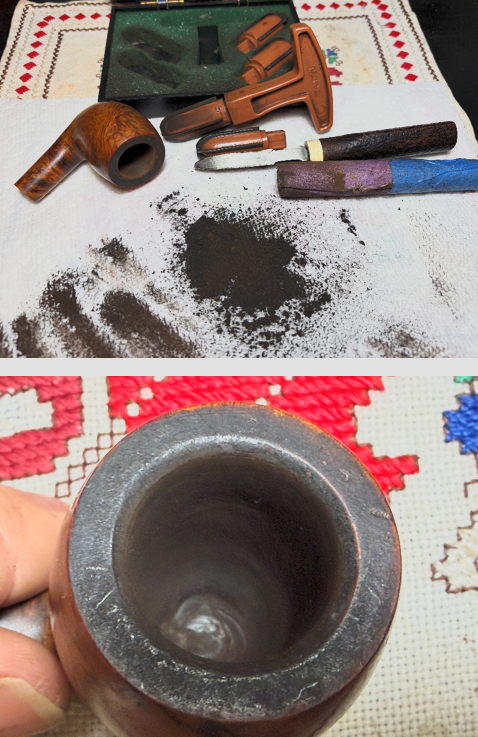
 All the tools are shown with the pile of carbon cake that was removed from the chamber. After a quick inspection, the chamber is without any heating issues.
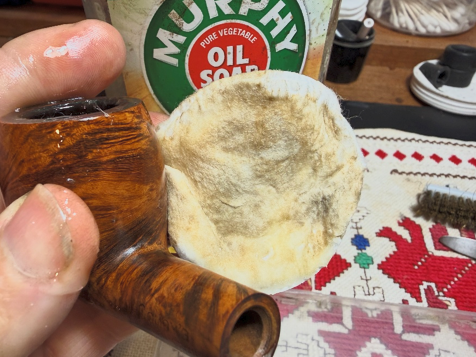
 Cleaning of the stummel continues by cleaning the external briar with undiluted Murphy Oil soap using a cotton pad.
 To work on the rim, the rim is scraped carefully with the Savinelli Fitsall Tool. This is followed by using a brass brush. Brass adds some earnest to the scrubbing without being too invasive.
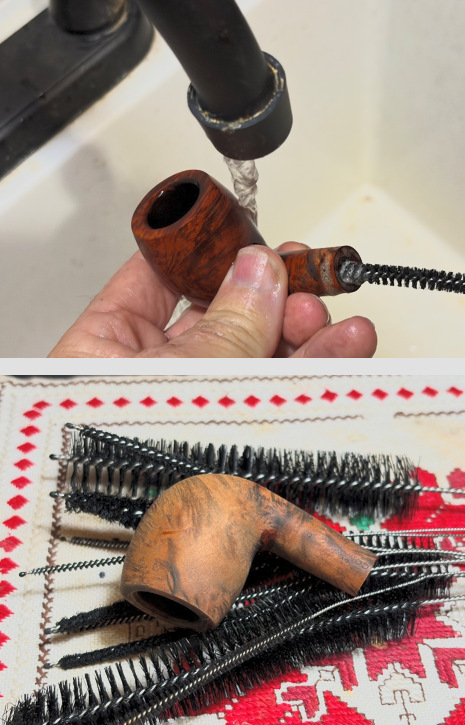
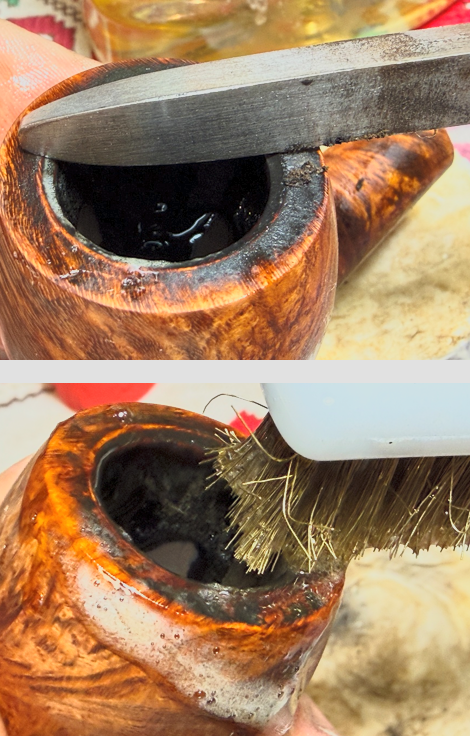 Next, the stummel is taken to the sink to work on cleaning the internals. Using warm water and shank brushes with anti-oil liquid dishwashing soap, the internals are scrubbed. The stummel is then thoroughly rinsed and returned to the worktable.
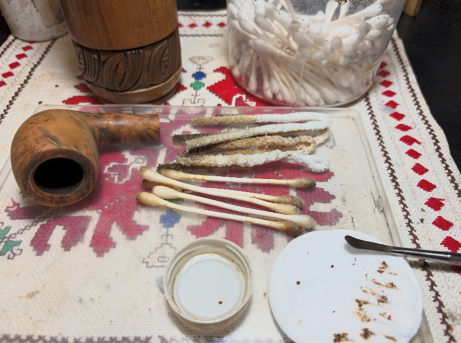
 The internal cleaning continues with pipe cleaners and cotton buds moistened with isopropyl 99% alcohol. The small dental spoon is also used to scrape the mortise walls. After the cleaners and buds start emerging lighter, the cleaning is completed and time to move on.
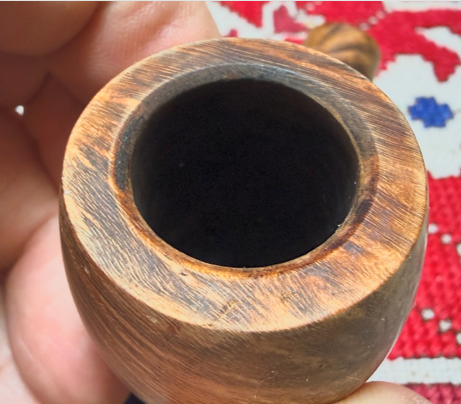
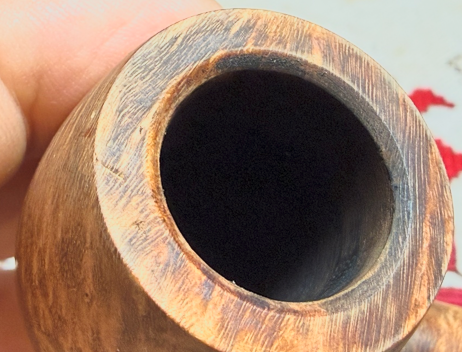
 Looking now more closely at the stummel after the cleaning, the rim came out really well except for the charring on the inner bevel. The briar is darkened on the upper side of the bowl in the picture below.
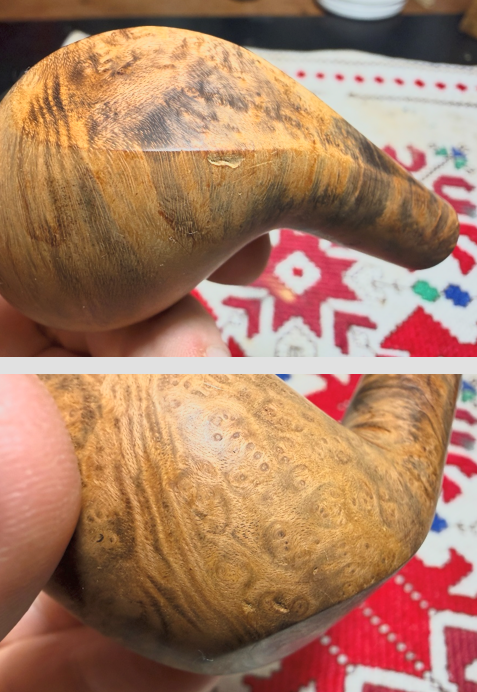
 There are two problem areas near the heel’s edge. There is a larger gash shown in the first picture and some pitting in the second picture.
 Addressing the rim first, I also noticed a large dent on the left side of the rim in the picture below.
 To address the dent and to clean up the lines of the rim, the stummel is topped by first inverting the stummel on 220 paper on the chopping board.
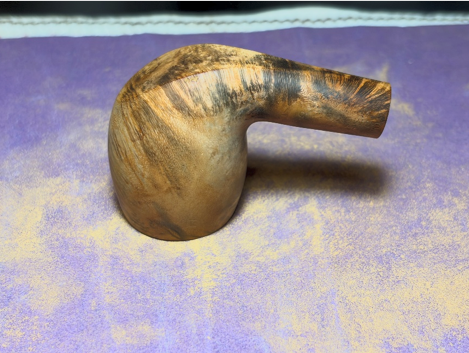 After the stummel is rotated several times the rim is checked. There is still a bit of the dent still visible.
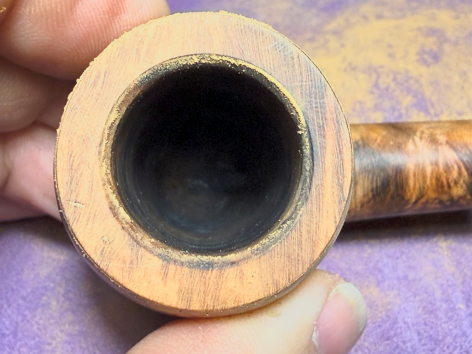 After some additional rotations the dent is gone and the rim looks good.
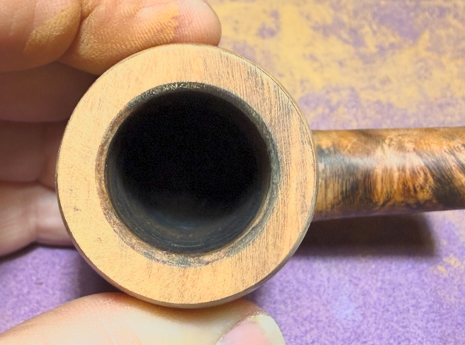 The 220 paper is then swapped for 320 grit paper and the stummel is rotated more. This is followed by 600 grit paper on the topping board.
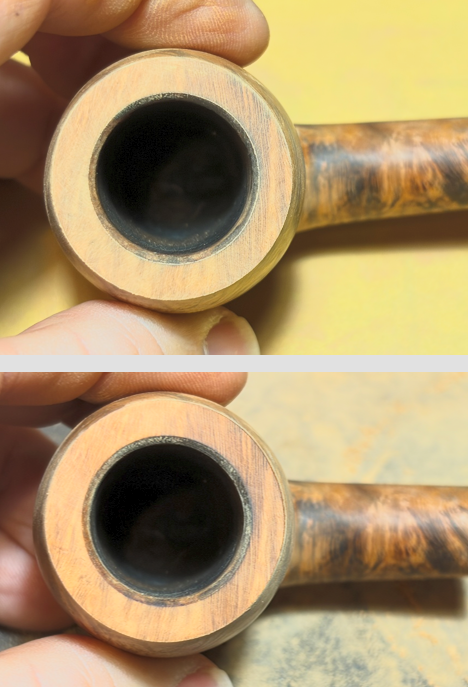 The rim looks great and now it’s time to catch the charred bevel up with the rim.
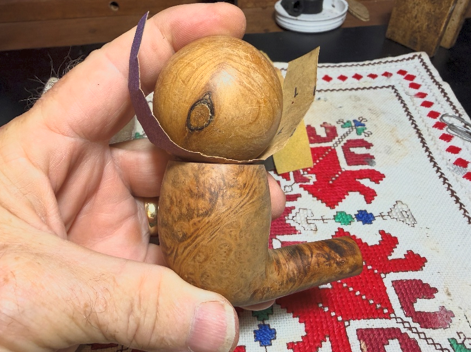
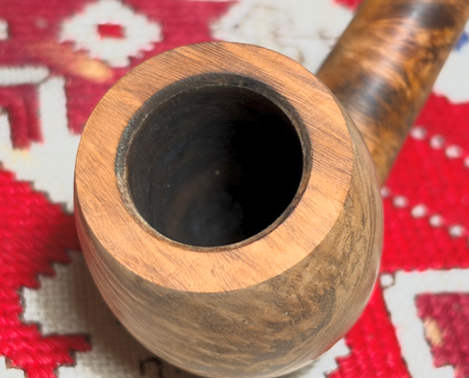 Using the wooden orb with the 220 paper pinched will help clean up the bevel. With the paper pinched, the paper is held stationary around the orb, and the orb is rotated around the inner rim.
 The 220 sanding strip is followed by 320 and 600 grit papers.
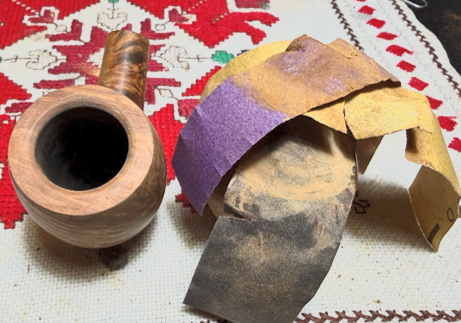 The rim looks great. The bevel has cleaned up very nicely.
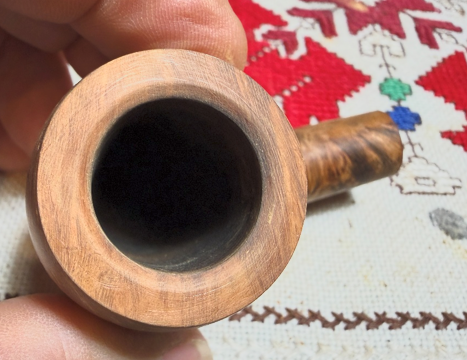 Next, the cut next to the heel edge and the pits on the opposite side need to be sanded out. I first try using a coarse sanding sponge on the cut, but this did not make too much progress with such a deep injury.
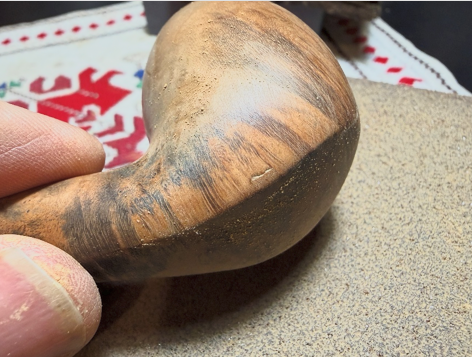 I switched to sanding the spots with 320 and 600 grit papers and this did the job. With the sanding paper I was able to focus directly on the injured briar without impacting the nearby briar.
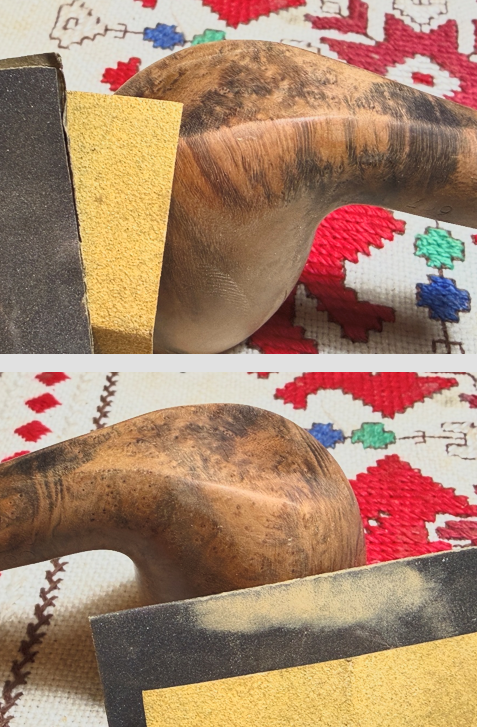 To clean the stummel of small scratches and blemishes from normal wear, sanding sponges are used. I bi-passed the coarse sponge and started with the medium grade, then light and fine.
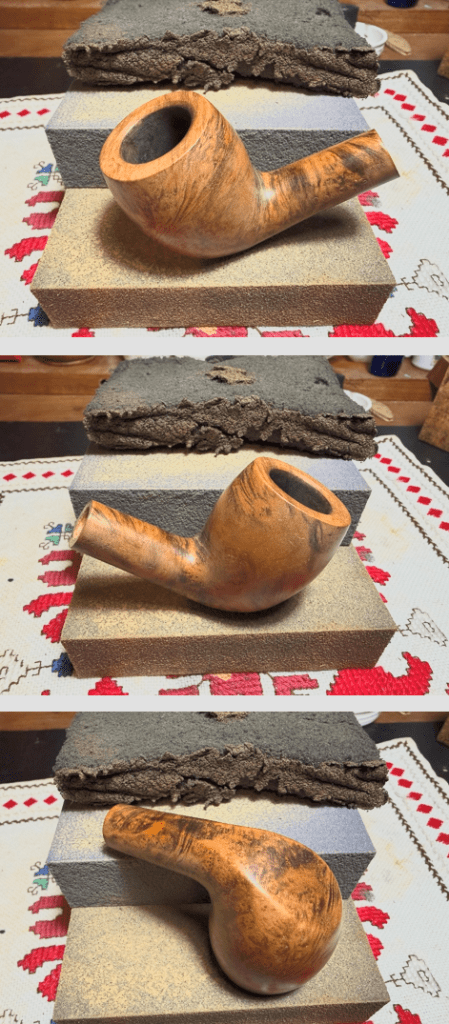 The sanding continues next with the use of micromesh pads. To wipe off briar dust and to give each successive pad better traction, after each pad the stummel is wiped with a moist cloth. The first set of pads are grades 1500, 1800 and 2400.
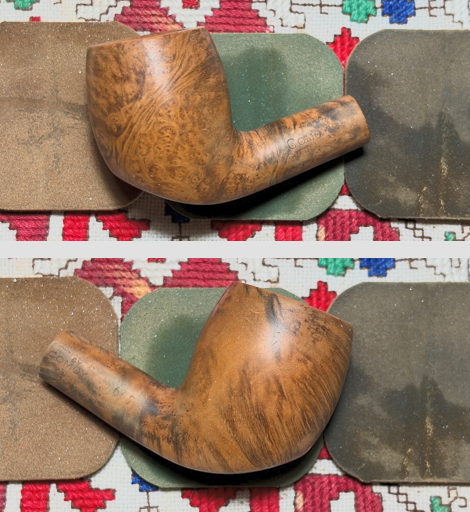 The second set of pads are pad 3200, 3600 and 4000.
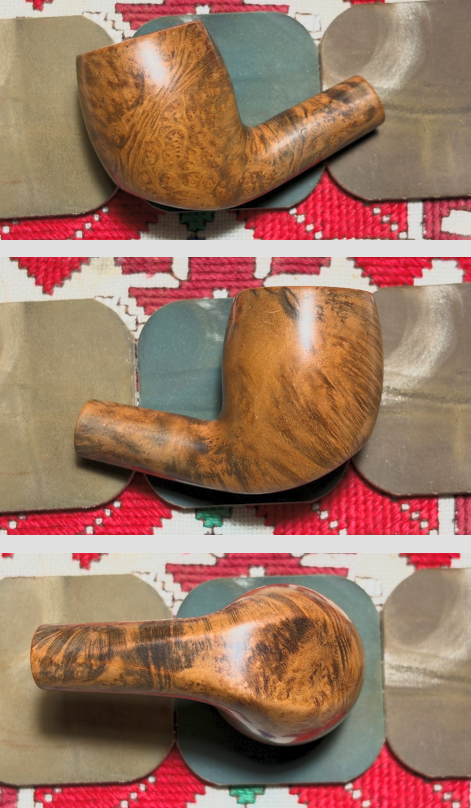 The final set of pads are grades 6000, 8000 and 12000. It is amazing how the grain emerges through the micromesh process. The dark grain on this pipe is amazing.
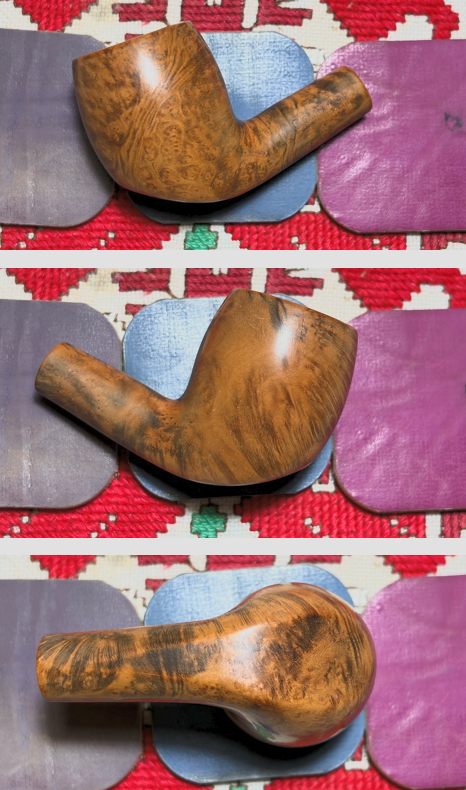 Mark Hoover’s ‘Before & After’ Restoration Balm (www.Lbepen.com) is a great product for bringing out the deep, natural hues out of the briar.
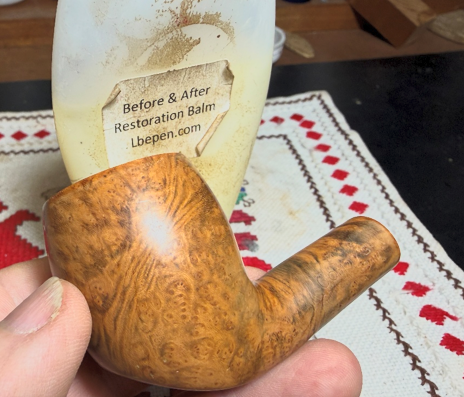 After putting some Balm on the finger, it is worked into the briar. With the Balm applied, the stummel is set aside for a few minutes while the Balm does what it does.
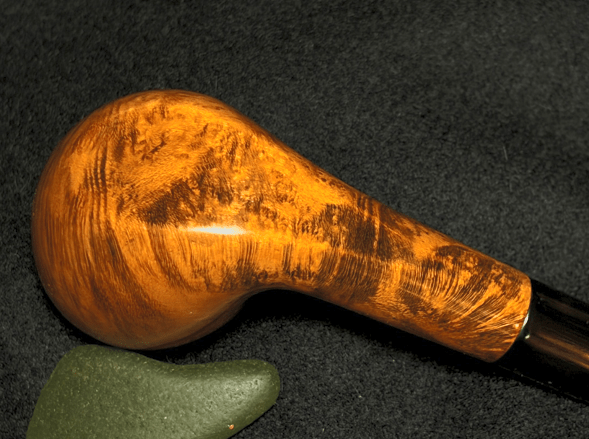
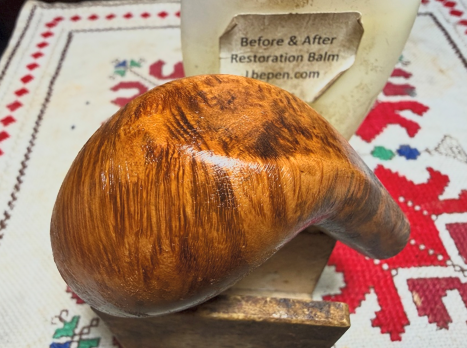 After the time has passed, the excess Balm is wiped off then buffed up with a dedicated microfiber cloth. Mark’s Balm has done a great job. My oh, my…. Now you know why the folks at Comoy’s calls this a Golden Grain. Nice.
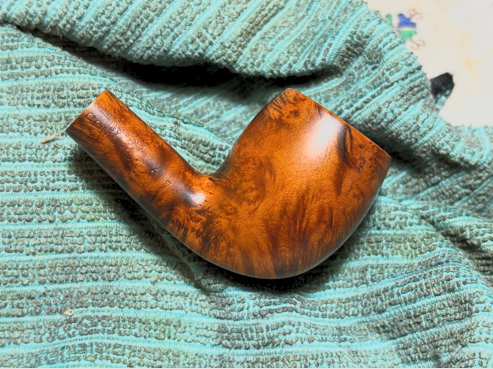 The stem has been soaking in Briarville’s Pipe Stem Oxidation Remover. After it’s fished out, the picture shows well how the oxidation rises to the surface as a scummy substance.
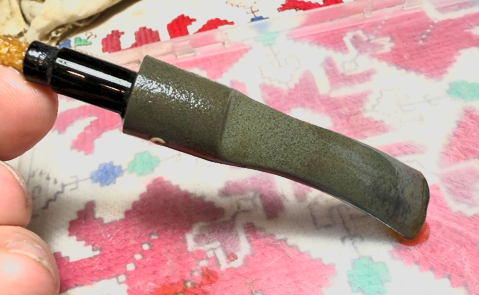 Using a cloth, the stem is rigorously rubbed to wipe off the raised oxidation. The airway is cleaned of the fluid with a pipe cleaner and isopropyl 99% alcohol.
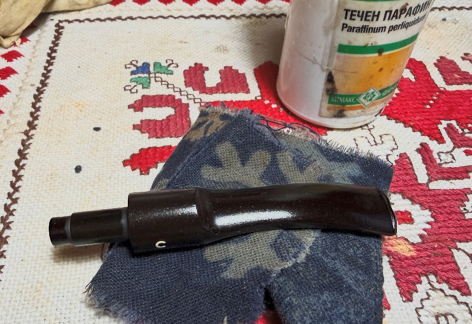
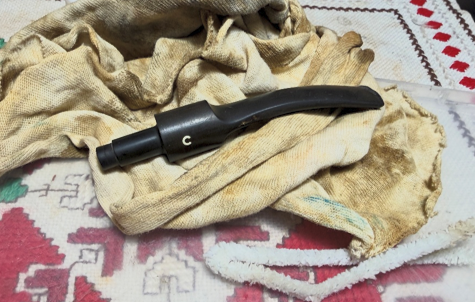 To help condition the vulcanite, the stem is rubbed with Paraffin oil, a mineral oil.
 Looking again at the upper and lower bit, there remains fine tooth chatter.
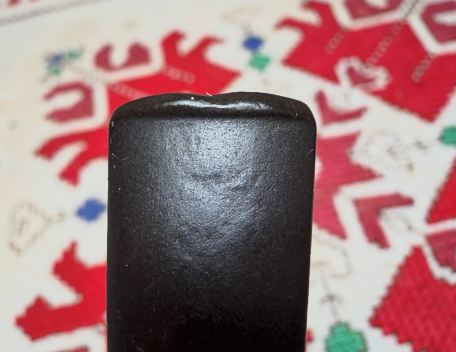
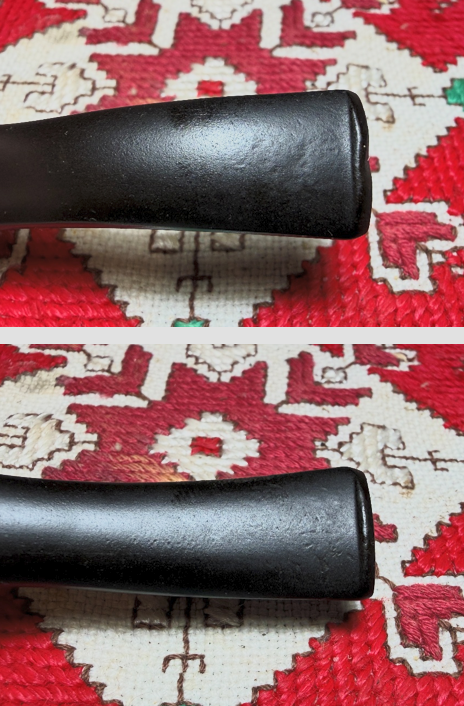 The upper button lip has been compressed.
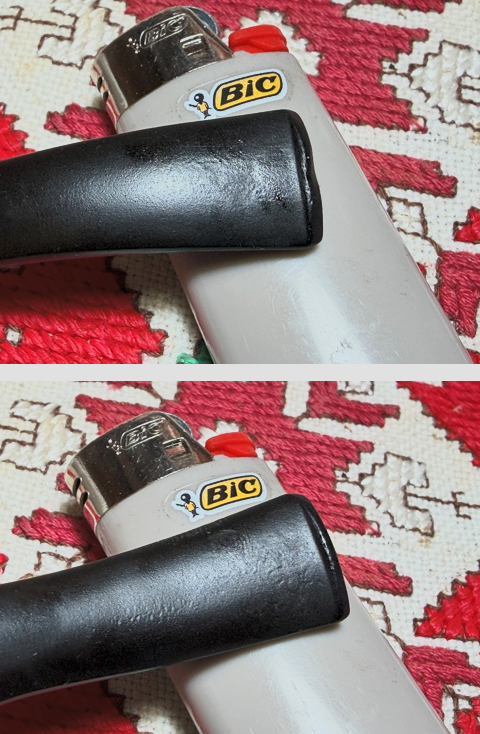
 To bring out the tooth chatter and perhaps help the button lip, the heating method is used. With the lighter, the bit is painted with the flame in a quick back and forth motion not lingering long over any one area. As the vulcanite heats, the physics of the rubber expands and often this can help to minimize the chatter and compressions. The chatter should sand out without problem.
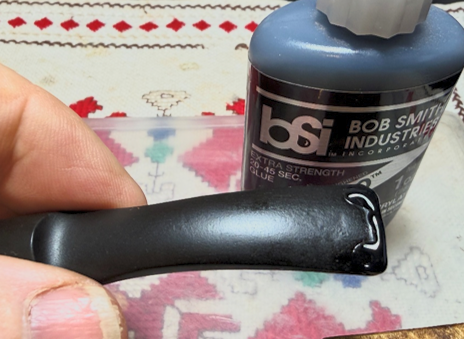
 The button lip is still compressed. Black CA glue is used to refresh the lip. In the picture below, the CA glue ran a bit before I was able to spray accelerator on the wet glue to keep it in place and to quicken the curing process. The stem is put to the side for a time to allow the button lip build to cure.
 After the patch has cured, needle files go to work defining the button lip and filing down the upper bit patch.
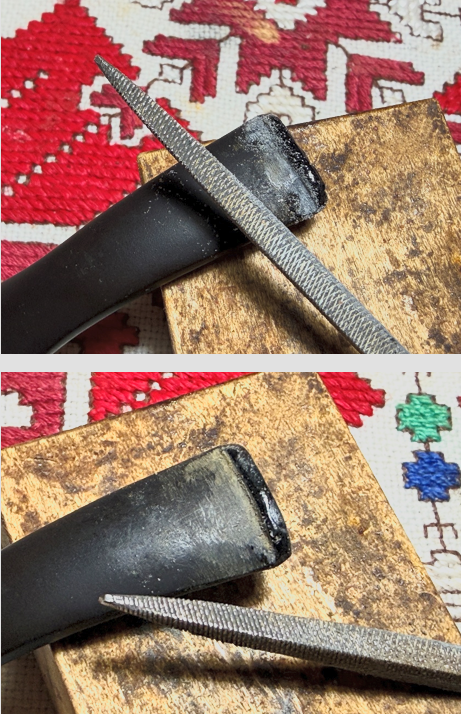 With the lower side of the bit which did not need a patch, the button lip is refreshed with a needle file.
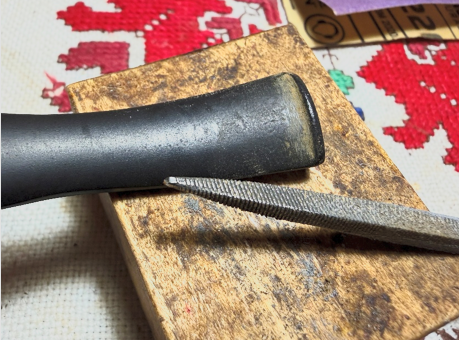 Next, the tooth chatter on the upper and lower bit and button is sanded out with 220 grit paper.
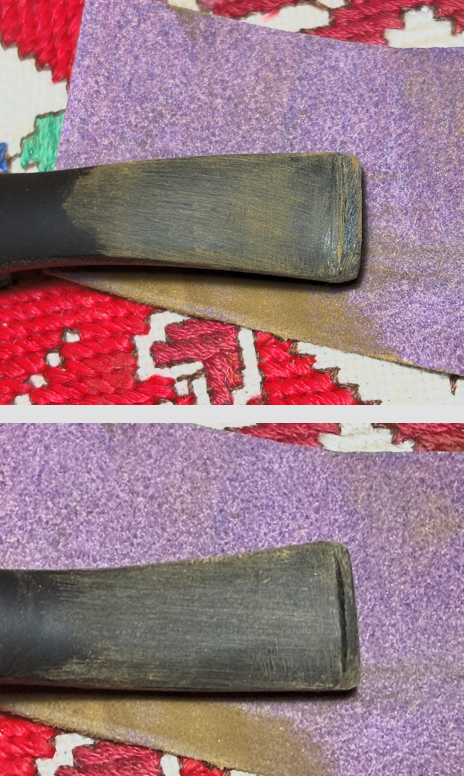 To address any lingering oxidation and scratching on the stem, the sanding is expanded to the entire stem with 220 grit paper. A shoulder guard is used to protect the stem facing.
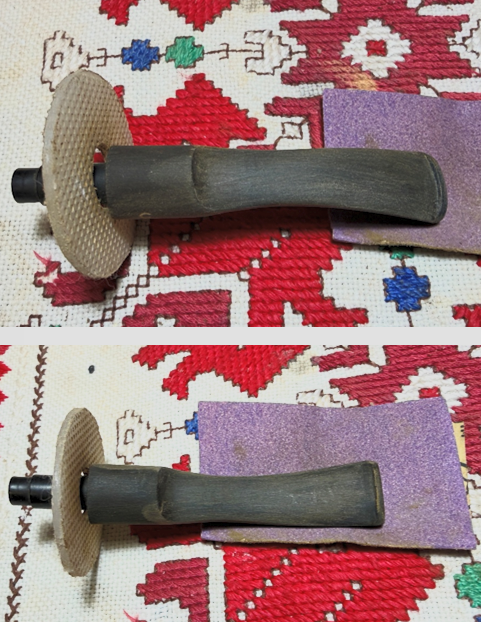 The sanding continues with the next finer step down using 320 grit paper – a guard is used.
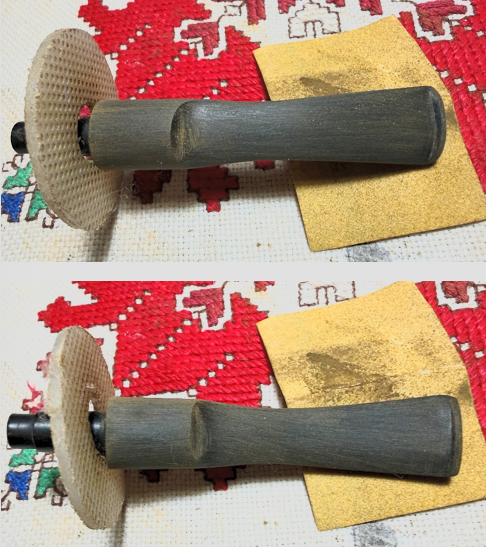 Following the 320 grit paper, the stem is wet sanded with 600 grit paper and followed by applying 0000 grade steel wool.
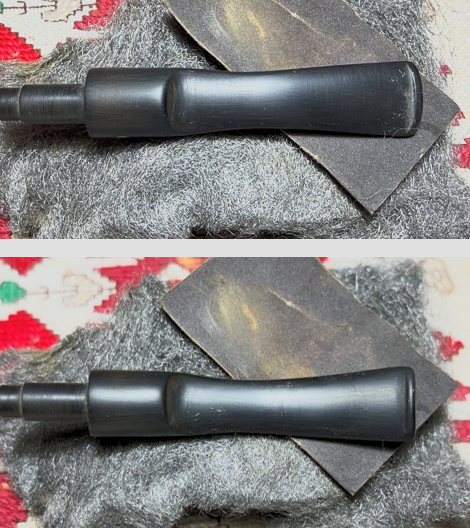 The micromesh process follows next. During this process sanding transitions to polishing with the finer pads. Between each pad, the stem is wiped with Obsidian Oil to condition the vulcanite and to guard against oxidation. The first set of 3 pads are grades 1500, 1800, and 2400.
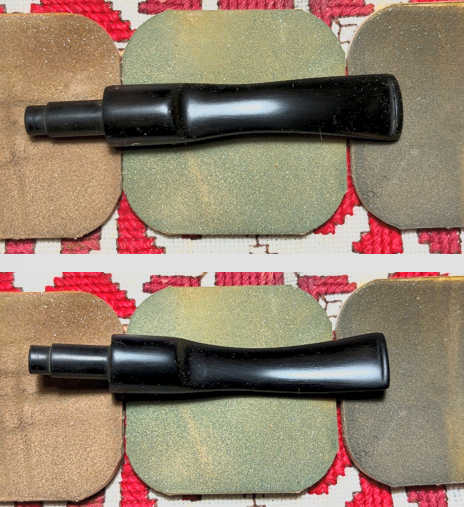 The second set of pads are grades 3200, 3600 and 4000.
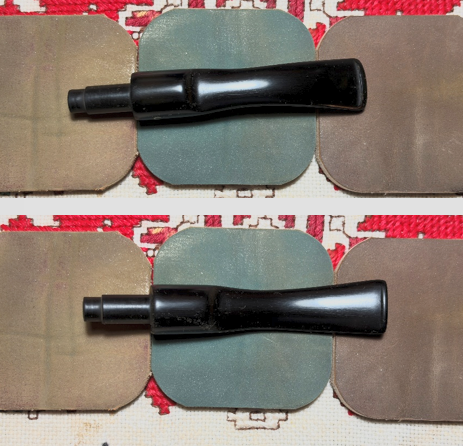 The final set are grades 6000, 8000 and 12000.
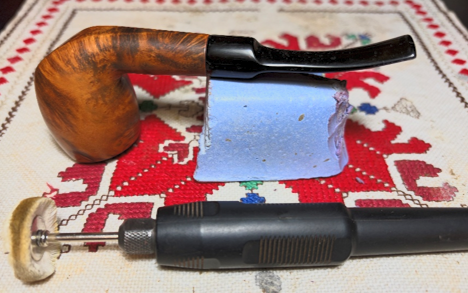
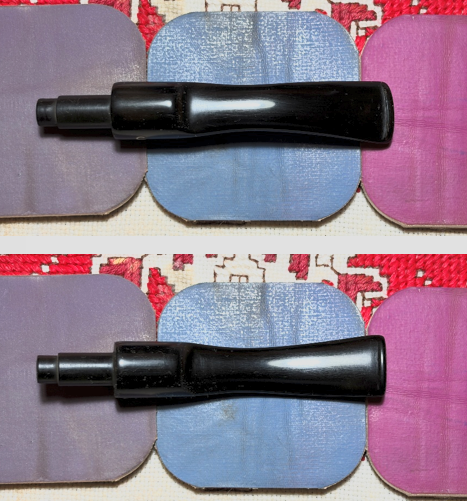 The stem is completed on its own and is reunited with the stummel. With a dedicated cotton cloth buffing wheel mounted on the rotary tool, with the speed set at about 40% of full power Blue Diamond compound is applied to the pipe.
 Through the compound application, a lot of compound dust is created. The picture below shows what I see. The dust is wiped with a felt cloth to clean it and to prepare the surface for the application of the wax.
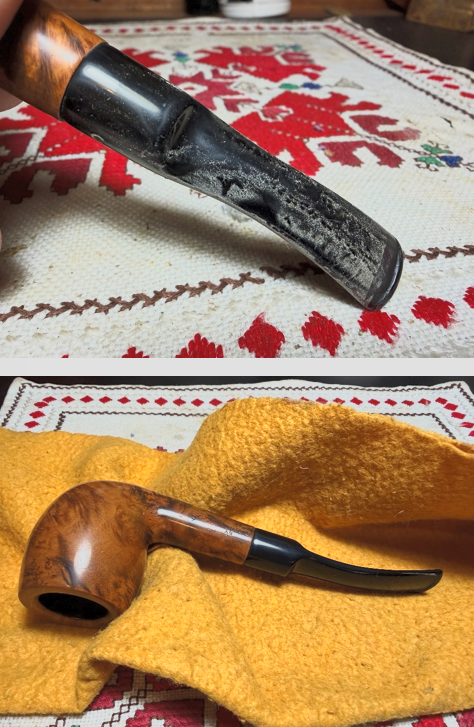 Another dedicated wheel is mounted at the same speed. Next, Carnauba wax is applied to the stem and stummel. After the wax application, the pipe is given a rigorous hand buffing with a microfiber cloth to remove excess wax and to raise the shine.
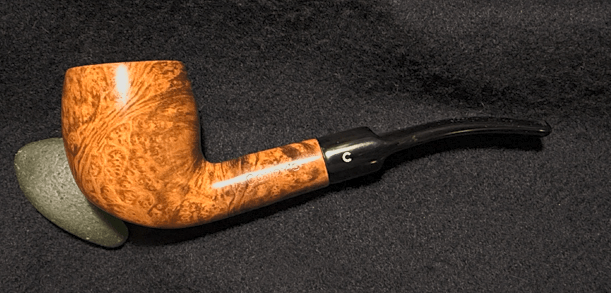
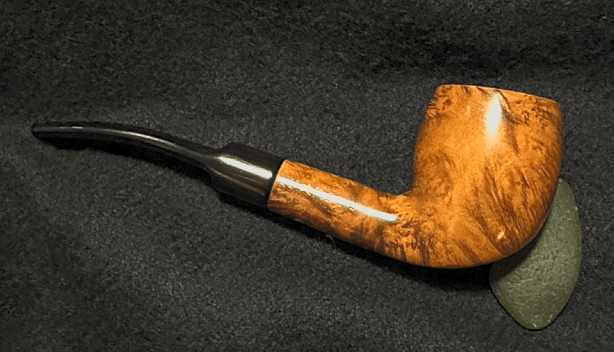
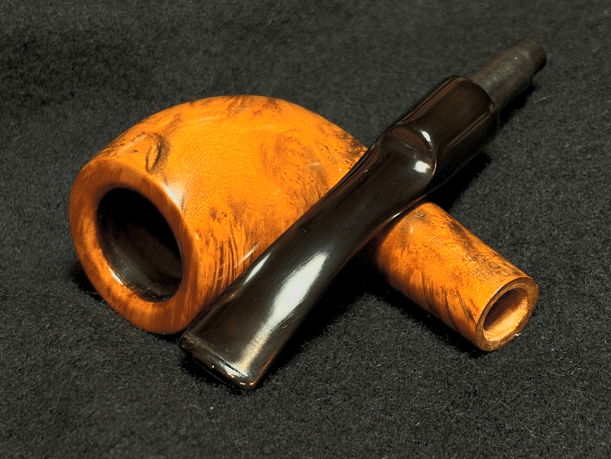
 This Comoy’s Golden Grain lives up to the Golden Grain billing with very distinctive grain with large darker patches of grain swirl. The heel is flat and curved to sit the pipe on the table. The Golden Grain line ended most likely in 1980 without a clear indication of when the pipe came online. The pipe can be described either as an odd ball or a rare exception regarding the COM stamping which is unique from every other Comoy’s Golden Grain that was found in the research. This Golden Grain seems to be a one of a kind. The dimensions are Length: 5 1/8 inches, Height: 1 3/4 inches, Rim width: 7/8 inches, Chamber width: 3/4 inches, Chamber depth: 1 1/2 inches. Doug commissioned this Comoy’s Golden Grain and will have the first opportunity to claim him in the Pipe Store. All the proceeds from the sale of pipes restored help support the work of Daughters of Bulgaria, now called Spring of Hope. It’s fun looking at ‘before’ and ‘after’ pictures to see how far we’ve come. Thanks for joining me!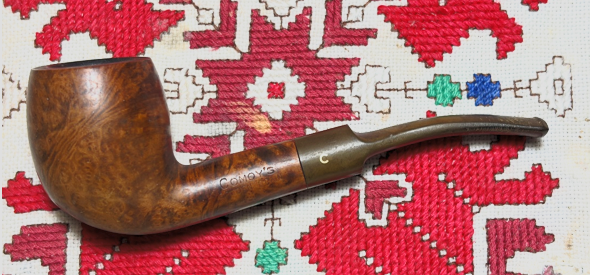
 The Pipe Steward
Mark it sold, Dal!
The story was fascinating. I’ll be going with “I just don’t feel like changing the stamp today…”.
LikeLike
Thanks, Doug. Definitely one-of-a-kind Comoy’s. I hope you enjoy your pipes and let me know how they smoke – I DON’T test them before sending them out in the post, but sometimes I’m tempted 🙂
LikeLike
I’m glad we found some details about that unusual COM. Great write-up and restoration! I’m sure Mr. Can is smiling somewhere, knowing his ebay descriptions are still quoted. His listings were one of a kind! I was fortunate to have met him once, at a Richmond CORPS pipe show.
LikeLike
I’m pleased we were able to dig out some information on that COM. Great job on the write-up and restoration. I’m sure Mr. Can is smiling somewhere knowing his flowery ebay listings are still quoted. His listings were one of a kind. I was fortunate to have met him once at a Richmond VA CORPS show.
LikeLike
Al, thanks so much for your words and for your help in figuring out, or NOT figuring out, the COM on the Golden Grain. I’ll be in touch again down the road!
LikeLike