
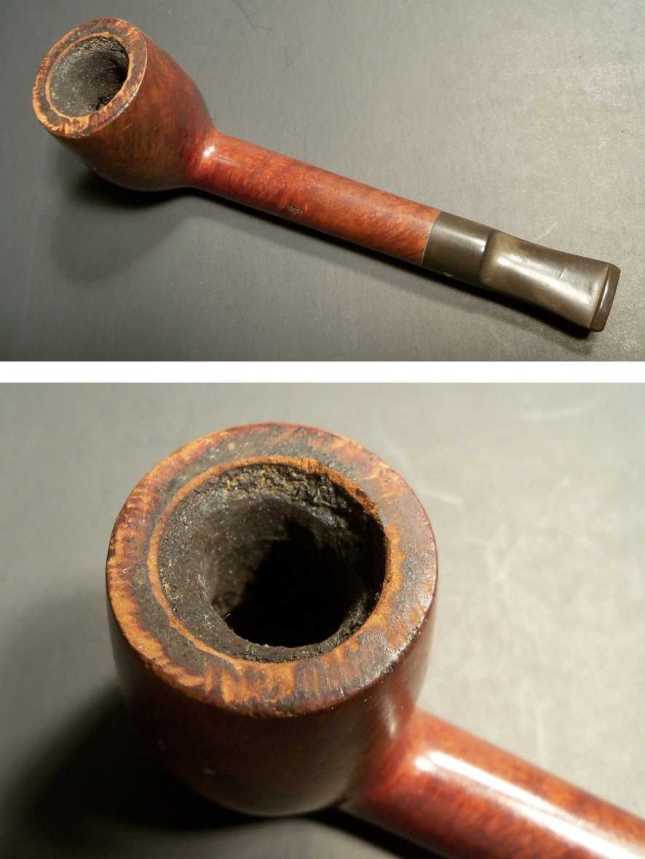
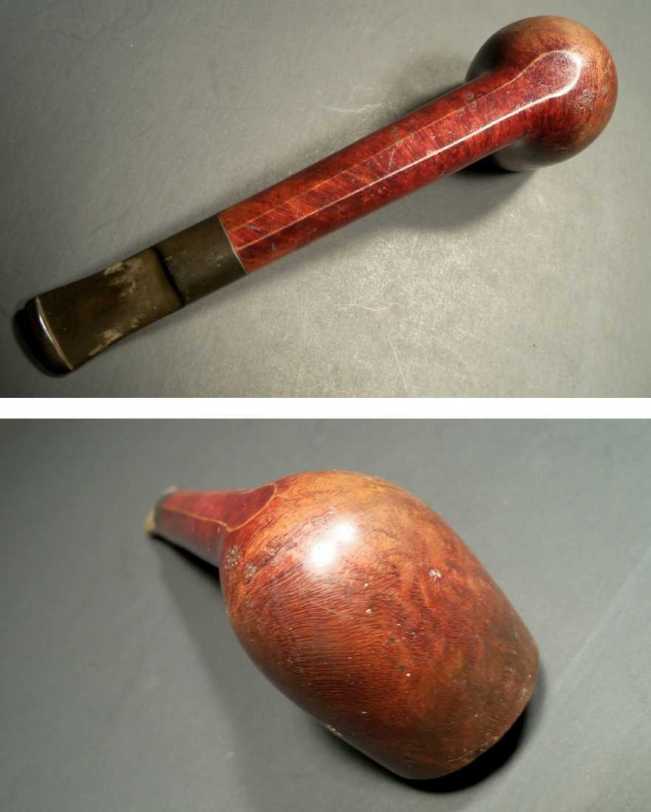
The Lovat now on the worktable came to me off the online auction block in January 2018, from a seller in Indiana. The pipe was bundled with 5 other pipes and overall, a good deal with new additions to the online collection, ‘For “Pipe Dreamers” ONLY!’, where pipe men and women here pipes whispering to them 😊. Here are the pictures I saw of the WDC Milano that got my attention from the seller in Indiana.
 Pipe man Todd has commissioned several pipes from me. His first pipe was while I still lived in Bulgaria. This was when I found out that Todd was an attorney, and I also discovered that he specialized in international and immigration law with a special heart for China. At that time, my wife and I were hosting a young lady from China – Chrystal, who had come to explore and understand better the work we were doing with the Daughters of Bulgaria – helping trafficked and sexually exploited women and girls. While staying with us, Chrystal discovered my work restoring pipes benefitting the Daughters of Bulgaria, and she wanted to commission a pipe to take back to China as a gift for her grandfather and also to help the Daughters. Chrystal’s commission project impacted me deeply. True to her word, after her return to China Chrystal sent pictures back of her grandfather enjoying his new AND treasured pipe from his granddaughter. The write up of Chrystal’s commission was called, A Special Gift for Her Grandfather in the People’s Republic of China – A Sculpted Rose Billiard of Italy. Here are some of the pictures she sent:
 Todd came into this story when I wrote to ask if he would be willing to be bumped down one place with his commissioned pipe to allow me to work directly on the pipe for Chrystal’s grandfather. When I explained the circumstances, it was then that I discovered Todd’s profession and special relationship with China – I discovered that he also spoke Mandarin!
From this beginning of our relationship, Todd has grown into a friend, and I have enjoyed our spirited discussions of faith, geo-politics and family – so much so that we were able actually to meet at Edward’s Tobacconist nearby in Denver where we shared a bowl (or two) during a visit to the area where he also has family. Todd also brought along one of his published books – oh, did I mention that he is also an author (SEE: Amazon G88)?? 😊 Todd has a penchant for nailing classic pipes. His collection is beyond my accounting and his tobacco palate is more refined than mine 😊. The WDC Milano Lovat fits Todd’s style. I’ve worked on Milanos before, but I haven’t seen this nomenclature. On the left flank of the shank is the crisp stamping of WDC in the classic inverted triangle. Beneath this is stamped MILANO. On the right side of the shank is stamped GENUINE BRIAR [over] DeResino PROCESSED. To the right of this is stamped the shape number, 18.
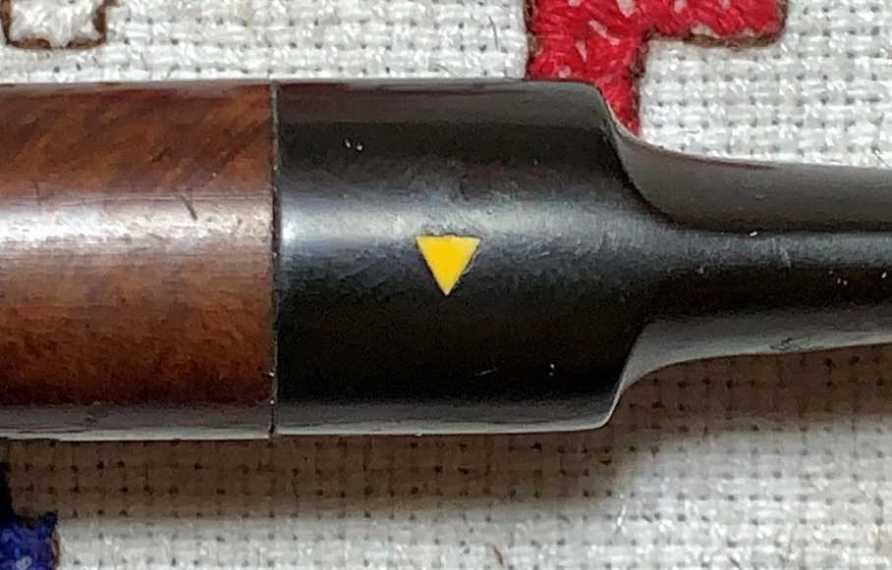
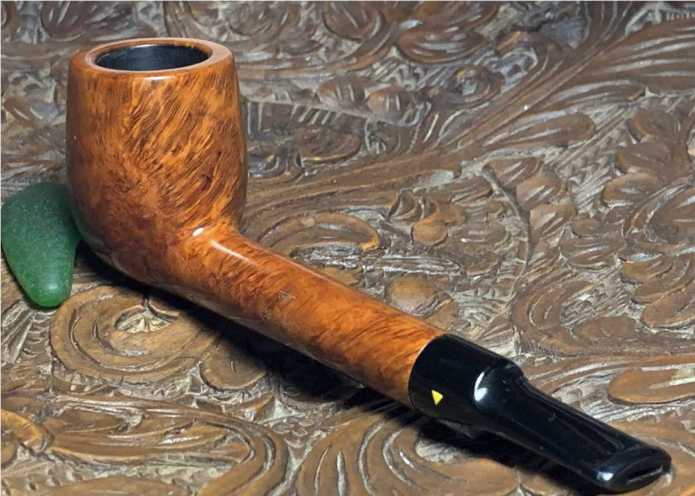
 The stem has an attractive, goldenrod hued inlayed inverted triangle – the WDC logo for more than a century.
 The Lovat belongs to the Canadian family and Bill Burney’s description of the fam is helpful in Pipedia:
 The WDC Milano Todd commissioned is the classic Lovat shape that is marked by the rounded shank and saddle stem. The stubby saddle stem gives a stout feel and with the longer, rounded stem adding the Canadian ‘classy’.
The history of WDC – William Demuth Co., is extensive and Pipedia’s article provides a good overview and examples of great period ads:
 William Demuth. (Wilhelm C. Demuth, 1835-1911), a native of Germany, entered the United States at the age of 16 as a penniless immigrant. After a series of odd jobs, he found work as a clerk in the import business of a tobacco tradesman in New York City. In 1862 William established his own company. The William Demuth Company specialized in pipes, smoker’s requisites, cigar-store figures, canes and other carved objects.
The Demuth Company is probably well known for the famous trademark, WDC in an inverted equilateral triangle. William commissioned the figurative meerschaum Presidential series, 29 precision-carved likenesses of John Adams, the second president of the United States (1797-1801) to Herbert Hoover, the 30th president (1929-1933), and “Columbus Landing in America,” a 32-inch-long centennial meerschaum masterpiece that took two years to complete and was exhibited at the World’s Columbian Exposition in Chicago in 1893.
The Presidential series was the result of Demuth’s friendship with President James A. Garfield, a connoisseur of meerschaum pipes. Demuth presented two pipes to Garfield at his inauguration in 1881, one in his likeness, the other in the likeness of  the President’s wife. Later, Demuth arranged for another figurative matching the others to be added to the collection as each new president acceded to the White House, terminating with President Hoover.
In early 1937, the City of New York notified S.M. Frank & Co. of their intent to take by eminent domain part of the land on which the companies’ pipe factory was located. This was being done to widen two of the adjacent streets. As a result of this, Frank entered into negotiations to purchase the Wm. Demuth Co.’s pipe factory in the Richmond Hill section of Queens. It was agreed upon that Demuth would become a subsidiary of S.M. Frank and all pipe production of the two companies would be moved to DeMuth factory. New Corporate offices were located at 133 Fifth Avenue, NYC.
Demuth pipes continued to be made at the Richmond Hill plant till December 31. 1972. Then the Wm. Demuth Company met its official end as a subsidiary company by liquidation. Demuth’s mainstay pipe, the Wellington, continued to be offered in the S.M. Frank catalog until 1976. In the mid-80’s, The Wellington even made a brief return as a direct to the consumer offer.
I’m familiar with the WDC Milano Hesson Guard series which is known for the patented air-cooling system created by William Wallace Hesson. The system is designed with internal metal fitments which, according to the ads below, reduce moisture, goo, and moves the pipe smoking world closer to the holy grail 😊. 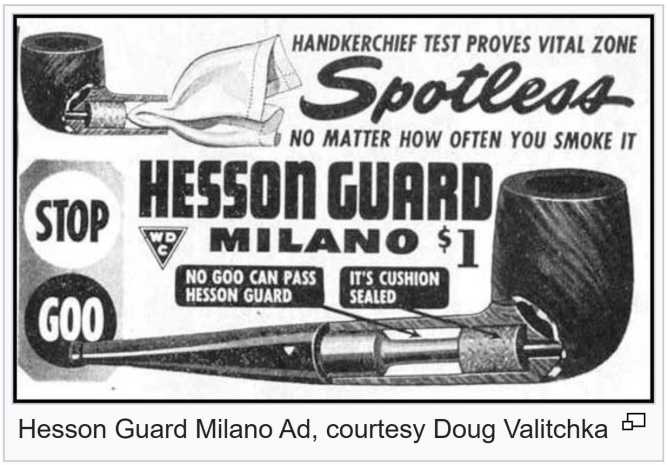
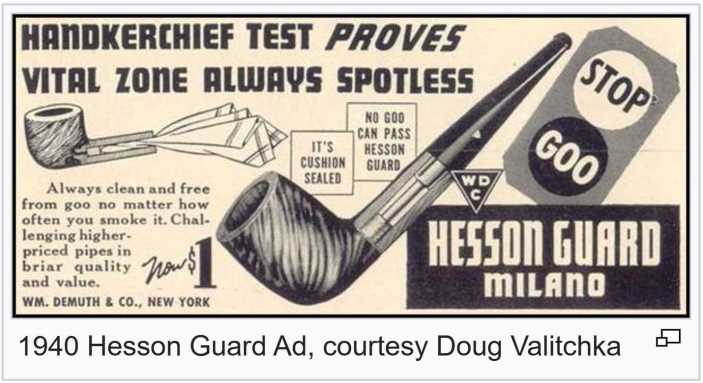 The Hesson system had two patents according to the Pipedia article, December 22, 1925, and in 1932. The picture below is my Milano Hesson Guard gifted to me by a professor when I was at Reformed Theological Seminary many years ago. I believe the design looks like the 1925 version of Hesson patents.
 The patenting of WDC Milano pipes is also relevant to the research regarding the Milano DeResino Processed on the worktable now. Mining out information about this particular brand hasn’t been easy, but in a general search with the Milano DeResino parameters, I came upon a partially defunct page on the Tapatalk Kaywoodie site called ‘W.D.C. Master List’. It contains a long list of W.D.C. Models and at one time, each model had pictures associated with each, but now the picture links are not working. Scrolling down the list hoping to find information about the DeResino Processed name, this is what I found:
Milano De Resino Processed – Patent # 1936060 which was applied for in Dec. 2nd 1932 and granted Nov. 21st 1933
This patent information took me back to the Milano patents listed in the Pipedia article. Along with the examples of the two Hesson patents was an additional 1933 patent attributed to a ‘D. P. Lavietes’ – specifically: Nov.21, 1933 patent, filed Dec. 2, 1932. I didn’t pay too much attention to this patent because I was looking for words, ‘DeResino Processed’, but saw none. However, the patent number listed above from the W.D.C. Master List, 1936060, was the finger print that connects this patent to the Milano DeResino Processed on the work table. Here are the patent pages from the Pipedia article (Courtesy of Doug Valitchka).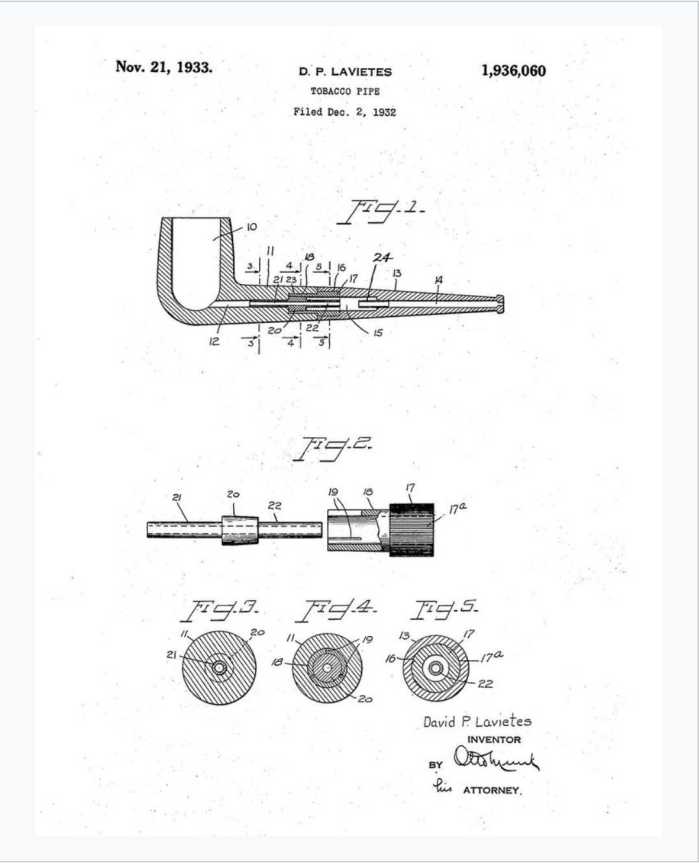
 I took the time to thoroughly plow through the text of the patent. After reading it, to summarize, the essential goal of the patent is stated as,
“An object of my invention is to provide a construction affording a cool, sweet smoke with the possibility of easily discharging from the pipe any solid matter which may deposit therein. Another object is to construct a pipe of a minimum number of parts so that the featherues of a cool smoke and facility of cleaning may be embodied in pipes capable of being sold at a low price.”
The key factor in achieving these aims is the fashioning of a ‘well’ that traps all the gunk (#15):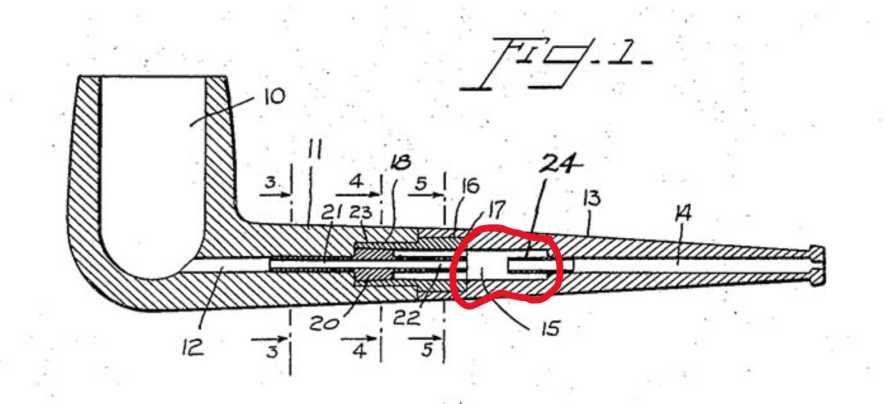 In the reading of the patent text, I found no reference to ‘DeResino Processed’. The only reference tying this patent to the Milano ‘DeResino Processed’ is from the W.D.C. Master List cited above. However, I found one more bit of information that could be considered anecdotal. Continuing to search for ‘WDC Milano De Resino’ a few hits came from pipes fitting the description being sold on different platforms. Of special interest with more street cred than most ‘for sale’ descriptions came from SmokingPipes.com. For sale was a WDC Milano De Resino Processed (48) and the description was written by Bear Graves with the accompanying photo:
American Estates: WDC Milano De Resino Processed (48) Tobacco Pipe Product Number: 004-009-0664 This pipe hails from the William Demuth company of New York. A well-regarded pipe manufacturer that ran from 1862 through the 1960s. Our best estimate places this particular bent apple as being produced from the 1930s to 1950s. –Bear Graves  The question still yet to be resolved is, what exactly does De Resino Processed refer to. With the help of Google Translate, De Resino means literally, ‘of Resin’. According to Google, the language is Galician, which is of an ethnic group in Spain which I knew from our time living in Madrid, Spain, some years ago. Resin is usually an oil of sorts naturally or synthetically produced. Still wanting a fuller explanation – tying something directly to the Milano production, I shot a note off to Steve with his www.RebornPipes.com experience asking what he knew about a WDC Milano De Resino Processed. The name was actually new to Steve as well. However, he sent a few links that he found referencing the name. I had seen one of these already – a De Resino for sale on Worthpoint referencing the patent connection. The other link I had not seen, and it turned out to be the key to solving the mystery.
The link was a 2012 discussion on the De Resino from CigarForums of all places, where a thread was labeled: “New guy question about a pipe I have”. He had bought the pipe and could not make out the meaning of De Resino…. A few fellow cigar men responded to the query pointing to De Resino Processed as referring to a briar treatment like oil curing or something similar and remarking that the pipe probably had some age. Then, ‘Indigosmoke’ chimed in with a link pointing to a 1934 ad in a Popular Science Magazine (LINK).  I loved looking at this magazine snapshot frozen in time – not only the science that was new and groundbreaking then, but the ads were great. The ads harkened back to a time when pipe smoking and tobacco use were a normal and casual part of life. The page which was relevant to the Milano unlocked the mystery. The WDC ad was on the left side of the page, but my eyes were also drawn to the comical ad for Sir Walter Raleigh. Apparently, using SWR in one’s bowl improved the health of one’s wife….
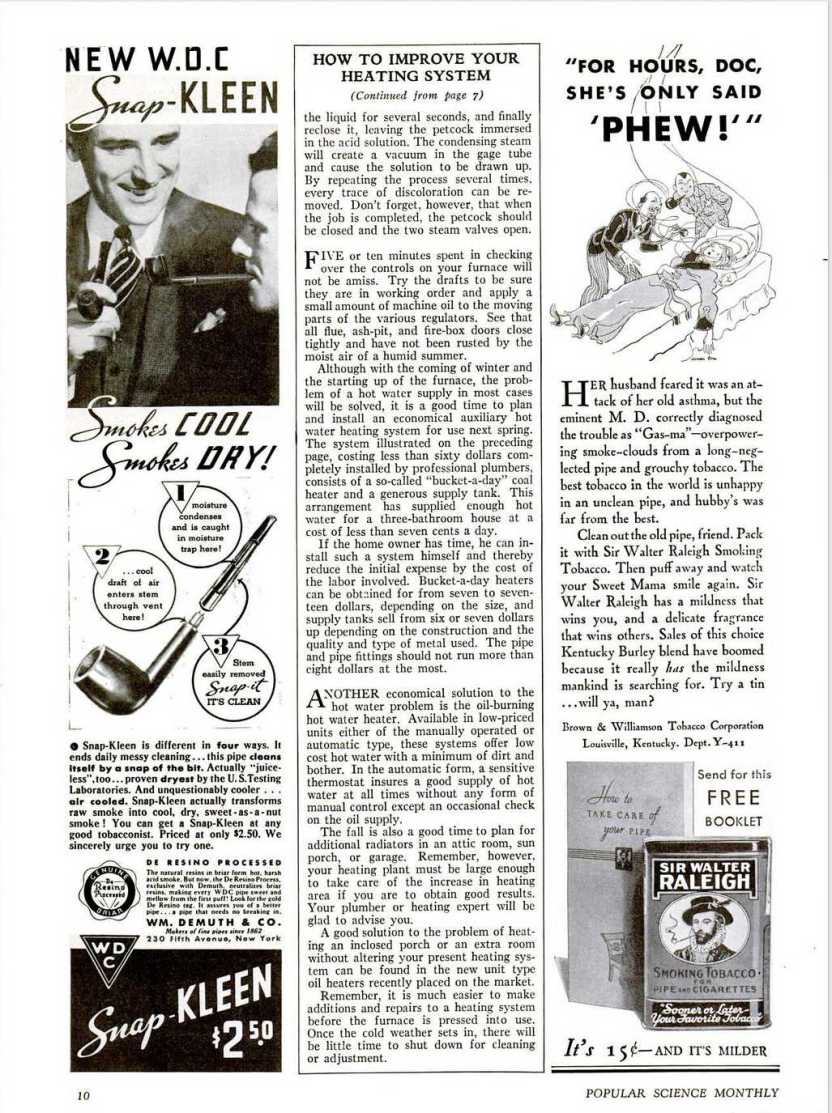 The WDC ad was promoting the Snap-Kleen pipe, but in small print on the lower side of the ad was the promotion and explanation of the De Resino Processed. I clipped the promo from the page above complete with the ‘Gold De Resino Tag’. The process neutralizes the briar resins so that the briar is sweeter and needs no breaking in. Mystery solved.
 The Milano De Resino Processed on the table most likely dates as suggested by Bear Graves of SmokingPipes.com from the 30s to the 50s. It has been linked to the D. P. Lavietes patent #1926060 of November 21, 1933. To confirm this patent design, I can take a look at the internal fitments once I get the stem off the stummel.
This leads to taking a closer look at the Milano now on the table. I have not been able to remove the stem – it is rock solid stuck, and every time I try to twist the short saddle stem, I brace myself for the unmistakable sound of a ‘snap’ indicating a cracked shank. This I do not need. The bowl has thick carbon build up which needs cleaning to examine the briar beneath. The rim is also worn with cuts and nicks on the edges, both externally and internally. The finish is all but gone and vestiges of the old finish can be seen.
 On the left side of the bowl there appears to be a significant cut into the briar.
 As one would expect, there are scrapes and dings over the surface of the stummel.
 The stem has minor oxidation with some bite compressions on the upper side.
  To begin the restoration of this WDC Milano, the stem needs to be dislodged from the shank without cracking the shank. I have tried twisting and turning, but with no success. The next method that has worked in such cases is to put the pipe in the freezer allowing the cooling of the materials to contract. If the fitments are metal as we’re assuming with the patented system, then what is stuck is the metal tubing which I believe should have a metal sleeve down the mortise. The pipe goes into the freezer and the next day another attempt is made. I first tried to hand twist the saddle stem, but still, it would not budge. Next, using a soft grip pair of pliers with a cotton pad to add more padding, the plyers grip the bit of the stem. With a gentle twist, the stem breaks loose and for the first time I can see the fitment. Success with no cracked shank.
 Hmmm, I’m not sure what I was expecting basing my expectations on the patent drawings, but here it is.
 The sleeve I believed would be metal in the mortise appears to be a cork lining – care needs to be taken to preserve this. There is an air-hole at the end of the tenon tubing.
  By looking at the ribbed end, I’m thinking that the very end of the tube in the picture below should be unscrewed. I’m also thinking that the soiled cylinder in the picture below comes out of the larger metal tenon tube. However, neither assumed junction would budge with the use of regular and soft grip pliers. Heating is also used using a Bic lighter to heat the nickel. This did not work either.
 The decision is made to give the stem an alcohol soak to see if this might soften the junctions.
  While the stem is soaking, the stummel is waiting. To begin, the starting picture shows the thick carbon cake.
 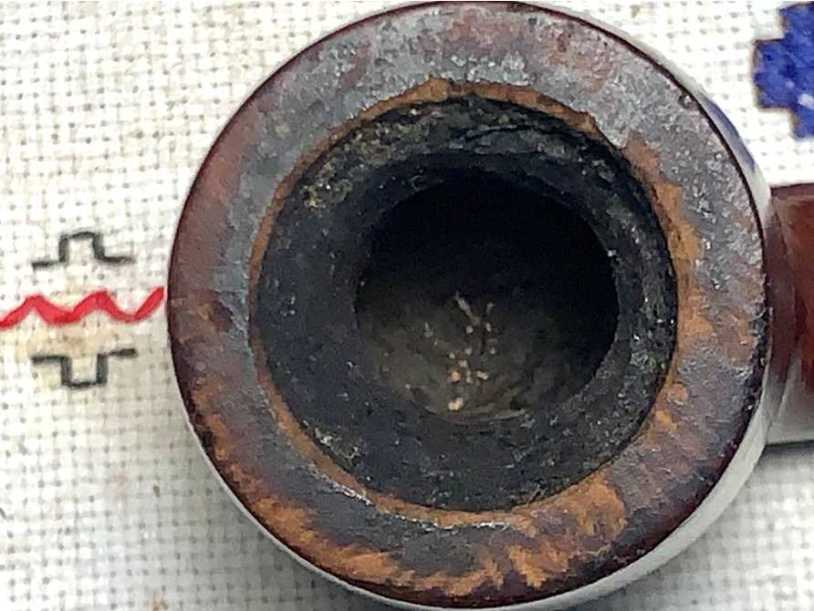 The Pipnet Reaming Kit is used with two blade heads clearing away the thick cake. This is followed by scraping the chamber walls further using the Savinelli Fitsall Tool and then sanding with 220 grade paper wrapped around a Sharpie Pen.
 An inspection of the chamber shows healthy briar – no heating problems detected.
 Moving next to cleaning the external briar, undiluted Murphy’s Oil Soap is used with a cotton pad to scrub the surface. There is somewhat of a ‘candy apple’ sheen from the old finish which I’m not crazy about. We’ll see if the cleaning removes the old finish.
 The brass brush helps with cleaning the rim and a Winchester pocket knife carefully scrapes the stubborn lava crusting on the rim.
 The stummel is next taken to the sink using hot water and anti-oil liquid dish washing soap and employing shank brushes the internals are scrubbed. I’m careful to avoid the cork lining at the mortise entry. After the stummel is thoroughly rinsed it returns to the worktable.
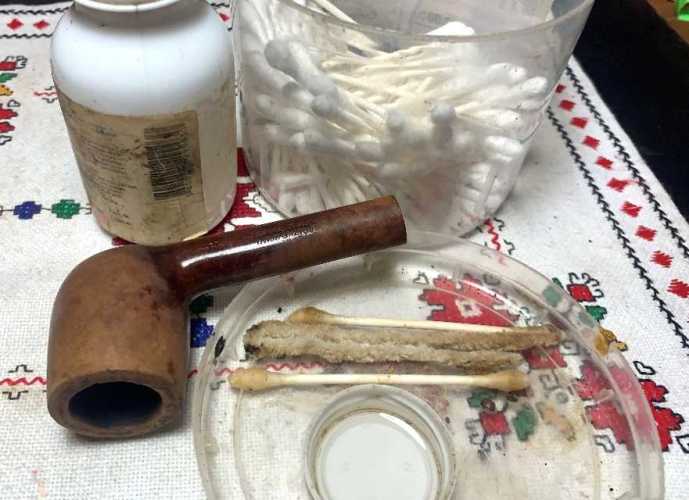
 Cleaning on the internals continues using cotton buds and pipe cleaners moistened with isopropyl 99% alcohol. Again, care is taken to avoid the cork lining. The internals are in bad shape, and it took some doing to make some headway. A drill bit the size of the airway was also used to help excavate the tars and oils from the airway surface. A small dental spoon was used to scrape the mortise as well – again, avoiding the cork lining.
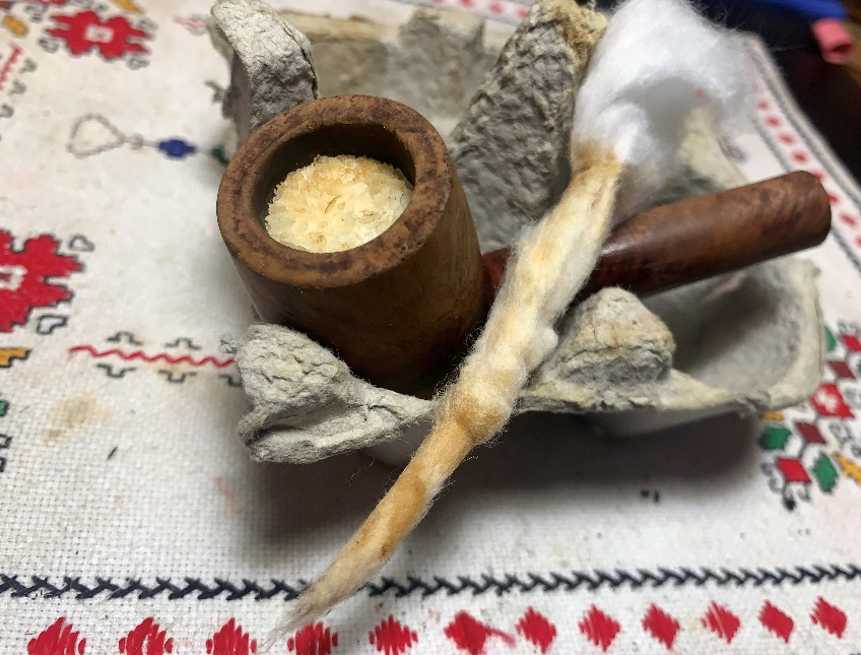
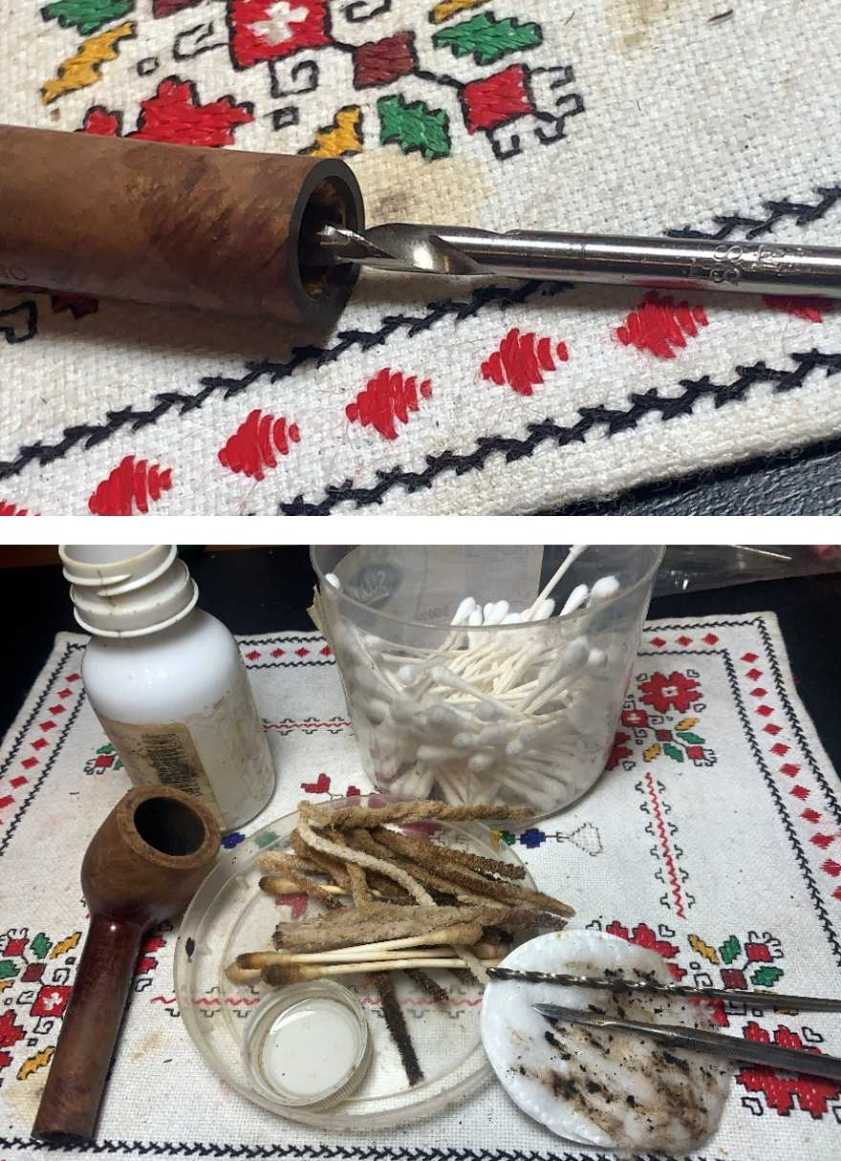 The hour is late and to continue the internal cleaning, a kosher salt and alcohol soak will be used. This slow cleaning method helps to draw tars and oils from the internal briar and to freshen the briar. A cotton wick is formed by pulling and twisting a cotton ball. The ‘wick’ helps to draw the tars and oils from the briar.
 The cotton wick is guided down the mortise and airway with the help of a stiff wire. I managed to bring the wick all the way to the draught hole.
 Next, kosher salt is used to fill the bowl. Kosher salt is used because it will not leave an aftertaste unlike regular iodized table salt. With the stummel placed in an egg carton for stability, the rim and end of the shank are angled to be roughly level. Isopropyl 99% alcohol then fills the chamber till it surfaces over the salt.
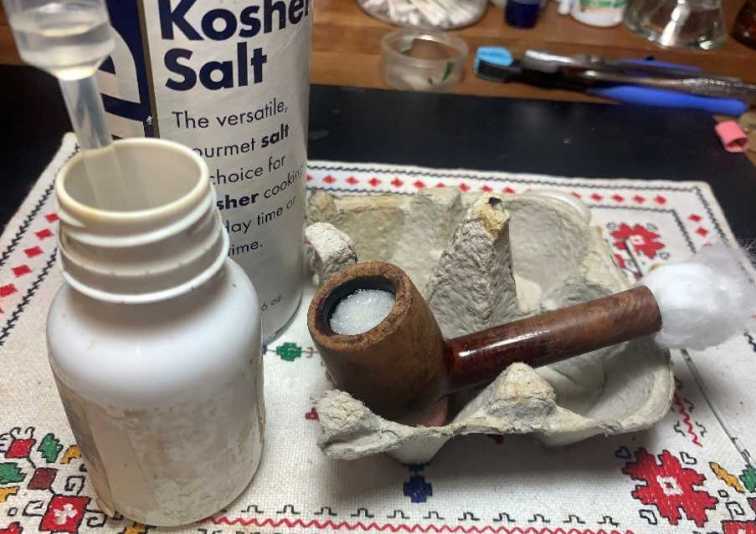 After a few minutes, the alcohol is absorbed and again the alcohol is topped off. The soak will continue through the night.
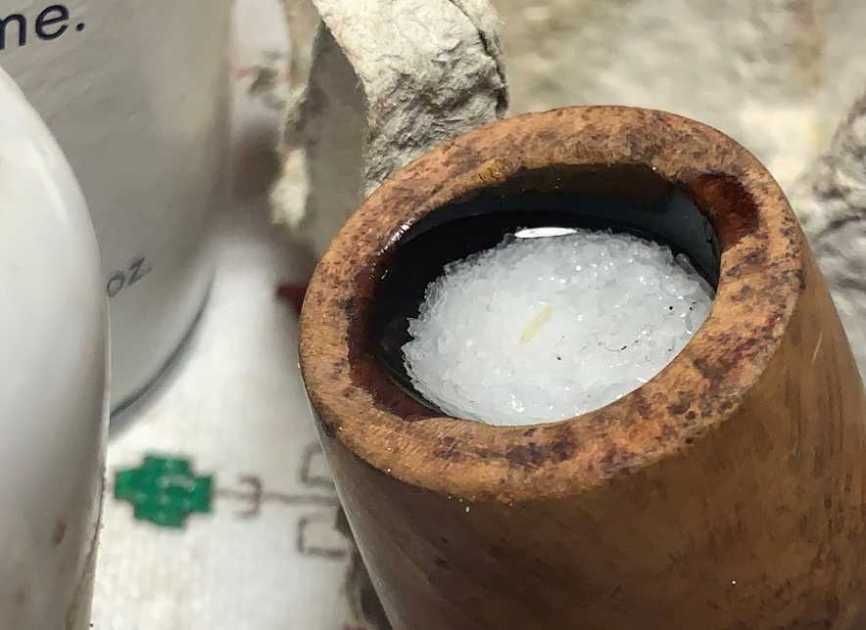 The next morning, indicators of the cleaning processes happening through the night are the soiling of cotton wick and salt.
  To confirm the cleaning, a few cotton buds and pipe cleaners are used, and the internals are as clean as I’m able to make them!
 Looking now at the results of cleaning the stummel, most of the old finish is gone and what is hanging on is in stark contrast which almost looks like a wet spot on the briar. The areas still holding on to the old finish are the shank and the crook.
 Using acetone with a cotton pad, the residual finish is removed from the stummel. I’m surprised that the finish residue appears to be an Oxblood or reddish hue – hmmm. I’ll need to think about this. My thoughts up to this point have been simply to go with the natural briar hue which is what I thought I was looking at 😊. Now that I see the reddish hue on the pad, looking at the pictures above, the finish is definitely bent in that direction, but the natural briar looks good.
 With all the cleaning, the cork lining in the mortise seems to be ok.
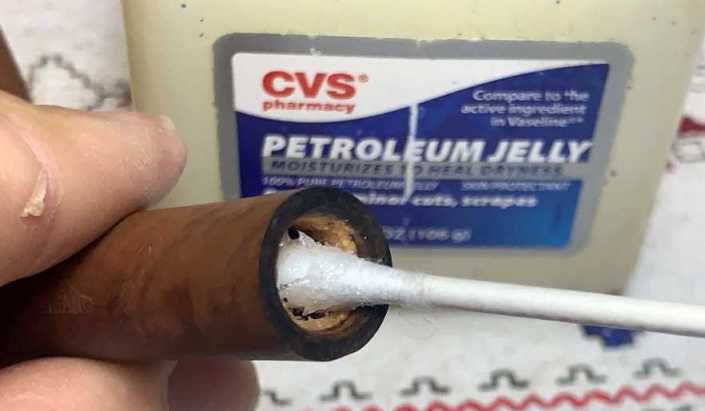
 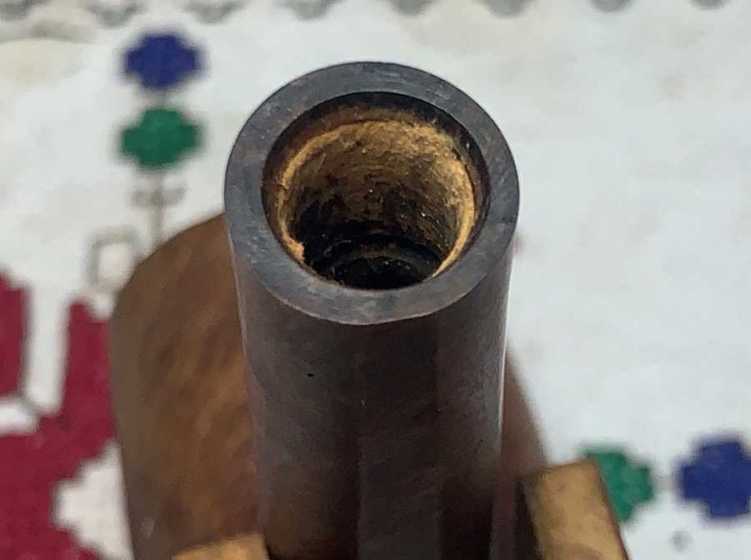 Whenever cork is used for fittings on a pipe, it’s a good idea to condition it so that it doesn’t dry out and then become prone to cracking and crumbling. Petroleum Jelly is used to accomplish this. Using a cotton bud, the Petroleum Jelly is swabbed over the cork.
 Looking now more closely at the stummel’s condition, the rim is full of edge wear both on the outside and inner part of the rim. The best way to address this is to top the stummel to restore a smooth surface and lines.
 There are a couple issues on the stummel that need addressing – the cut on the lower left bowl quadrant and just below this, on the heel, the briar has been skinned from contact with hard surfaces.
 I’ll start from the top and work my way down. First, 220 grade paper has been placed on a chopping board and this becomes my portable topping board. The goal is to take as little as possible off the top in order to refresh the rim. A starting picture is taken to mark the progress.
 With the stummel inverted, it is rotated a number of times on the 220 paper. The progress is checked as I go along.
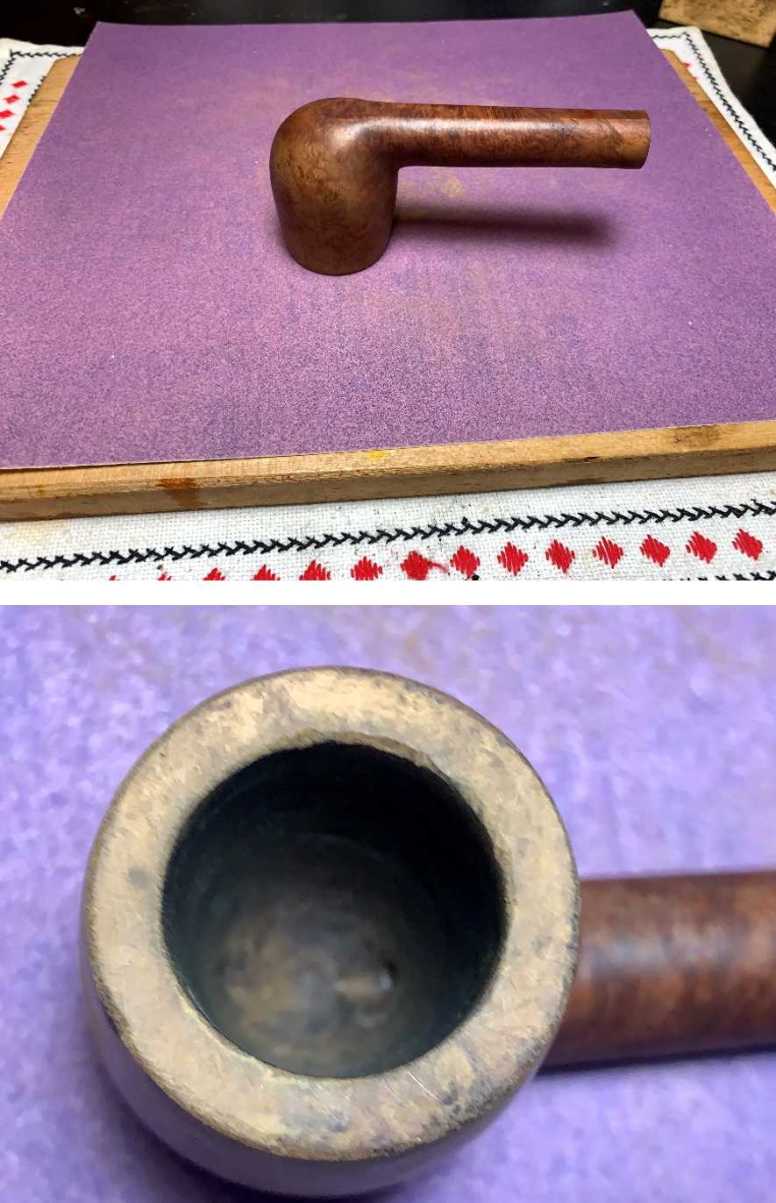 Enough briar has been removed from the rim at this point with 220 paper.
 The 220 grade paper is exchanged for 600 grade paper and the rotation continues.
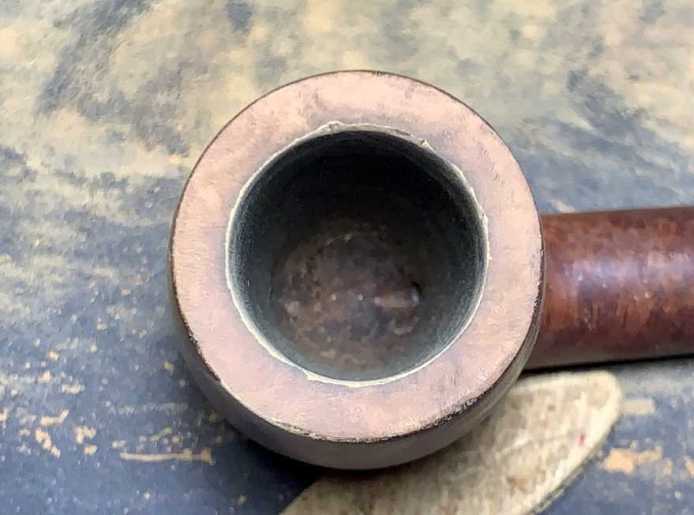 After a time, I like the condition of the rim plateau. It looks great, but the picture below shows the remnants of damage to the outer and interior rim edge.
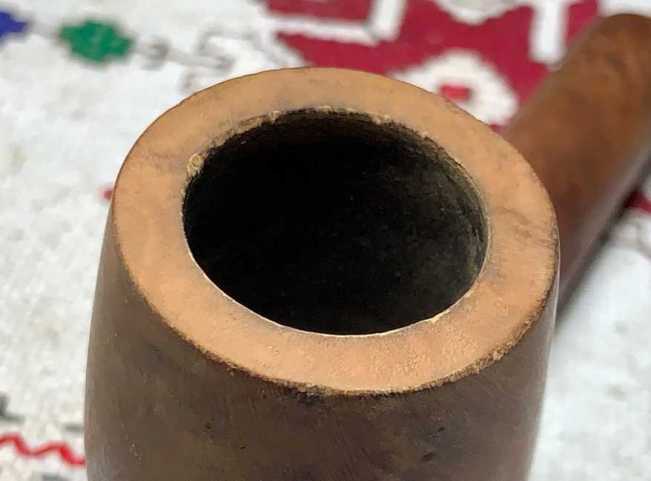 To address the remaining nicks and dents on the inner rim edge, a smart bevel is cut using a strip 220 paper wrapped around a wooden sphere. As the picture shows, as the paper is pinched around the sphere, the sphere is rotated in the inner rim edge.
 The 220 paper is followed in the same way with 600 grade paper.
 The resulting bevel looks good. The outer edge of the rim will be addressed when I get to the general sanding later.
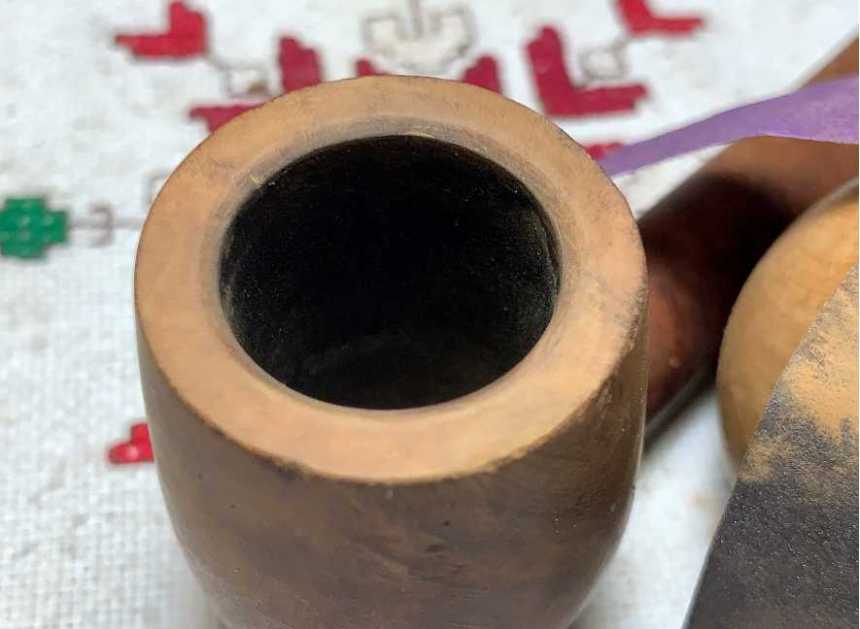 The two issues I see on the stummel surface needing to be addressed are the cut on the lower left quadrant of the bowl and a skinned patch just beneath it. First, the cut is cleaned with a sharp dental probe.
 Regular clear CA glue is applied to the cut and then briar dust is sprinkled over the wet patch to help with blending as the patch cures.
 After the patch has thoroughly cured, the flat needle file is used to file down the excess patch material flush with the briar surface.
 This is followed by sanding the patch with 220 paper and then 600 grade. It can’t be helped when sanding like this is needed it leaves behind a lighter patch of briar where the patina has been removed with the patch work. Continued sanding will darken the area, but the patch may continue to be visible to some extent.
 The next issue is the skinned spot that probably resulted from the pipe being placed on a hard (concrete?) surface.
 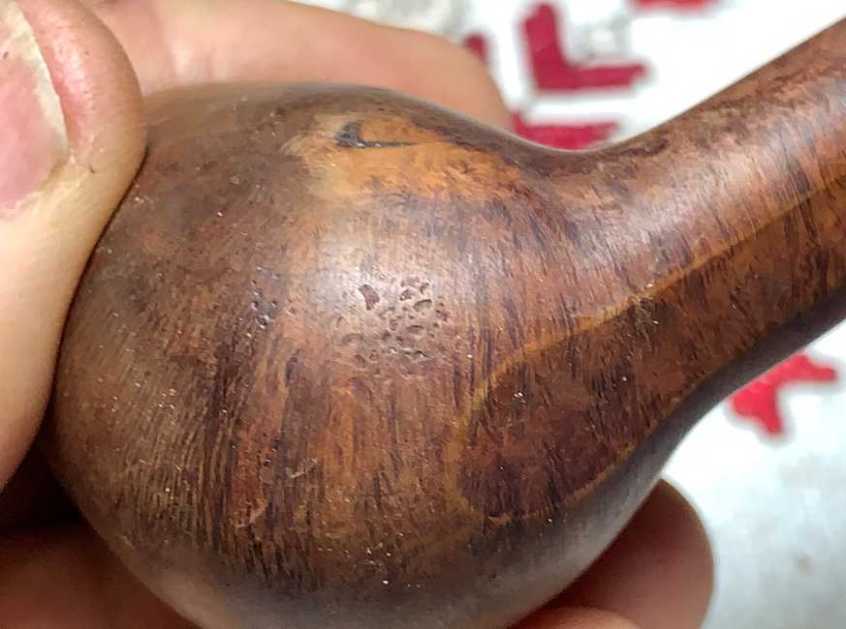 Sanding first with 220 paper the skin pits are sanded down. This is followed by sanding the area with 600 grade paper.
 To address the entire stummel, to clean the edge of the rim and to erase small scratches on the surface, two sanding sponges are used – a medium grade and light grade. The grain on the Milano Lovat stummel is looking good.
 Continuing with the sanding/polishing of the stummel, micromesh pads are applied. The pads are applied in sets of three – 1500 to 2400, 3200 to 4000, and 6000 to 12000. Between each pad, the stummel is wiped with a damp cotton cloth to help clear away dust and improve the traction of each pad.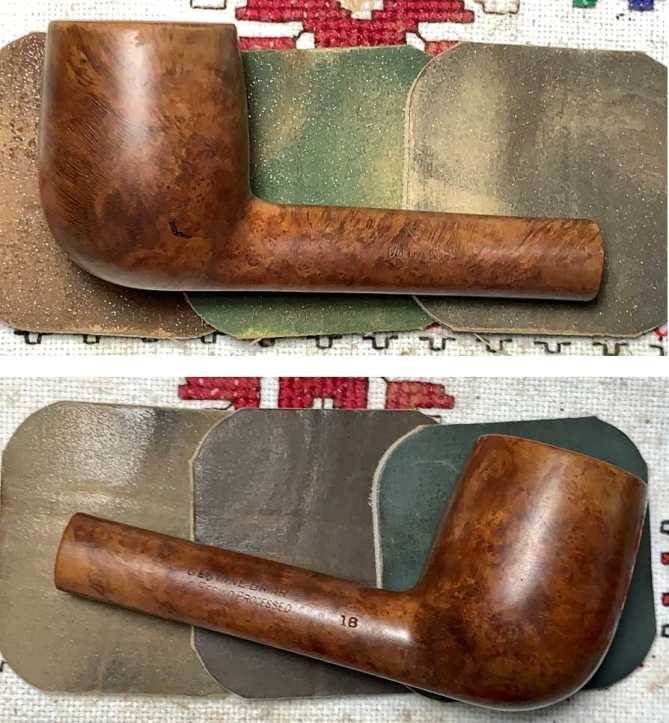
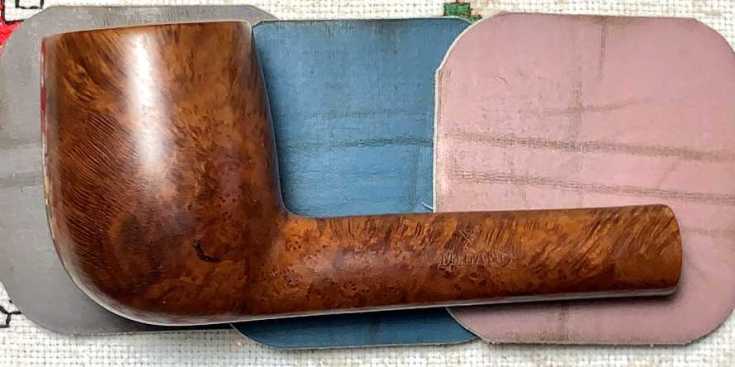 Wow! As I watched the grain emerge through the micromesh process and how the briar darkened to a natural glow, the debate I had going in my mind about applying a dye to this stummel evaporated into oblivion. This WDC Milano GENUINE briar needs no help from me. The natural hues and grain are good to go. However, Mark Hoover’s excellent product, ‘Before & After’ Restoration Balm makes what is already eye catching, better. The Balm takes the natural hues and brings them out even more distinctly. Some Balm is placed on the fingers and worked into the briar. It starts out with a creamy texture then thickens into a wax as it’s worked into the briar. After thoroughly applying the Balm, the stummel is set aside for about 15 minutes to allow the Balm to do its thing.
 After the time has passed, a microfiber cloth dedicated to Balm removal wipes off the excess balm and buffs the wood very nicely. Not bad.
  The stem has been soaking for several hours in alcohol with the hope of breaking loose the nickel fitment to be able to clean. Needle nose pliers were able to grip the ribbed end piece and rotate. As the tube begins grudgingly to rotate, I discover that the cylinder is not pressure fit but threaded as the next picture shows.
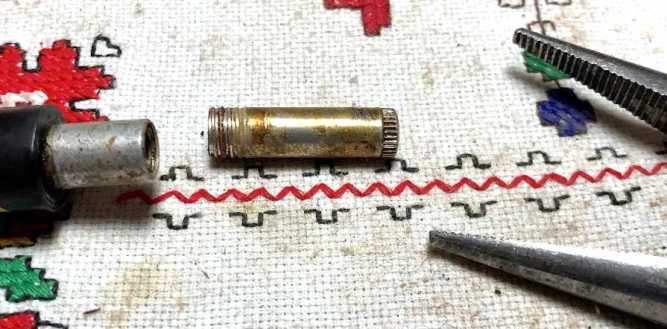 Looking into the cylinder, I can see a small air tube coming into the open area – I assume that this open area is the ‘#15 trap’ described in the patent information above. The trap is where all the good stuff is collected.
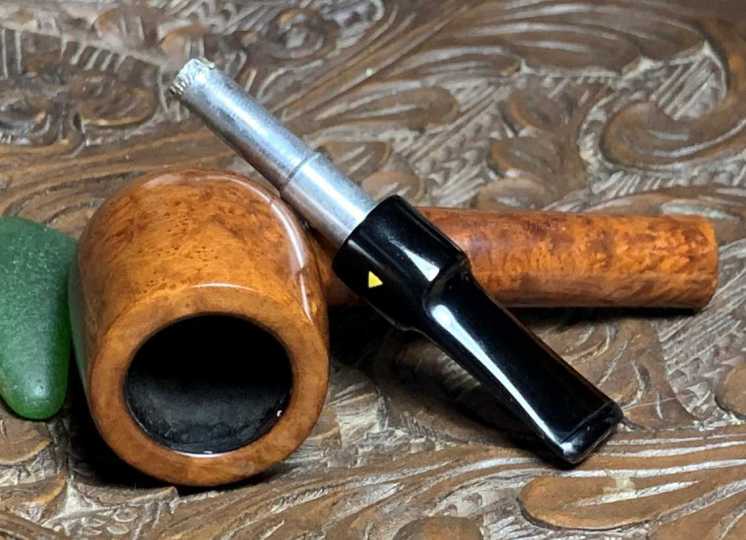
  Next, looking into the tenon cylinder, another air tube enters the trap area from the opposite direction. The general concept is that the two tubes enter the trap area from different directions but do not meet. This leaves an open-air cavity that collects the moisture as the air flows ‘above’ the gunk from the shank-side air tube to the tenon side air tube. When the cylinder is threaded tight, it forms an air tight connection so that the air only moves through the tube system.
  One plunge into the cylinder with a cotton bud shows the muck that has collected and waiting for some time to be liberated! As I work on cleaning the cylinder, it becomes apparent, at least I think it’s apparent, that the ribbed end of the cylinder SHOULD come off – I’m assuming it’s threaded as well. The reason for this ‘apparent’ thinking is that cleaning the cylinder is very difficult with the air tube protruding into the cavity. All the gunk circles the air tube and getting it out requires working around the air tube with a pipe cleaner or toothpick or a dental probe. Care is given cleaning this way.
  I try to rotate the ribbed end of the cylinder with pliers to no avail. The decision is made to let the cylinder soak in WD40 to see if it can penetrate the connection allowing it to be unscrewed. We will see.
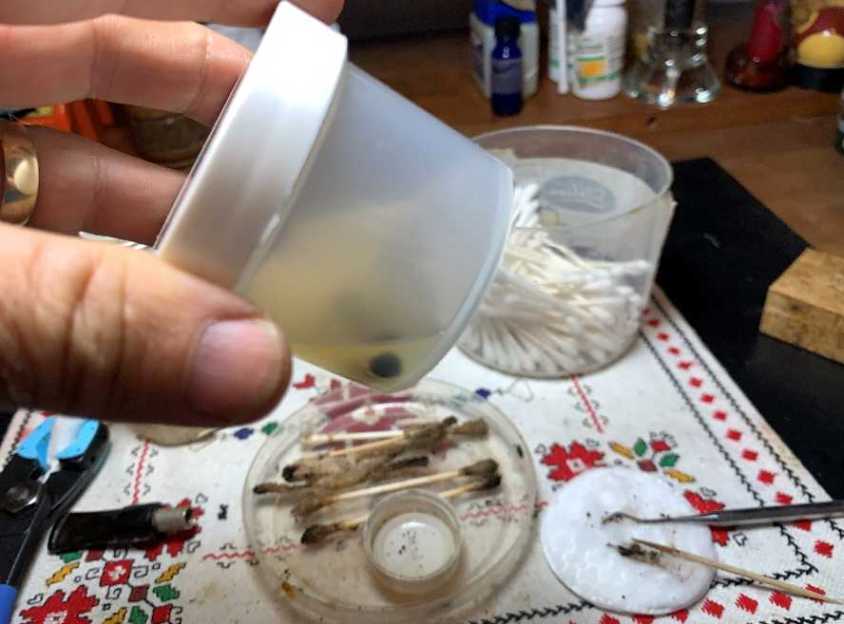 With the cylinder soaking, work continues on the tenon which has the same issue – a protruding air tube. I see no way of simplifying the cleaning process on this end, so pipe cleaners and isopropyl 99% paired with some toothpicks and cotton buds do an adequate job. 0000 grade steel wool also does a good job sprucing up the nickel tenon and threads. A word of advice to a new steward of this 1930s technology – clean after use!
 The short Lovat saddle stem is in decent shape. There’s a couple bite compressions on the upper side and a compressed button on the lower side. To minimize these compression, the heating method is used to expand the vulcanite to reclaim its original shape. To do this, a Bic lighter is used to paint each side with flames. As the vulcanite heats, it expands, and the compressions are lessened to a degree. After the heating process, before and after pictures show the results. The compressions are still visible, but sanding should easily erase the damage. Upper:
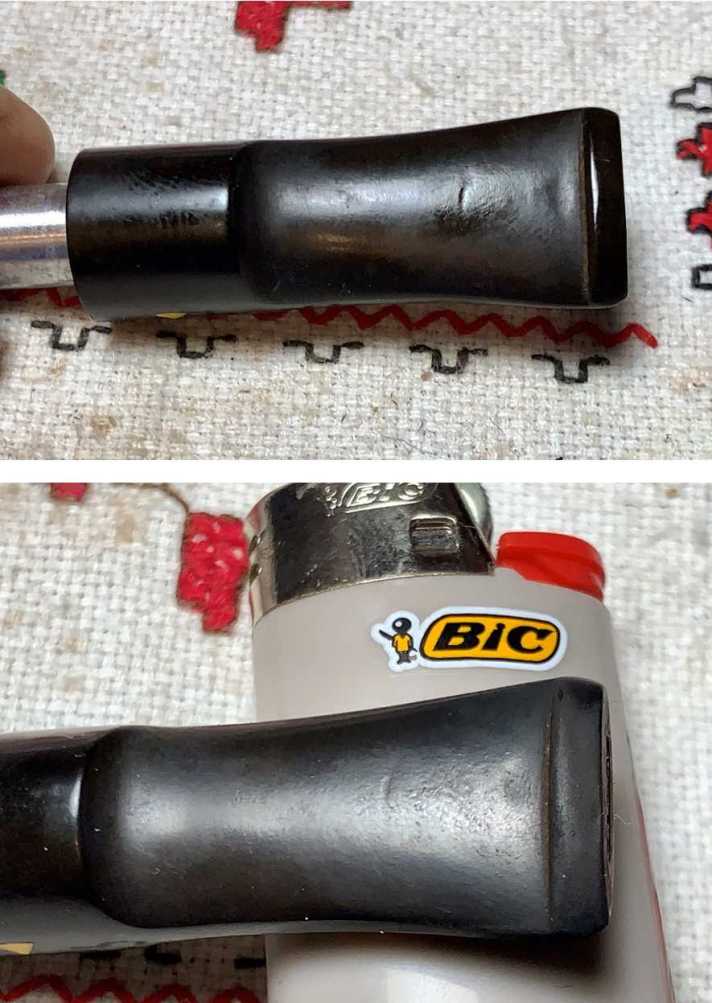 And the lower side:
 The bit is next sanded with 220 grade paper to erase the compressions and to deal with any residual oxidation.
 The sanding is expanded to the entire stem using 470 grade paper.
 Next, the stem is wet sanded with 600 grade paper, and this is followed by applying 0000 grade steel wool.
 The sanding/polishing continues with the application of micromesh pads beginning with wet sanding with pads 1500 to 2400. Dry sanding follows with pads 3200 to 4000 and 6000 to 12000. Between each set of 3 pads, Obsidian Oil is applied to condition the stem and to guard against oxidation. After sanding, the stem looks great.
 Well, in the interest of full disclosure and thanks to Todd for his resilient patience, the saga of the aluminum fitment will not be resolved. After soaking in WD40 and trying to remove the end cap proved to be fruitless, I reached out to Doug Bisbee of DK Metal Pipes (See LINK). Doug has helped before on issues having to do with metal pipes. I wrote to Doug asking for his advice on removing the lodged cap from the aluminum tube. His advice was to give the cylinder a long soak in alcohol and then use a soft grip vice (aluminum clamps) to squeeze gently the circumference around the end beneath the cap. Doug was hopeful that the soak and gripping would do the job. Well, the soak in alcohol lasted about 6 weeks as my wife and I traveled in the Pacific Northwest camping and visiting places such as Yellowstone, Grand Tetons, and Glacier national parks. The cylinder soaked throughout this time as work on the pipe waited for our return to Golden, Colorado, home of Coors Beer and home-base for us.
 Upon our return, I returned to the worktable hopeful that the cap would loosen and be able to be removed from the cylinder. Not wanting to mangle the soft metal, the cylinder was clamped in the vice using aluminum clamps and a soft grip pair of pliers. When this failed to work, regular needle nose pliers was used to try to rotate the cap. This did not move the cap either but chewed up the end a bit some because of the metal on metal contact.
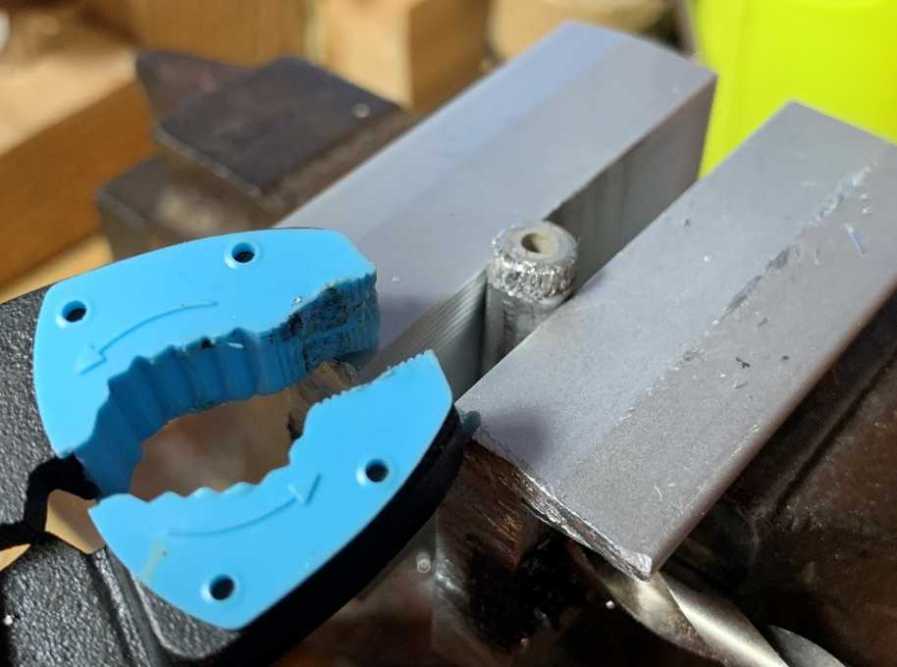 After reaching out to Doug one more time for any additional recommendations, the decision was reached to quit before something catastrophic happened to the cylinder. The new steward will need to give a little more care and effort to clean the cylinder. This can be done, but it will be an additional effort.
 After the cylinder is re-threaded with the stem tenon/cylinder the WDC Milano ‘well trap’ was again in business.
 After the stem and stummel are reunited, the rotary tool is mounted with a cotton cloth buffing wheel for the application of Blue Diamond compound. With the speed set at about 40% full power, the compound is applied to the entire pipe.
 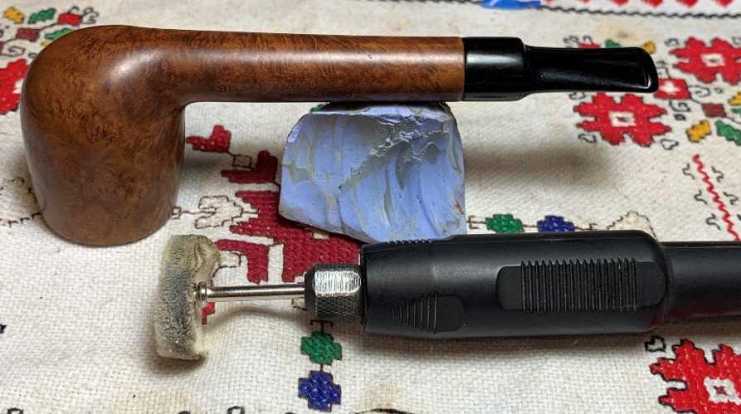 After application of the compound, compound dust has collected over the surface. A felt cloth is used to buff/wipe the dust off in preparation for the application of wax.
 The cotton cloth buffing wheel is exchanged for a wheel dedicated to wax. With the speed the same, carnauba wax is applied to stem and stummel. After the wax is applied, the pipe is given a rigorous hand buffing with a microfiber cloth to both remove excess wax and to raise the shine.
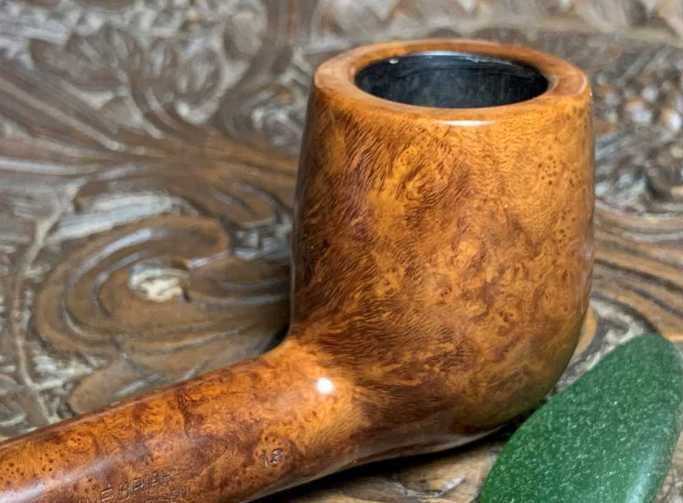
 It took quite a while for this WDC Milano DeResino Processed Lovat to be restored, but I’m pleased with the results. I wish I could have removed the cap from the well trap for easier cleaning, but this was not to be. The pipe has some vintage dating between the 1930s and 50s. the grain is bold and eye-catching. The Lovat bowl has plenty of room for a good amount of one’s favorite blend. Todd commissioned this pipe and will have the first opportunity to acquire it in the Pipe Steward Store benefitting the Daughters of Bulgaria – helping women and girls who have been trafficked and sexually exploited. Thanks for joining me!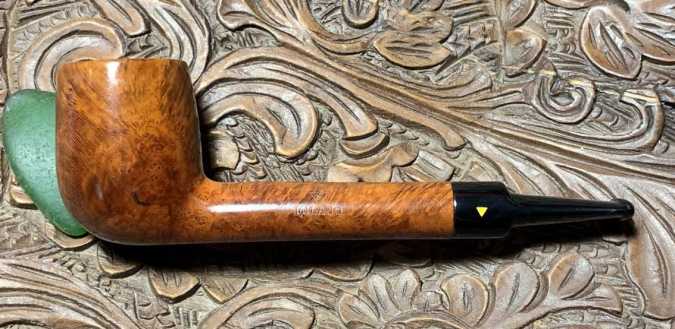
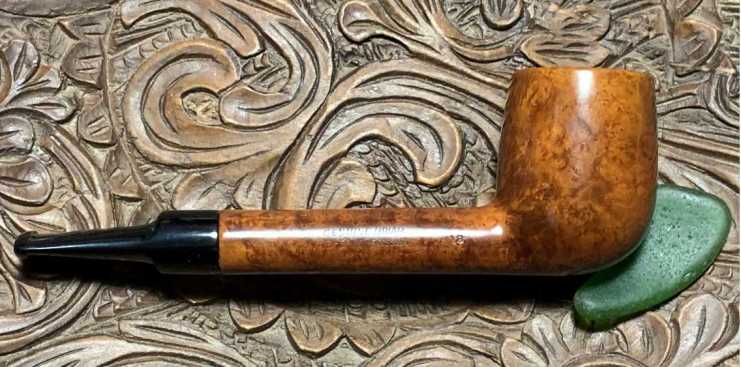
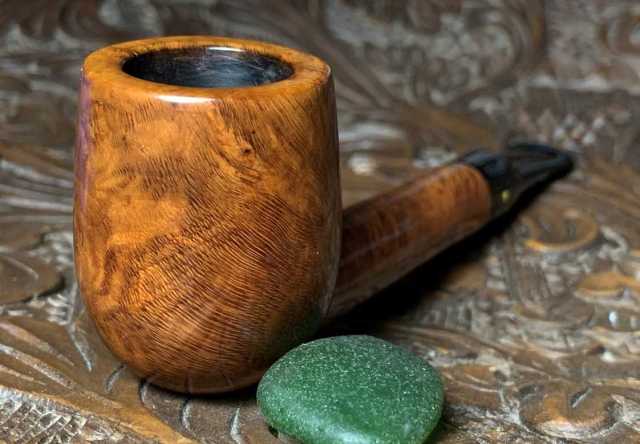

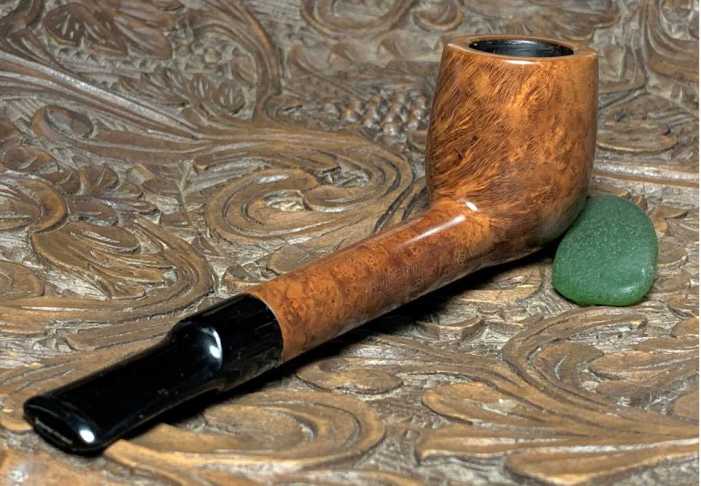


 The Pipe Steward

Absolutely magnificent and masterful write up! Thoroughly impeccable restoration and workmanship! Love this pipe and can’t wait to add it proudly to my collection! The tough decisions are (1) which blend to smoke in it; and (2) which of Dal’s inventory of needy pipes is next for me to commission.
LikeLiked by 1 person
Thanks so much Todd!
LikeLike