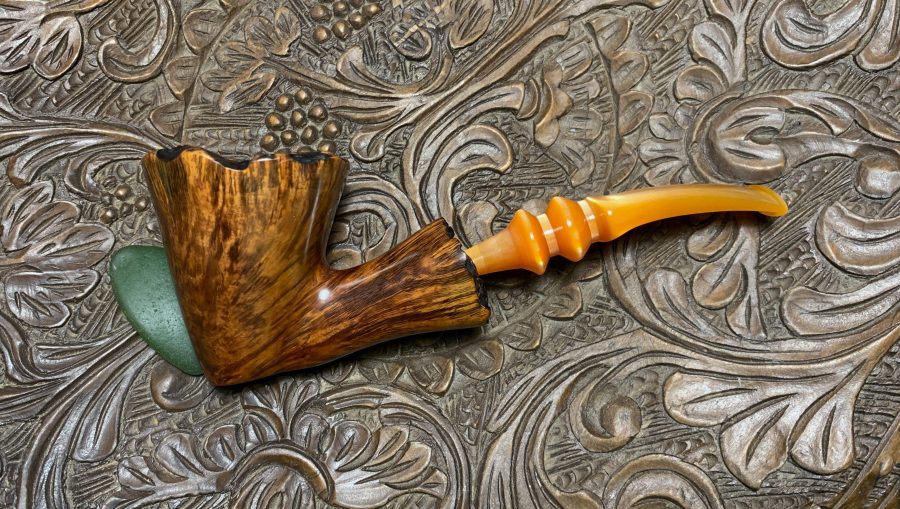
With Christmas soon to come, I have received commissions from loved ones of very fortunate pipe men. This beautiful Nørdin Freehand was commissioned by Jocelyn who wrote to me with this request:
We live in Butler PA, USA. My husband, Mark, is an avid pipe smoker. I would love to give him a unique, possibly historical, pipe as a Christmas gift. I would also like to support Daughters of Bulgaria in the process.
Do you have a pipe available you would suggest? If not for Christmas, his 60th birthday is next August, and I could plan ahead for that. I appreciate your help. Thank you, and God’s peace be with you.
Jocelyn
I was already acquainted with Jocelyn through the church she attended in Butler, a church that has supported my wife and me for many years. She also stood out to me because my eldest daughter also has the name, Jocelyn 😊. What I appreciate also is that Jocelyn’s desire to gift her husband with a great pipe is complimented by her desire to support the ministry of the Daughters of Bulgaria which my wife and I co-founded in Bulgaria some years back. My recommendation to her was to look through the virtual ‘Help Me!’ baskets in the For “Pipe Dreamers” ONLY! collection to see if a pipe would whisper to her – ascribing to the Harry Potter philosophy with wands but with pipes: The pipe chooses the steward’. One did. The Nørdin came to me in August of 2021 in what I call the Lakewood Lot of 14 pictured here. I met a fellow pipean in Lakewood, Colorado, just south of Golden where we live, who was selling a zero-gravity recliner on Facebook Marketplace which I had my heart (and back!) set on. When I went to look at the chair with the hope of purchase, I pulled up into the driveway and the man who I would eventually purchase the chair from was sitting outside in his chair with pipe in hand. Of course, conversation followed with Ron, and I discovered that he was downsizing his collection for health reasons. On a subsequent visit to see his pipes, my wife and I enjoyed his hospitality.
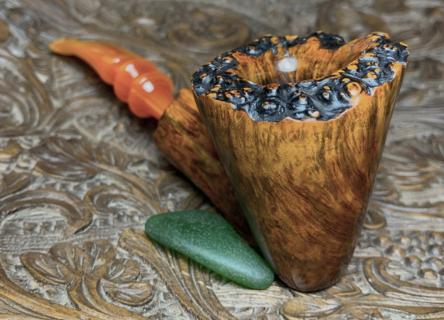
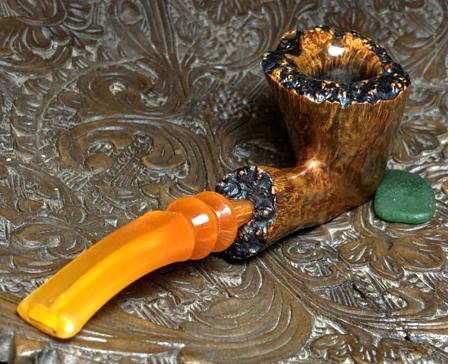
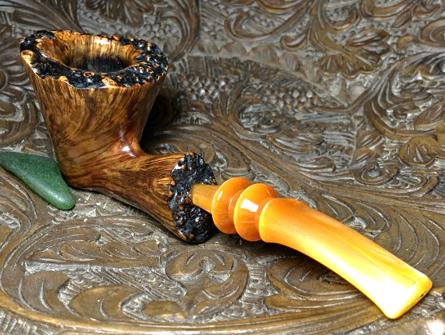
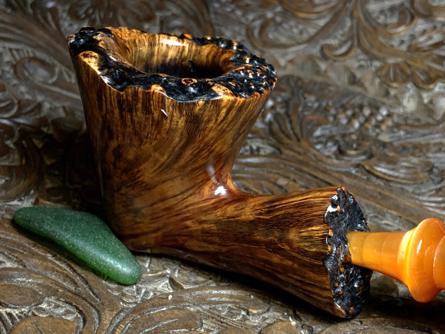
 In the end, I acquired 2 different lots of pipes from Ron who obviously had a soft heart for Danish Freehands. The Nørdin that Jocelyn chose for her husband, Mark, chose a diamond. Here are pictures of the Nørdin Made in Denmark Freehand destined for a place under the Christmas tree in Butler, PA.


 On the back of the shank is stamped the nomenclature: NØRDIN [over] MADE IN DENMARK. The Freehand is an excellent example of the Danish philosophy, ‘Follow the grain’. The grain reaches out over the large block of briar. Both the bowl and shank plateaus give the craggy landscape that stands in contrast to the smooth, flowing briar grain. Pipedia’s article on Nørdin is a book and begins with a brief overview of the man behind the Nørding name (LINK):
Erik Nørding was born in Copenhagen, Denmark. Originally educated in engineering. Pipe carving began as a hobby, but as time went by, he became more interested in pipe making as a profession. During the last 40 years Erik Nørding  has built his own business, which today produces approximately 50.000 pipes a year, 90% of which are for the export market. From pipe design innovations to knife making to custom machinery and barbecue cookery, Erik Nørding´s inventiveness keeps expanding.
A blacksmith and engineer, Nørding knows his way around pipe making machinery. Strangely, it was not his love for woodworking that propelled Erik Nørding into the pipe making field — it was his terrific facility with machines.
This overview is then followed by an extensive interview with Erik Nørding by Chuck Stanion. I include the opening of the interview because I like the way the author sets up the ‘kind of man’ has his name stamped on 1000s of pipes:
“I started as a blacksmith at age 15,” he says, sitting comfortably in the game room of his home outside of Copenhagen, Denmark. He looks like a blacksmith. As he smokes his pipe, his hard, powerful hands seem to overpower the simple tasks of lighting and tamping. “My father was a blacksmith and an engineer,” he says. “He had a razor blade and garden tool factory and passed away when I was 16 years old. I started working as a boy in the factory on a stamping machine, just to earn some money.”
He pauses to remember, looking up toward the ceiling. The walls are lined with hunting trophies. Thirty or 40 game animals stare glassily from their mounts into the center of the room: Black bear, grizzly bear, antelope, elk, moose, deer, impala, wildebeest, gnu, wild boar, caribou — even a huge tiger shark. Nørding is the Ernest Hemingway of pipe makers, an inveterate sportsman.
The last description of Nørding I find especially poignant – Nørding is the Ernest Hemingway of pipe makers, an inveterate sportsman. I will not include the entire article, but the story of how Nørding became a pipe maker is worth archiving here:
Long before he graduated from engineering school at age 25, he was a more experienced pipe smoker than most men his age. He frequented a pipe shop in Copenhagen and often had his pipes repaired there. “The guy who did the repairs in that shop” says Nørding, “could see that it was a good business, and he wanted to start his own pipe making shop.” That repairman’s name was Skovbo. One day he approached the young Erik Nørding with a proposition. “You are a blacksmith and an engineer,” Skovbo said to Nørding. “You must know a lot about machinery. Can you make me some pipe making machinery?”
“I told him I could make anything he wanted,” says Nørding. “But I didn’t have any money. So, I borrowed S200 to buy some bearings, and I scoured junkyards for old broken machinery. I bought inexpensive housings and put in new bearings and new shafts.” It was Nørding’s first contract, and he wanted to get a good start, so he took great care in making the best possible tools for the pipe maker. “I made him a little polishing machine, and a lathe, and a sander for shaping pipes.” When he had everything put together and running perfectly, he called Skovbo and told him his machinery was finished.
 “He came out and looked it over,” says Nørding. “He turned on the electricity and watched everything run. He had some blocks of wood with him, and he tried everything out. Finally, he looked at me and said, ‘It’s exactly as I wanted. Perfect. How much do I owe you?’ I told him the price — I don’t remember how much it was, but it was very inexpensive.”
Skovbo thought the price was very good. “That’s fantastic,” he said. “The price is right. Now I’ll start out for myself, make some pipes and when I earn some money, I’ll pay you.”
It must have been a terrifically discouraging moment for a young man who had just completed what he thought was his first paying job in a new career. As Erik Nørding now remembers that moment, sitting in a beautiful home that contains a pipe making shop large enough for 20 workers making tens of thousands of world-famous pipes, his face exhibits amusement at that memory. But back then, as a youngster trying to get a foothold in the world, his expression must have been more akin to horror. “I told him that was not good enough,” says Nørding. “I told him I was a poor man, I didn’t have any money, I needed to be paid for my work.” But Skovbo told Nørding that he couldn’t pay him.
“Then I will keep the machinery,” said Nørding. “I’ll make pipes myself.”
“You don’t know how to use this machinery,” said Skovbo. “You know nothing of pipe making.”
“Well, you’re not getting it. You should have told me before I did all this work that you didn’t have the money to pay for it.”
Skovbo thought it over. “Why don’t we start together?” he said.
That’s how Erik Nørding became a pipe maker.
 The partnership that was born between Skovbo and Nørding produced the line of pipes in the early 1960’ called SON (combination of names in Danish: Skovbo og Nørding). In the mid-60s, after Nørding bought out Skovbo, he changed the company name to Nørding. According to the Pipedia article,
Consumer interest in Danish freehand pipes helped Nørding expand throughout the 1970s and early ’80´s. “They were easier for me to carve,” he says, “because nobody in those days knew the free-hands. We were making thousands and thousands of those.” The Nørding factory at that time reached its peak production, and Nørding employed 52 workers.
Things have slowed somewhat since, and currently Nørding employs 6 pipe makers, who produce approximately 15,000 pipes a year. They work in the shop that takes up the lower level of the Nørding residence. It’s spacious, more than 800 square meters, with three main workrooms, several smaller offices, and a large storage area for the 20,000 blocks of briar kept on hand, which comes mainly come from Corsica and Greece. “I don’t age it,” says Nørding. “I allow it to dry properly, so it ages a little during that process, but once it is dry it’s fine for pipe making. All this talk about it being necessary for briar to age 30 years or whatever for good pipes, in my opinion, is nonsense. I’ve seen every stage of harvesting. I’ve been out digging the briar; I’ve been to sawmills; I’ve experienced everything. And I’m telling you, once you can dry a piece of briar without it cracking, it is ready to work.”
Nørding’s website (Nørding Pipes Home) includes more great information about Nørding and their current offerings. Today, the Nørding family is carrying on what Erik began. Erik’s son and grandson, Knud and Victor, have joined the patriarch in continuing the family business.
With a deeper understanding and appreciation for the Nørding name, it’s time to look closer at the Nørding on the worktable. This Freehand is a beauty. Often, I struggle with not adding pipes to my personal collection rather than putting them in the Pipe Dreamers collection. This is one of those times! This project is more of a refreshing rather than a restoration. The chamber has a cake build up which needs to be cleared for fresh briar to emerge. The bowl needs to be cleaned of grime and the plateaus refreshed. The orange marmalade, honey acrylic stem is striking and in good condition, but it does have tooth chatter needing to be addressed.
The first step in refreshing this Nørding Freehand is to clean the stem’s airway with pipe cleaners and isopropyl 99% alcohol. It didn’t take much to clean. Putting the stem to the side, cleaning the stummel is next beginning with removing the cake from the chamber. A starting picture shows the 2-inch depth of the chamber – a lot of one’s favorite blend will pack down nicely in this chamber.
 Since the chambers of Freehands are so deep, they are also canonical with the taper tightening as it descends. My antique Kleen Reem Pipe Tool is what I use in such situations. I found this artefact at a Flea Market in Kentucky, and it has been a helpful tool. The jaws can contract and reach down to the tight floor of the chamber and the jaws expand as the knob on the top is turned. As the tool reams starting from the floor, it is backed out gradually and with a small turn of the knob the jaws expand just enough to snug up to the widening slope of the chamber walls.
 After reaming with the ‘Kleen Reem’, the Savinelli Fitsall Tool is used to scrape the chamber wall further removing more carbon cake build up. It can reach into the hard-to-get places well.
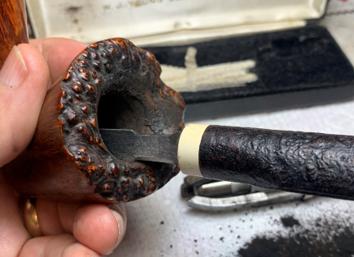 Next, to further clean and smooth the chamber, 220 paper wrapped around a Sharpie Pen is used to sand the chamber.
 The full arsenal on display.
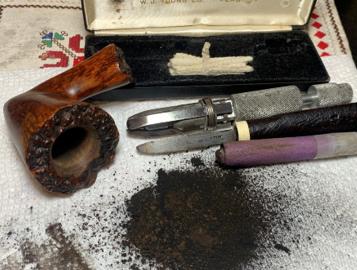 A quick inspection of the chamber reveals healthy briar – no heating veins or fissures.
 One bonus that I discover during the process of removing the cake and the lava flow at the edge of the plateau is the smooth briar patch between the crags of the plateau and the chamber. This will shine up very nicely and present a pleasing contrast from the steward’s perspective as he enjoys a bowl.
 Next, to clean the external briar undiluted Murphy’s Oil Soap is used to remove dirt and grime.
 The scrubbing starts with using a cotton pad then expands to using a bristled brush to clean the craggy knolls of the plateaus.
 After scrubbing, the bowl is taken to the sink where the internals are scrubbed using shank brushes and liquid anti-oil dishwashing soap with hot water. After the scrubbing, the stummel is thoroughly rinsed and returned to the worktable.
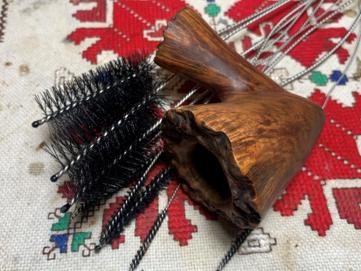 To continue working on the internal mortise and airway, bristled and smooth pipe cleaners are used to scrub with isopropyl 99% alcohol. Cotton buds are also used. After the buds and pipe cleaners emerge lighter, the internals are clean and it’s time to move on.
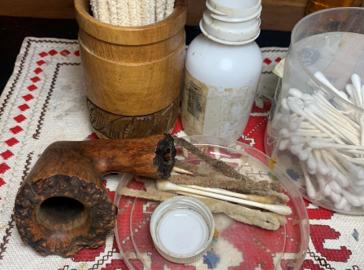 With the basic cleaning complete, I look at the stummel to see what is needed. The cleaning removed some of the back finish on the plateaus. New dye will be applied to refresh these. After the cleaning, the smooth briar on the plateau is more prominent. This area will be sanded with micromesh pads.
 Using the full regimen of 9 micromesh pads, the smooth briar patch is sanded with pads 1500 through 12000 grades. Between each pad, a damp cloth wipes off the dust and provides more traction for the following pads. The grain in the smooth briar pops now. I like what I see.
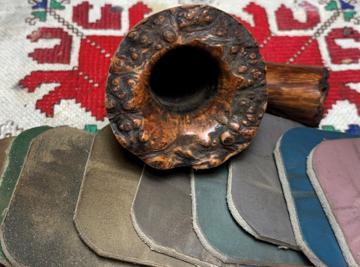 Looking over the briar landscape of the stummel, I see only miniscule scratches.
 To refresh the briar, which is in stellar condition already, only the finer of the micromesh pads will be used – 3600, 4000, 6000, 8000 and 12000 grade pads. Between each pad the surface is wiped with a wet cloth to remove dust and to give the next pad more traction.
 The next step is to apply Fiebing’s Black Leather Dye to the bowl and shank plateaus.
 A folded pipe cleaner is used to apply the dye carefully over the craggy landscapes on both plateaus.
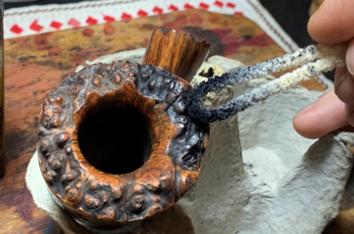 The finished look of the black dye applied refreshes the plateaus and sets off the contrast.
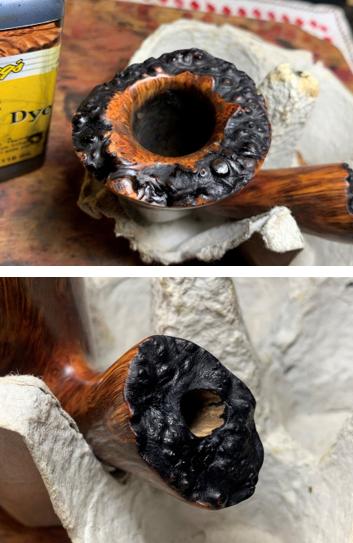 After the dye has set for a while, the peaks of the crags are sanded with micromesh pads 1500 to 3200 to reestablish the lighter contrasts of briar. This effect gives the briar a rustic feel. I like it.
 To condition the briar and to bring out the natural hues of the grain, Mark Hoover’s ‘Before & After’ Restoration Balm is used. After placing Balm on the fingers, it is worked into the stummel and the plateaus. When the Balm is first applied, it has a cream-like consistency. After it is worked into the briar it gradually thickens into a waxy substance. After thoroughly worked in, the stummel is set aside for about 15 minutes to allow the Balm to be absorbed in the briar.
 When the time has passed, a dedicated micromesh cloth is used to wipe and buff off the excess Balm. This Restoration Balm never disappoints.
 The ‘marmalade’ and honey marbled acrylic stem is striking. The shades of yellow, gold, tan… hold the eyes with no problem. The acrylic has tooth chatter pressed into the upper and lower bit which needs addressing.
 The bit area is first sanded with coarser 220 paper to remove the chatter upper and lower.
 The bit sanding continues next with 470 grade paper – upper and lower.
 The sanding is expanded to the lower stem by wet sanding with 600 grade paper.
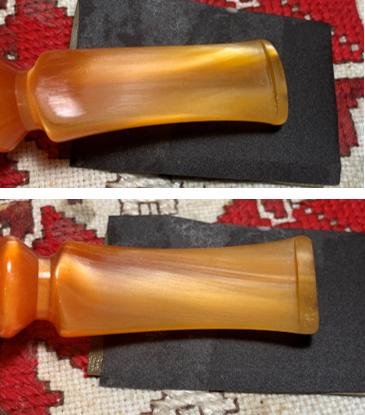 Next, the entire stem is sanded with micromesh pads beginning by wet sanding with pads 1500 to 2400. Following this, dry sanding is done with pads 3200 to 4000 and 6000 to 12000. To condition the acrylic Obsidian Oil is applied between each set of three pads. The acrylic finishes the cycles with that glossy, wet-looking pop. Very nice.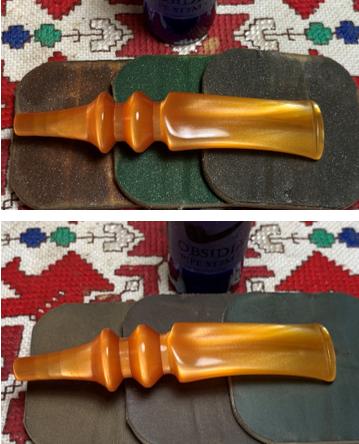
 Next, the acrylic stem and stummel are reunited and after mounting a cotton cloth buffing wheel to the rotary tool, Blue Diamond compound is applied. Blue Diamond is a very fine abrasive which further polishes the surfaces. The rotary tool is set at about 40% full power.
 The compound is not like wax, but a fine powder which accumulates on the surfaces during application. To clear this dust off in preparation for the application of wax, a felt cloth is used to wipe off the debris.
 The final step – Another dedicated cotton cloth buffing wheel is mounted on the rotary tool with the speed at 40% full power. Carnauba wax is then applied to stem and stummel. After applying the wax, the pipe is given a hand buffing with a microfiber cloth to remove excess wax and to raise the shine.
 This Freehand lives up to the name inscribed on it – Nørdin Made in Denmark. The dimensions are Length: 6 5/16 inches, Height: 2 1/4 inches, Plateau width: 2 1/16 inches, Chamber width: 3/4 inches, Chamber depth: 2 inches. This translates into a lot of pipe in the palm. The grain is flowing and distinctive. Living up to the Danish mantra, ‘Follow the grain’ – the bowl captures vertically oriented grain and the shank was shaped along the horizonal grain lines. The surprise for me is the ‘flames’ of smooth briar circling the inner plateau providing an eye pleasing scape for the steward. They do remind one of flames licking up from the campfire. The acrylic stem’s luminescent honey/marmalade marbling sets off the entire presentation. Jocelyn commissioned this Nørdin for her husband, Mark, as a gift for the Christmas tree. She has the first opportunity to claim the Nørdin from the Pipe Store benefiting the Daughters of Bulgaria – helping women and girls who have been trafficked and sexually exploited. Thanks for joining me!







 The Pipe Steward
Great story and outcome for the pipe! Did you get the zero-gravity recliner as well?
LikeLike
Yes, I sure did, and my back is thankful!
LikeLike