
This Ser Jacopo Rusticated Bent Egg came into my possession in a totally serendipitous way in June of 2021. The world was still up in the Covid frenzy, and my wife and I were still transitioning from life in Bulgaria to setting up shop in Golden, Colorado. One of the necessities of life I was looking for was a comfortable lawn chair that I could relax in while enjoying a bowl of my favorite blend in the back yard. My wife is the type of woman that is described in Proverbs 31, “An excellent wife who can find? She is far more precious than jewels….” One of the characteristics of this woman of jewels is that she has business acumen which is described as, “She is like the ships of merchants….” She found on an online market place what her grateful husband was longing for – a ‘zero-gravity’ chair. She reached out to the gentlemen living in nearby Lakewood who had it for sale and made the deal. That day, I drove to his house to pay the gentleman and to collect my new chair.
When Google maps found his house, I was met by a gentleman sitting in his chair in the shaded driveway puffing on his pipe. The money was paid, but when one meets another pipe man puffing in the wild, conversation was bound to happen. I found out that Ron seldom smoked his pipe these days per doctor’s orders, but he once had quite a collection but was selling it bit by bit. I shared what I did with pipes – collect, restore, and sell to benefit the Daughters of Bulgaria and that I would be interested to see what was left of his collection if he was still finding new homes for them. He went inside and came back out in a few minutes with some nice specimens – 6 stummels, but only 3 pipes mated with stems and one rogue stem. Thrown in were two genuine Czech tools. The stummels/pipes were on the ‘VERY’ nice side of things. He said that he had more pipes in a box inside that he would have to find, and he thought there would be more stems that needed to be mated. I asked if he might be willing to sell the others and his response was affirmative, but he needed to go through them first and would call me. We went ahead and settled on what I now call the Lakewood Lot of 6 in the hope of finding some stems looking for their mates! When I got the Lot of 6 home, I took this picture. The inventory from the top left down: Søren Hand-Carved Made in Denmark Freehand, Ice Age 636 K11 Italy Freehand, Ser Jacopo Per Aspera Ad Aspira Fatta A Mano R2 Italy Rusticated Egg. On the right side: Stanwell EGD No. 969-48 Hand Made in Denmark Freehand, Stone Ag e Walnut 607 Italy Freehand, and a Kaywoodie White Briar 76B Canadian.
Not long after this, Ron called and said he wanted to sell the rest of his pipes. It was a lot of 14 pipes with 2 stummels having cracks. My wife joined me when we went to look at the pipes in Lakewood. My hope was not only to see the pipes but to see if the missing stems from the Lot of 6 might be in the box!
 We had a great visit learning more about Ron as we talked. We discovered that Ron’s background was in intelligence, and he served in the AirForce then with NSA. His family is in eastern US, but settled in Denver area after a government job brought him West. We learned that he goes to a Baptist church nearby after my wife saw his well-worn NIV Bible on the end table and devotionals. He shared that he had had a rough background but was thankful to the Lord for his life now. I discovered also that we shared some strong affinities – Ron loves single malts – Glenmorangie is his favorite (like mine), and he has dirty martinis – like me! Clancy books on the shelves 🙂 as do I.
When we got down to business, he opened the shoe box and spread the Lot of 14 pipes on the leather ottoman before us. As I examined Ron’s collection, it became obvious he had an affinity for Danish Freehands. Yet, he had other higher shelf pipes that were beautiful. I also discovered that Ron was not one who kept stem/stummel pairings with strict adherence. Some of the mated pairs were not meant to be together – stems were mismatched in the Freehands, and a few stems were solo. Later on, I would have a good time as the match maker. The Lakewood Lot of 14 came home with us with an appreciation for the pipe man we had come upon selling my prized zero-gravity chair. When the pipes got home, I was able to mate the proper stems with the stummels. Only 13 are pictured below because one beautiful Freehand’s shank and stummel were completely broken – a project in the future. The pipes were uploaded to the For “Pipe Dreamers” ONLY! collection and several of these pipes have already been commissioned. The Ser Jacopo from the Lakewood Lot of 6 is among them. In the picture above, the lone black stem on the bottom right was mated with the Ser Jacopo stummel – it seemed to be the most likely candidate.
 Pipe man, Jeff, is a prolific contributor on the Old Codgers FB Group and I have enjoyed getting to know him interacting on comments and postings. Jeff first reached out to me looking at some Zulus in the ‘For “Pipe Dreamers” ONLY! collection, but in the end, he didn’t hear the whisper – in Harry Potter fashion, the pipe chooses the steward. I found out that Jeff, like me, is nearing retirement and resides in Dallas, Georgia. Later however, the Ser Jacopo got his attention. Here are pictures of it.

 On the left quadrant of the underside panel is stamped, PER ASPERA [over] AD ASTRA.
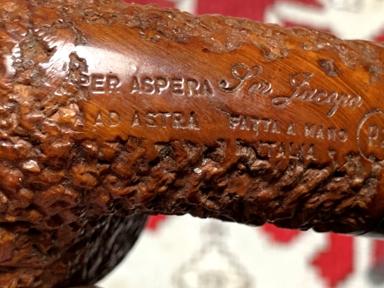 To the right of this in fancy cursive is stamped, Ser Jacopo [over] FATTA A MANO [over] IN ITALIA. To the far right stamped in a circle is R2.
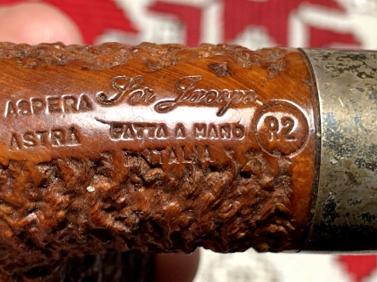 The only other marking I found was the .925 stamped on the shank cap indicating the grade of silver.
 Ser Jacopo is a well-known name and the pipes produced with this name stamped on them are exceptionally beautiful pipes. Because they are so well crafted, they are highly sought for and valued. Pipedia’s Ser Jacopo article is a good place to start to get a general overview of the name.
Ser Jacopo (provided by Marble Arch Ltd., US importer and distributor of Ser Jacopo)
 Ser Jacopo, better to say Ser Jacopo dalla Gemma, was started by Giancarlo Guidi in 1982 upon leaving Mastro de Paja.
Giancarlo Guidi and Bruto Sordini broke away from Mastro de Paja in 1981 in pursuit of their own company. Ser Jacopo was named after an Italian nobleman. Guidi and Sordini, having taken part in creating the now infamous Pesaro “school” of pipe making, wanted to expand further. To accomplish this, Ser Jacopo focused their efforts on the pairing of the briar with a seemingly endless variety of mounts. Through the use of precious metals and stones, horn, and exotic woods Ser Jacopo pipes are given unique characters that many collectors find quite aesthetically pleasing. Although Ser Jacopo pipes borrow heavily from classical shapes, they are indeed quite unique in style.
In addition to creative mountings, Ser Jacopo is also well known for making themed pipes, and the most famous of these themes is perhaps the Picta Series, where pipes are modeled after pipes seen in pictures by and of famous artists, such as Vincent Van Gough.
Ser Jacopo makes multiple grades of pipes, with the “entry” level being the Geppetto brand, and the highest grade being the “Gem” series.
The small Ser Jacopo shop produces approximately 6000 pipes per year. The pipes are known for using outstanding Italian briar, which is well seasoned. The pipes have earned a well-deserved reputation for having excellent smoking qualities, equal or better than any other fine Italian pipe maker (or, for that matter, any other pipe maker in the world).
Giancarlo Guidi passed away on August 6, 2012, leaving behind a great legacy. He was 64 years old.
The nomenclature pictured above is explained as well in the Pipedia article:
The standard nomenclature found on Ser Jacopo pipes is as follows:
Ser Jacopo Fatta A Mano In Italia Per Aspera Ad Astra
Fatta A Mano translates to “Made By Hand”. Per Aspera Ad Astra is a Latin phrase found on Ser Jacopo pipes and is the Ser Jacopo motto. It translates to “To the Stars Through Travails”, meaning that success comes through hard work. In the Summer 1997 Pipes and Tobaccos article Giancarlo Guidi translated this as “through a difficult way until the stars are reached”.
Ser Jacopo Pipes are generally found in one of three finishes (rusticated, sandblast, smooth) designated by a letter and number code:
R1: Rusticated, dark brown or plum finish.
R2: Rusticated, light brown finish.
S: Sandblast, black
S1: Sandblast, dark brown
S2: Sandblast, light brown
S3: Sandblast, tanshell
L: Smooth, red, usually with silver trim
L1: Smooth, flame grain, various finishes
L2: Smooth, straight grain, various finishes
L3: Smooth, straight grain extra, discontinued.
All the stampings that are described above are on our Ser Jacopo, the moto: “To the Stars Through Travails” and “Made by Hand”. The encircled R2 indicates a Rusticated, light brown finish. There is no specific production line as part of the nomenclature. However, one important issue came up in the research and looking at probably 100s of pictures of Ser Jacopo pipes online searching for a pipe that was similar to the Ser Jacopo on the table – a pipe with a silver shank cap and a stem with no logo marker. I found no examples of SJ stems without some logo – a dot or a letter. The following panel was clipped from Pipephil showing a partial listing of pipes and the stem markings. At this point in the research, I’m coming to an opinion that the stem that was cobbled from Ron’s box is not the Ser Jacopo’s stem. It has a perfect orientation in the bend but the tenon does not seat snugly in the mortise. It’s a bit loose. Can I find a genuine Ser Jacopo stem? I sent a letter to an Italian based distributor of Ser Jacopo pipes, Al Pasia’, asking if they had information about how a replacement stem could be ordered. However, I’m not expecting a response as there was a notification on their website that the Milan office was closed until the beginning of September – August is vacation month in much of Europe. I also sent a note to Steve to get his input about the stem since he has restored several Ser Jacopo pipes.
Steves response: Hey Dal, The stem looks funny to me for the silver ferrule. I have not seen any that are fit to the ferrule in that manner. I think it is indeed a replacement. The pipe could well be an earlier one. But that stem is not right. Steve
With Steve’s questioning response, I decide to proceed with the restoration of the faux stem but hold out hope that I can find a genuine replacement from Italy….
With a better understanding of the Ser Jacopo on the table, I now take a closer look at the what the SJ needs to begin again. I see no major issues, but mainly cleaning and maintenance with the stummel. The black acrylic stem has tooth chatter and some compression that need addressing. The looseness of the tenon/mortise needs to be addressed as well. To begin with cleaning the stem’s airway, pipe cleaners and isopropyl 99% alcohol are used. It took only 2 pipe cleaners to clean the stem.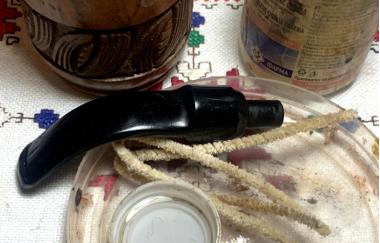 The bit has significant tooth chatter and a few compressions. The lower button lip is also compressed.
 The compressions will be patched using medium thick black CA glue. To prepare the surface, it is first sanded with 600 grade paper to rough up the acrylic so that the CA will have a better grip. The bit is then cleaned with alcohol with a cotton pad.
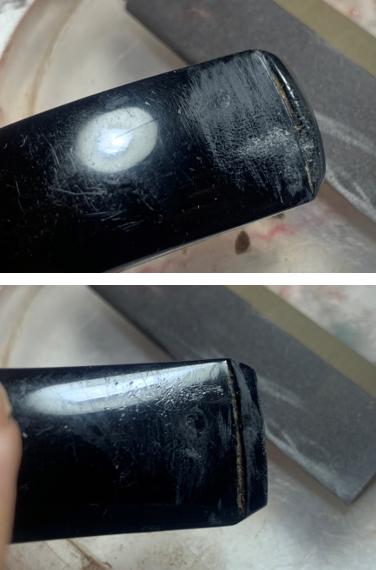 Next, the black CA is applied on the compressions and a line of CA was also placed over the button lip – upper and lower.
 When the patches cure, a flat and square needle files are used to file down the patch mounds and shape the button lips – upper and lower. The button was also filed to redefine the button edge.
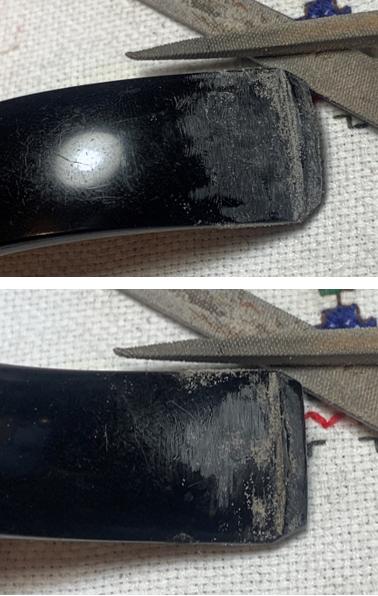 After the filing, the bit and button are sanded with 220 paper to erase the rougher filing tracks and to smooth the patch area.
 After the 220, 320 paper continues the sanding expanding to the entire stem.
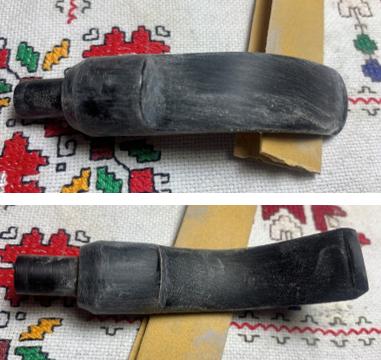 Next, the stem is wet sanded with 600 grade paper and this is followed with applying 0000 steel wool.
 The polishing of the acrylic stem continues with the micromesh pads 1500 to 2400, 3200 to 4000, and 6000 to 12000. Between each pad Obsidian Oil was applied to condition the acrylic and to give the pads more traction.
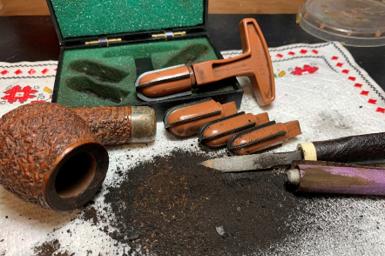
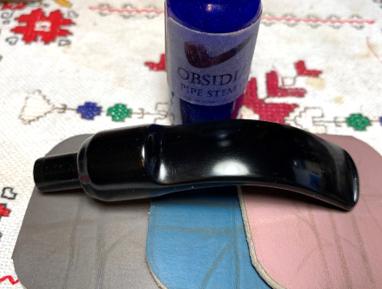 Turning now to the Ser Jacopo stummel, the cake in the chamber is pretty thick.
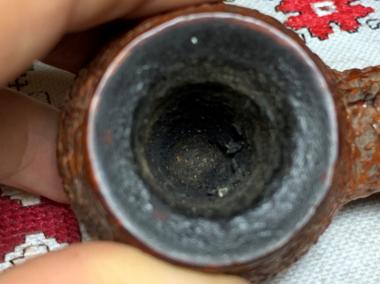 To clear the carbon cake, build up all 4 blade heads of the Pipnet Reaming Kit are used. The reaming was followed by scraping the chamber walls with the Savinelli Fitsall Tool. The cleaning is completed by sanding the chamber with 220 paper wrapped around a Sharpie Pen. This is definitely a ‘Maxima’ pipe even though it isn’t marked. The bowl is very large – lots of blend can hide in there!
 An inspection of the chamber reveals healthy briar with no burning or heating issues in spite of the thick cake.
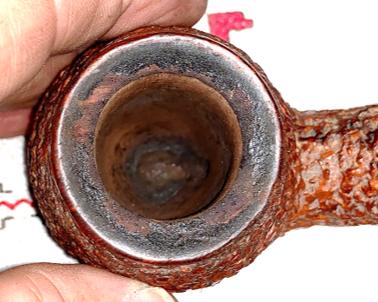 Turning next to cleaning the external rusticated finish, I’m looking forward to seeing how it cleans up. There is lava flow over the rim which needs to be cleaned.
 The wonderfully craggy rusticated surface is full of grime. These pictures mark the starting point.
 Using undiluted Murphy’s Oil Soap, scrubbing begins with a cotton pad and switches to a toothbrush to get into the crags. The cotton pad did not last long scrubbing the crags, so the bristled toothbrush scrubbed and did a good job.
 The inwardly canted rim was covered with a thick lava crust. The edge of the Savinelli Fitsall Tool scraped the crusting in the rim. This was done slowly and carefully to avoid gouging the rim’s briar.
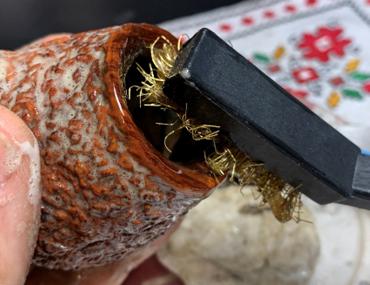
 A brass wire brush is also used on the rim. The brass brush does a good job of removing the vestiges of carbon left. The bass does not hurt the briar by being too invasive.
 The stummel is taken next to the sink and the internals are cleaned with shank brushes using anti-oil liquid dish washing soap. After scrubbing, the stummel is rinsed thoroughly and brought back to the worktable.
 The internal cleaning continues with cotton buds and pipe cleaners moistened with isopropyl 99%. A small dental spoon is also used to scrape the mortise walls to remove the tar and oils. With the buds and cleaners coming out lighter, this phase is done. The cleaning will continue later with a kosher salt and alcohol soak.
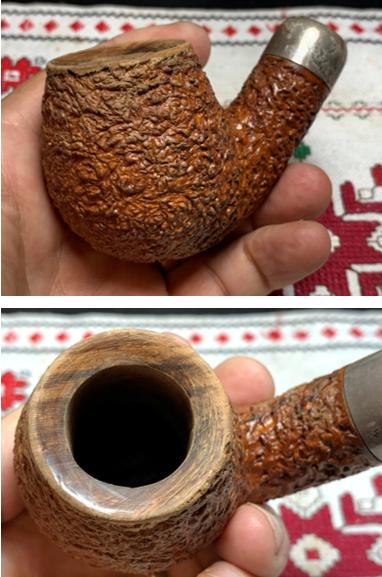
 I’m pleased with the cleaning of the exterior surface. Most amazing is the rim. The beauty of this pipe is going to be the smooth briar grain of the rim contrasting with the rough craggy rusticated bowl – I like the strong grain already visible on the canted rim.
 The cleaning of the internals continues with a kosher salt and alcohol soak. To form a ‘wick’ a cotton ball is stretched and twisted. The cotton wick acts as a wick to draw out the tars and oils in the internal briar.
 Using a stiff wire to help, the wick is guided down through the mortise and airway and it emerges at the draft hole. It took a few tries to succeed, but good to go now.
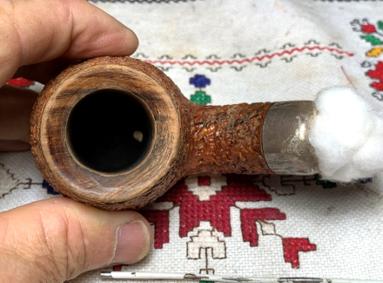 Next, the chamber is filled with kosher salt. Kosher salt is used because it does not leave an aftertaste as regular iodized table salt does. The stummel is placed in an egg carton with the rim and shank end level. A large eye dropper is used to fill the chamber with isopropyl 99% alcohol until it surfaces over the salt.
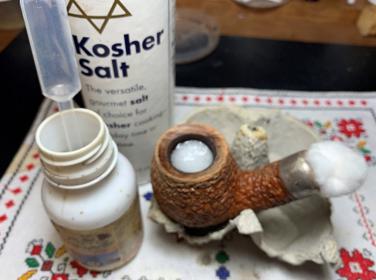 After a few minutes, the alcohol is absorbed into the salt and cotton wick and the alcohol is again topped off. The stummel is left to soak through the night. Time to turn off the lights.
 The next day the the wick and the salt show signs of the soiling indicating the tar and oils drawn out during the overnight soak. The salt is tossed and the remnants of salt crystals are removed from the bowl by rubbing a cotton bud like a broom on the chamber walls. I blow through the mortise to make sure no salt is left.
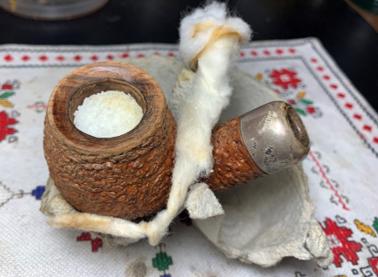 To confirm the cleaning, only one bud and pipe cleaner were needed. They did not soil any at all. This stummel is clean and the salt soak helps the clear away ghosts and sweeten the briar.
 With the cleaning done, the rim is next. The inwardly tapered rim is broad and grain is already visible after the cleaning.
 Another very minute artistic contribution that to me is very appealing is the very thin smooth briar ring encompassing the edge of the rim. Contrasting smooth and rough is pleasing to the eye and augments the natural beauty. It gives the effect of a cap on the bowl.
 There is some residual darkened briar on the aft side of the rim and small scratching which are normal wear and tear. To smooth and remove the blemishes the rim is sanded with 220 paper then followed by 470.
 During the sanding, I notice on the back side of the rim a small chip out of the smooth briar ring.
 Regular, clear CA glue is used to patch the chip. Clear CA is used to allow the hue of the light briar to be seen through the patch. This will help the patch to blend. A toothpick is used to apply glue. To avoid applying too much, some CA is placed on the side of the tooth pick near the tip and gravity moves the glue to the tip. The tip is then touched on the patch and only a small amount leaves the toothpick. This allows for more control.
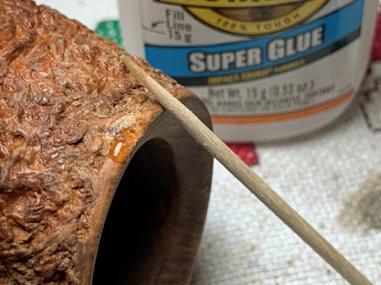 After the patch has cured, it is sanded with 220 then 470 paper to smooth the patch down and to blend it.
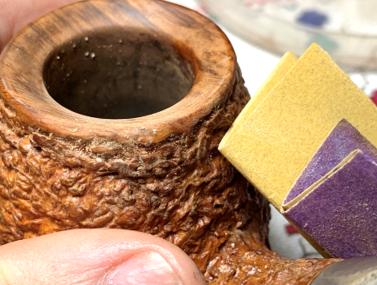 This is followed by applying 600 grade paper to both smooth and blend the patch and sand the rim plateau.
 Next, sanding/polishing continues on the rim and edge using the full set of 9 micromesh pads from 1500 to 12000 grades. Between each pad, a moistened cotton cloth dampens the rim to clear the dust and to give each pad more traction. My, oh my. The rim ‘cap’ looks great!
 Next, to bring out the natural hues in the rusticated briar and rim, Mark Hoover’s ‘Before & After’ Restoration Balm is used. The pictures don’t show as well as I can see with the naked eye, but the briar surface has lightened areas indicating dry briar. This can be seen nearer to the top of the bowl in the second picture.
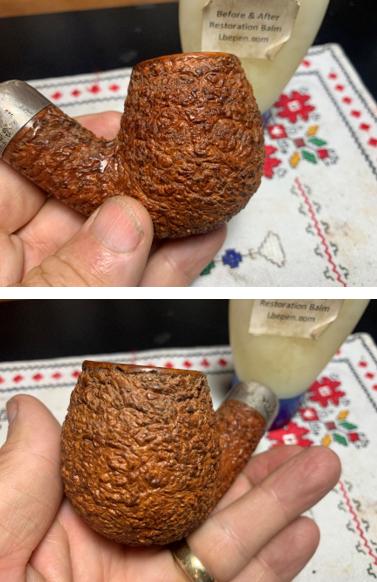 The Balm is placed on the fingers and is worked aggressively into the craggy briar surface. The bowl almost drank the Balm as it was applied. After the Balm is thoroughly applied, it is set aside for about 15 minutes for the Balm to be absorbed.
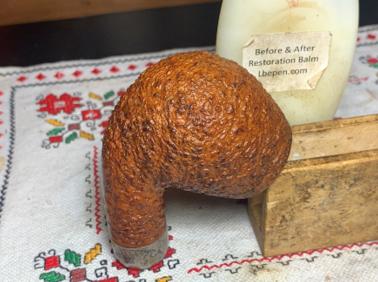 Even with the picture, the richness of the grain hues have come out after the bowl was buffed with a dedicated microfiber cloth. Nice!
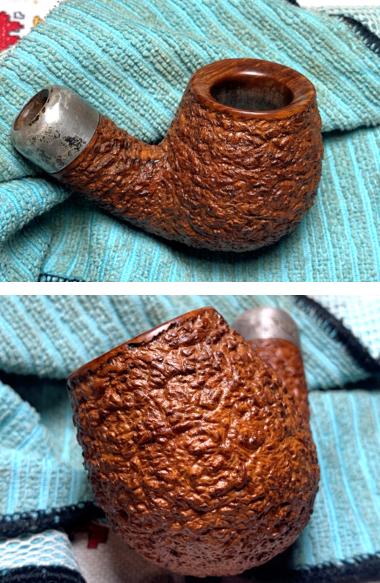 Next, the .925 silver shank cap needs to be cleaned and polished.
 I use first a silver cleaner product which doesn’t do much. The next two pictures show the starting point to mark the progress.
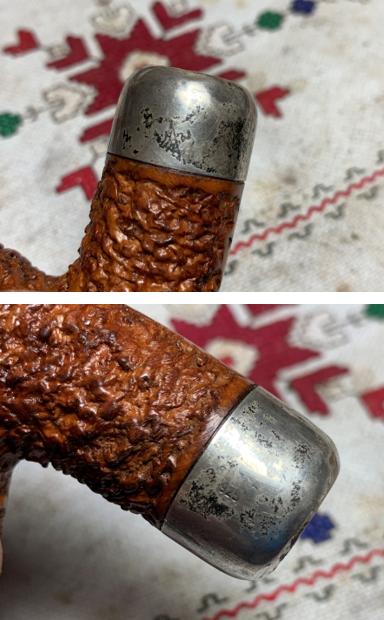 The application of the cleaner leaves something to be desired.
 Next, a fine green compound is used on metals with a cotton cloth buffing wheel mounted on the rotary tool.
 Before applying the compound, the shank is covered with painters’ tape to protect the briar from the black substance that is generated by buffing the silver with compound.
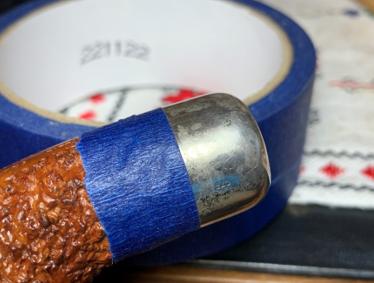 After applying the compound, the silver has shined up nicely. I like it.
Well, it is now several months after the last picture taken above. This project began in August, and it is now December, a few days before Christmas. Jeff has been EXTREMELY patient as I have ‘wrangled’ with folks in Italy trying to secure a genuine Ser Jacopo stem.
When I sent the note in August, I received a quick and hugely helpful response from Leonardo Sportelli of Al Pasia’. I had sent pictures and some questions, but my primary aim was to secure a Ser Jacopo stem. Here is what he wrote:
Hello Dal – Looking at the pictures you sent, the stem seems not to be original. The pipe is a R2, Spongia line Ser Jacopo pipes are generally produced in three finishes (rusticated, sandblast, smooth) and various colours. Apart from the Gem series that often have date codes, the other pipe series are difficult to date. The only helpful indication is that prior to 1997 the mouthpiece featured a red coral dot, sometimes enclosed in a silver band. In more recent productions the red coral dot has been substituted by a silver letter “J”, the exception being the Gem series which is identified by a precious gem enclosed in a gold band, and the entry level La Fuma series which features a red dot, but no longer made of coral. Looking at the stamping this pipe seems to be a quite recent production, 10/15 years old. I hope this helps in some way. All the best, Leonardo Sportelli
 What I learned from Leonardo is that the pipe on the worktable is an R2 Spongia line. A quick trip to Google Translate renders an unsurprising English rendering: ‘Sponge’ – which fits for a description of the finely rusticated surface. The pipe’s production of 10 to 15 years ago would place the dating of the pipe with these brackets: 2008 to 2013.
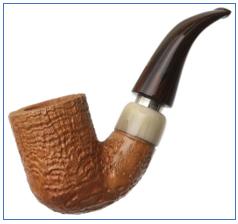
Armed now with the name of the specific line, I did a search of the Ser Jacopo line and found that there were many examples of light blasted or rusticated surfaces. What I also discovered was that I could not find an example of the Spongia line that had a silver shank cap or ferrule. I did find this similar Ser Jacopo listed on SmokingPipes.com. It had a shank cap, but it was acrylic though helpful to visualize the style.
Leonardo also gave me the link for Arcahadia Smoke where I could acquire a Ser Jacopo stem. My first email to Arcahadia Smoke was in August. The details of the months of back and forth I had with these folks I will not dwell on, but only to celebrate that the stem that I was hoping to secure finally arrived today – a few days before Christmas! Here are some pictures of the stem from Italy: As I looked at the flat stem facing and comparing it to the rounded shank ferrule – the match did not look right. The raw tenon is oversized on purpose so that it can be downsized to create a custom fit. When the tenon is sanded down and seats into the mortise, the rounded shank cap would butt up against a flat stem facing.
 To create the junction I imagined, this picture overshades the tenon. The marks show the unnatural union.
 However, it was when I noticed that the base of the tenon was raised that the light began to shine over the horizon. It was then that I recalled something else I had noticed but had not registered as I looked at the 100s of pictures in my search of Sir Jacopo pipes….
 I would say that 95% of the pictures I saw all had a fancy ‘tenon bridge’ between the stem facing and the shank ornaments. Again, the picture I used above is below. The flat facing of this tapered stem is softened as it is mated with a rounded shank cap by an extension between the facing and the cap. The ornamental detail that goes into the shank and stem union is obviously a hallmark of the Ser Jacopo popularity and quality.
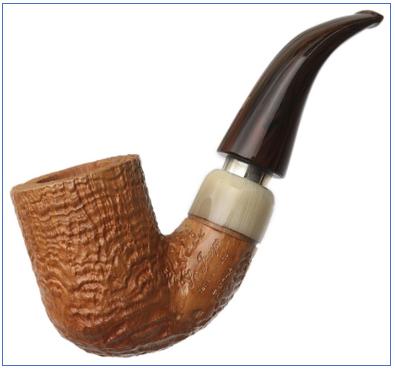 A couple of random pictures show additional examples of extension ornamentation.
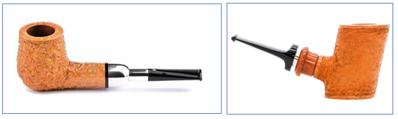 After some thinking puzzling through the options, a pathway began to open. I have a large selection of brass bands, caps and VP caps and tried and tested several VP caps that might give me an idea what an approach would look like. I found the perfect fit pictured below.
 Since I’ve waited this long, what’s another few weeks… I went to Vermont Freehand’s website and was thankful to find a VP cap that will work. To be on the safe side, I order 2. With this done, the decision is made to press on with the sizing of the tenon leaving a little more uncut tenon to allow for the VP cap to be mounted over the rise. Using the caliper, the mortise is measured. The diameter is 9.94mm. Next, the raw tenon is measured at 12.03mm. The difference is roughly 2mm.
 To begin, a line is drawn around the tenon to mark the edge of the VP cap. I want to leave a slight ledge to provide a footing for the bent edge of the cap.
 Next, a guide hole is drilled in the airway to allow the PIMO Tenon Turning Tool (TTT) to be mounted on the stem.
 The TTT is mounted on to the hand drill and the tool is set to an approximate depth to create a base line for trimming the tenon.
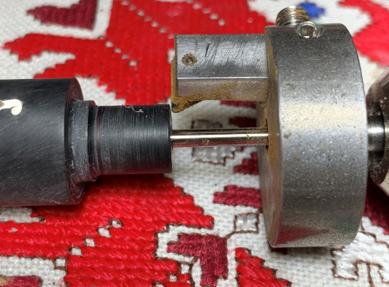 A test cut is made and fortunately, a test cut was made. The test cut is a bit too thin.
 The carbide cutter arm is backed out again and another cut is made. The cut left the tenon a bit larger than the mortise diameter.
 Sanding commences next to slowly bring the tenon diameter down to size. A coarse 120 grade paper is used initially then 220 paper. During the entire sanding process the goal is to keep the sanding uniform and not create a cone effect where the tenon tapers too much.
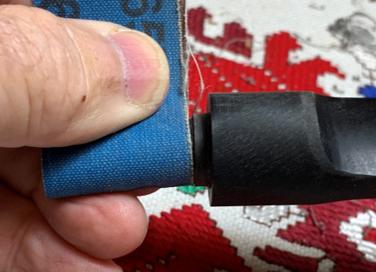 A flat needle file is also used in the process. The stem is rolled on the saddle while the filing stays uniform and level.
 As the tenon size is reduced slowly, the tenon begins to fit into the mortise. There is a lot of filing, sanding, and test fitting throughout the process.
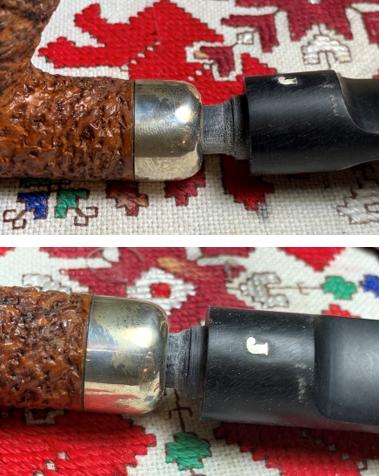 The tenon finally comes to a proper depth and the brass VP cap provides a temporary look at the extension. I like what I see. A question has come to my mind about rounding the edge of the stem facing a bit to soften the presentation. I’ll wait until the stem is sanded and bent to a proper orientation before making this decision.
 Even though the stem is new, it has cut marks and some blemishes. To erase these, 220 sanding paper is used to sand the entire stem.
 The 220 paper is followed by 320 paper.
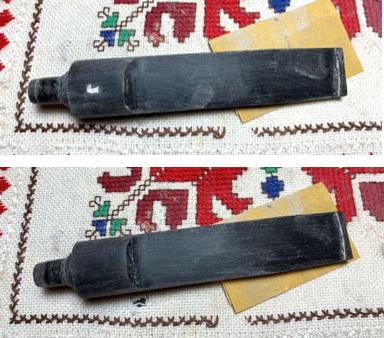 Next, the entire stem is wet sanded with 600 grade paper.
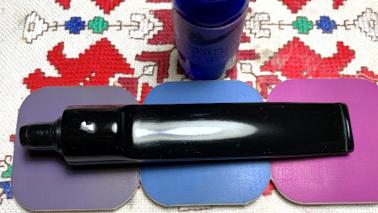
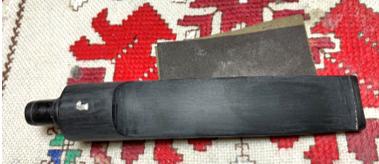 Following the general sanding, micromesh pads are used to sand/polish the stem starting first by wet sanding with pads 1500 to 2400. The wet sanding is followed by dry sanding with pads 3200 to 4000 and 6000 to 12000 grade pads. To condition the stem and to guard against oxidation, between each set of 3 pads, Obsidian Oil is applied and worked into the vulcanite. Wow – the pop looks good!
 The next step is to bend the stem to a proper orientation in relation to the stummel. The general rule of thumb is the bit of the stem should be on a parallel with the horizontal plane of the rim. I like to sketch the current situation along with an estimate of where the stem needs to be for a good orientation.
 Bending the stem is done by heating the rubber in the mid-section of the stem with a hot air gun. Before doing this, a pipe cleaner is inserted through the airway to guard the integrity of the airway during the bending process. A roll of electrical tape does a good job helping to form the bend after heating. It has a good curvature and can roll back and forth while the bend is forming. A bowl of cool water is on the worktable to dip the bent stem which cools the rubber holding the bend in place.
 The first heating cycle produced a bit too much bend as the diagram below shows.
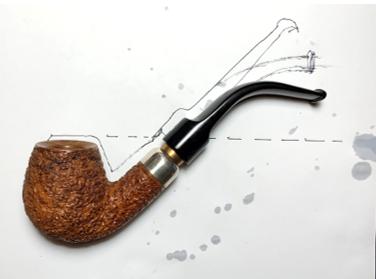 It doesn’t take much to reheat the vulcanite and as it is heated, the bend loosens. When the bend is at the proper place, it is dipped in a bowl of cool water to hold the bend. The bend looks good using the temporary brass extender. My work is on hold until the new VP cap arrives from Vermont Freehand.
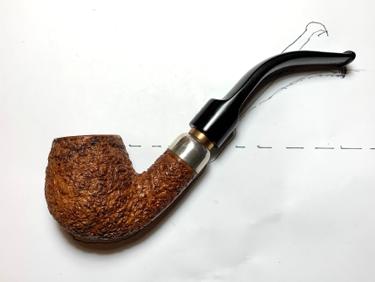 A few days after Christmas, the package from Vermont Freehand arrived. A comparison of the nickel VP cap with the brass cap I was using shows that the depth of the former is less.
 The step that I created next to the step that came with the stem will need to be filed down. The second picture below shows that there is a gap between the VP cap and the shank facing as it is now.
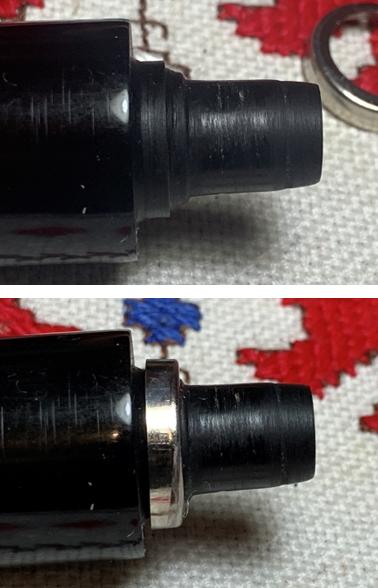 A square needle file is used to file down the edge of the step. This is followed by fine tuning the tenon by sanding with 220 and 600 grade papers.
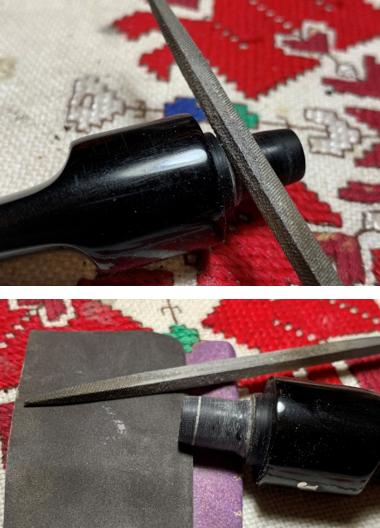 Before mounting the cap on the stem, using fine green compound, the nickel band is buffed up using a metal dedicated cotton cloth wheel.
 Regular clear CA glue is used to cement the VP cap in place. Glue is placed on the toothpick and then applied to the step. I’m careful not to spread CA glue where it’s not needed around the tenon.
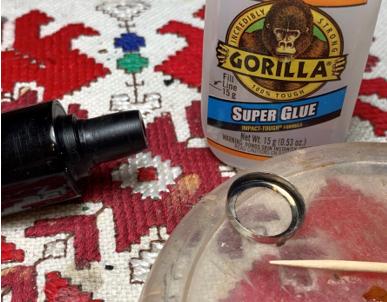 The clothespin is used to place pressure on the cap while the glue cures.
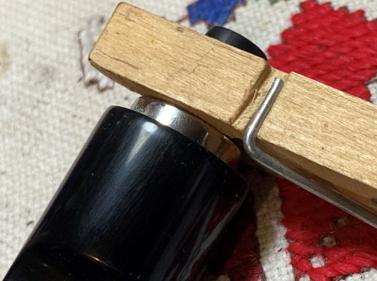 After a time, the CA secured the VP cap in place. It looks great!
 On the home stretch! With the stem and stummel reunited, Blue Diamond compound is applied only to the smooth briar rim and the stem. With a dedicated cotton cloth buffing wheel mounted on the rotary tool at 40% full power, the fine abrasive is applied.
 To remove compound dust, a felt wheel is used to wipe the stem and stummel.
 Finally, with another dedicated cotton cloth wheel mounted, carnauba wax is applied to the stem and stummel. When applying to the rusticated surface, the wax is very light. After the wax is applied, a micromesh cloth is used to give the pipe a rigorous hand buffing to remove excess wax and to raise the shine.
 Ser Jacopo pipes are what are described as upper shelf pipes. This 2008 to 2013 Spongia R2 is comfortable on that shelf. Even though this project took several months to complete, acquiring the Ser Jacopo stem from Italy was worth the effort. Re-creating the ornamental shank/stem transition was not expected, but it came out well. The pipe’s dimensions places it in the maxima category – Length: 7 1/2 inches, Height: 2 1/4 inches, Rim width: 1 3/8 inches, Chamber width: 7/8 inches, Chamber depth: 1 7/8 inches. The weight of the pipe is 3.3oz. The Spongia rustication is beautiful and the slight contrast with the smooth rim is pleasing. There is little doubt that this pipe will pack a sizable amount of one’s favorite blend and provide much time reflecting on the new year. Jeff commissioned this Ser Jacopo Spongia and as the commissioner will have the first opportunity to claim him from the Pipe Steward Store benefiting the Daughters of Bulgaria – helping women and girls who have been trafficked and sexually exploited. Thanks for joining me!
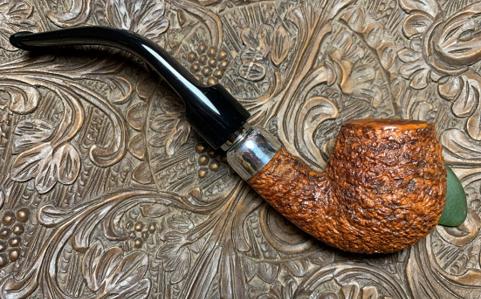

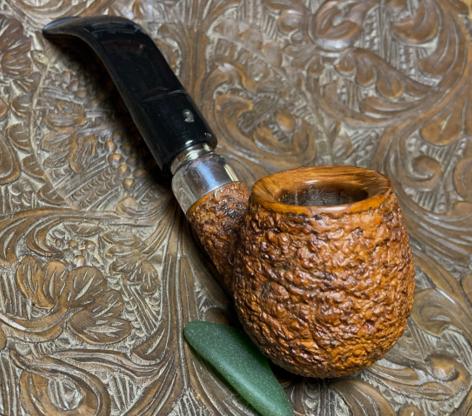


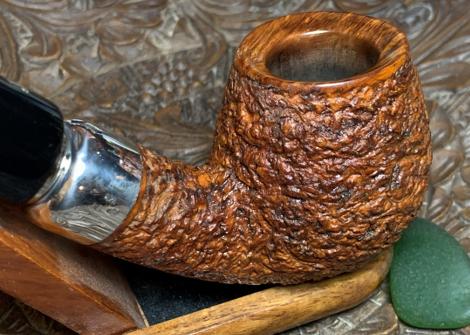


Please Pray for the People of Ukraine!
www.Voice-of-Ukraine.com
www.CratesForUkraine.com
 The Pipe Steward
Pingback: A Striking Søren Hand-Carved Made in Denmark Freehand is Given New Life – The Pipe Steward