
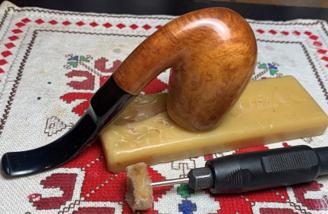
The W.Ø. Larsen HANDMADE came to me in August 2021 in what I call the Lakewood Lot of 14. I met Ron in the Denver suburb of Lakewood when I went to his house to purchase a Zero Gravity reclining lawn chair. When I pulled up to his house, he was sitting in the driveway puffing on his pipe. Of course, conversation ensued, and I discovered that he was selling off his collection of pipes and the W.Ø. Larsen that is on the worktable now was among them. Here is the Lakewood Lot that Ron sold to me with the pipe marked on the top right.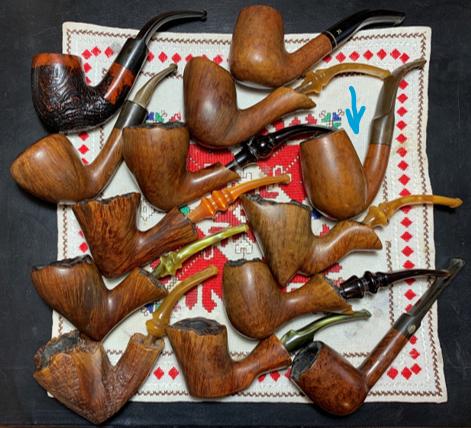 This was quite a collection of nice-looking pipes that found their way to the For “Pipe Dreamers” ONLY! online collection where pipe men and women can commission a pipe that gets their attention. All these pipes help to benefit the Daughters of Bulgaria – a work that my wife and I co-founded during our years of serving in Sofia, Bulgaria. We are no longer in Bulgaria, but our hearts continue to resonate with this beautiful ministry helping broken people.
My good friend and fellow pipe restorer, Paresh, reached out to me about this rather large Egg-shaped pipe. If there’s anything I’ve learned about Paresh over the years is that he enjoys a good-sized pipe. A previous gargantuan that I restored for Paresh was originally posted by Steve on Rebornpipes (A Meer-lining and Crack Repair to Rescue a Doomed Gargantuan Kilimanjaro Made in Tanganyika Bent Billiard | rebornpipes).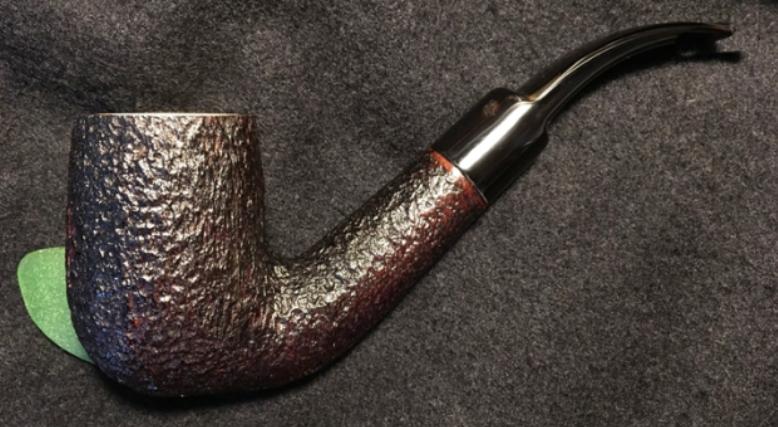 However, what will always stand out to me concerning Paresh was when Steve, Jeff (Steve’s brother), and I visited Paresh and his family in India where we had the privilege of not only restoring one of his inherited pipes from his grandfather (West Meets East in India to Restore a Grandson’s Treasure – an 1846 BBB | rebornpipes), but also enjoying Paresh’s stellar hospitality. Of the many high points in that trip, perhaps the highest point for me personally was riding behind Paresh on his motorcycle while weaving through the dense, chaotic, Indian traffic! If the Lord gives me time and resources, one of the things on my bucket list is to return to India to visit Paresh and Abha and their two beautiful daughters – but this time, bring my wife, Beth, to meet Abha 😊. The Lord gives us one life to live, and I am thankful that my path crossed this path that led to India. Paresh was drawn to the W.Ø. Larsen and here are pictures of the pipe on the worktable.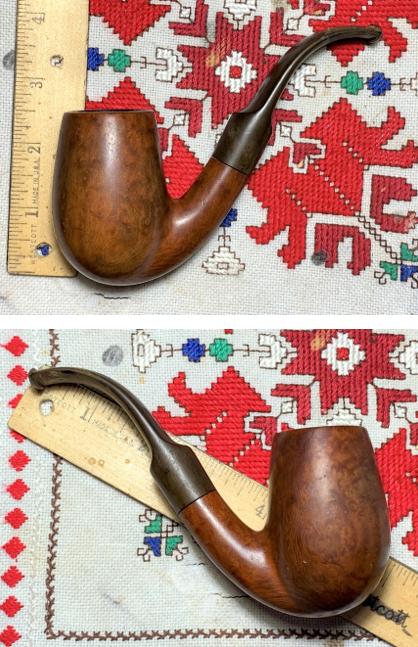
 A few pictures are needed to show the full nomenclature wrapped around the back of the 3/4 bent shank: SELECTED GRAIN [over] 15 W.Ø. LARSEN [over] HANDMADE [over] MADE IN DENMARK.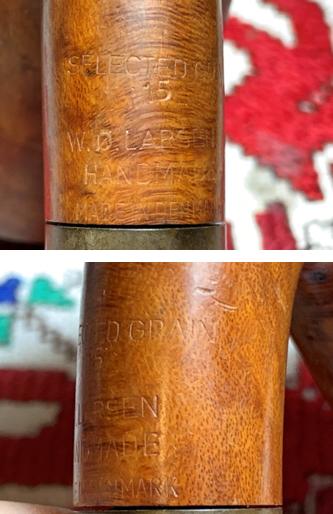
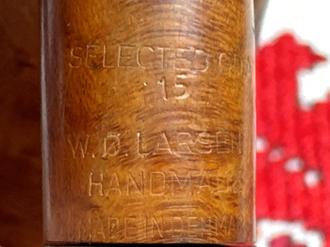 The very ample dimensions are Length: 5 11/16 inches, Height: 2 1/2 inches, Rim width: 1 1/4 inches, Chamber width: 7/8 inches, Chamber depth: 2 1/8 inches. The information in Pipedia about the W.Ø. Larsen name is helpful. There are 2 brief histories recounted in the article and the first is from FinePipes.com:
W.Ø. Larsen was one of the most famous tobacco shops in Copenhagen, with a beautiful store located on Copenhagen’s famous “Walking Street.” During the 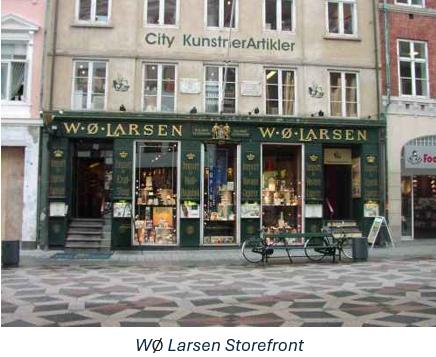 flowering of the Danish pipe in the 1960’s, they first began retailing pipes by such carvers as Sixten Ivarsson, Sven Knudsen, Poul Rasmussen, and Brakner. Urged on by his store manager Svend Bang (S. Bang), the owner, Ole Larsen, decided to begin making pipes in the basement of the shop. He first hired Sven Knudsen as the pipe maker, who soon passed the job to his protégé Hans “Former” Nielsen. Larsen’s fortunes rose along with the rest of the Danish pipe business, and Former was soon managing a group of carvers in the old Larsen cigar factory. Among these were Teddy Knudsen, Tonni Nielsen, Jess Chonowitsch, Peter Hedegaard and others, who were responsible for the Select and Straight Grain series before they branched out on their own. After Former left to start Bentley pipes in Switzerland, his duties were taken over by Soren Refbjerg Rasmussen, while the Straight Grains were made by Teddy’s student Benni Jorgenson. As Ole’s health began to fail, the reins were taken over by his son Nils. Nils became convinced that the way for Larsen to prosper was by entering the low-end market, and acquired the Georg Jensen pipe factory to make an array of less expensive pipes. This turned out to be a fatal error, and Larsen was recently sold to Stanwell, who continue to produce so-called “Larsen” pipes in their huge factory. Thus ended an important part of Danish pipe history. Courtesy, FinePipes.com
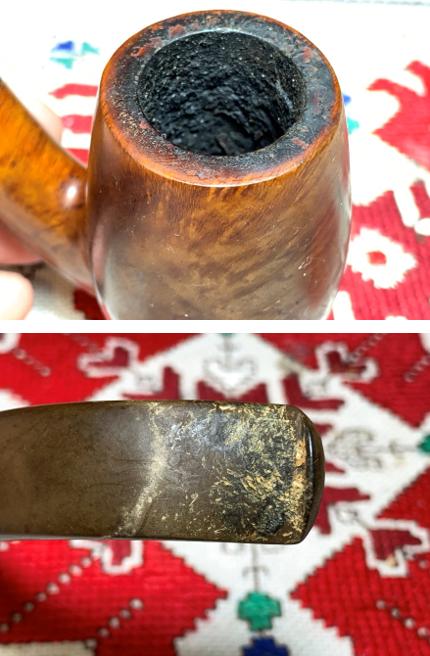
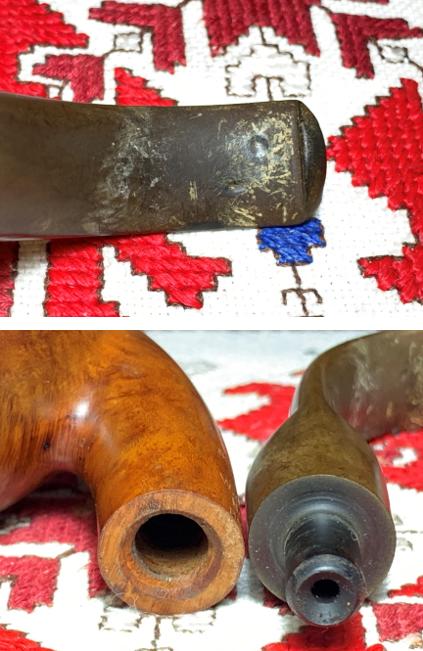
I did not find any specific information that would help to date the pipe on the table or who the master was that shaped it, but with a better understanding of the W.Ø. Larsen name, I take a closer look at the pipe on the worktable. The chamber has a light cake build up and there is the normal lava flow on the rim. The stem has significant oxidation with the bit showing tooth chatter – the normal signs of use of a good pipe. To begin, fresh pictures are taken of the oxidation in the stem. It appears to be deep.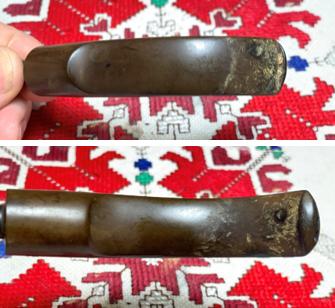 Before addressing the oxidation, the airway is cleaned with pipe cleaners moistened with isopropyl 99%. The 3/4 bend makes it difficult for the pipe cleaners to navigate the airway, but with some effort, they will.
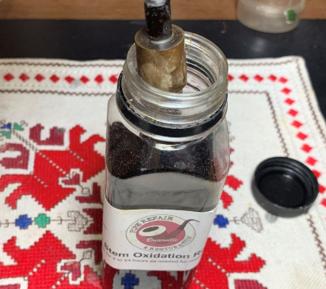
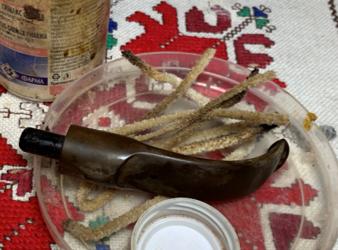 Next, the stem is given a soak with Briarville’s Pipe Stem Oxidation Remover to address the oxidation.
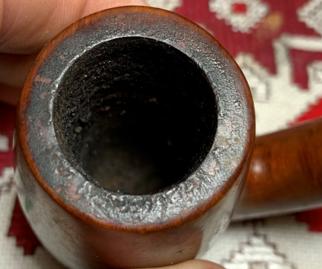
 Transitioning to the stummel, the light carbon cake build up is shown.
 Three of the 4 Pipnet Reaming Kit blade heads are used to ream the chamber.
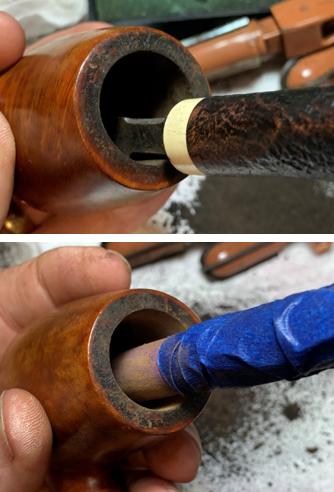
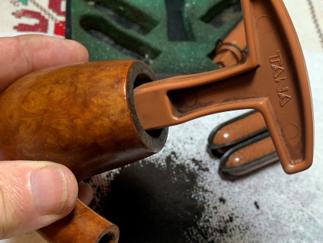 Following the reaming, the chamber wall is further scraped using the Savinelli Fitsall Tool and this is followed by sanding the chamber with 220 paper wrapped around a Sharpie Pen.
 The full arsenal of tools is shown in the picture below and after a quick inspection, the briar in the chamber shows no problems with heating. Moving on.
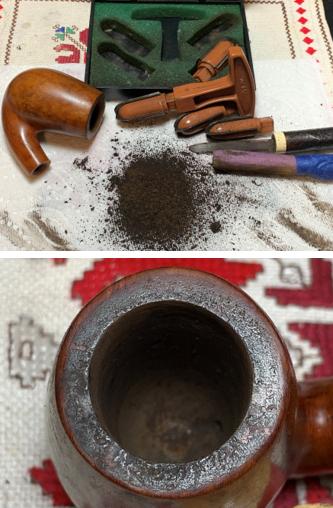 Next is cleaning of the external briar. A few starting pictures are shown of the rim and the grime on the stummel.
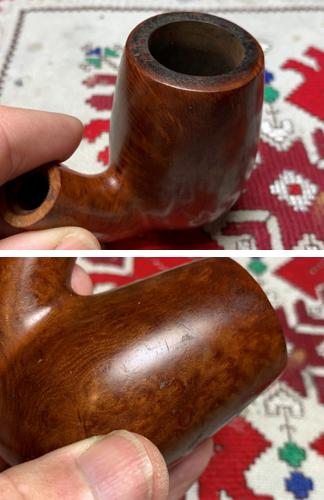 Undiluted Murphy’s Oil Soap is used to scrub the surface with a cotton pad.
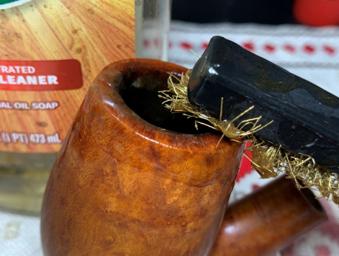
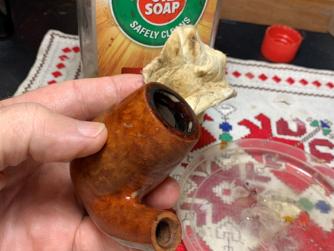 A brass brush also helps with cleaning the rim. Brass is used to clean the rim with a bit more muscle but does not harm the briar.
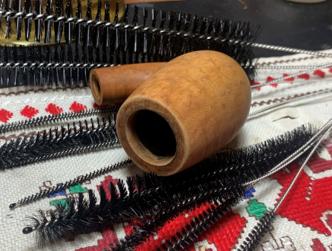
 Next, the stummel is taken to the sink where warm water and liquid anti-oil dishwashing soap are used to scrub the internals with shank brushes. After the scrubbing, the stummel is thoroughly rinsed and returned to the worktable.
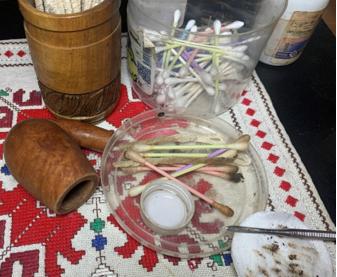
 To continue and fine tune the internal cleaning, cotton buds and pipe cleaners are moistened with isopropyl 99%. A small dental spoon is also used to scrape the mortise to remove tar and oils. Not too much effort was expended when cleaners and buds emerged lighter.
 With the basic cleaning of the stummel completed, the focus switches to the rim. The picture shows a darker ring on the inner edge of the rim and a bunch of scratching.
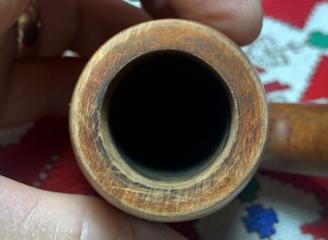 To clean the rim of scratches and to reestablish clean lines, the stummel is topped using 220 paper on the chopping board. With the stummel inverted, it is rotated over the paper several times.
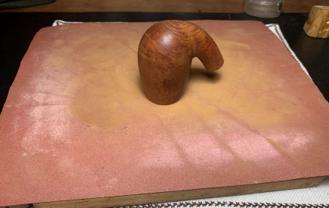 The 220 paper cleaned the rim nicely.
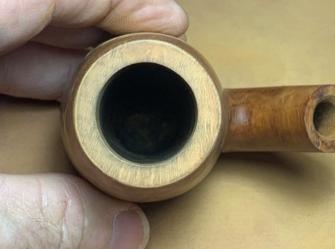 The 220 paper is next exchanged with 600 grade paper and rotated over the paper several more times. The rim looks great.
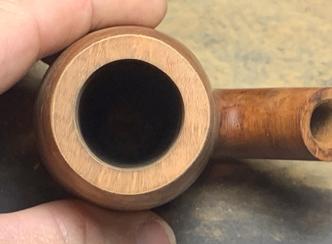 Normal wear and tear miniscule nicks and scratches are on the briar surface.
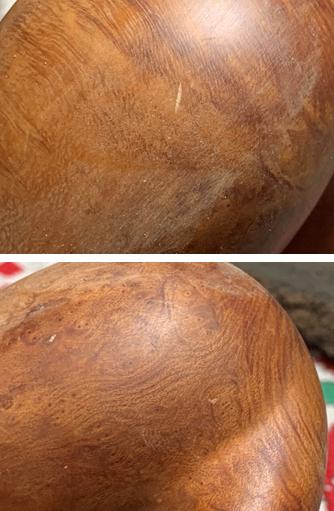 To clean the stummel without overt sanding, sanding sponges are used. Only 3 sponges are used – medium, light and fine to clean the surface.
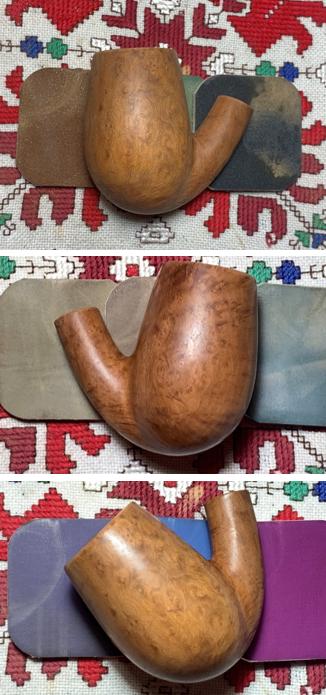
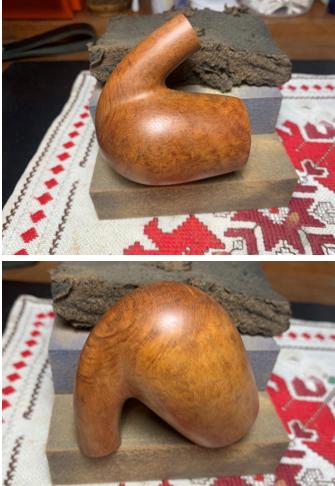 Following the sanding sponges, micromesh pads are used starting with pads 1500 to 2400, then 3200 to 4000 and 6000 to 12000. Between each pad the stummel is wiped down with a moist cotton cloth to remove the dust and to give the next pad more traction.
 To bring out the natural hues of the briar, Mark Hoover’s Before & After Restoration Balm does a great job. After putting some Balm on the fingers, it is worked into the briar. The Balm starts with a cream like consistency then thickens to a wax like consistency as it is worked in. After the Balm is applied over the entire stummel, it is set aside for about 15 minutes allowing the Balm to be absorbed.
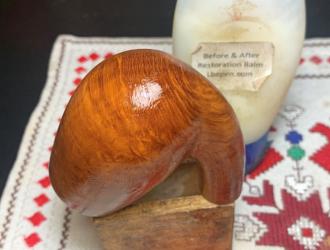 After the time has elapsed, a dedicated micromesh cloth is used to wipe off the excess Balm and to buff up the shine. I love how the grain has emerged.
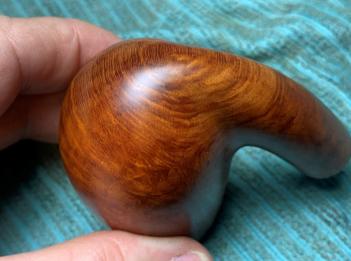
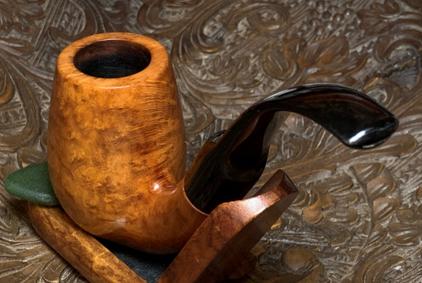
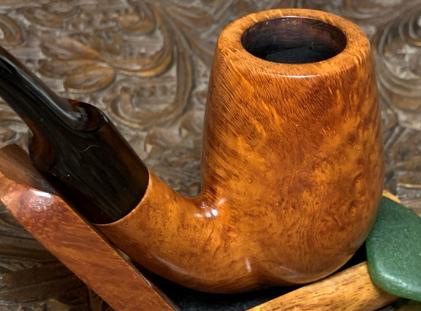
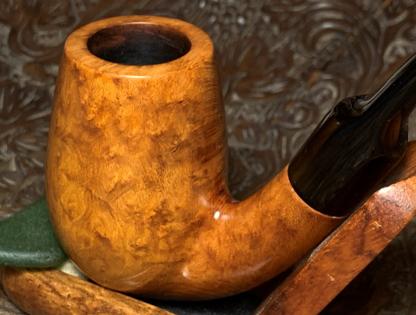
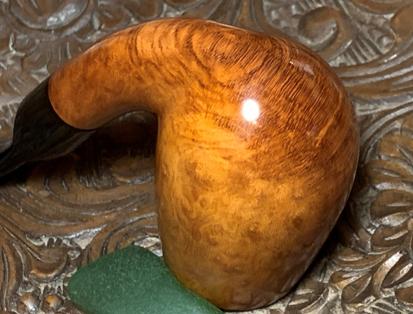
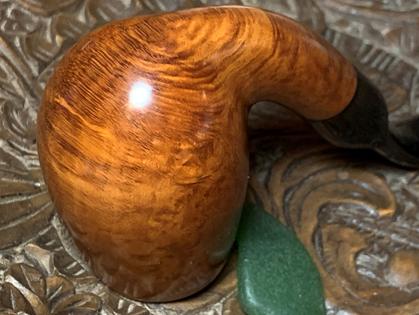
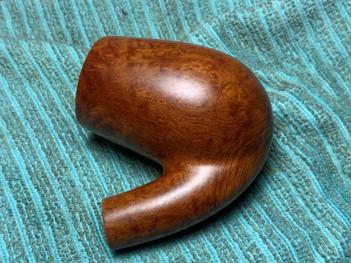 The circular grain patterns on the heel of the stummel are especially striking and reveal that the artisan chose a block to allow this design to unfold. The Danish Freehand motto, ‘Follow the Grain’ was done here in a unique way. Instead of following the length or reach of the grain, the lateral horizontal expression is captured. I like it.
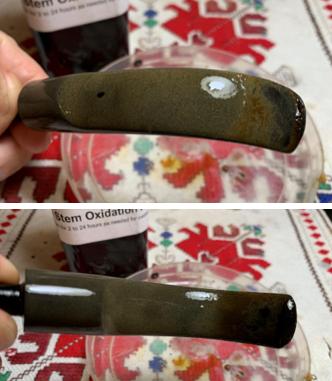
 The stem has been in a soak for several hours to help address the oxidation in the vulcanite rubber. After it is fished out of the Oxidation Remover, a few pictures show how the oxidation has been raised.
 The stem is rigorously rubbed with a cotton cloth to remove the raised oxidation. The Oxidation Remover soak did a great job.
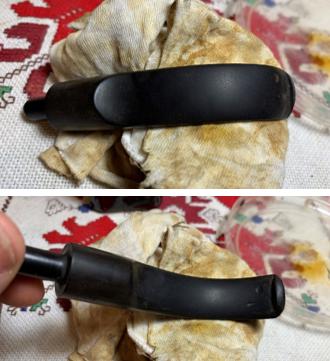 A few pipe cleaners moistened with isopropyl 99% are used to clear the airway of the Oxidation Remover fluid.
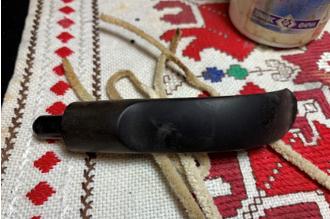 The upper and lower bit both have tooth compressions that need addressing.
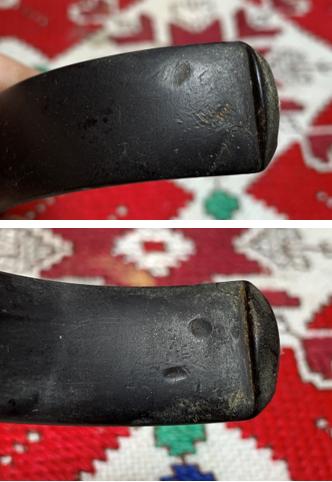 After cleaning with alcohol, Black Medium-Thick CA glue is used to fill the bite compressions – upper and lower. An accelerator is used on the patches to hold them in place and to quicken the curing time.
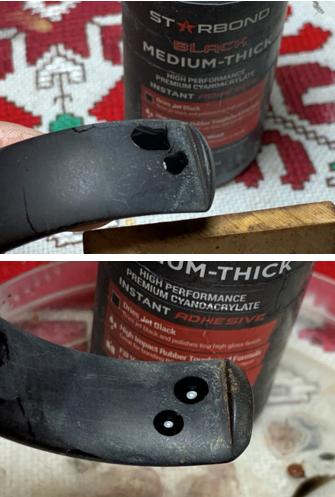 When the CA glue patches have cured, the patch mounds are filed down flush to the stem surface using needle files – upper and lower.
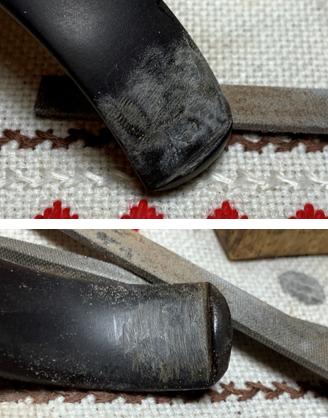 Filing is followed by sanding the bit with 220 grade paper to smooth the filing tracks.
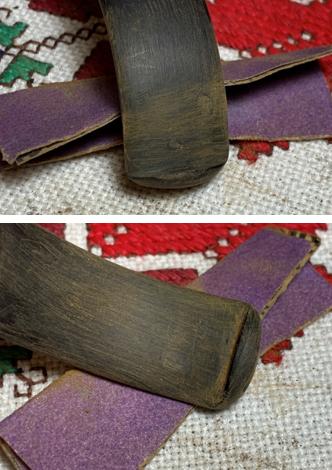 The sanding is expanded to the entire stem using 220 grade paper. A plastic disk is used to protect the saddle stem facing from shouldering as the saddle is sanded.
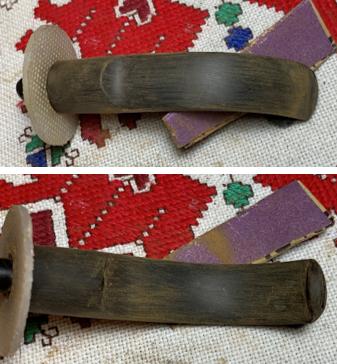 The shouldering guard continues to be used as the finer 320 paper sands the stem.
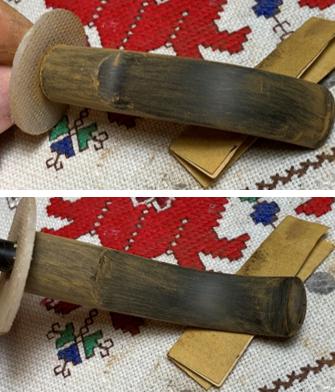 The 320 sanding is followed by wet sanding with 600 grade paper then applying 0000 grade steel wool.
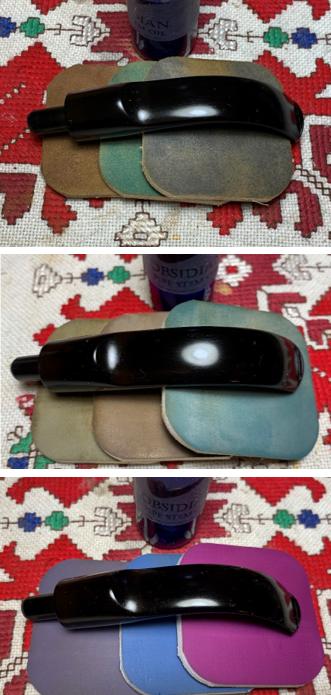
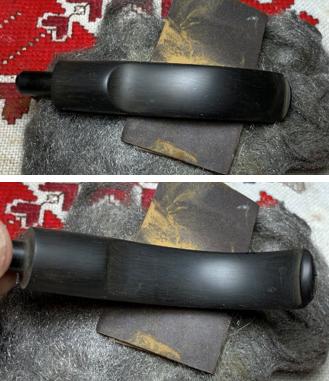 To transition from sanding, micromesh pads move more into the polishing phase. First, the stem is wet sanded using pads 1500 to 2400. Dry sanding follows using pads 3200 to 4000 and 6000 to 12000. Between each set of 3 pads, Obsidian Oil is applied to both condition the vulcanite and to guard against oxidation. The pop has come out in the vulcanite!
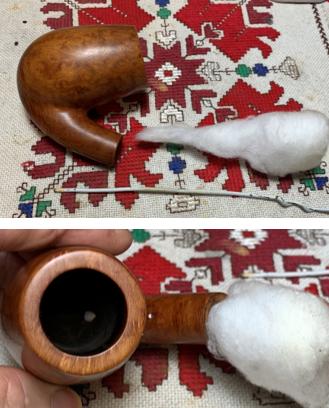
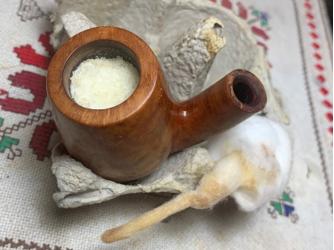
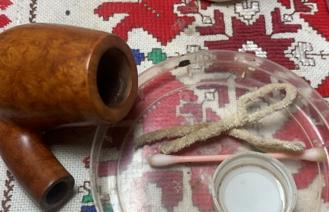
 It’s New Year’s Eve and it’s time to check out the festivities on TV – watching NYC’s and Nashville’s count down celebrations gives us who live out here in the Mountain Time Zone plenty of time to watch the new year come in. Before shifting gears, the internal cleaning of the stummel continues with a kosher salt and alcohol soak. This soak helps to draw out the tar and oils from the internal briar and to sweeten/refresh the briar. A cotton ball is pulled and twisted to create a wick which will be inserted in the mortise to the draft hole. The thick wire helps to guide the cotton down the mortise.
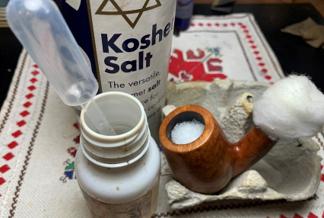
 Kosher salt is used to fill the chamber. Kosher salt is used rather than regular iodized table salt because the iodized version has an after taste, but the kosher does not. After the stummel is placed in the egg crate with the rim and shank end roughly level, the bowl is filled with isopropyl 99% alcohol until it surfaces over the salt.
 After about 10 minutes, the alcohol has been absorbed and is topped off. The stummel is put aside through the night allowing the soak to draw the tar and oils from the internal briar.
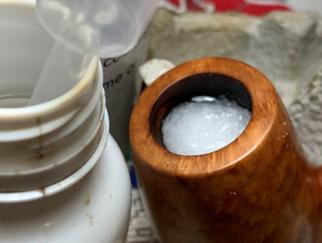 The kosher salt and alcohol soak has continued through the night, and my first action of 2024 is to remove the wick and take a picture showing the soiling of the cotton and salt which indicates the drawing action through the night. The used salt is cleared from the chamber and wiped clean with a paper towel. Blowing through the mortise assures no salt crystal is left behind.
 To confirm that the internals are clean, a cotton bud and few pipe cleaners moistened with isopropyl 99% are used.
 Now on the home stretch – after the stem and stummel are reunited, a dedicated cotton cloth buffing wheel is mounted on the rotary tool, and with the power set at 40% full power, Blue Diamond compound is applied to the pipe.
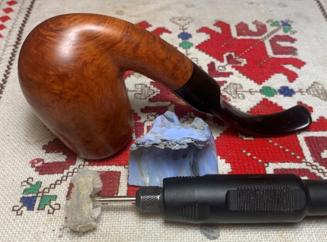 Compound dust has accumulated over the pipe’s surface and a felt cloth is used to wipe it off. This is done in preparation for the application of the wax.
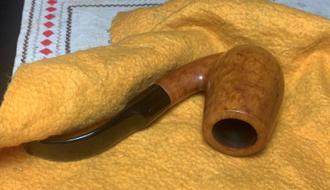 With another dedicated wheel mounted at the same speed, next carnauba wax is applied to the pipe. When completed, the pipe is given a rigorous hand buffing with a microfiber cloth to remove the excess wax and to raise the shine.
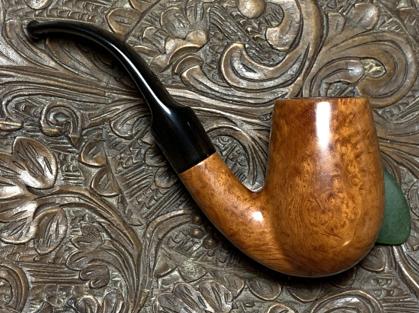
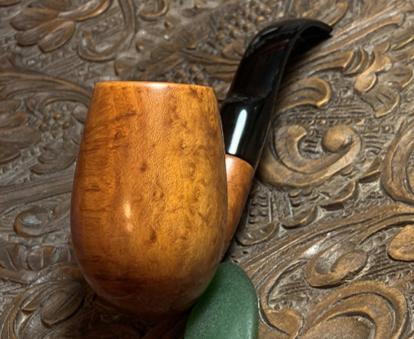
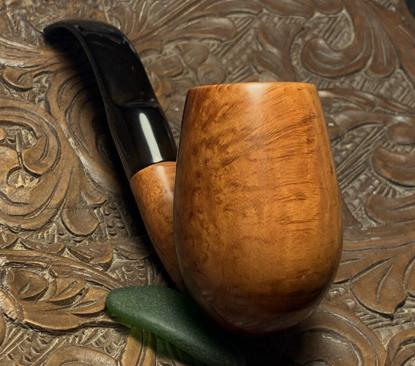
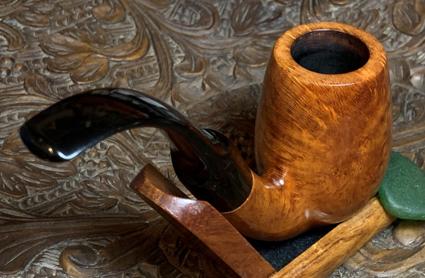
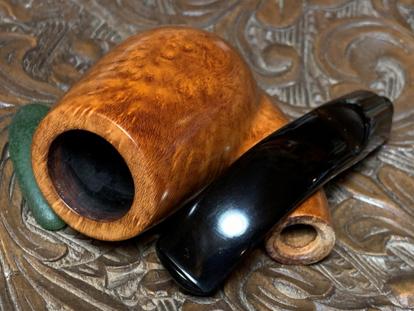
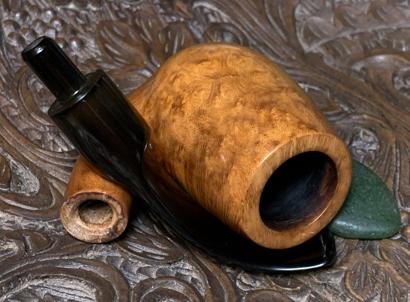
 This Danish W.Ø. Larsen HANDMADE is an exquisite, classic shaped pipe. The positioning of the horizontal grain centered on the heel and then expanding upward into both bird’s eye and flame grains – well, the positioning and shaping of the bowl reveals the work of a W.Ø. Larsen master. The egg shape provides a large viewing landscape and the 3/4 bend completes the classic look. The chamber depth of 2 1/8 inches will provide the next steward with an ample amount of room to pack his favorite blend. Paresh commissioned this W.Ø. Larsen and will have the first opportunity to acquire him from the Pipe Steward Store benefiting the Daughters of Bulgaria – helping women and girls who have been trafficked and sexually exploited. Thanks for joining me!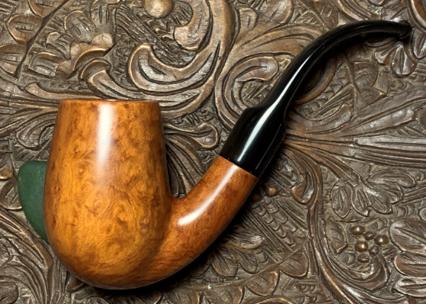


Dal, really enjoyed seeing the steps you take to restore this pipe. Having restored my 1955 Chevy, (especially the stainless steel) I can relate to the various steps and time taken with the sandpaper to get the best results.
LikeLiked by 1 person
Thanks, Bill! I like the comparison especially because 1955 is my birth year 🤠.
LikeLike
Dal, I still haven’t found any substantial information about the pipe I gave you when you visit us at Faith Church. As best as I can recall I purchased it in the late 60’s most likely in New England, and I’m leaning toward Peterborough, NH. I looked at my records of things I purchased while on an Eastern European Summer Seminar with Gordon College in 1969 and I didn’t list it. My wife doesn’t recall my using it and we met just after that trip, so I must have had it earlier between 1966 and 1968. Other than smoking it for “pleasure” I would use it to “smoke” honeybees to calm the bees a little prior to doing a quick inspections of bee hives. Hopefully it will find a good home and help the Daughters of Bulgaria. I’ve been reading Voice of Ukraine daily. Thanks.
LikeLiked by 1 person
Bill, Thanks for connecting your first response to you! The Amphora is a very nice pipe and I appreciate your generosity. Thanks for the additional information which I’ll place in my records to use when someone commissions it. You used it to smoke bees? That’s a good one – haven’t heard that before!
LikeLike