
The next pipe on the table is a quintessential ‘60s/70s’ Flower Power pipe – at least that’s the vibe I get looking at it. It came to me in September 2017 from a seller in Georgetown, Texas. The seller was from a non-profit called the ‘Caring Place’ that sells things to help needy folks in the community. The Lot of 66 pipes was the largest I had acquired at that point in my Pipe Steward career. I wrote to the seller asking if they could tell me anything about the donor of the pipes. Unfortunately, they could not, but they thought the pipes were all from one man who had passed, and his family donated the pipes to promote a good cause. The byline on the seller’s picture on eBay said: “Huge Lot Of 66 Smoking Pipes Pre-Owned Pre-Smoked and Deeply Loved.” Many – most of the pipes of Lot of 66 have already found new homes with new stewards after having been passed on from a pipe man who ‘deeply loved’ his pipes. Here are pictures of the Lot of 66. I had to splice a couple of pictures together to get most of them in. The the pipe is on the lower left. All 66 pipes were posted in the For “Pipe Dreamers” ONLY! online collection where pipe men and women can commission pipes benefiting the Daughters of Bulgaria – an organization that my wife and I co-founded during our years living and working in Bulgaria helping women and girls who had been trafficked and sexually exploited. It was in the Pipe Dreamers ‘Help Me! Baskets where pipe man Josh saw the the pipe and reached out to me to commission it and a Mastercraft Pot that has seen better days. In my communications with Josh, I found out that he is a husband and father of 2 school aged kids and a pet dog which completes the family. He is a government worker in Virginia and a fellow-follower of Jesus. Josh also shared with me his motivation for commissioning the pipes:
I have several friends I’d like to get into pipe smoking. They are cigar guys, so I keep “guest pipes” for them and some nice, restored estates are the next step from the cobs they have been using (not that there is anything wrong with a cob).
I’m happy to collaborate with Josh in converting others to the pipe community. Here are pictures of the pipe Josh commissioned: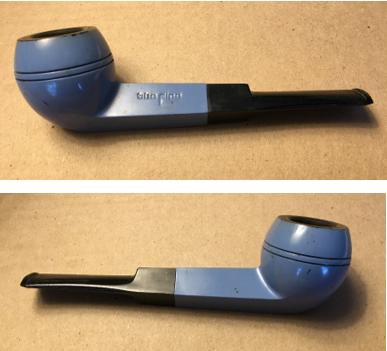

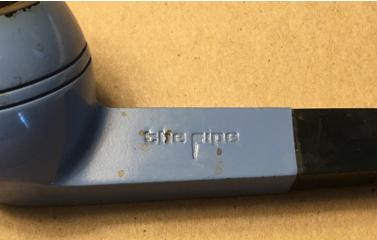
 The nomenclature is on the upper left panel of the Bulldog diamond shank: the pipe. The unique thing about this stamping is the ‘p’ which is an inverted pipe. That’s cool.
 To learn more about the pipe, Pipedia is my first stop. The the pipe article is brief and provides a starting point:
the pipe (pyrolytic graphite/phenolic resin)
In 1963, Super-Temp Corporation began making plastic pipes with pyrolytic graphite bowl liners. They were called the pipe. In 1965, Super-Temp contracted to market their unique pipes through Venturi, Inc., the company which sold Tar Gard cigarette filters. Colors and stripes began to be offered circa 1967. About 1970, THE SMOKE pipes were added to the line – they were non-traditional shapes with a less expensive bowl liner. Venturi pipes were added around 1972 – they had no liner in the bowls at all. The pipes were out of production by 1975.
This brief article included a couple of pictures of an Apple shaped with what appears to be the same color as the pipe on the worktable (Example and details, courtesy Doug Valitchka).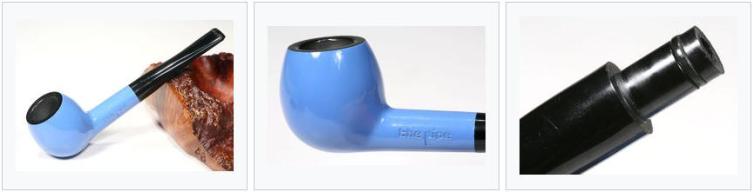 The tenon pictured on the right above shows the O-ring that was standard for the pipe stems. A quick look at our Bulldog shows an O-ring intact. I’ll condition the O-ring with oil later.
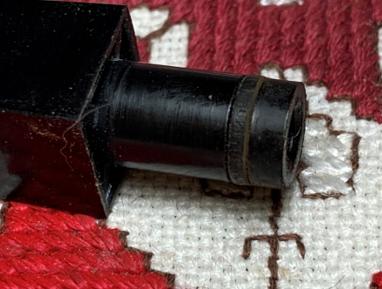 Also, in the Pipedia article were two external links which lead to a trove of the pipe information. Both links reference a the pipe collector, Dr. Billy W. Taylor II, Ph.D. One link goes to his website, thepipe.info, and the other to a September 9, 2014, interview of Dr. Taylor on Pipesmagazine.com by Brian Levine (http://pipesmagazine.com/blog/radio-talk-show/the-pipes-magazine-radio-show-episode-104/). For those wishing to dive more deeply into the pipe are encouraged to give these links a look.
From this the pipe (www.thepipe.info) site I learned that the Bulldog on the table is English Blue. I was also able to glean some information about how to smoke and clean a the pipe since it’s not like a briar pipe.
I was curious about the patent information referenced (Smoking Element (thepipe.info)) and did some digging and found the original patent documents at https://ppubs.uspto.gov/pubwebapp registered to E. C. Buckingham first filed in August 1963 and granted May 1965. The patent is entitled, ‘Smoking Element’. I include photos of the patent documents.
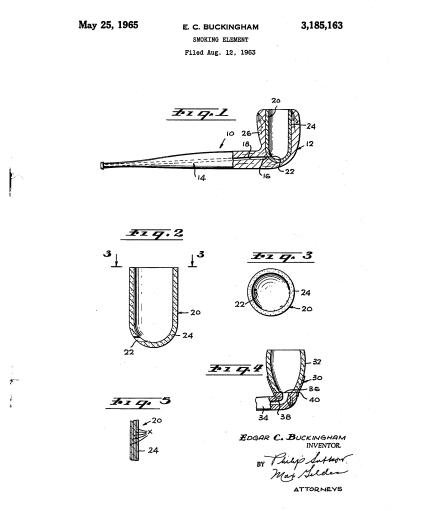
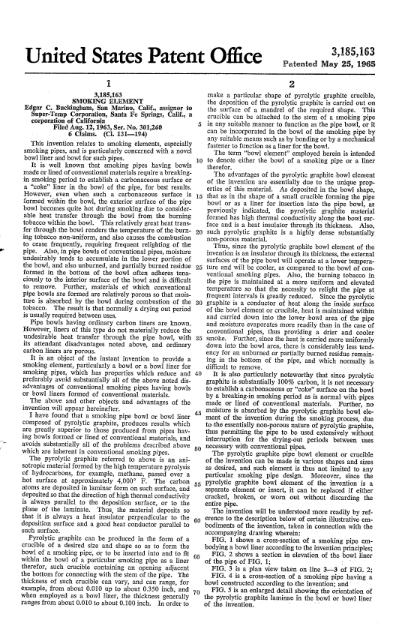
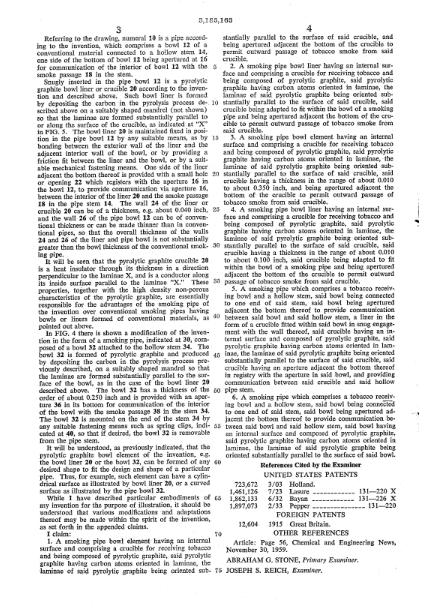
I’m intrigued by patents which are essentially proto-types advertising ‘hooks’ to convince the patenting panel that this new kind of pipe is essentially different and better than the standard pipe. Of course, there’s some science involved as well! On page 2 of patent document above, after describing all the problems of traditional briar pipes (Point #3), Mr. Buckingham provides a personal rationale for his invention in Point #8:
I have found that a smoking pipe bowl or bowl liner composed of pyrolytic graphite, produces results which are greatly superior to those produced from pipes having bowls formed or lined of conventional materials, and avoids substantially all of the problems described above which are inherent in conventional smoking pipes.
Alas, the unending search for the pipe smoker’s holy grail continues: “The cooler, dryer smoke”!
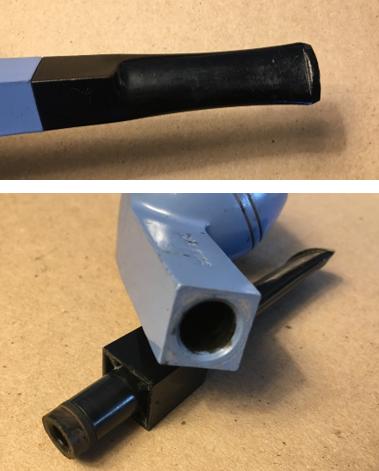
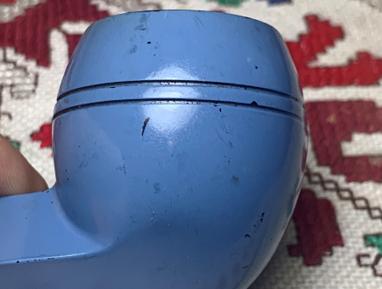
With a much better understanding of the pipe with information provided by Dr. Billie Taylor, it’s time to take a closer look at the the pipe English Blue Bulldog on the worktable. The cake is very light if any at all. The interior looks like it’s in good condition.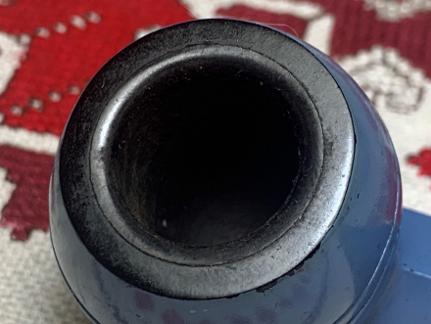 The stummel has its share of grime and paint chips. The grime will come off during the cleaning – the chips will not.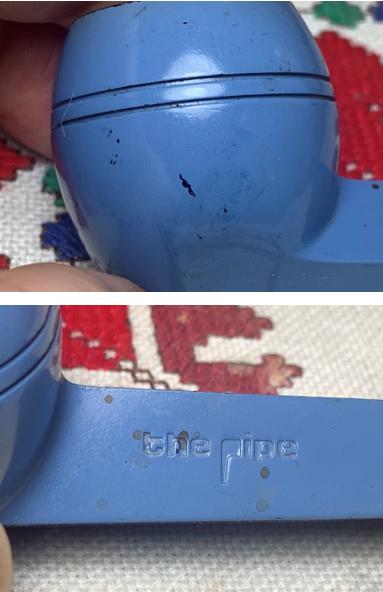
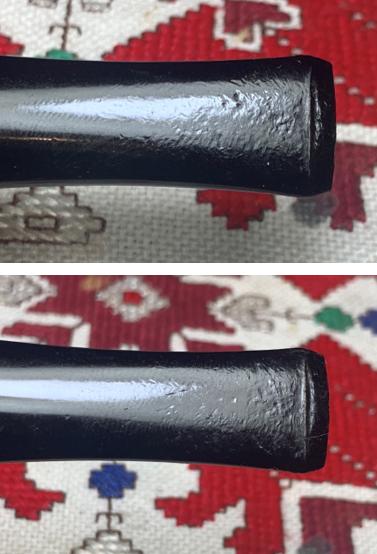
 The Bakelite (plastic) stem’s bit has been chewed with passionate gusto! Most of it is superficial chatter and should be addressed with sanding. However, working on plastic stems is never an easy task. The plastic is more sensitive to scratching and does not respond as straightforward as vulcanite stems usually do.
 The next picture of the tenon shows the O-ring in place – which I deduced from some of the reading is often missing.
 To prove the claim that this is a plastic stem, the cross-molding design strengthening the tenon is easily seen.
 In the cleaning process, I use some of the pointers from www.thepipe.info/cleaning. To soften the very light cake, I use warm water with some Murphy’s Oil Soap mixed in. The pipe soaks for a few minutes to allow the cake to soften.
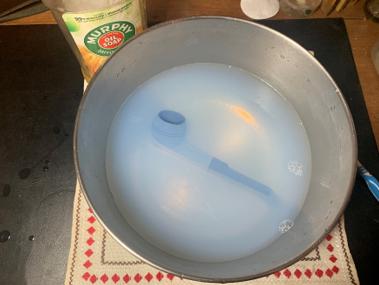 With briar pipes, using metal tools on the chamber is the norm for clearing away the cake. However, the pipe a toothbrush is used to scrub the chamber. After the chamber is cleaned, pipe cleaners are used to clean the stem’s airway through the draft hole. There was no blockage, so the pipe cleaners do the job without difficulty.
 The external surface is scrubbed with a non-scratch pad and then thoroughly rinsed under cool water at the sink.
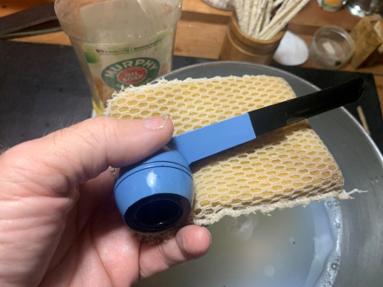 The pipe is then dried with a micromesh cloth.
  After the pipe has dried, the stem is removed, and a few cotton buds moistened with isopropyl 99% are used to clean the internals more thoroughly. It only takes a few and the buds start emerging lighter.
 The chamber cleans up nicely and the novel lining can be seen for the first time.
  After the cleaning, the paint chips and blemishes remain. They will continue with this pipe as a badge of honor representing his vintage.
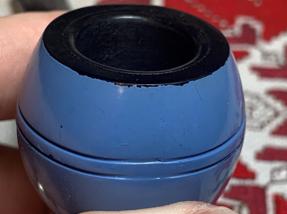 The stummel is done for the time being as the attention is switched to the stem. The Bakelite stem has significant tooth chatter that needs addressing. Another look at the close-up pictures shows the starting place to mark the progress. Removing scratches from the plastic material is not that easy – more difficult in my experience than vulcanite stems. We’ll do what we can and see how it goes.
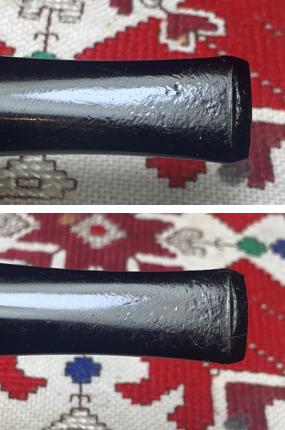 To begin, 220 grit paper is used to sand out the chatter and some compressions on button. Flat and squared needle files are used to file out the rough area of the bit and to refresh the button – upper and lower.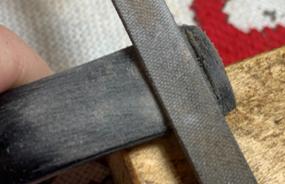
 The sanding expands to the entire stem next using 320 grit paper. A shoulder guard is used to protect the shank facing from sanding over the edge and creating a rounded shoulder.
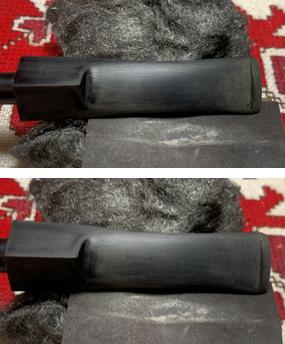
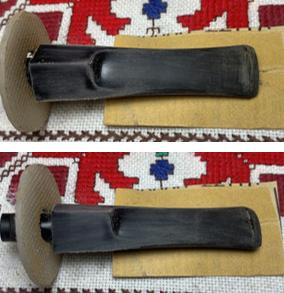 Next, the stem is wet sanded with the finer 600 grit sanding paper. The sanding is followed by applying 0000 grade steel wool to the stem.
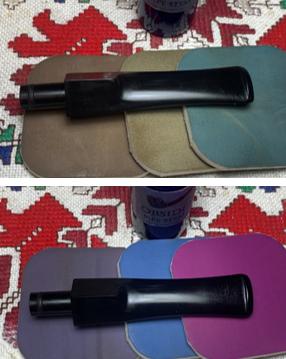
 Moving now into the fine grit micromesh pads, the stem is wet sanded with pads 1500 to 2400 and then dry sanded with pads 3200 to 4000 and 6000 to 12000. Between each set of 3 pads, Obsidian Oil is applied to the stem.
 Next, a dedicated cotton cloth buffing wheel is mounted on the rotary with the speed set a bit lower than usual – about 30% instead of 40% full power. With stem and stummel rejoined a light application of Blue Diamond compound is applied. The speed is slowed, and a light application is given because I’m concerned about the Bakelite stem melting. Too much friction with the wheel and compound could overheat the material and that would not be fun. The fine abrasive compound is effective in working out fine scratches on the stummel surface and especially the stem.
 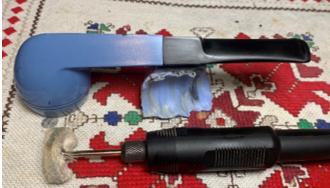 A felt cloth is used next to remove the compound dust from the surface.
 In the interest of full disclosure, at this stage I was not satisfied with the results of the stem. Patches of very fine scratches could still be seen, and this could not be passed on! I decided to go all the way back to sanding the stem with 320 grit paper and worked back through each of the sanding and polishing steps – 320, 600, 0000 steel wool, micromesh pads, and Blue Diamond compound. After completing the second cycle, I like the results much better. It’s not perfect, but much better than where we began!
Next, Mark Hoover’s, ‘Before & After’ Fine and Extra Fine polishes are applied to help condition the Bakelite material. Starting first with the Fine Polish, a small amount is placed on the fingers and worked into the stem. This picture shows what the polish looks like. After the Fine Polish is applied, it is wipe off with a paper towel. The same process is used in applying next the Extra Fine Polish.
 The next step was also gleaned from Dr. Taylor’s suggested process – car polish is used to shine up the English Blue stummel painted surface. As with my car, the polish is applied with a damp cloth and when it dries, it is wipe and buffed off with a cotton cloth.
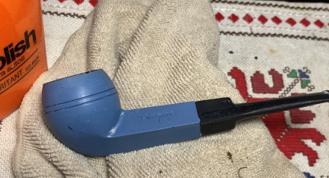 To buff up the stem, I found that Steve had worked on a the pipe and instead of applying carnauba wax to the stem, he applied Conservator’s wax (Cleaning up a sad “the Pipe” Billiard | rebornpipes). Following his lead, Museum wax is used which is thicker than carnauba wax which probably would just smear around on the Bakelite surface. The wax is applied and then after the stem and stummel are reunited, the pipe is buffed with a micromesh cloth to remove excess wax and to raise the shine.
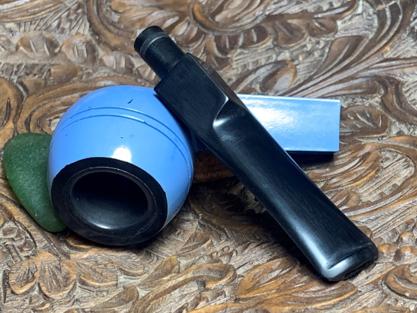
 This is my first time working on a the pipe and it was an interesting experience to work on a synthetic material that reminds me of Brylon. The stem was the greatest challenge, but I’m pleased with the results. The English Blue Bulldog is sharp looking and represents well the 60s/70s cultural vibe. Josh commissioned the pipe Bulldog and as the commissioner, will have the first opportunity to claim him from The Pipe Steward Store benefitting the Daughters of Bulgaria – helping women and girls who have been trafficked and sexually exploited. Thanks for joining me!



Please pray for the people of Ukraine!
www.Voice-of-Ukraine.com
www.CratesforUkraine.com
 The Pipe Steward
Hey Dal,
Just a heads up that this link doesn’t go anywhere. But also, the Jan 7 post is missing from your site. Perhaps the post remain in draft vs published status?
Sincerely, Darren Chick
LikeLike
Pingback: Rescuing a Lowly Mastercraft Pot of Italy from Basket Pipe Oblivion – The Pipe Steward
Pingback: A The Pipe Restoration – NebraskaPeteGeek