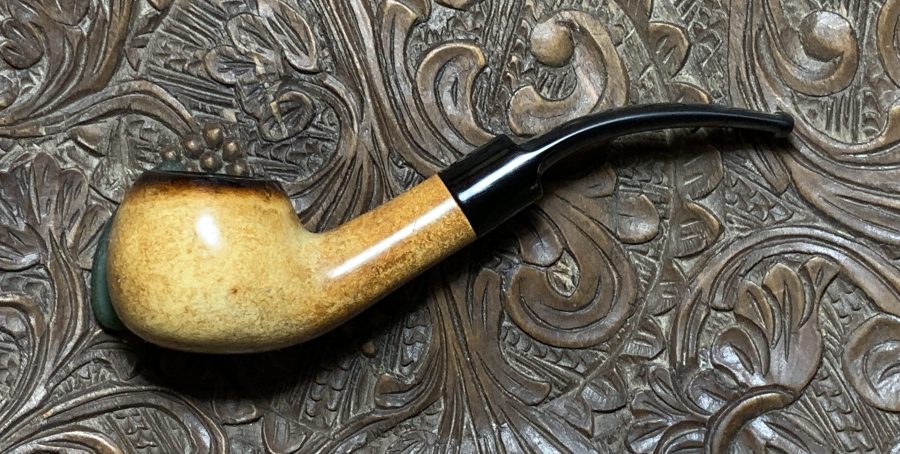
After celebrating the birth of our 10th grandchild – a boy 😊, it’s time to look at the next pipe on the worktable. This Meerschaum is the second of 3 pipes that pipe man, James from Dayton, Ohio, has commissioned. The first, pictured below, was another striking Peterson’s Meerschaum that turned out great (Reviving a 1971 Peterson’s Dublin Sterling Silver Meerschaum of Tanganyika). I met James at South Dayton Presbyterian Church last fall as my wife and I were traveling visiting churches, family, and friends in what was a 5000+ mile road trip. I appreciated meeting James and discovering that he is a disabled veteran and a family man AND going to school for a degree in graphic design. The first Meerschaum James commissioned was to add to his collection. This next Thompson Block Meerschaum is to be a gift for his father. James shared that he enjoys doing his homework and joining his brother and father at a local pipe and cigar shop called, “The Wharf”. This pipe would add to the fellowship with his father. Here is the second Meerschaum destined as a gift for James’ father.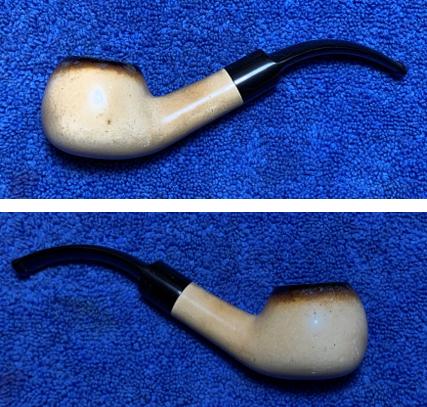

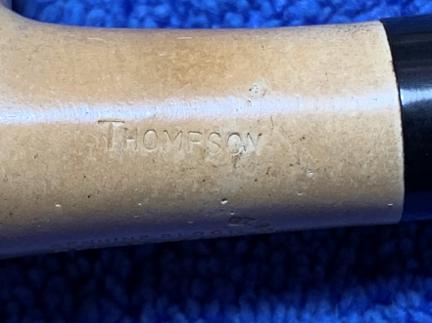
 The nomenclature is stamped in the Meerschaum on the left shank flank: THOMPSON.
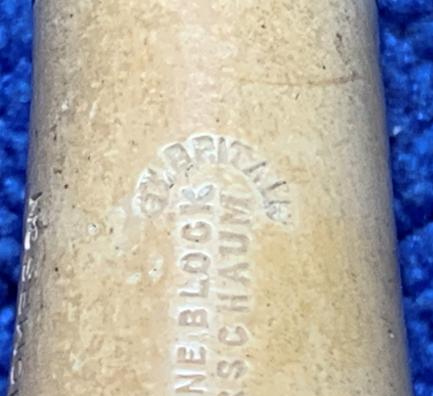
 On the underside of the shank is stamped, GENUINE BLOCK [over] MEERSCHAUM.
 To the right of this is stamped forming an arch is the COM: GT. BRITAIN.
 I acquired this Meerschaum in what I call the Lot of 68 in February 2019 from a seller in West Hartford, Connecticut. These pipes have gradually populated the ‘For “Pipe Dreamers” ONLY’ collection where pipe men and women are able to commission pipes that get their attention. A large portion of the sale of each pipe helps to benefit the Daughters of Bulgaria, a work that my wife and I co-founded in Bulgaria. The picture shows the Lot of 68 and the Thompson in the center.
 My research on the origins of the Thompson Block Meerschaum name can be summarized like this: It was made with African Meerschaum from the Tanganyika Meerschaum Corporartion (Tanganyika Meerschaum Corporation – Pipedia) and produced by Laxey Pipe Ltd. on the Isle of Man. This conclusion was deduced from comments made about Thompson from various pipe forum threads. Here is one example from Pipesmagazine.com (2012) among several that I found that demonstrates what I have found generally:
@tschiraldi – Thanks! It’s my understanding that the Thompson Meerschaum pipes were made by the Manx Meerschaum Company on the Isle of Mann (Great Britain). Back story is that my 3x Great Grandfather was Sir Hall Caine who was a famous author known as the Manx Man and lived on the Isle of Mann. I thought it would be cool to own a pipe made by the Manx Meerschaum Company which was made on the Isle of Mann. Just thought it was interesting.
“It’s my understanding…” is the key idea. I found several comments with the assumption that Thompson Block Meerschaum pipes were produced by ‘Manx’ or ‘Laxey’ – the same producer. When doing the research on James’ first commission, I discovered that the Laxey Co. produced the Peterson’s Meerschaum. Here is the Pipedia information on Laxey Pipes Ltd.:
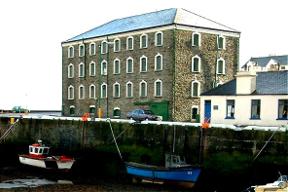 Laxey Pipes Ltd. resided in a historical 19th century four-storey Man stone building at The Quay, Old Laxey, Isle of Man, which thankfully has been preserved.
The company specialized in the production of meerschaum pipes using the Meerschaum mined by the Tanganyika Meerschaum Corporation in the Amboseli basin in Tanganyika (since 1964 part of the United Republic of Tanzania).
Please note: you may often find names like “Manx Pipes Ltd.”, “Man Pipe Co.” and others more, but there is no indication of another Isle of Man pipe producer other than Laxey Pipe Ltd. at any time!
Laxey Pipes Ltd. marketed their own brands like “Manxpipe”, “Manxman”, “Manxland” e.c. Names like “John Bull”, “White Knight” (unwaxed), “Domino” (black, or lined) indicated some shapes / colours of Laxey’s own series. The stems either showed the astronomical sign for “male” or “man” (circle + arrow), or the crest of the Isle of Man, the 3-legged X in a circle. Manxpipes and Laxey’s other brands were available through pipe retailers in general, but also were sold (mainly) to tourists through their own shop in Laxey.
Furthermore Laxey Pipes Ltd. manufactured the meer bowls for Peterson, Barling, Nørding and others from the later 1960’s until 2001. Man Pipe e.g. was a brand distributed by Comoy’s. The bowls usually showed no nomenclature indicating the orderer. “Genuine Block Meerschaum” was engraved frequently. Often, just the stems were different, while bowls were the same.
Supply of meerschaum from East Africa ran out (Kenya / Tanzania exhausted, Somalia inaccessible), and thus the last Laxey meers were supplied to trade in May, 2001. Laxey Pipes Ltd. tried to survive continuing with briar pipes – mainly in the Danish style -, but to no success. It closed down business in July 2002.
In this article from Pipedia, there is no direct mention of Thompson Block Meerschaum however, it was left open that there were other brands produced from the 1960s until 2001 beyond those mentioned – Peterson, Barling, and Nording.
I tend to agree with the sentiments of the Thompson Block Meerschaum pipes being produced by Laxey. Why? First, with the COM being ‘GT. Britain’ leaves few options (if any) of a Meer block being produced other than on the Isle of Man. Secondly, the Thompson on the worktable resembles other products of Laxey with the smokestack coloring and the usual stamping: “Genuine Block Meerschaum”. Here are examples of Laxey pipes including our Thompson. The last characteristic that promotes the Isle of Man provenance is that the Thompson is made with African Meerschaum. Tanganyika Meerschaum that was used by the Laxey production is described as tougher, less porous, and cheaper than Meerschaum mined in Turkey (Tanganyika Meerschaum Corporation – Pipedia). The denser characteristics of the Thompson on the worktable I believe fits the general characteristics of African Meerschaum. Even though I can find no direct link with Laxey and Thompson, I believe it is a safe assumption that Thompson was produced by the Laxey Company on the Isle of Man. If this is to be accepted, the dating of the Thompson would be no later than 2001 when Meerschaum ran its course from the mines of Tanganyika.
Looking now at the pipe itself, I am guided by the idea that Meerschaum simply needs some TLC – ‘less is more’. Cleaning and waxing are the usual approach – not much more. The chamber appears to have very little cake build-up which is what you want to see. Meerschaum requires no protective cake. 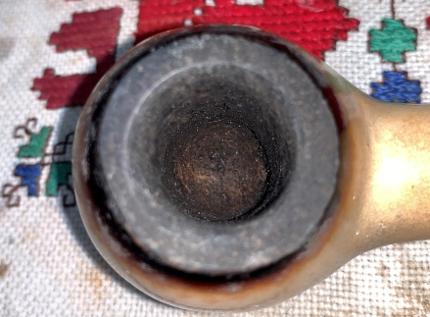 The Meer surface will be cleaned. It is pitted with small pinpricks over much of the surface. The surface will receive a light micromesh sanding after the cleaning to smooth this out as much as possible without being too aggressive.
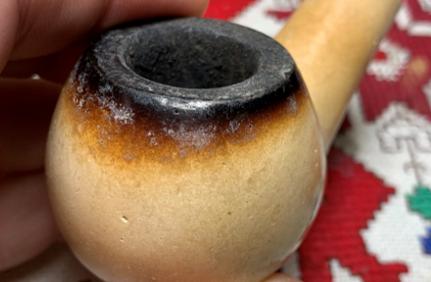
 The smokestack coloring on the top of the Brandy bowl provides a rustic feel. There are rough spots in the coloring that I will look at more closely after cleaning if needed.
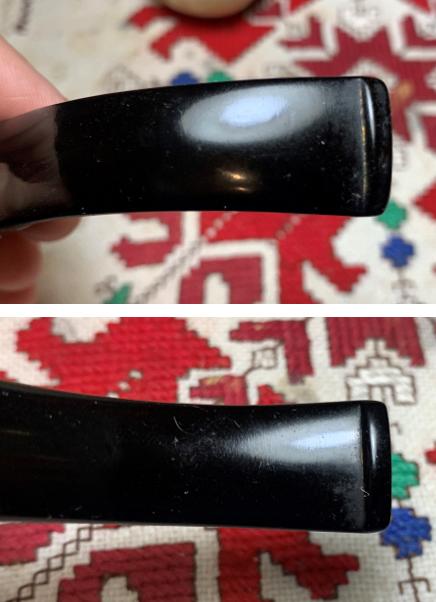
 The vulcanite stem is in very good condition – almost no tooth marks can be seen nor any oxidation.
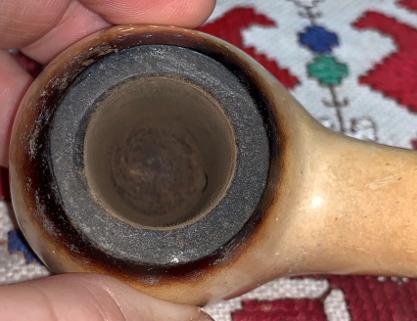
 Starting with the Meerschaum stummel, the chamber is scraped with the Savinelli Fitsall Tool and then sanded with 220 grit paper wrapped around the Sharpie Pen.
  The chamber looks good after the cleaning.
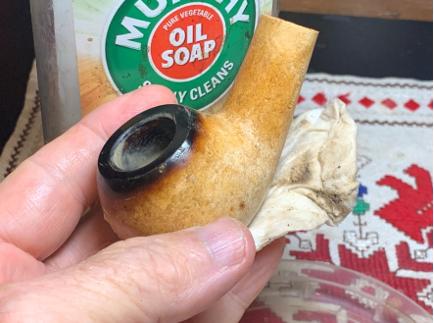
 Next, the Meer surface is cleaned using undiluted Murphy’s Oil Soap and cotton pads. The rim shows some lava flow build up that needs addressing as well. After scrubbing the surface with the cotton pad, the stummel is taken the sink to rinse the surface.
 To clean the internals, pipe cleaners and cotton buds are used with isopropyl 99%. It did not take long, and the cleaners were emerging lighter.
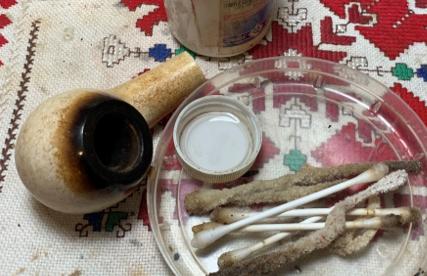 After the cleaning, it appears that the Meerschaum has a nice patina developing. This is good.
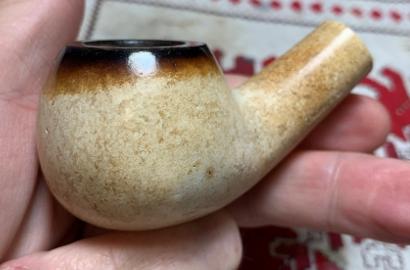 To further clean and smooth the Meerschaum but not to damage the patina, the 5 finer micromesh pads (3600 to 12000) are used to sand/polish the surface. The pits that I mentioned earlier, at this point I’m not concerned with. To sand them out completely would damage the patina. The pits will add to the rustic feel of the pipe 😊.
 Looking at the chimney top rim, the hue of the dark dye has worn off on the edge of the rim. To touch this up a bit, a dark brown Chestnut dye stick is used to color in the lightened edge.
 Next, the Meerschaum will be given a beeswax treatment which is where the magic happens when restoring a Meerschaum pipe. Beeswax is used not only to protect and shine the Meerschaum, but also to augment the development of the patina. First, the beeswax is heated with the hot air gun in the mason jar. It is heated until the wax liquifies.
 The Meerschaum stummel is also warmed which helps with the application of the liquified beeswax. Using a horsehair brush (which won’t melt) the hot beeswax is applied over the stummel. As the wax cools it congeals. Over time, I have developed an approach that I believe has enhanced the Meerschaum’s capacity to absorb the beeswax and thereby enriching the patina. During the application of the beeswax with the horsehair brush, I keep the hot air gun aimed at the stummel which is positioned over the mason jar. A cork inserted into the chamber acts as a handle. As wax is being applied the continuous application of hot air from the gun keeps the stummel warm and the wax liquified. Using the brush with the help of gravity, the excess liquid beeswax is coaxed downward with the excess wax dripping into the mason jar. When the stummel has been completely covered by the beeswax, the stummel is put aside to allow it to cool. I couldn’t take a picture of this process without a third arm 😊.
 While the stummel is on the sideline, attention is turned to the stem. To clean the airway, isopropyl 99% is used with only two pipe cleaners doing the job. Moving on.
 To address the miniscule signs of wear on the bit, the bit is sanded with 320 grit paper – upper and lower.
 This is followed by wet sanding with 600 grit paper and then 0000 grade steel wool is applied.
 Transitioning next to more of the polishing, micromesh pads are used. Starting by wet sanding, pads 1500 to 2400 are used. Then the stem is dry sanded with pads 3200 to 4000 and 6000 to 12000. To condition the stem and to guard against oxidation, between each set of 3 pads, Obsidian Oil is applied. The stem looks great.
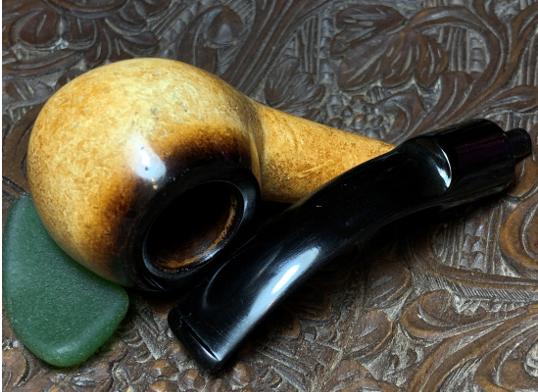
 Turning again to the stummel, the cooled beeswax on the surface has solidified and is thick and doesn’t clean off easily. It takes a good bit of buffing and soft scraping to clear the ‘gummy’ layer off to get down to the Meerschaum surface. The Meerschaum is buffed rigorously with a microfiber cloth and Wow! I love the results. The Meerschaum almost appears to have grain patterns and the honey brown patina is striking. I’m pleased with character of this Tanganyika Meerschaum and how it received the beeswax treatment.
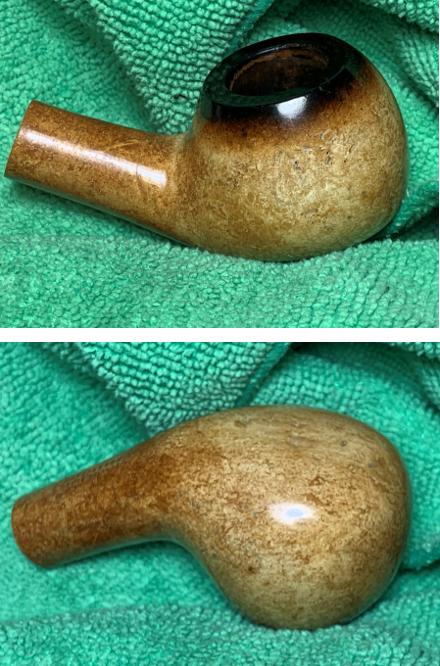 With the refreshing of the Meerschaum stummel completed, before reuniting the stem and stummel, Blue Diamond compound is applied to the stem. With a dedicated cotton cloth wheel mounted on the rotary tool with the speed set at about 40% full power, the compound is applied to the stem.
 To rid the stem of compound dust in preparation for the wax, it is wiped with a felt cloth.
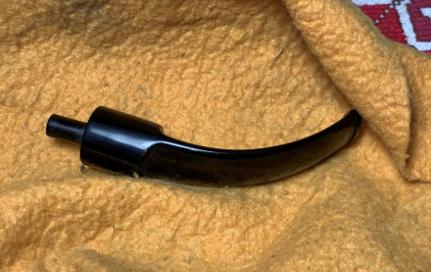 With another dedicated buffing wheel mounted on the rotary tool, carnauba wax is applied to the stem.
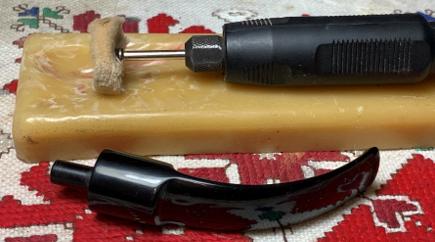 One last mini project I see which should have been done earlier – the stem bend is a little too tight. The end of the bend should be parallel with the plane of the rim. But as pictured below, there is a distinct gap between the end of the stem and the clothespin as the stem curls down.
  To rectify this, the hot air gun heats the bend of the stem. When the vulcanite rubber warms and becomes supple, the stem starts to straighten without any help from me. When stem bend reaches the right pitch, the stem is taken to the sink and the rubber is cooled with tap water to hold the bend. The stem is then given a quick touch-up of carnauba wax, and the entire pipe is given a hand buffing with a microfiber cloth to raise the shine.
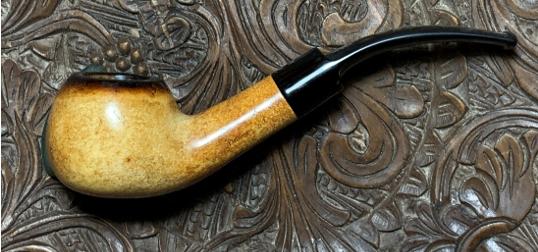
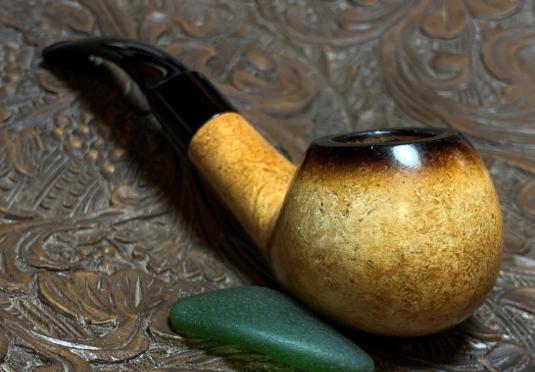
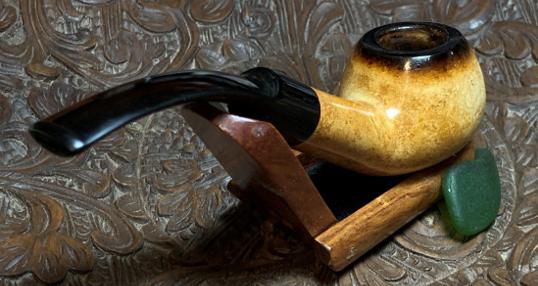
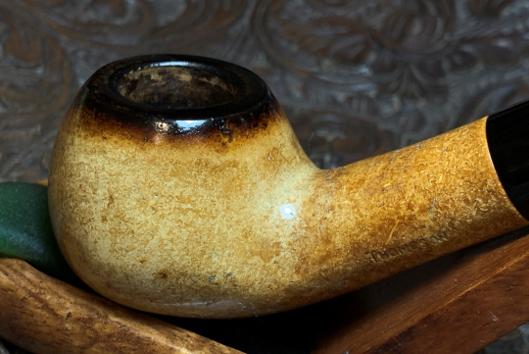
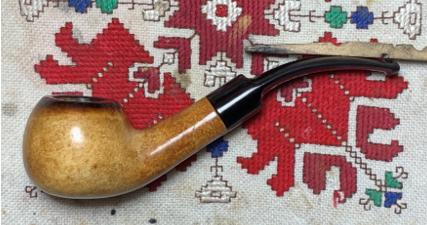 It was interesting diving into the provenance of the Thompson name and I’m confident that this pipe was produced on the Isle of Man by Laxey. I’m pleased with the transformation of this Block Meerschaum. The beeswax treatment did its magic, bringing out the patina in striking fashion. The Meerschaum is also interesting with its textured, patterned appearance with the chimney top giving a rustic vibe. James commissioned this Thompson Genuine Block Meerschaum as a gift for his father. As the commissioner he will have the first opportunity to claim the Thompson from the Pipe Steward Store. A portion of all proceeds from pipes help to benefit the Daughters of Bulgaria. The ‘before & after’ pictures remind us of how far we’ve come! Thanks for joining me!





 The Pipe Steward
Pingback: Road Trip Restoration #2: Replacing the Shattered Shank Extension for an Heirloom Sixten Ivarsson Stanwell 62 – The Pipe Steward
Pingback: A Thompson Block Meerschaum Billiard Restoration – NebraskaPeteGeek