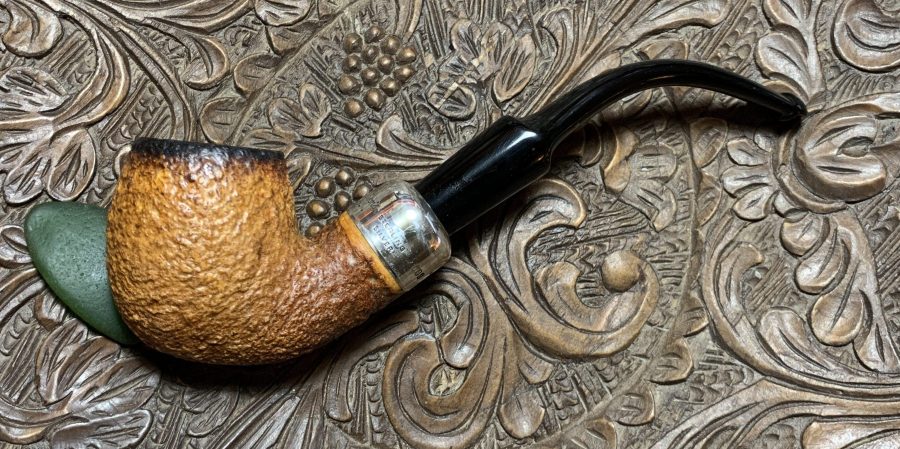
The next pipe on the worktable is the first pipe that I am restoring from the Lot of 68 pipes that I acquired February 24, 2019. This Lot came from a seller in West Hartford, Connecticut, and what got my attention was not only the size of the Lot, but also the meticulous listing the seller gave of the pipes on the auction block. This was not a throw-away Lot like many online are. The bidding was fierce, but I knew my limit and fortunately for me and for future stewards, that line was not reached and the Lot of 68 came to Sofia, Bulgaria, where we were still living. Here is the picture the seller posted of the Lot of 68 and I’ve included the list of pipes that are now gradually populating the For “Pipe Dreamers” ONLY! online collection where pipe men and women can commission pipes which benefit the Daughters of Bulgaria – a work that my wife and I co-founded in Bulgaria helping women and girls who have been trafficked and sexually exploited.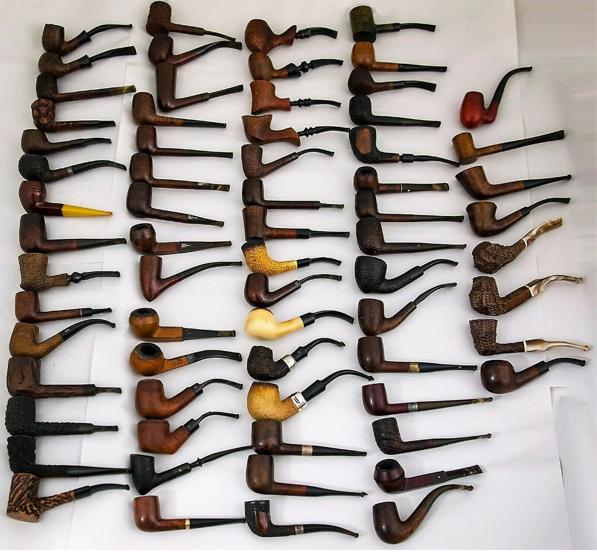
- Gold Grain Imported Briar (14k gold 1/4 O.R.G. band)
- Creston (Sterling silver band with Sterling marks)
- Sterling Hall Hand Made 50 (B in diamond) (Sterling silver band)
- Slendaline London Made By Sasieni 14 Reg’d 865291 (Sterling Silver Band)
- Peterson’s System Standard Made in the Republic of Ireland 314 (Sterling silver band with K&P and Peterson’s logo and Sterling marks) (P on mouthpiece)
- Peterson’s Dublin (Sterling silver band with Sterling marks)
- Peterson’s Deluxe Made in Ireland
- Dunhill Bruyere 113 F/T Made in England8 2A (Sterling Silver band)
- Dunhill Bruyere 48 F/T Made in England4 4A Pat. No. ?/4/34
- Dunhill Tanshell 253 F/T 4T
- Stanwell 39 Regd. No.969-48 Hand Made in Denmark (S with crown on mouthpiece)
- Stanwell 23 Hand Made in Denmark
- Comoy’s Tradition 370 (C on mouthpiece)
- Comoy’s Sandblast 186 Made in London England (C on mouthpiece)
- Charatan’s Make London England Belvedere 1018 (CP on mouthpiece)
- Charatan’s Make London England Special 281 DC
- Savinelli Capri 310 Root Briar (S in shield)
- Savinelli Punto Oro 602 Italy (S in sheild)
- Big Ben Crosley 348 Made in Holland
- Big Ben Crosley 340 Made in Holland [small hole in bottom of bowl]
- Guildhall London 30
- Guildhall London No Number
- Guildhall London 234
- Thompson Meerschaum Genuine Block Gt Britain
- Thompson Meerschaum Genuine Block Gt Britain
- Bolton Best Briar Genuine Leather Imported Briar Made in Belgium (leather bound bowl)
- Bolton Best Briar Genuine Leather Imported Briar Made in Belgium (leather bound bowl)
- Bolton Best Briar Genuine Leather Imported Briar Made in Belgium (leather bound bowl)
- Duke of Kent Meerschaum Algerian Briar Made in France (D in octogon) [small crack to rim of bowl]
- Masterbuilt Imported Briar
- Custombuilt Imported Briar
- Simpson Piccadilly
- Arne Nygaard 72 1B
- Monarch 1074C Pat. 1989069
- Colonel Fraser Hand Made 263
- Longchamp France (leather bound bowl)
- Barok Bruyere St. Claude
- Herter’s Angler’s Pipe Made in England 147 (Herter’s on mouthpiece)
- Royal Guard 582 Made in Denmark (RG on mouthpiece)
- Kriswill Count Handmade in Denmark (starburst on mouthpiece)
- Kilimanjaro 45 Made in Tanganyika (rhinoceros on mouthpiece)
- Merkur 2000 W Germany 907 (logo on mouthpiece)
- Amphora Genuine Briar X-? 732 Made in Holland (A in circle on mouthpiece)
- Lillehammer GL Super Extra 61 (GL on mouthpiece)
- Hurricane Standard London X17
- Tribune 606 (909)
- BBB Tiger Grain London 710
- Royal Sovereign 190
- Kaywoodie Standard 42
- Ehrlich
- Sullivan Powell Burlington Arcade 283
- Dr Ewot 8556 Genuine Briar [large crack in bowl]
- Multiple pipes with no name Handmade In Denmark
- Multiple pipes with no name made in Italy
- Multiple pipes with no name made in England
- Multiple miscellaneous pipes with no name
- Condition: Excellent used condition. Three pipes have flaws noted in the list above.
The Lot of 68 waited in a box until I was ready to post them online, and over the Christmas holidays I started posting these pipes and still have about a third of the pipes to go. Before I started posting the 68, this past fall my wife went on a 5000+  mile road trip camping in our small R-pod travel trailer and visiting churches in the mid and northeast USA that have supported our work over the years. I took a sampling of the Lot of 68 with us because I gave talks at some of the churches about how I got into restoring pipes through our work with the Daughters of Bulgaria. I displayed these pipes on a table and if there happened to be a pipe man looking to commission a pipe, I had candidates ready to go!
James is a member of South Dayton Presbyterian Church where my wife and I spoke one evening at the end of September. I enjoyed meeting him and his father who were both pipe men. I discovered that James is a family man with 4 children. He stays plenty busy as a husband and dad, and he is also going to school. Yet, even with all this going on, he wrote and shared:
But I still manage a little time to work on homework at the local pipe and cigar shop, “The Wharf”. I can work on homework while smoking my favorite Randy Wiley pipe. It is certainly nice to take that time. It is also something I do with my father and younger brother.
In our subsequent communications I asked about him going to school – with a family that would make him a very busy man! When I asked him if he was pursuing a further degree, etc., I found out that he is a disabled vet and my appreciation for his service and sacrifice were expressed. He wrote:
Yes. I was blessed to receive assistance from a program for disabled veterans and returned to school to get a degree in Graphic Design. I am so thankful to be back in school and a Christian school at that. My goal for the future is to work for a mission organization, taking photos, designing published material, and managing websites. I was in the Air National Guard for 5 years and the Active Army for 6 years. I deployed to Afghanistan for the year of 2006.
My prayers are with James, his family, and his aspirations for the future.
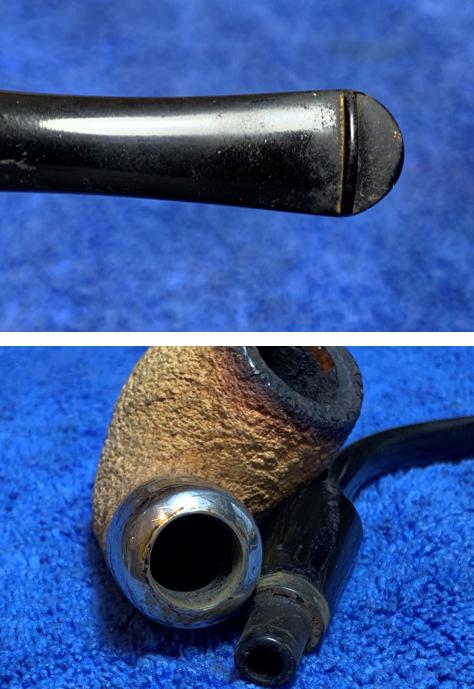
At the church, I had the pipes spread out on the table and James saw the Peterson Dublin Meerschaum adorned with a sterling silver ferrule. The Meerschaum had a dark trim around the top of the bowl to give that rustic smokestack vibe. It didn’t take any convincing before James was asking about commissioning the Peterson. Here are pictures of the pipe that got James’ attention.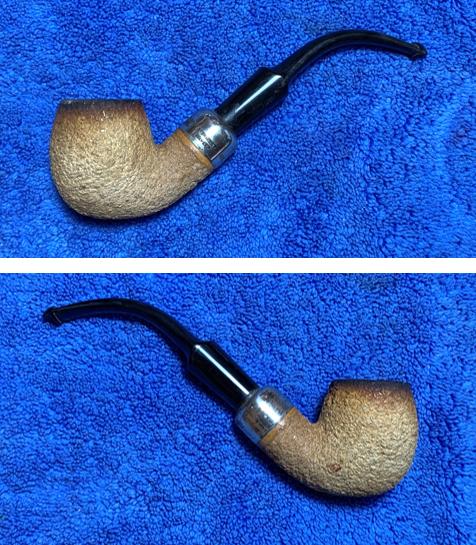
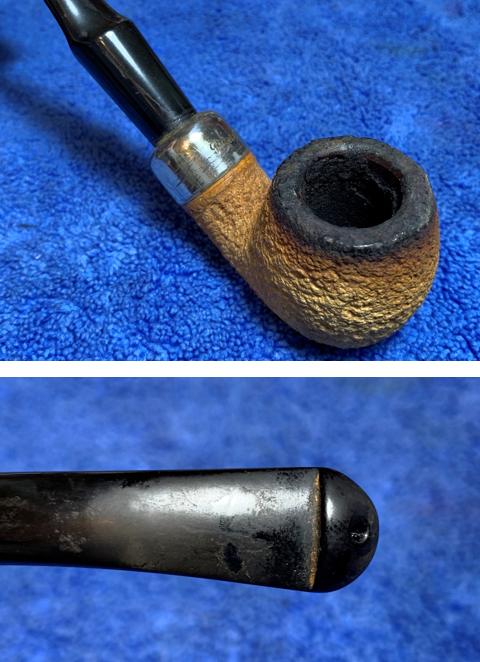
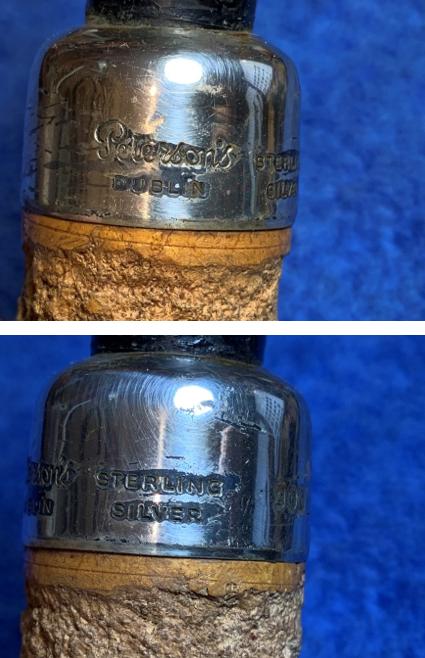
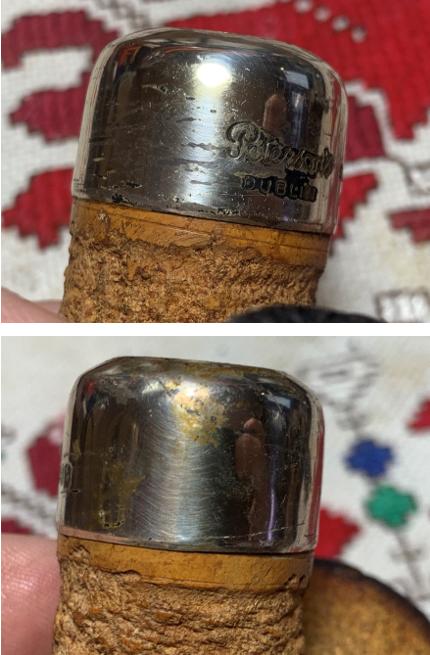
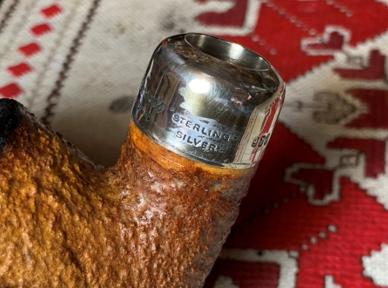
 The only markings on the pipe are stamped on the sterling silver ferule. Moving around the ferule is stamped in cursive, Peterson’s [over] DUBLIN. Continuing to the right, STERLING [over] SILVER.
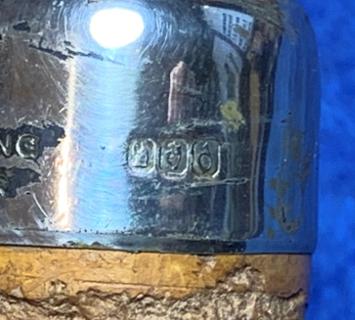
 Further to the right are stamped 3 hallmarks. At this point, I don’t know if these are faux hallmarks for decorative appearances or pointing to information on the provenance of this pipe.
 Pipephil’s brief accounting of the history of Peterson is a good place to start (Peterson: historical pipes — Pipes: Logos & Markings (pipephil.eu):
The Peterson brand is issued from the association of the brothers Friedrich and Heinrich Kapp with Charles Peterson. The Dublin tobacco shop first named “Kapp Brothers” (1865) became the “Kapp & Peterson” Company. Tom Palmer bought the Peterson business in the early 1990s.
Production (2006): ~ 120 000 Pipes / year
1875 – 1915: Patent Era
1915 – 1949: Pre Republic Era (Irish Free State, Made in Eire, Made in Ireland)
1950 – Present: Republic Era (Made in the Republic of Ireland)
1991 – Present: Modern Era (Tom Palmer buys over Peterson)
The links next to each ‘era’ go to the Pipephil entries for Petersons produced in those periods. Much more information and pictures of Peterson pipes can be found at the Pipedia Peterson article (Peterson – Pipedia). The hallmarks on the ferule are the key to finding out more about this pipe. My ‘go to’ place for information about Peterson pipes is Mark Irwin’s site, www.PetersonPipeNotes.org. I’m saving up my shillings to purchase his book on Peterson Pipes 😊. This site is the place to go to drill down information about Peterson. I found exactly what I was looking for in his tab, Hallmarks (Hallmarks – Peterson Pipe Notes). I discover very quickly that the hallmarks on the Peterson are not faux markings. The discussion on Peterson hallmarks (or, stampings) is broken down into 5 groupings:
- The “K&P maker’s mark;
- Nickel-mount marks (often confused for hallmarks by the unknowing);
- Irish sterling hallmarks (stamped by the Dublin Assay Office);
- Irish gold hallmarks (also stamped by the Dublin Assay Office);
- British sterling hallmarks.
Our ferule has ‘Sterling’ stamped on it as well as ‘Dublin’. In the listing above, ‘3. Irish sterling hallmarks (stamped by the Dublin Assay Office)’ is the group that is relevant to the pipe on the worktable. I jumped down to look at this section and repeat much of the text from the site because I find it very interesting and helpful:
Irish sterling hallmarks denote the year in which a piece was made or hallmarked and began with the foundation of the Dublin Goldsmiths Company in 1683. Peterson hallmarked pipes have been documented by my co-author Gary Malmberg from 1891 to 1938 and 1969 to the present, leaving a 30-year gap, which K&P later confirmed. Approximate dating of a precious-metal mounted pipe made during these 30 years is possible, as I said at the outside, but requires The Peterson Pipe Book or an extensive collection of Peterson catalogs to understand the contextual history of shapes, lines, finishes and stains….
It was a great effort but marred by the fact that, at the time, they didn’t realize that K&P hadn’t hallmarked any pipes from 1938 through 1968…!
Three symbols appear on a Peterson sterling band or ferrule (note that sometimes only two appear on tenon end of a spigot or on a silver rim cap]. The first is Hibernia, the symbol of Ireland. She is depicted seated with one arm on the harp. This is the distinctive symbol of the Dublin Assay Office identifying sterling that has been assayed in Ireland. The second original symbol is the Harp Crowned, a fineness mark indicating the quality of the silver. It appeared on hallmarked Peterson pipes through 2002. Here it is on a 305 sterling mount marked “T” for 1984: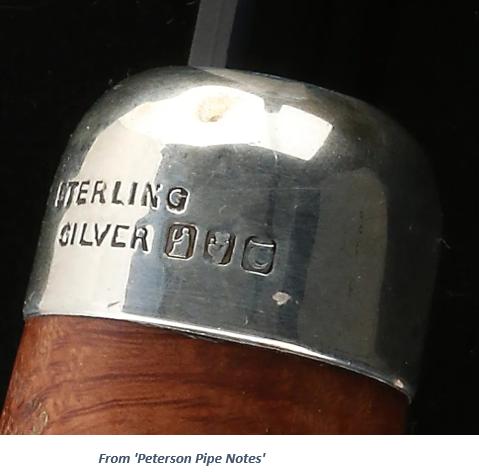 After looking at the picture above, I decided to take a better picture of the hallmarks on the Meerschaum. They are exactly as stated above. The first stamp on our ferule pictured below is the ‘Hibernia’ the symbol of Ireland. The lady is shown with her harp. Curious about the term, I looked to Wikipedia (Hibernia – Wikipedia) and discovered that Hibernia is a Classical Latin name for Ireland which was taken from the Greek geographical exploration accounts to describe the land. The Hibernia was adopted as the specific marking of the Dublin Assay Office.
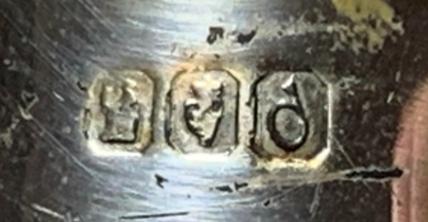 The next marking in the middle above, is the “Harp Crowned’ which indicated the quality of the silver – .925. The final mark points to the dating. The text continues:
The third mark is the date letter. These follow a system peculiar to the Goldsmiths of Dublin, sometimes using the Celtic alphabet, sometimes the English one. Quite often the date sequence will skip a few letters in each cycle that look too much like the letter next to it in the alphabet. Here’s a simple chart for your use…
The chart referenced I include below with the letter ‘d’ matching the style on our pipe marked – 1971: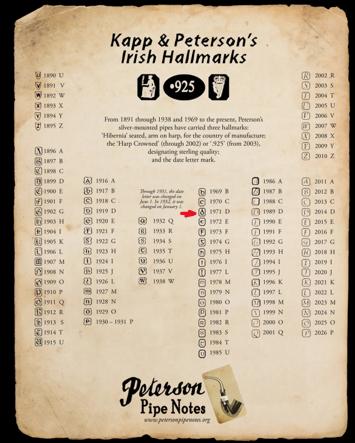 This pipe came off the production line in 1971 – that is cool. I was 16 years old, and the top songs of the year were Three Dog Night’s, ‘Joy to the World’ and Rod Stewart’s, ‘Maggie Mae’. It was the 1971-1972 NFL season that saw my Miami Dolphins perfect season, and it was the year that I owned my first car, a 1968 VW Bug (well, my parents owned it).
There is one more bit of information to add to what we know about the provenance of the 1971 Meerschaum on the table. It’s interesting that in all the sources of Peterson information available, I found almost nothing about Peterson Meerschaums. The current Peterson website has no Meerschaums (Peterson Pipes and Accessories) or information about them that I could find. The last bit of information came from a pipe man, Michael who was commenting on the ‘Old Codgers Smoking Pipe’ FB thread of my last project – a Kiko Meerschaum. I mentioned that my next project was a Peterson Meerschaum and Michael commented:
The Pete meerschaums were made by Laxey Manxman on the Isle of Man, UK. They also made pipes for Barling, Nørding and several others. Laxey had a special calcination Prozess, that made their meers about as tough as pipes made of briar.
I took this information to Pipedia (Laxey Pipes Ltd. – Pipedia) and found out more about the Peterson on the worktable:
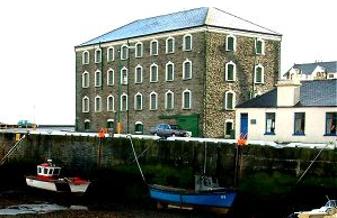
Laxey Pipes Ltd. resided in a historical 19th century four-story Man stone building at The Quay, Old Laxey, Isle of Man, which thankfully has been preserved.
The company specialized in the production of meerschaum pipes using the Meerschaum mined by the Tanganyika Meerschaum Corporation in the Amboseli basin in Tanganyika (since 1964 part of the United Republic of Tanzania).
Please note: you may often find names like “Manx Pipes Ltd.”, “Man Pipe Co.” and others more, but there is no indication of another Isle of Man pipe producer other than Laxey Pipe Ltd. at any time!
Laxey Pipes Ltd. marketed own brands like “Manxpipe”, “Manxman”, “Manxland” e.c. Names like “John Bull”, “White Knight” (unwaxed), “Domino” (black, or lined) indicated some shapes / colours of Laxey’s own series. The stems either showed the astronomical sign for “male” or “man” (circle + arrow), or the crest of the Isle of Man, the 3-legged X in a circle. Manxpipes and Laxey’s other brands were available through pipe retailers in general, but also were sold (mainly) to tourists through their own shop in Laxey.
Furthermore Laxey Pipes Ltd. manufactured the meer bowls for Peterson, Barling, Nørding and others from the later 1960’s until 2001. Man Pipe e.g. was a brand distibuted by Comoy’s. The bowls usually showed no nomenclature indicating the orderer. “Genuine Block Meerschaum” was engraved frequently. Often, just the stems were different, while bowls were the same.
Supply of meerschaum from East Africa run out (Kenya / Tanzania exhausted, Somalia inaccessible), and thus the last Laxey meers were supplied to trade in May, 2001. Laxey Pipes Ltd. tried to survive continuing with briar pipes – mainly in the Danish style -, but to no success. It closed down business in July, 2002.
With this information, what can be concluded about the Peterson Meerschaum on the worktable is that it dates from 1971 with silver marks placing it in Dublin and of .925 quality. The Meerschaum bowl was produced by Laxey Pipes Ltd. based on the Isle of Man, UK. The Meerschaum was mined from the Tanganyika Meerschaum Corporation which I’m familiar with – the producer for Meerschaum for the Kiko brand of pipes.
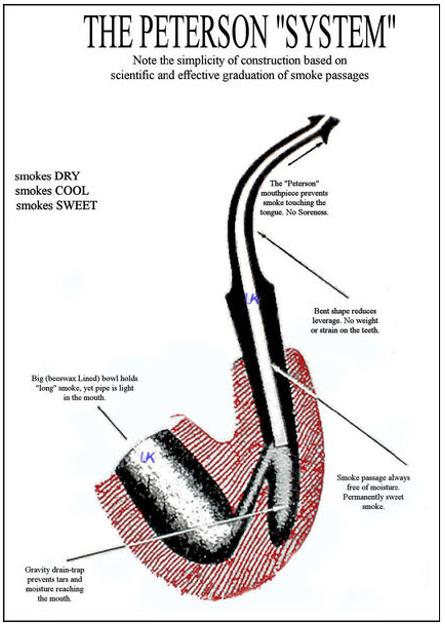
What is also interesting to me about the Peterson Meerschaum on the table is that it was fashioned like the classic Peterson System Pipe. In the chart below from Pipedia (File:System.jpg – Pipedia), the shape that looks to be the closest is 314 which has more of an Apple shape bowl rather than a Billiard.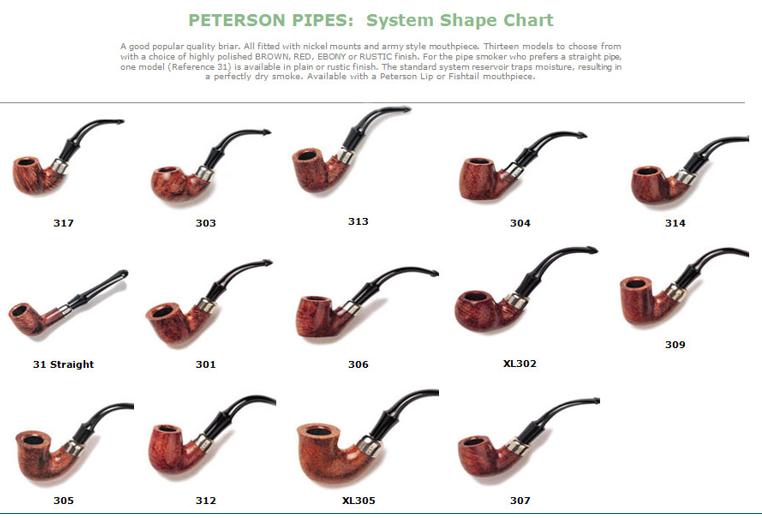 One more item of interest. Not only does the Meerschaum shape appear to be a System Pipe Shape, but the drilling appears to be consistent with System Pipe design. The picture below shows the upper hole airway drilling and the larger trap drilling below. Below this picture of our Meerschaum is the cut-away showing the side view of the ‘Peterson System’ (File:System2.jpg – Pipedia).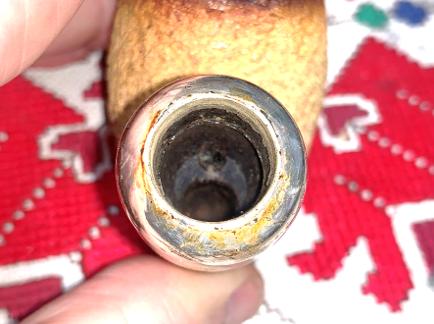
 With a better understanding of the Peterson Meerschaum on the worktable, it’s time to look at the specific issues. The chamber has a cake build up which is not needed for a Meerschaum. This will be cleaned down to the Meerschaum.
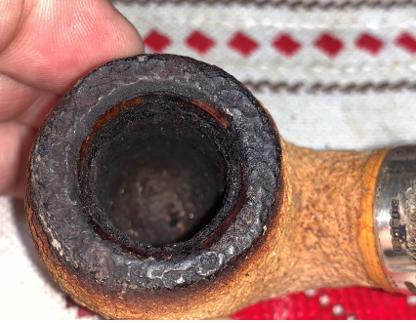 The rim has a good bit of lava and grime in the sculpted plateau. There are some minor chips on the edge of the rim in the black ‘smokestack’ trim. After cleaning, these lighter chips will be masked with a dye stick.
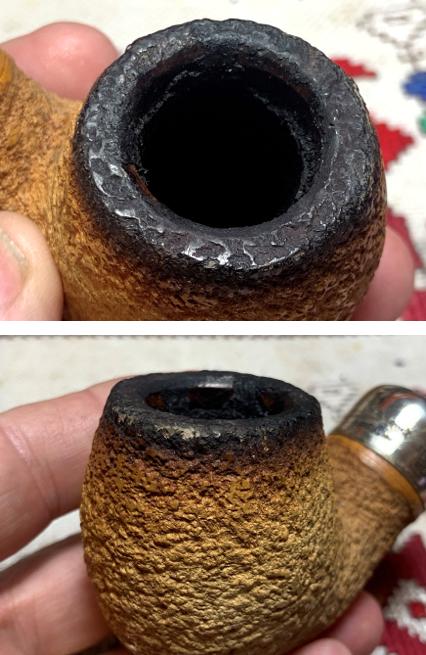 The sterling silver ferule or shank cap has what appears to be scratches and rubs on the surface where the silver is worn. We’ll see how these blemishes will buff out and buff up.
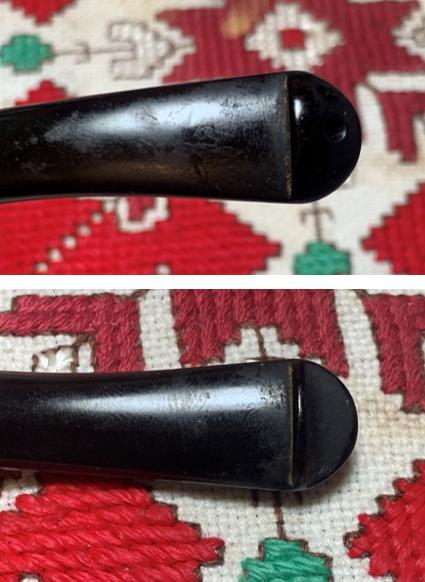
 The military P-lip stem is in relatively good shape. There is minor chatter on the bit – upper and lower. I detect only mild oxidation.
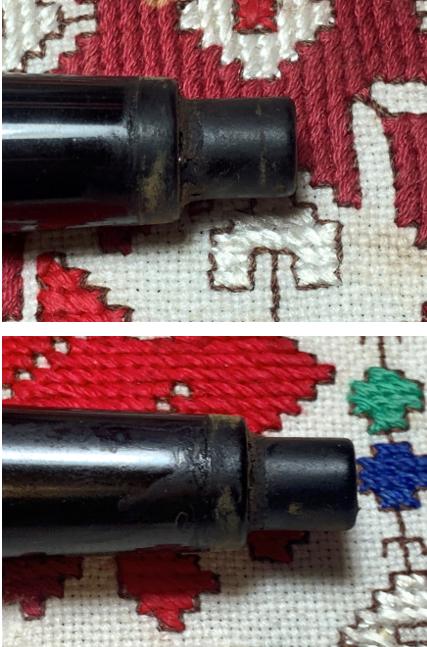
 The tenon and the area inserted into the mortise need cleaning and sanding.
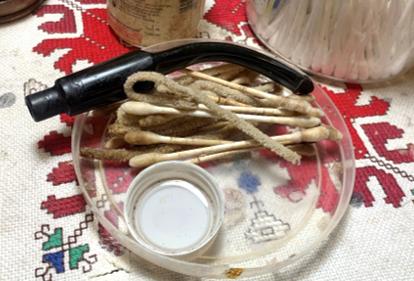
 To begin, the airway is cleaned using pipe cleaners and cotton buds moistened with isopropyl 99% alcohol. The cavity in the stem probably will accommodate a 6mm filter.
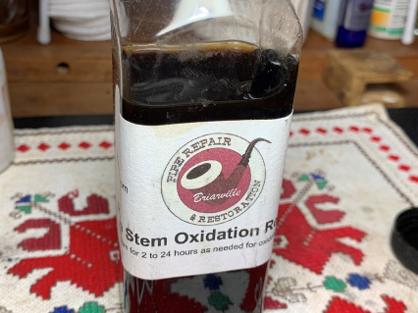
 To address the mild oxidation, the stem is placed in a soak of Briarville’s Pipe Stem Oxidation Remover. It will soak for several hours.
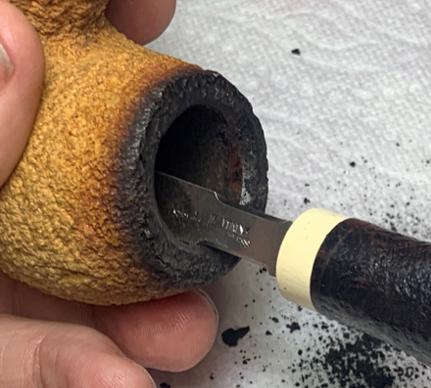
 Next, cleaning starts on the stummel by clearing the carbon cake buildup in the chamber. First, the Savinelli Fitsall Tool scrapes the walls. A reaming kit with blade heads is not used to ream the chamber because this method could put too much pressure on the walls, and they could crack. I’ve never had this happen and I don’t want to test it.
 The scraping is followed by sanding the chamber with 220 grit paper. The clears away the remnants of carbon from the chamber.
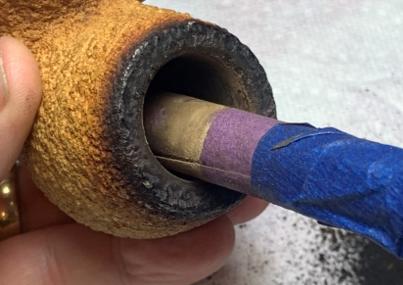 A quick inspection of the clean chamber shows no problems with cracking or heating issues.
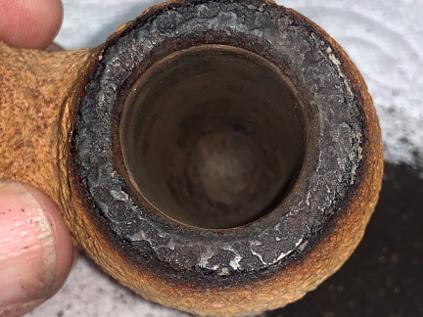 Moving next to cleaning the external surface, undiluted Murphy’s Oil Soap is used. A few pictures show the condition of the Meerschaum.
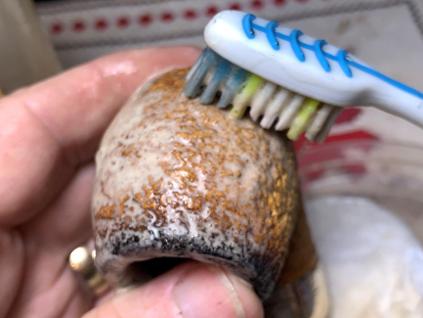
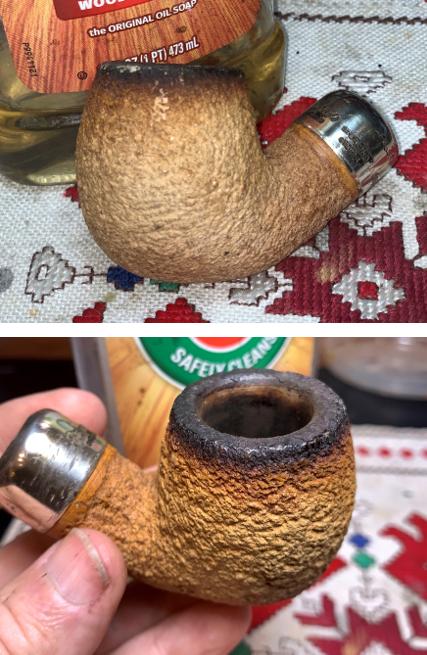 First, a cotton pads are used to scrub but the rough Meerschaum surface tore it up quickly. A bristled toothbrush was then used to do the heavy scrubbing.
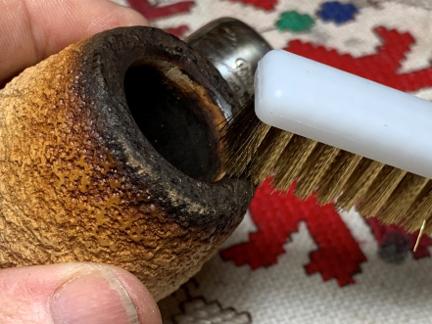
 A soft brass brush is also used gently to break up crusted lava on the rusticated rim.
 The stummel is next taken to the sink where shank brushes and anti-oil liquid dishwashing soap are used to clean the internals with warm water. After scrubbing and a thorough rinsing, the stummel comes back to the worktable.
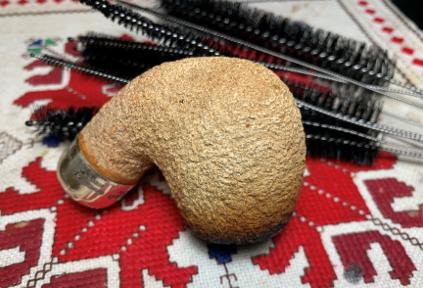 Continuing with the internals, pipe cleaners and cotton buds moistened with isopropyl 99% go to work. The small dental spoon also scrapes the internal walls excavating the tar and oils.
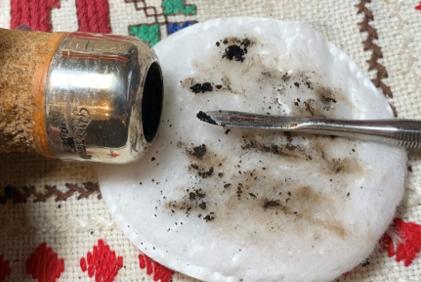 It took quite a bit of effort with buds and cleaners, but they started emerging lighter and time to move on.
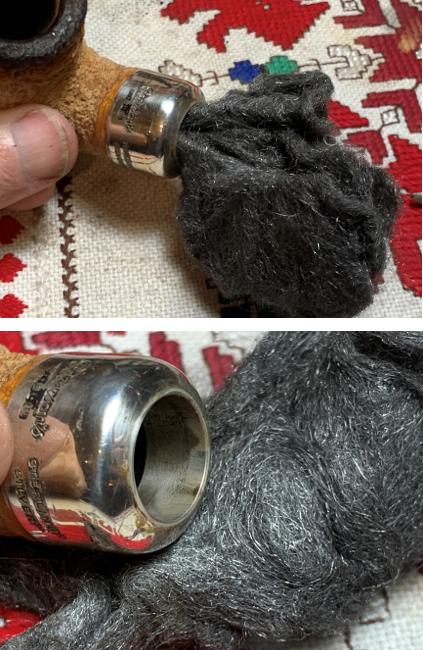
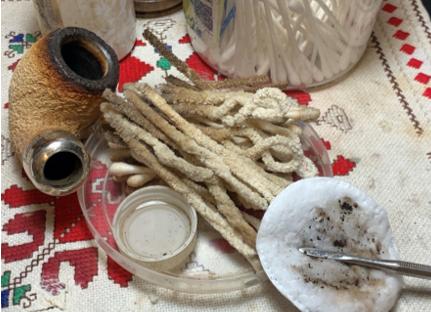 During the cleaning process, I noticed that the inner surface of the silver ferule is stained.
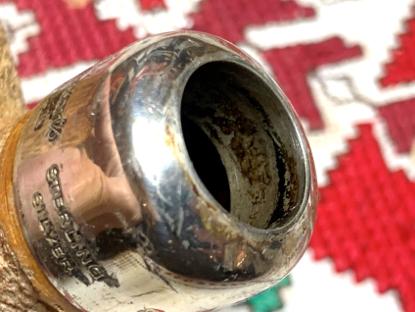 To clean this, 0000 grade steel wool is stuffed in the mortise and using my pinky finger inserted in the mortise, the wool is rotated around. This does a good job.
 The smokestack trim on the rim has some chips where the light Meer is poking through. These need to be addressed with a black dye stick.
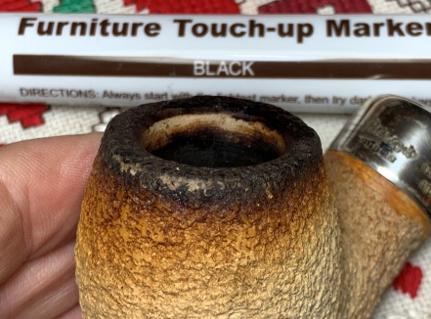 The refreshed rim looks great.
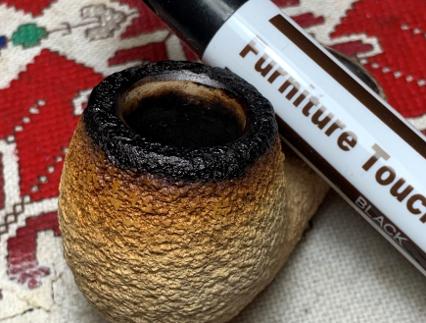 Next, the stummel receives a bee’s wax treatment. Applying bee’s wax is the traditional method of waxing a Meerschaum stummel. It protects the Meerschaum, and it also helps to develop the sought after honey brown patina of an aged Meerschaum pipe. My last project was a Kiko Countryman Block Meerschaum Billiard that comes from the same mines of Tanganyika. The Peterson Meerschaum was from the same African source. I’m curious to see if applying the bee’s wax has the same results as with the Kiko. Like the Kiko, after the cleaning, the Peterson Meerschaum is light and has a dry appearance. This is where the ‘magic happens’ with Meerschaum.
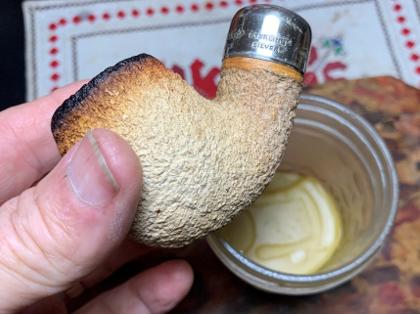 The bee’s wax is in a mason jar which is heat resistant. The hot air gun warms the bee’s wax and eventually it begins to liquify.
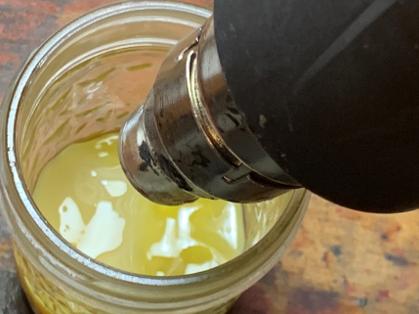 Along with heating the bee’s wax, the stummel is also heated. This helps the bee’s wax to spread more evenly over the surface. A horsehair brush is used to apply the bee’s wax. If one uses a synthetic brush, it will melt. After the entire stummel has received a coating of the bee’s wax, which is pictured in the next picture, the process continues as the stummel is heated and using the brush to continue to thin the wax.
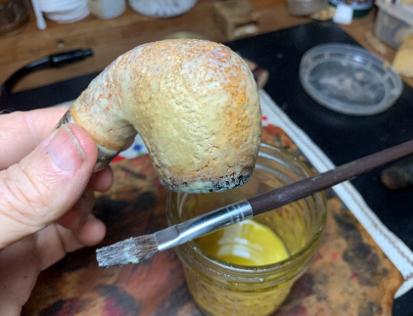 The way I do this next step is not pictured because I don’t have enough hands! I pinch the hot air gun between my knees with the hot air pointed up. While holding the stummel over the jar with one hand, I use the brush with the other. While the hot air heats and liquifies the wax, it drips down, with the help of gravity, into the jar. I do this around the entire stummel until the Meerschaum surface has a thin coating of bee’s wax. The stummel is set aside to allow it to cool.
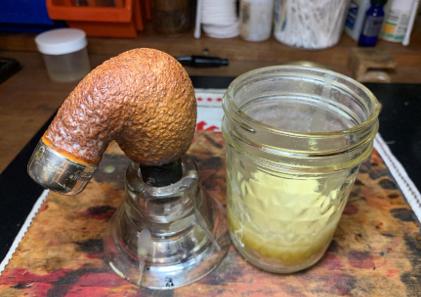 After the stummel has cooled, a microfiber cloth and a good bit of elbow grease help to rub/buff off the excess bee’s wax and to raise the shine. I would say as I look at the rich honey patina, that the magic happened 😊.
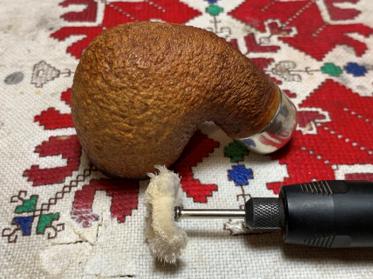
 The sterling silver ferule is not in great shape. It appears that some of the silver has worn off. I’ll give it a buff using a cotton cloth buffing wheel and green compound to see if it will help. To protect the Meerschaum from possible runover by the buffing wheel and the black residue that results from polishing metal, the shank is wrapped with painters’ tape.
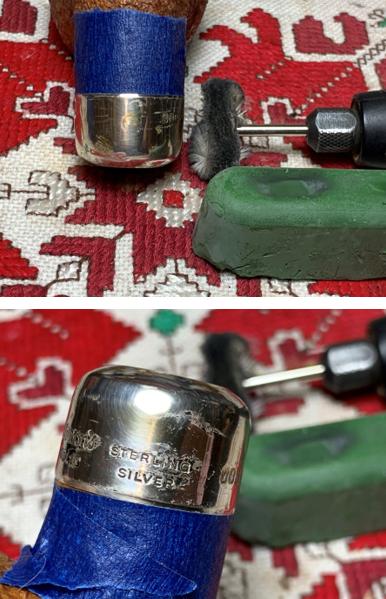 Unfortunately, there is the appearance of blotching in the silver. The residual sterling silver shined up nicely, but what I assume are nickel patches beneath the silver, are a bit duller.
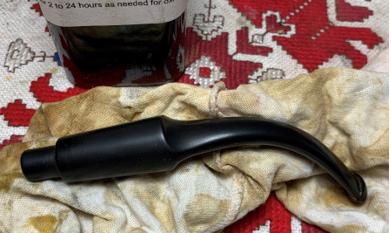
 The P-lip stem has been soaking in Oxidation Remover for several hours. When it’s fished out, it is rubbed briskly with the cotton cloth to wipe off raised oxidation. The stem looks good.
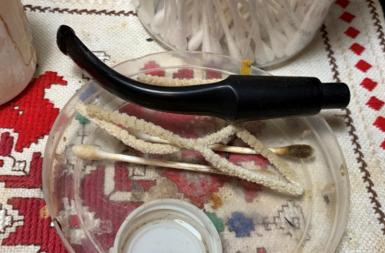
 A few cotton buds and pipe cleaners moistened with isopropyl 99% alcohol are expended to clean the airway from residual Oxidation Remover fluid.
 There is one bite compression on the upper bit. The lower bit looks good.
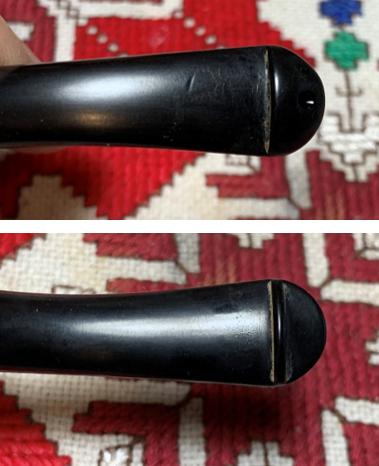 To address the tooth compression on the upper bit, 320 grit paper is used on the bit alone.
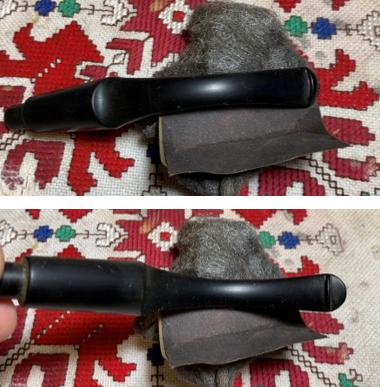
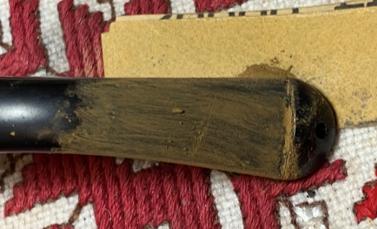 This is followed by wet sanding the entire stem with 600 grit paper and then 0000 grade steel wool is applied.
 Going next to applying the full regimen of 9 micromesh pads, first the stem is wet sanded using pads 1500 to 2400 and then dry sanded with pads 3200 to 4000 and 6000 to 12000. The micromesh process is the stage transitioning from sanding to polishing. The P-lip looks great.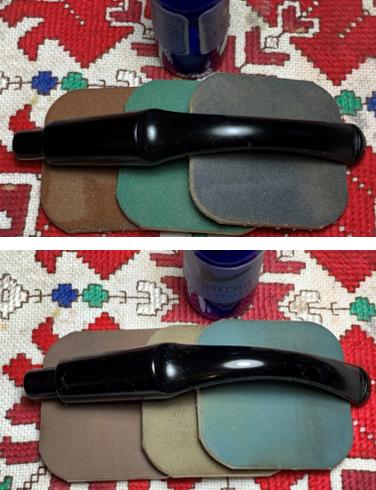
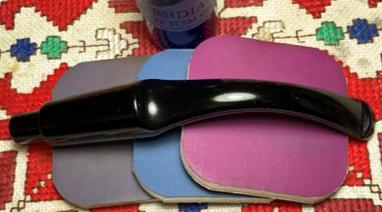 Next, after a dedicated cotton cloth buffing wheel is mounted on the rotary tool, Blue Diamond compound is applied to the stem. Blue Diamond is a fine abrasive that remove very fine blemishes.
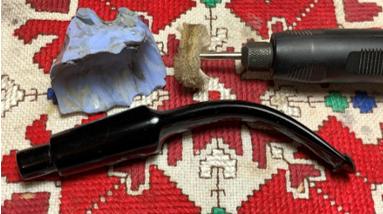 To remove the compound dust that accumulates on the stem, a felt cloth is used to wipe the stem in preparation for wax.
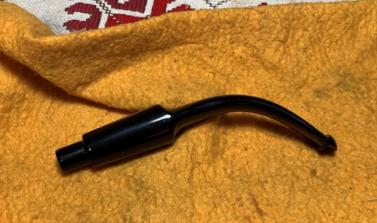 Next, with another dedicated cotton cloth buffing wheel mounted, carnauba wax is applied to the entire stem. After application of the wax, the stem is given a rigorous hand buffing with a microfiber cloth to remove excess wax and to raise the shine.
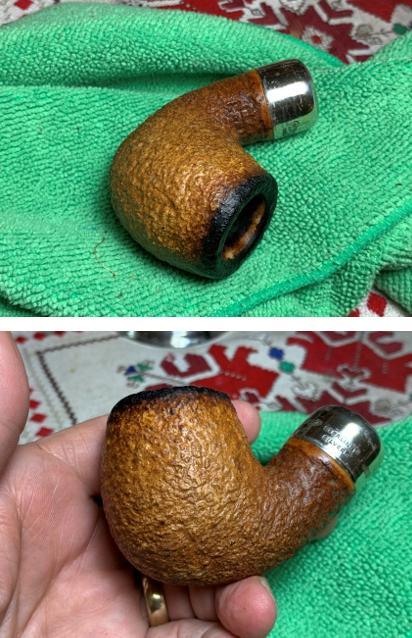
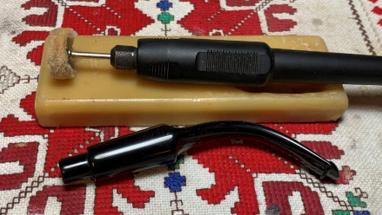 One more step – a clean cotton cloth wheel is mounted on the rotary tool with the speed set at about 50% full power – a bit faster than usual. Then the Meerschaum stummel is given a buff. The higher speed of the buffing wheel super heats the bee’s wax one more time to spread it, to remove excess and to raise the shine nicely.
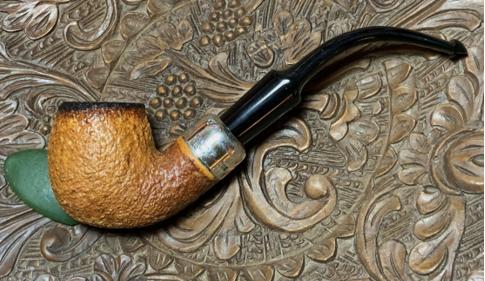
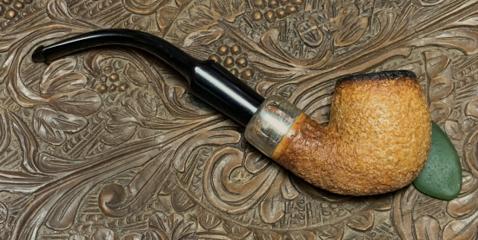
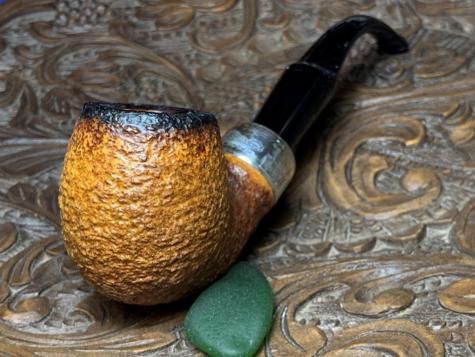
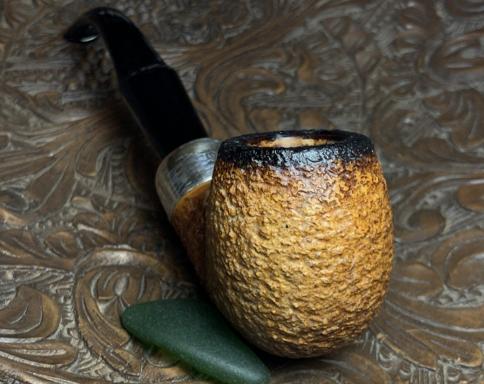
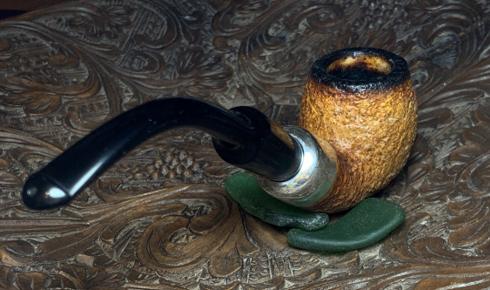
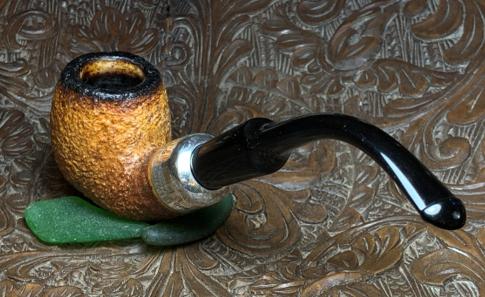
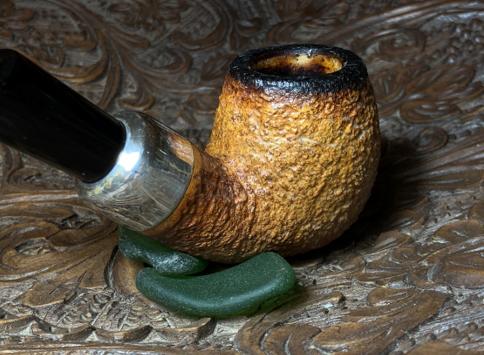
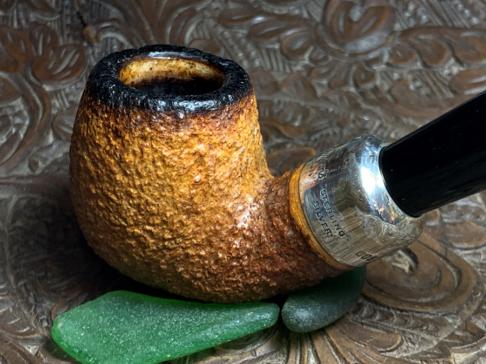
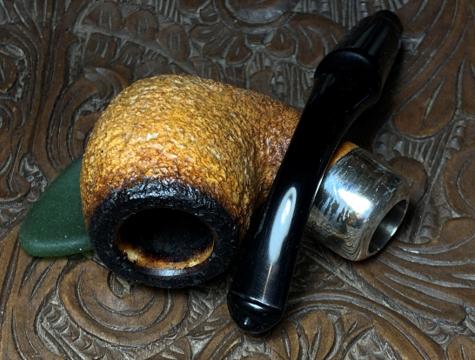
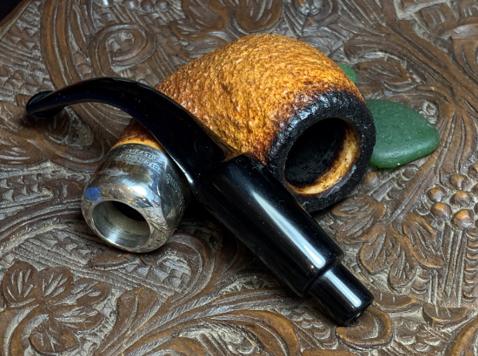
 Wow! I’m pleased with the outcome. The bee’s wax treatment gave the Tanganyika Meerschaum a rich honey hue patina which is nice. The 1971 vintage of this Peterson’s Dublin Meerschaum Sterling Silver ‘314’ makes him a true collector. The Meer-rock finish provides a nice feel in the palm as well as something nice to look at while one enjoys a favorite blend. The dimensions of the Peterson are Length: 6 13/16 inches, Height: 1 7/8 inches, Rim width: 1 1/4 inches, Chamber width: 7/8 inches, Chamber depth: 1 3/4 inches. James commissioned the Peterson and will have the first opportunity to acquire him from the Pipe Steward Store benefiting the Daughters of Bulgaria – helping women and girls who have been trafficked and sexually exploited.
Thanks for reading the blog and if you have any questions, please send them on! A comparison to remind us how far we’ve come. Thanks for joining me!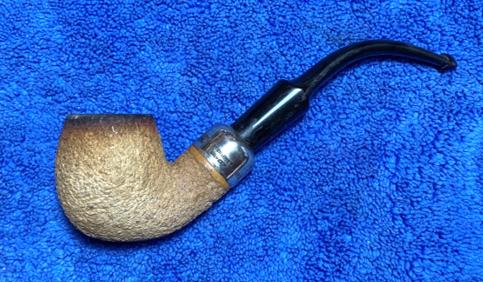


Nice job! Those hallmarked Peterson meers have really gone up in value. I’m sure your serviceman was pleased with this pipe!
LikeLiked by 1 person
Thanks, Al. It’s a keeper for sure.
LikeLike
Pingback: Diving into the Provenance of a Thompson Genuine Block Meerschaum GT. Britain Brandy – The Pipe Steward
Pingback: Road Trip Restoration #2: Replacing the Shattered Shank Extension for an Heirloom Sixten Ivarsson Stanwell 62 – The Pipe Steward
Pingback: An ‘Old Time Recipe’ Rim Repair for a Thompson Genuine Block Meerschaum GT. Britain Dublin – The Pipe Steward