The next pipe came to me in what I have called the Lot of 68. The Lot was acquired in February 2019 from a seller in West Hartford, Connecticut, and these pipes have been getting the attention of pipe men in the For “Pipe Dreamers” ONLY collection helping to support the Daughters of Bulgaria, a work that has helped women and girls who have been trafficked and sexually exploited. Here is the Lot of 68 and the Tribune 909 Dublin is in the 4th row and 5 pipes down. The Tribune got the attention of pipe man Bill when I met him last fall when I was able to join the Holy Smokes Cigar and Pipe Club in Landenberg, PA. It was a great experience for me and was my first time to be part of a group like this as a club. I wish I could land such a fellowship like this in the Denver area! Bill is a granddad and has 5 kids that he’s raised. I was invited to the Holy Smokes group by pipe man Darren, who has commissioned many pipes from me and MOST of them were intended as gifts for others. When I met Bill at the Holy Smokes gathering, Darren introduced him to me as the recipient of another pipe that he had commissioned as a Christmas present – the Pickwick Arms Bulldog (See: Christmas Tree Bound: Renewing a Stout French Made Pickwick Arms Bulldog).
 Later, Darren sent me this picture of Bill enjoying the Bulldog. As a Miami Dolphins fan for MANY YEARS I decided not to hold the cap insignia against Bill 😊. When I asked Bill about his cap, he did say that he was a Dallas fan and that he was surrounded by Philadelphia Eagles fans on all sides living in Pennsylvania! He wrote that his family had moved to Texas during his teen years from Indiana. After graduating from college at Texas A&M, Bill started working there and found his wife and all 5 of their children were born in the Dallas area. This explains well the Dallas Cowboys cap 😊.
 I had a box of pipes at the Holy Smokes group that were available for commissioning and Bill chose the Tribune. Here are pictures of the sharp looking rusticated Dublin with smooth briar finger panels on both sides of the bowl that Bill desires to add to his collection.

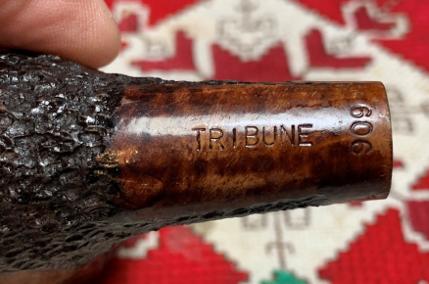
 The nomenclature is stamped smartly on the smooth briar panel on the underside of the shank: TRIBUNE. To the right of this and parallel to the shank facing is the shape number: 909.
 I’ve never worked on a pipe marked ‘Tribune’ and I’m interested to see what I can find about it. After looking at all my regular places (Pipephil and Pipedia), I found no reference to a ‘Tribune’ pipe production line or company. The only connection came from my copy of, ‘Who Made That Pipe?’ by Herb Wilczak and Tom Colwell, that listed ‘Tribune’ as a production of the US-based Wenhall Corporation.
 I’ve worked on one Wenhall pipe that was stamped Wenhall Futura 87 (Reclaiming a Wenhall Futura 87 Fancy Rusticated Miniature Billiard from a Shank Crack and Crushed Stem). Here is a picture of that Wenhall pipe:
 Pipedia has an article dedicated to ‘Wenhall Pipes Ltd. (Wenhall – Pipedia) which I included in the former restoration and here it is repeated:
Wenhall Pipes Ltd. was a distribution company out of New York City.
By the end of the 1970’s Wenhall approached Michael Kabik and Glen Hedelson, at that time operating from a farm house in Glen Rock, Maryland to create a line of freehands called Wenhall. The situation was favorable, because Kabik & Hedelson had ended their cooperation with Mel Baker of Tobak Ltd. to produce the famed Sven-Lar freehands shortly before.
Upon Wenhall’s offer the partners got a bank loan and set up a studio of 2000 square feet in a fairly new industrial park in Bel Air, Maryland and took on the name Vajra Briar Works. Wenhall initially wanted 500 pipes a week! But Kabik & Hedelson doubted that they could move that much product and told them they would produce 250 pipes per week. Happily, some of the old crew from Sven-Lar joined them at Vajra Briar Works, and thus they rather quickly met the production demands.
Furthermore during this time, Wenhall requested to create a line of pipes consisting of 12 different shapes. The line was called The Presidential and, while they repeated the same 12 shapes for this series, each one was freehand cut. Although they came up with interesting designs, mainly developed by Hedelson, especially Kabik was never really happy with the line or the concept, but, by this time, they had nine people on full-time payroll.
The stint with Wenhall lasted a couple of years, at which time they asked them to join Wenhall in a move to Miami, Florida. But by this time Kabik and Hedelson felt very uncomfortable with the owners of Wenhall and decided that they’d rather close the shop than make the move. Time proved that decision very wise, as Wenhall folded shortly after the move. All the same they had to close Vajra, but scaled down to the two of them and moved the operation to the farm house Glen was currently living in.
Presumptively for a shorter period only Wenhall had pipes made in Denmark by Karl Erik. (BTW K.E. Ottendahl ceased all sales to the USA in 1987.)
As I commented earlier with the Futura restoration, the article makes no mention of Futura or Tribune as a line and the article itself is primarily dedicated to the popular Freehands produced by Michail Kabik and Glen Hedelson working WITH Wenhall. Wenhall is described as a ‘distribution company’ and if the Tribune connection that Wilczak and Colwell described with Wenhall is correct, then we must assume that the Tribune is ‘another line’ that Wenhall put out. Until more information can be found, that’s about as far as I can postulate about the Tribune on the worktable.
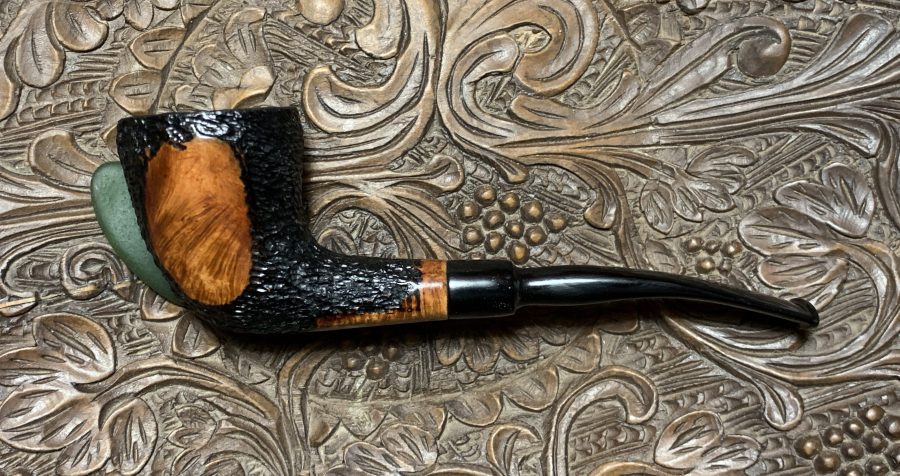
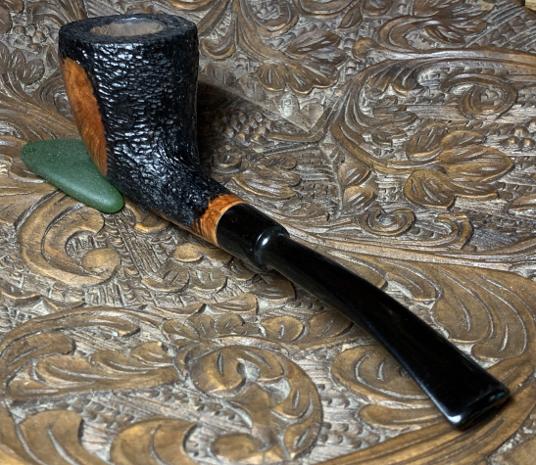
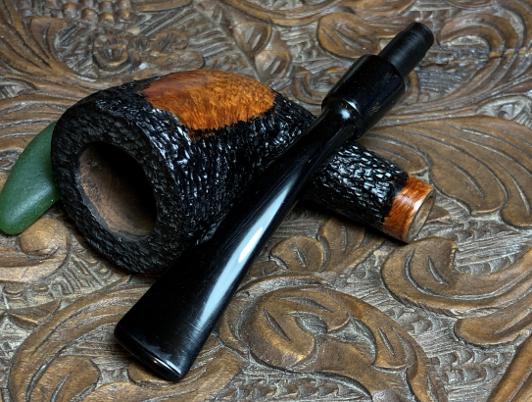
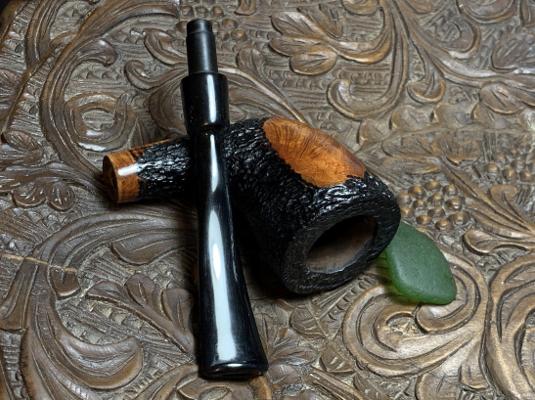
The pipe itself is an attractive rusticated Dublin with finger ‘pads’ on each side of the bowl. The saddle stem also has a fishtail shape which adds to the attractiveness. The chamber has minimal cake build up, but the rusticated rim needs cleaning.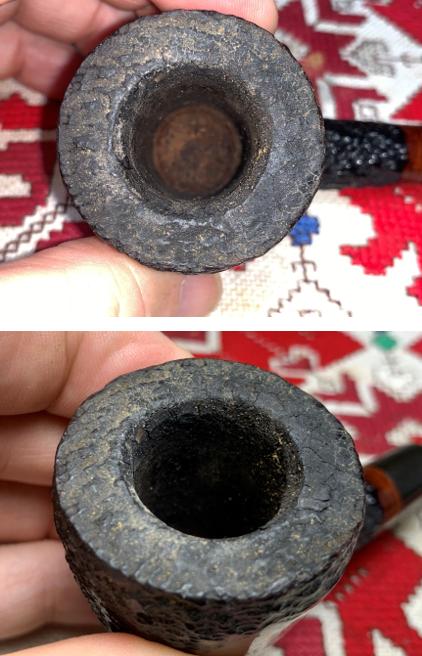 The rusticatiion has a crocodile skin tightness to it and looks good. The rusticatiion needs cleaning as well as the smooth panels. The panels show grime and normal wear and tear scratches.
 The ‘Saddle Fishtail’ stem has minor tooth chatter and no indication of oxidation. There are normal scratches from wear on the saddle.
 To begin the restoration of this Tribune Rusticated Dublin, the stem’s airway is cleaned. Only one pipe cleaner moistened with isopropyl 99% alcohol was needed to do the job.
 Even though I detected no oxidation, to be on the safe side, the stem is placed in a soak of Briarville’s Pipe Stem Oxidation Remover for several hours.
 With the stem soaking, attention turns to cleaning the stummel. First, the chamber is reamed to allow fresh briar to emerge allowing a new steward to develop a new cake. The chamber was reamed with 3 blade heads from the Pipnet Reaming Kit. This was followed by scraping the chamber walls with the Savinelli Fitsall Tool. The job was completed by sanding the chamber with 220 paper wrapped around a dowel rod.
 An inspection after the cleaning shows a healthy briar chamber. Moving on.
 Moving next to cleaning the external rusticated surface and rim, undiluted Murphy’s Oil Soap is used to scrub with a cotton pad.
 A toothbrush also scrubbed the rough rusticated surface.
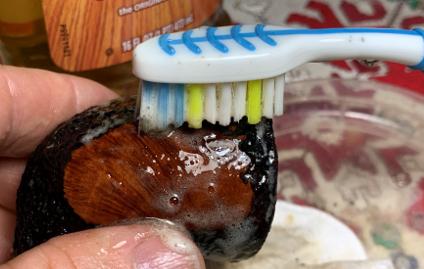 The rim is covered with a stubborn crusted lava flow. On the shank side of the rim the lava was hard embedded in the rustication and took a good bit of scrubbing from a soft brass bristled brush to see some improvement. The brass adds muscle to the cleaning, but it does not damage the briar.
 The rusticated wood on the rim is starting to regain its shape as the lava is broken up. I also use my thumbnail to plow the crud.
 Next, the stummel is taken to the sink to work on the internals. Using warm water, the internals are scrubbed using shank brushes and anti-oil liquid dishwashing soap. After a thorough rinsing the stummel comes back to the worktable.
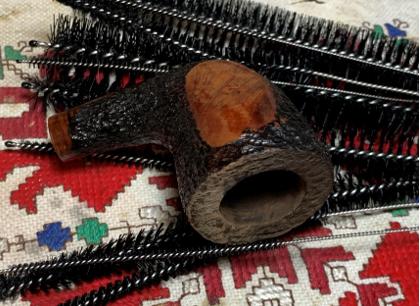 Continuing with the internal cleaning, cotton buds and pipe cleaners moistened with isopropyl 99% are used to do the job. Helping is a small dental spoon scraping the mortise walls excavating the tar and oils.
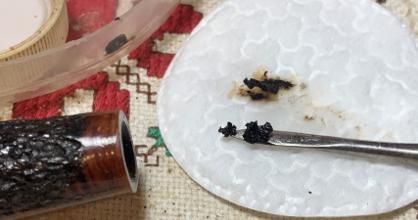 In time the buds and cleaners emerge lighter – time to move on.
 Looking more closely at the aftermath of the external cleaning, not surprisingly, the black dye has worn off the rim.
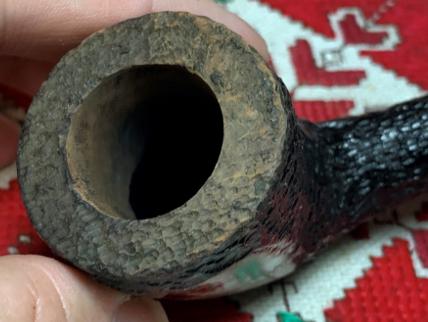 The smooth briar panels show old finish that has been partially removed through the cleaning. The darker blotches are the old finish.
 To remove the remainder of the old finish from the smooth briar, the surface is rubbed with a cotton pad moistened with alcohol. That does the trick nicely.
 To sand and polish the smooth briar panels, micromesh pads are used beginning with pads 1500 to 2400, then 3200 to 4000 and finally, pads 6000 to 12000. Between each pad, a moistened cotton cloth is used to wipe the smooth briar to clear the briar dust and to improve the traction of the following pad.
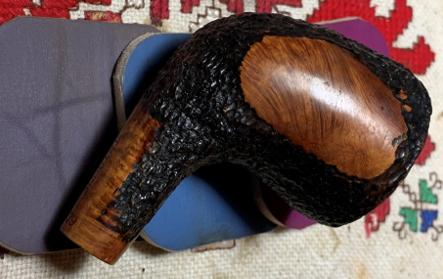 Now, the crocodile skin rusticated surface needs to be refreshed. The rim is especially in need, but the entire surface will be addressed.
 Fiebing’s Black Leather Dye is used to do the job. Using a folded pipe cleaner, the black dye is carefully painted on the rusticated surface – staying on the rusticated surface and not running over the smooth natural briar panels. After application of the dye, the stummel is set aside to allow the dye to settle.
 The stem has been soaking in a batch of Briarville’s Pipe Stem Oxidation Remover for several hours. The stem did not show oxidation, but the soak helps to make sure that the vulcanite stem is oxidation free. After the stem is fished out of the oxidation remover, it is rubbed rigorously with a cotton cloth to wipe away the oxidation that has been raised.
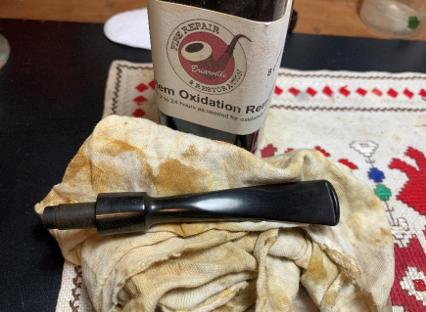 To clear away the solution from the airway, a lone pipe cleaner moistened with isopropyl 99% alcohol is used. The stem looks good.
 There are some imperfections in the vulcanite. There is a very small compression on the upper bit that should be erased with sanding.
 The pinprick marks on the saddle appear now not to be scratches, but imperfections in the vulcanite itself. Even so, sanding is what will address these spots on the saddle.
 First, the entire stem is sanded with 320 grit paper.
 The 320 grit paper is followed by wet sanding with 600 grit paper and then 0000 grade steel wool is applied.
 In the interest of full disclosure, after the sanding above, there were still some indications of the pinprick marks on the saddle. I returned to sand these with 220 grit paper, then 230, 600 and 0000 steel wool. There are still very minute marks on the saddle that can be seen, but I don’t want to sand more fearing that the saddle might become a bit out of shape. Next, the stem is polished/sanded with micromesh pads starting with wet sanding with pads 1500 to 2400. This is followed by dry sanding with pads 3200 to 4000 and 6000 to 12000. Between each set of 3 pads, Obsidian Oil was applied to the vulcanite stem to guard from oxidation and to condition the stem.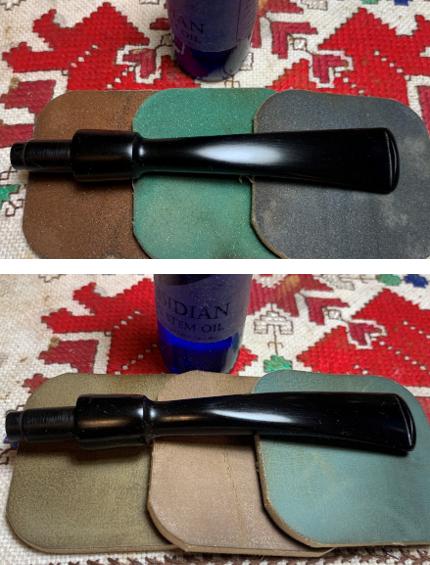
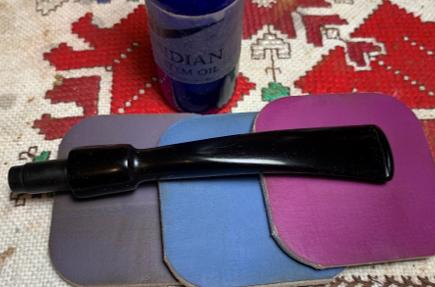 Next, Blue Diamond compound is applied to the smooth briar panels and to the stem. The compound is not applied to the rustication because the compound would pack into the crags of the rustication. This would not be fun to clean. With a cotton cloth buffing wheel mounted on the rotary tool and the speed set at about 40% full power the compound is applied.
 To clean the compound dust a felt cloth is used to wipe the pipe. This is done to prepare the surface to receive the wax.
 With another cotton cloth mounted at the same speed, carnauba wax is applied to the entire pipe. The rustication just receives a very light touch of wax, so it doesn’t get caught in the rustication. After the application of wax, the pipe is given a rigorous hand buffing with a microfiber cloth to remove excess wax and to raise the shine.
 This Tribune 909 Rusticated Dublin came out nicely. The Dublin shape always gives a vibe of attitude. The tight crocodile skin rustication is set off nicely with the natural smooth briar panels. The provenance coming from the US-based Wenhall Co. is a bit inconclusive, but even so, the Tribune Dublin promises to provide a lot of fellowship with one’s favorite blend packed in the ample bowl. The dimensions are Length: 6 3/8 inches, Height: 2 inches, Rim width: 1 9/16 inches, Chamber width: 7/8 inches, Chamber depth: 1 5/8 inches. Bill commissioned the Tribune and will have the first opportunity to acquire him from the Pipe Steward Store. A portion of the proceeds help to support the Daughters of Bulgaria, a ministry helping women and girls who have been trafficked and sexually exploited. Thanks for joining me!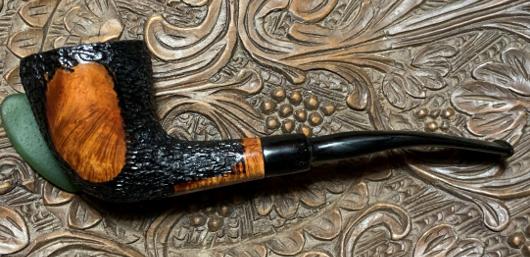




 The Pipe Steward
Nicely done, Dal!Join us anytime!
LikeLike
Thanks!!
LikeLike
Pingback: Addressing Chamber Heating Problems with a Ben Wade Made in London England 23 Dublin – The Pipe Steward