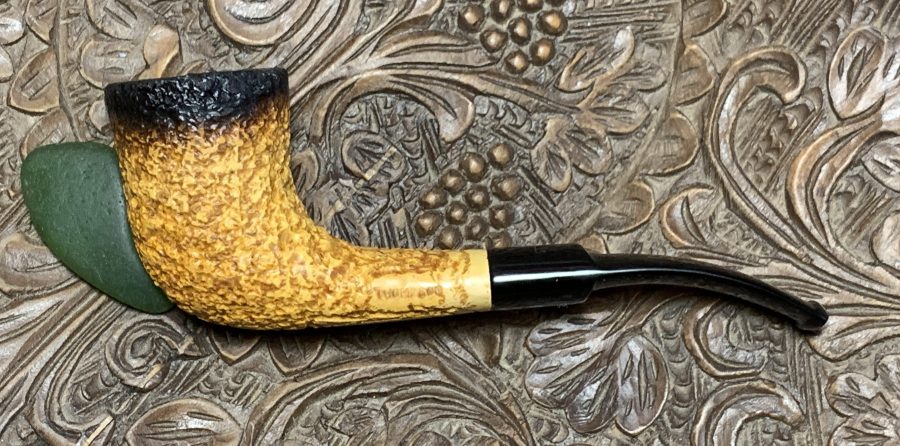
It’s nice being inside working on the next pipe in the queue with the cold outside here in Golden, Colorado. Last night it was 3 degrees outside…. The next pipe on the worktable is another pipe I acquired in February 2019 from a seller in West Hartford, Connecticut. The Lot of 68 pipes on the auction block got my attention and my final bid resulted in these pipes coming home and making their way to the For “Pipe Dreamers” ONLY! online collection where pipemen and women can commission pipes benefiting the Daughters of Bulgaria (now called, Spring of Hope) helping women and girls who were trafficked and sexually exploited. The Thompson Genuine Block Meerschaum Dublin is circled in the center of the Lot of 68. Pipeman Justin reached out to me and inquired about several pipes in the Pipe Dreamers collection. I found out that Justin is a family man and found out that he discovered The Pipe Steward from a friend of his who was a former team member and friend of ours in Bulgaria. Drew and Marianna served in Bulgaria with their children, and we were very thankful for their time with us. Justin decided to commission two pipes, a goliath Lorenzo Oom Paul which I view as truly a ‘Pipe Dreamer’ endeavor and the Thompson Meerschaum on the table now. Here are pictures of the first pipe – the Thompson that got Justin’s attention.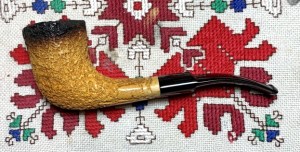
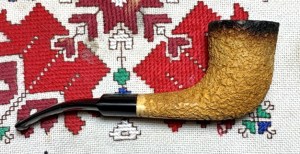

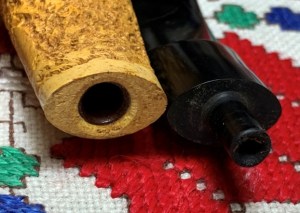 The nomenclature is chiseled on the left side of the shank: THOMPSON.
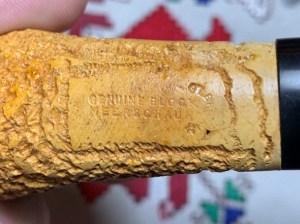
 On the smooth underside is: GENUINE BLOCK [over] MEERSCHAUM.
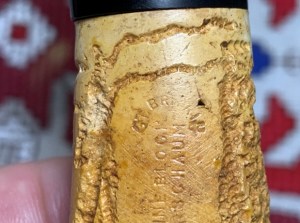
 To the right of this and chiseled in an ark is the COM: GT. BRITAIN.
 I have benefited from working on Thompson Meerschaums before and the research I did. Here is the information that fills out our understanding of provenance of the Thompson on the table. Thompson Block Meerschaum was made with African Meerschaum from the Tanganyika Meerschaum Corporation (Tanganyika Meerschaum Corporation – Pipedia) and produced by Laxey Pipe Ltd. on the Isle of Man. This conclusion was deduced from comments made about Thompson from various pipe forum threads. Here is one example from Pipesmagazine.com (2012) among several that I found that demonstrates what I have found out generally about Thompson:
@tschiraldi – Thanks! It’s my understanding that the Thompson Meerschaum pipes were made by the Manx Meerschaum Company on the Isle of Mann (Great Britain). Back story is that my 3x Great Grandfather was Sir Hall Caine who was a famous author known as the Manx Man and lived on the Isle of Mann. I thought it would be cool to own a pipe made by the Manx Meerschaum Company which was made on the Isle of Mann. Just thought it was interesting. The opening statement above, “It’s my understanding…” is the key idea. I found several comments with the assumption that Thompson Block Meerschaum pipes were produced by ‘Manx’ or ‘Laxey’ – the same producer. When doing the research on a Peterson Meerschaum (Pictured above – Reviving a 1971 Peterson’s Dublin Sterling Silver Meerschaum of Tanganyika – The Pipe Steward), I discovered that the Laxey Co. produced Peterson’s Meerschaum. Here is the Pipedia information on Laxey Pipes Ltd.:
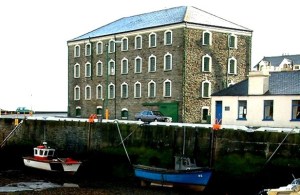 Laxey Pipes Ltd. resided in a historical 19th century four-storey Man stone building at The Quay, Old Laxey, Isle of Man, which thankfully has been preserved.
The company specialized in the production of meerschaum pipes using the Meerschaum mined by the Tanganyika Meerschaum Corporation in the Amboseli basin in Tanganyika (since 1964 part of the United Republic of Tanzania).
Please note: you may often find names like “Manx Pipes Ltd.”, “Man Pipe Co.” and others more, but there is no indication of another Isle of Man pipe producer other than Laxey Pipe Ltd. at any time!
Laxey Pipes Ltd. marketed their own brands like “Manxpipe”, “Manxman”, “Manxland” e.c. Names like “John Bull”, “White Knight” (unwaxed), “Domino” (black, or lined) indicated some shapes / colours of Laxey’s own series. The stems either showed the astronomical sign for “male” or “man” (circle + arrow), or the crest of the Isle of Man, the 3-legged X in a circle. Manxpipes and Laxey’s other brands were available through pipe retailers in general but also were sold (mainly) to tourists through their own shop in Laxey. Furthermore Laxey Pipes Ltd. manufactured the meer bowls for Peterson, Barling, Nørding and others from the later 1960’s until 2001. Man Pipe e.g. was a brand distributed by Comoy’s. The bowls usually showed no nomenclature indicating the orderer. “Genuine Block Meerschaum” was engraved frequently. Often, just the stems were different, while bowls were the same.
Supply of meerschaum from East Africa ran out (Kenya / Tanzania exhausted, Somalia inaccessible), and thus the last Laxey meers were supplied to trade in May, 2001. Laxey Pipes Ltd. tried to survive continuing with briar pipes – mainly in the Danish style -, but to no success. It closed down business in July 2002.
In this article from Pipedia, there is no direct mention of Thompson Block Meerschaum however, it was left open that there were other brands produced from the 1960s until 2001 beyond those mentioned – Peterson, Barling, and Nording.
I tend to agree with the sentiments of the Thompson Block Meerschaum pipes being produced by Laxey. Why? First, with the COM being ‘GT. Britain’ leaves few options (if any) of a Meer block being produced other than on the Isle of Man. Secondly, the Thompson on the worktable resembles other products of Laxey with the smokestack coloring and the usual stamping: “Genuine Block Meerschaum”.
The following Meerschaum is an example of a Manxman pipe, and it is very similar to the pipe on the worktable pictured below it. The darkened smokestack and the detailed rusticated surface are key characteristics. The last characteristic that promotes the Isle of Man provenance is that the Thompson is made with African Meerschaum. Tanganyika Meerschaum that was used by the Laxey production is described as tougher, less porous, and cheaper than Meerschaum mined in Turkey (Tanganyika Meerschaum Corporation – Pipedia). The denser characteristics of the Thompson on the worktable I believe fits the general characteristics of African Meerschaum. Even though I can find no direct link with Laxey and Thompson, I believe it is a safe assumption that Thompson was produced by the Laxey Company on the Isle of Man. If this is to be accepted, the dating of the Thompson would be no later than 2001 when Meerschaum ran its course from the mines of Tanganyika.
With a renewed appreciation for the Thompson on the worktable, I take a closer look at the pipe itself. The chamber has some cake build up that will be cleaned. A Meerschaum pipe needs no cake to protect the chamber and one of the great things about Meerschaum is that it requires no time of rest as briar pipes. It’s ready to go from bowl to bowl without pause. The rim needs cleaning with lava flow crusted over the rim and embedded in the rustication.
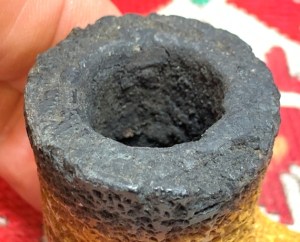 What’s almost invisible is a chip off the back side of the rim which is camouflaged very well by the dark smokestack hue. It’s even difficult to see it in the photo above focused on it. The following pictures show the borders of the chip. I’m not sure I will try to ‘repair’ this chip because the repair might draw more attention to the issue. I’ll think about this…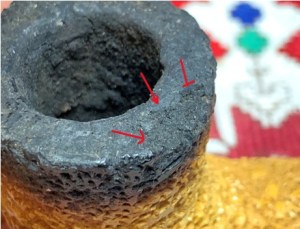
 The vulcanite stem shows no signs of oxidation, and I do not detect any tooth chatter. The pipe has been treated kindly. It needs basic cleaning.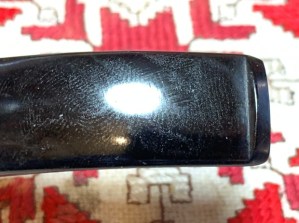
 To begin the restoration of the Thompson, the chamber is cleaned. To clear the chamber of the cake, the Savinelli Fitsall Tool scrapes the chamber. The chamber is not reamed with the Pipnet Reaming Kit because it would create too much torque on the stummel and risk cracking the Meerschaum.
 Following the Fitsall Tool, the chamber is sanded with 220 grit paper wrapped around a dowel rod.
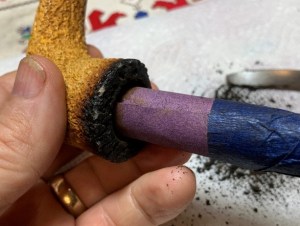 After clearing the cake, fresh Meerschaum is revealed, and a quick inspection looks good.
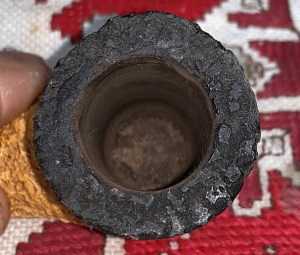 Cleaning the external Meerschaum is next using undiluted Murphy Oil Soap. A few pictures show the starting point.
 The rim is also in need of cleaning with grime embedded in the rusticated crevasses.
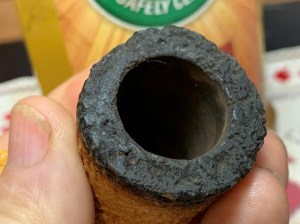 With the rusticated surface, a bristled toothbrush does a good job scrubbing the rough surface.
 A soft brass brush also helps to clean the crevasses of the rim.
 After the scrubbing, the stummel is taken to the utility sink where the internals are scrubbed with warm water and anti-oil liquid dishwashing soap and shank brushes. The stummel is rinsed thoroughly after the internal cleaning and transported back to the worktable.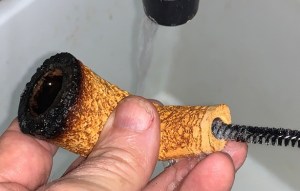
 Continuing with the internal cleaning, pipe cleaners and cotton buds moistened with isopropyl 99% are used. A small dental spoon also scrapes some tar and oils off the mortise wall.
 With the cleaning of the stummel completed, I take another look at the chip on the rim. Even though the chip is pretty well camouflaged, being somewhat of an OCD perfectionist, the fact that I know its there makes me want to fix it more 😊! I have used with success and ‘Old Time Recipe’ that I found from Troy of Baccy Pipes (Old Time Meer Lining Repair Method On a Kaywoodie Shellcraft #5651 – Baccy Pipes) where he used a mixture of egg whites and chalk to create a mixture that when cured, emulated very nicely Meerschaum. I believe one of the first times I employed the ‘Old Time Recipe’ was restoring a pipe for my friend from India, Paresh (A Meer-lining and Crack Repair to Rescue a Doomed Gargantuan Kilimanjaro Made in Tanganyika Bent Billiard | rebornpipes). Using the recipe with this Thompson would introduce a variable that I haven’t done before – turning the white mixture into the black matching the smokestack hue. To do this I would mix activated charcoal into the recipe and see what happens. Here we go.
The components needed are finely ground chalk, egg whites and the wild card, activated charcoal.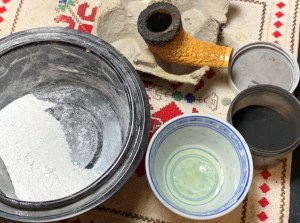 I start by adding the chalk to the egg white and mixing with a pipe nail. As usual, I seem to mix more than is needed for the job. Troy’s specific recipe was measuring 1:2 parts whites to chalk for his project, but I’m going on the thickness with this project. I end up cutting the mixture in half to reduce the liquid. I continue adding chalk and mixing so that the mixture starts to thicken.
 I start adding some activated charcoal to the mixture as well – mixing it in as the mixture thickens.
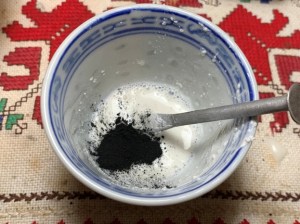 After adding more chalk and activated charcoal, it starts to thicken to thickness that I’m aiming for – thick enough to hold its shape and not slump after applying it to the rim chip.
 This is what the Recipe looks like as I start applying to the rim.
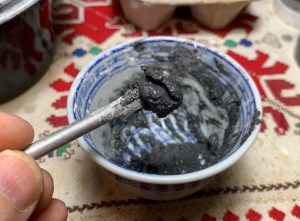 As I said before, I mixed way more than needed. I like the rough texture resulting from the charcoal in the Old Recipe mixture. It blends quite nicely with the rough Meerschaum smokestack rustication. The mixture needs to be cured fully and thoroughly so I set the stummel aside for the night and see what it looks like tomorrow.
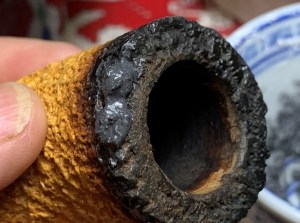 The next morning, I discovered that the patch hue had lightened a good bit. The surface of the patched areas is rubbed with my finger to test how firm it felt, and it seems good and solid. One concern I had earlier was that the Old Recipe might not adhere to the edge, but it did and really looks good except for the contrast in color.
 Whether the smokestack rim had a chip or not, the normal restoration process would have included refreshing the dark hue with a black dye stick. With the patch, the question is whether I needed to add the charcoal at all since the dye stick was to be used either way. Not sure, but its probable that the added charcoal gave additional texture to the patch with more roughness that blends well with the surrounding Meerschaum. The picture below shows the patch partially doctored to show the transformation in process.
 After the finished job, the dye stick is applied not only to the patch, but also to the entire rim and smokestack. I simply followed the black smokestack around the stummel with the dye stick. It looks good and my OCD perfectionism is satisfied.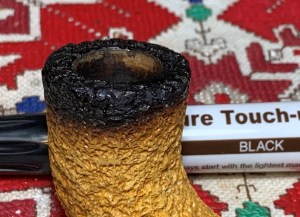
 The next mini project is to apply beeswax to the stummel surface. Beeswax is the age-old method of conditioning Meerschaum and often helps to enhance the honey-hued patina which increases the value and collectability of a Meerschaum pipe. The beeswax is heated and liquified and then applied to the Meerschaum. I keep the beeswax in a mason jar that can handle the heating. A horsehair brush is used to apply the liquified beeswax to the stummel. Horsehair is used because a regular brush will melt with the heat – I’ve learned this the hard way.
 The hot air gun is used to heat and liquify the beeswax.
 My approach to applying the beeswax is a bit of a juggling act. Two folded pipe cleaners are inserted in the mortise to act as a handle so that I don’t burn my hand with the hot air. The Meerschaum stummel is also heated with the gun and while the beeswax is liquid and with the hot air gun carefully aimed at the stummel (pinched between my knees!) positioned over the mason jar, the hot beeswax is painted on with the brush. Since I only have two hands, I had to put the brush down to take the picture below that shows the set up. The reason I keep the hot air gun running and aimed at the stummel is so that the heated excess beeswax will drip off the stummel. The liquified beeswax, if not heated, will solidify very quickly and leave a thick congealed beeswax layer on the Meerschaum surface which is very difficult to then remove by buffing. The goal is to leave a very thin beeswax layer which can be more easily buffed up and shined.
 After the beeswax is applied to the entire stummel, it is set aside allowing the Meerschaum stummel to cool.
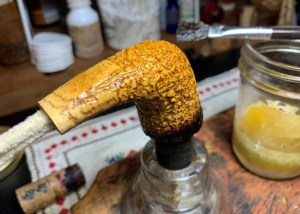 After cooling, the stummel is buffed with a microfiber cloth. I like the results.
 The stem is next. It is in good condition with no evidence of oxidation. It does have minute scratches and roughness on the stem which needs addressing.
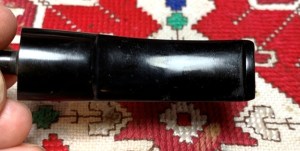 To begin, cleaning the airway is accomplished with one pipe cleaner moistened with isopropyl 99%.
 Since there’s no biting damage to the bit but only small scratches, the finer 320 grit paper is used to sand the entire stem. The shoulder guard is used to protect the shank facing from the sanding.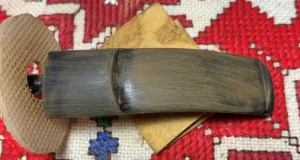
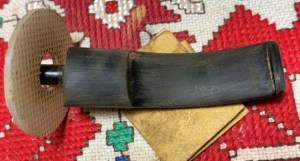 Following the 320 grit paper, the stem is wet sanded with 600 grit paper followed by applying 0000 grade steel wool.
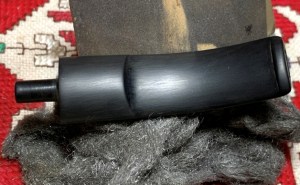 Next, using micromesh pads the stem is sanded. Between each pad, Obsidian Oil is applied to the vulcanite to condition it and to guard against oxidation. The first set of pads are 1500 to 2400, then 3200 to 4000, and finally 6000 to 12000.

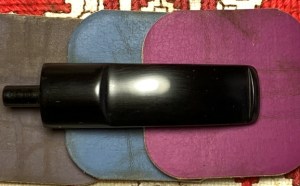 Next, Blue Diamond compound, a fine abrasive, is applied to the stem after mounting a dedicated cotton cloth buffing wheel onto the rotary tool. The speed is set at about 40% of full speed.
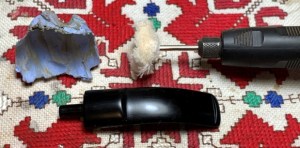 After using the compound, compound dust is over the stem. To clear away the dust a felt cloth is used to prepare the stem for the wax.
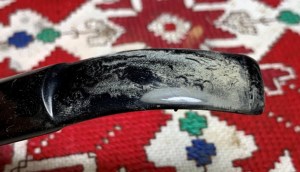 After changing the cotton buffing wheel to another dedicated buffing wheel for wax, carnauba wax is applied to the entire stem. After applying the wax, the stem is given a hand buffing to remove excess wax and to raise the shine.
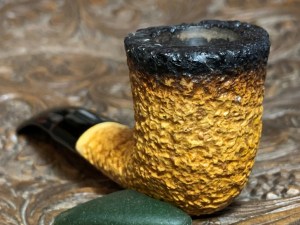
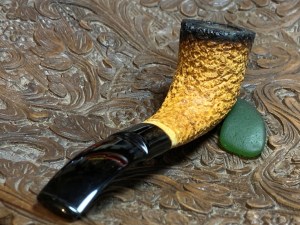
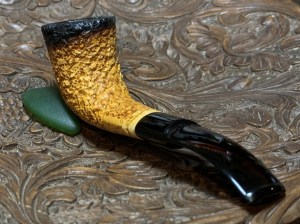
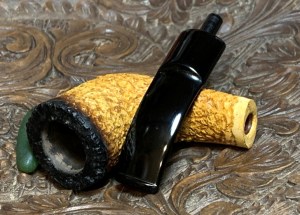
 The Thompson Genuine Block Meerschaum stummel and stem are finally reunited. I’m pleased with the repair to the rim using the Old Time Recipe I got from Troy of Baccy Pipes. It looks great. The honey hued Meerschaum is eye catching, and the Dublin shaped smokestack gives a rustic feel. The dimensions are Length: 5 3/8 inches, Height: 1 7/8 inches, Rim width: 1 3/8 inches, Chamber width: 3/4 inches, Chamber depth: 1 1/2 inches. Justin commissioned the Thompson and as the commissioner will have the first opportunity to claim him from the Pipe Store. A portion of the proceeds of all pipes restored help benefit the work of the Daughters of Bulgaria, now called Spring of Hope. Thanks for joining me!


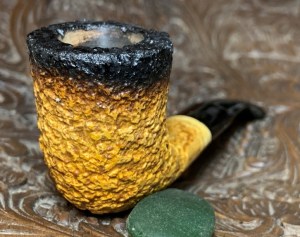



 The Pipe Steward
Pingback: Quite the Find in Burgas, Bulgaria: Resurrecting A Lorenzo Spitfire Goliath Oom Paul – The Pipe Steward