
The Sculpted Vineyard Meerschaum now on the table came to me recently when Corey from Orange, California, reached out to me concerning a box of pipes he discovered in the attic. The pipes had belonged to his father who passed away 10 years earlier. He did not know that his father had smoked pipes, but his mother confirmed this and said that he had one day simply put them away. This was the first of many pictures Corey sent to me assessing the value of his father’s pipes. After communicating back and forth and seeing the variety of styles, I made an offer to Corey. His dad had an impressive collection of pipes and Corey chose to keep some for himself as keepsakes. 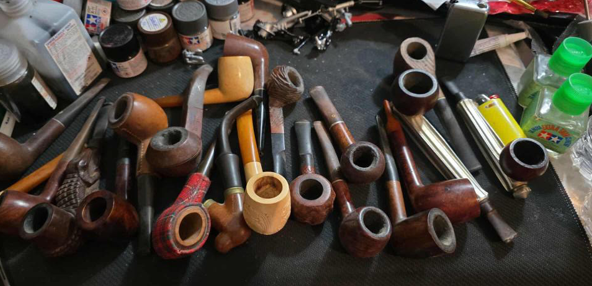 We came to an agreement and Corey boxed his dad’s pipes with care and passed them on to me. After unwrapping each one, the Lot of 35 pipes were arranged so that I could take a picture of the entire lot. Corey’s father passed on a very eclectic collection with a few Meerschaums, Curtis metals, briar figurines, and a number of classic Kaywoodies along with others. These pipes will be making their way into the ‘For “Pipe Dreamers” ONLY!’ online collection waiting for pipemen and women to commission. Each commissioned pipe benefits the Daughters of Bulgaria (now called, Spring of Hope) which my wife and I co-founded when we lived in Bulgaria – helping women and girls who had been trafficked and sexually exploited. Today, the ministry has expanded by developing programs aimed at prevention. The Sculpted Vineyard Meerschaum is on the left in the middle in the picture below.
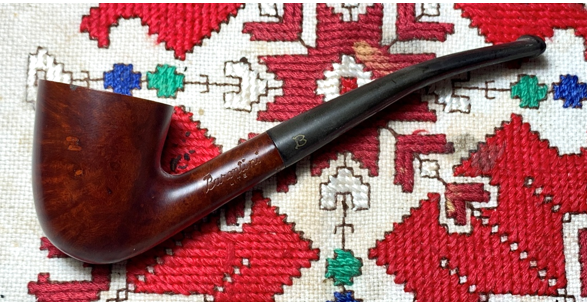
 I do not deal with many women who could be called, pipe women, or more correctly, cigar women, but all this changed. Amy had reached out to me several weeks before with a request that I don’t often get. She heard about The Pipe Steward from friends of ours – an Anglican pastor and his wife and their family members who live next door to us here in Golden. Amy asked if she could come and see my pipes along with others. With our travels, it took a while to work out a time when she, along with a friend, Jenny, came. I found out that they attended the Anglican Church and that they, along with their husbands, gather on special occasions to smoke cigars. This was a surprise for me to hear! I discovered that they both came not just to see where I work but to choose a pipe for themselves! They had discussed between themselves that it would be nice to try a pipe instead of cigar. In my book, this is a classy step up for these ladies😊. When they came, after perusing my ‘Man Cave’ where the pipe magic happens, they sat down at a small table and I began ‘serving’ boxes of pipes to them, one after another, for them to look through. As they looked at one pipe after another, they were waiting for THE pipe that would whisper to them. We adhere to the Harry Potter mantra but not for wizards, but for pipemen AND women: “The steward does not choose the pipe, but the pipe chooses the steward.” Jenny heard the whisper of a very sharp looking, petite Barontini Lite 22 Italy Bent Dublin.
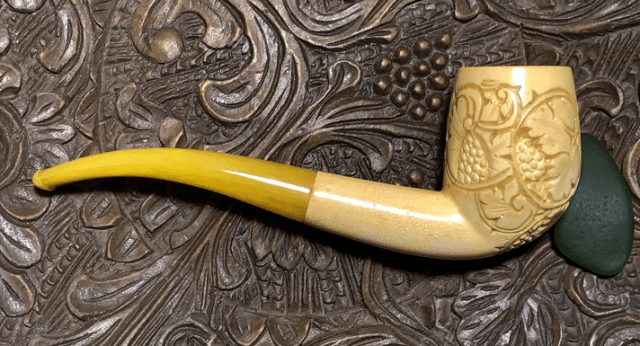
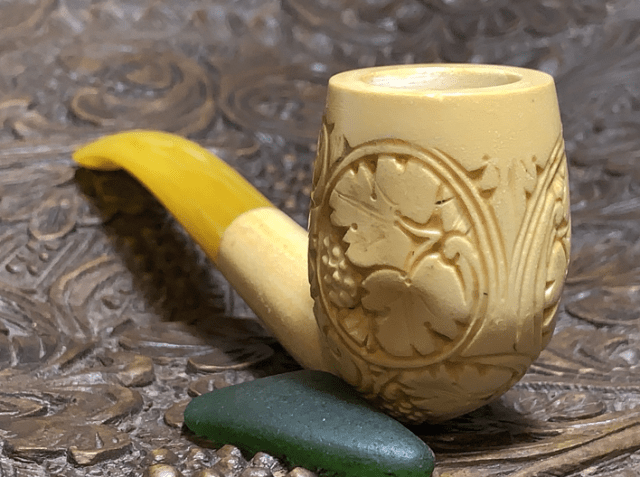
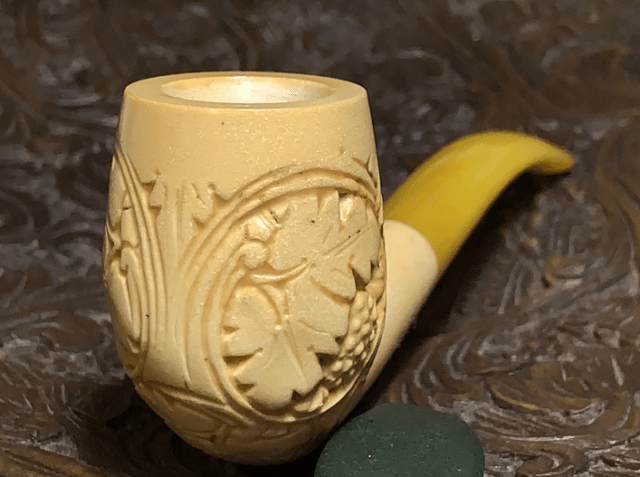
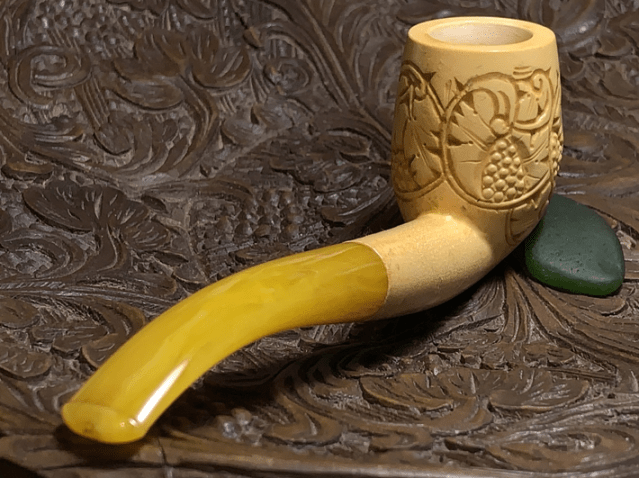
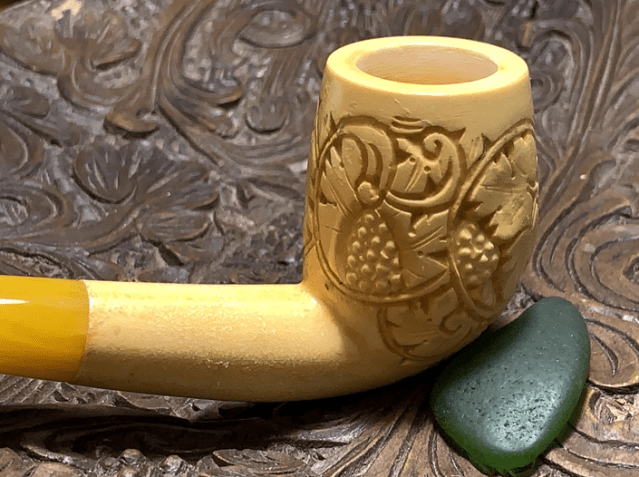
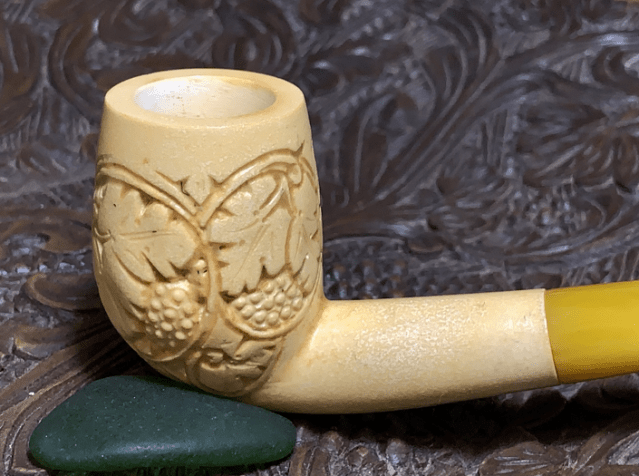
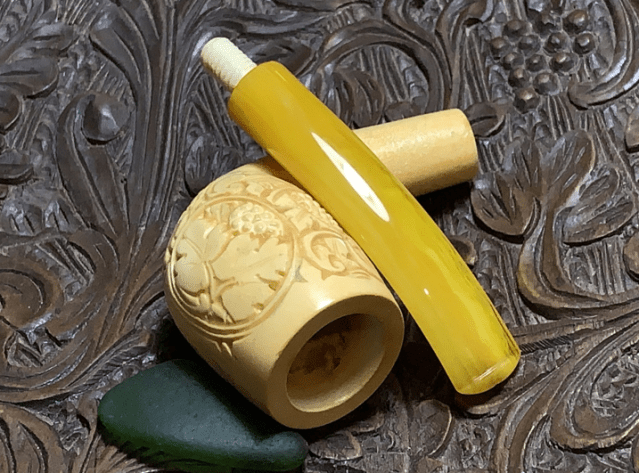
 The very first pipes I showed them were Corey’s dad’s Lot of 35. It was from this Lot that Amy heard the whisper of this ornately sculpted Meerschaum. Here are pictures of Amy’s choice.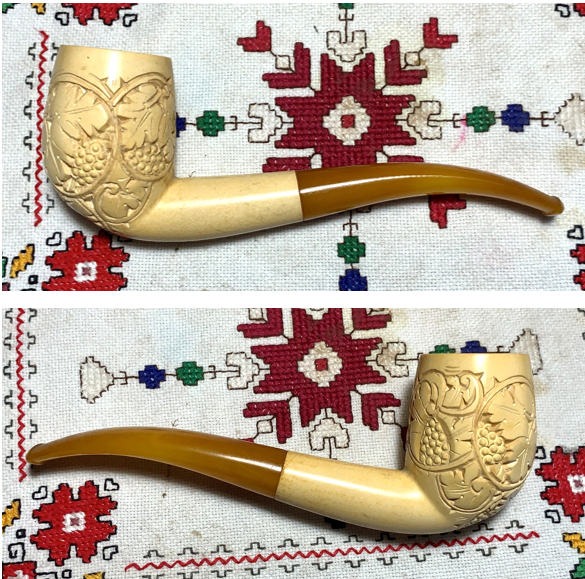
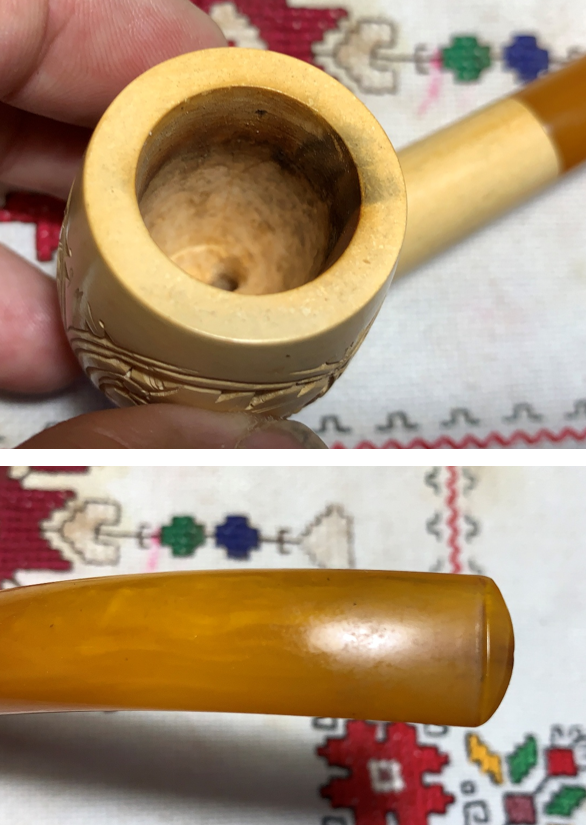
 There are no markings to determine the provenance of this Meerschaum. But Meerschaum is almost exclusively mined in Turkey. There are other places where Meerschaum is mined but Turkey boasts of the best quality. This helpful information comes from the now defunct website of altinokmeerschaumpipes.com:
Basics About Meerschaum
The noble Meerschaum is unique among pipes. Its mysterious properties make it a perfect smoke and, at the same time, a work of art; a pipe highly prized by the Connoisseur and beginning smoker alike. Meerschaum is a German word meaning sea foam. The geologist knows the light, porous Meerschaum as hydrous magnesium silicate. The pipe smoker knows it as the perfect material for providing a cool, dry, flavorful smoke. The mineral itself is the fossilized shells of tiny sea creatures that fell to the ocean floor over 50 million years ago, there to be covered and compressed over the ages by layer upon layer of silt. Profound movements in the earth’s crust raised the creamy white stone of Meerschaum above sea level. There men eventually discovered it and created an incomparable pipe from it. The first record of Meerschaum as a pipe dates from around 1723.
Some characteristics of Meerschaum pipes in contrast to briar pipes, is that Meerschaum does not need to rest between smokes. One can lock and load and go again. Meerschaum also does not need (or want) a protective cake in the chamber as is needed with briar.
Meerschaums also develop a sought for patina as they are smoked. This also comes from the Altinok Meerschaum website:
What types of tobacco are best for coloring a Meerschaum? A Meerschaum’s color results from the light, volatile oils found in all tobaccos. While smoking a tobacco with a high oil content, such as the Latakia in an English blend, may yield a darker color, your Meerschaum will also color nicely with your favorite tobacco.
One more helpful bit of information for the novice Meerschaum steward:
Can I smoke my Meerschaum pipe the same way I smoke my briar pipes? No. One of the fascinating qualities of Meerschaum is its ability to change color from white to golden to a deep reddish brown. This results from the oil in the tobacco and wax on the outside of the bowl. If it is smoked too fast or too hot, the wax may melt down and only the base will color. Do not touch the bowl with your hands when the pipe is warm. The softened wax may cling to your fingers and the pipe will color in blotches. However, some pipe smokers prefer Meerschaum for its smoking properties, rather than for its ability to change color. If the coloring is not of importance, then, of course the Meerschaum can be handled and smoked in the normal manner. Note: Some manufactures produced antiquing or re-wax kits that can be used to touch up a Meerschaum pipe.
Not handling the warm bowl with your hands may be a challenge – I suppose the intent is that one holds the stem. I’ve handled my Meerschaums with my hands, and they have still developed a patina quite nicely.
Looking now at the pipe, the Delrin threaded connector comes off with little trouble. This clears the way for cleaning. The stem is acrylic – possibly Bakelite, it has that feel about it. To clean the airway, all needed was one pipe cleaner and a cotton bud moistened with isopropyl 99%. The orific button and airway are very tight. I could not get the pipe cleaner all the way through the stem. I ended up cleaning the airway by using the pipe cleaner through both ends of the stem.
 The bit has very mild chatter on the upper and lower sides, with a small compression on the bottom which you can see in the light’s reflection.
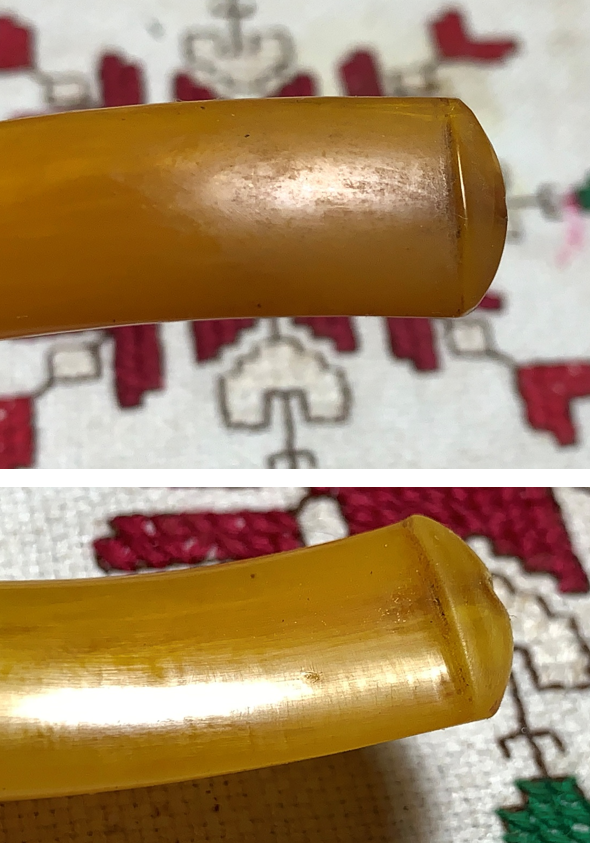 To clean the bit, 320 grit paper is used to erase the chatter and sole tooth compression on the lower bit.
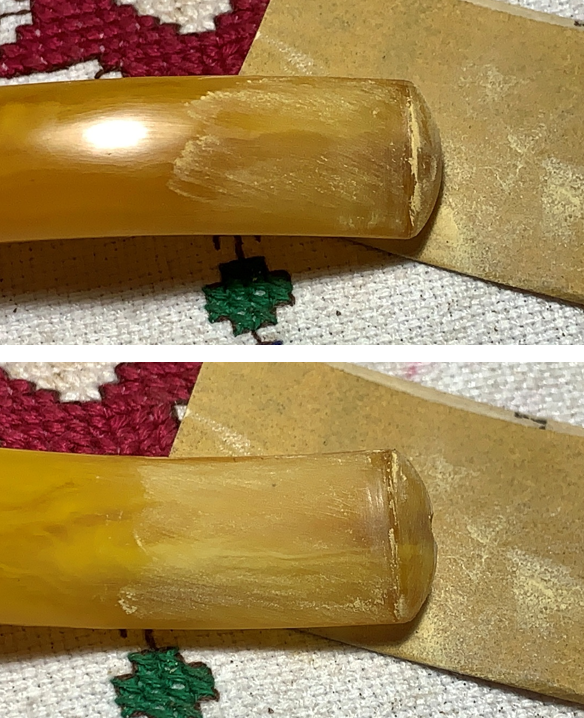 This is followed by wet sanding the entire stem with 600 grit paper and following this by applying 0000 grade steel wool.
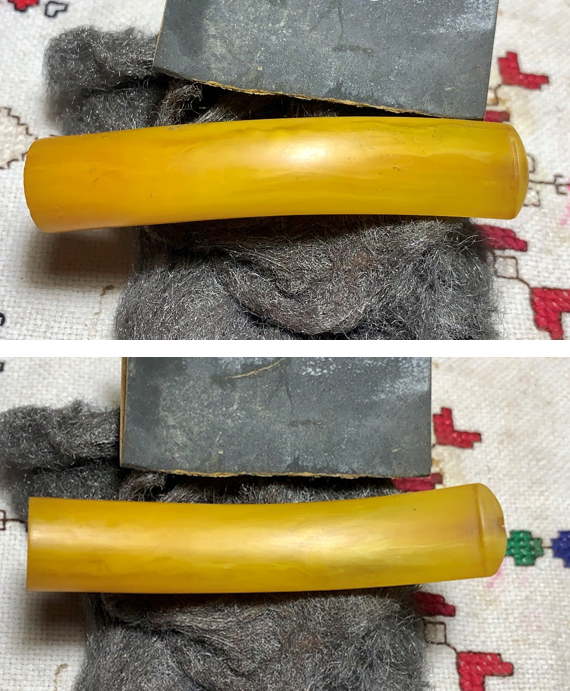 Continuing to sand and transitioning to polishing, 9 micromesh pads are applied. Between each pad, the stem is wiped with Obsidian Oil to help condition the stem. The oil is then wiped off with paper towel to not gum up the pads. The first set of 3 pads are 1500, 1800 and 2400.
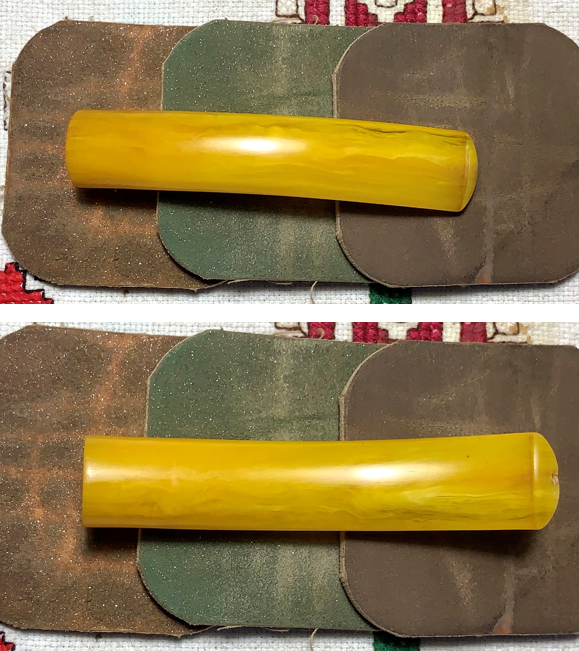 The second set of pads are 3200, 3600 and 4000.
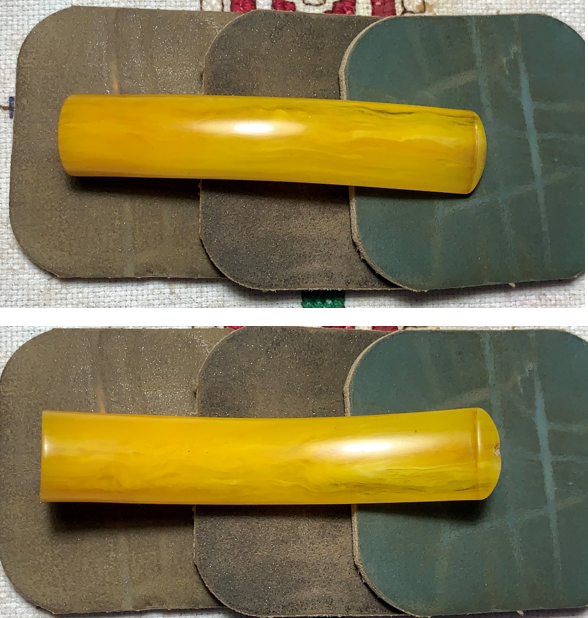 The final set are 6000, 8000 and 12000. The stem’s marbled honey hue now pops. I liked watching this emerge during the process – nice.
 Turning next to the stummel, the internals are not in need of much. One pipe cleaner and cotton bud moistened with isopropyl 99% are used.
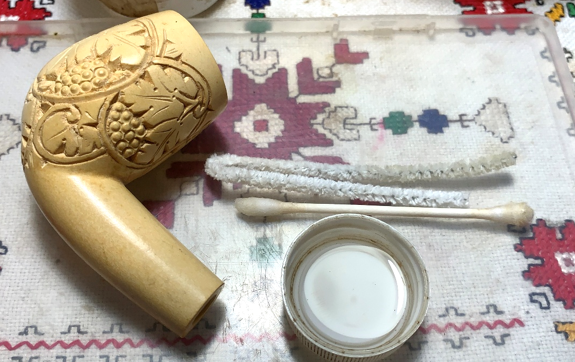 The external Meerschaum is in good condition. I see no chips and or noticeable scratches. The rim has some lighting charring that flows to the chamber.
 To clean the chamber, 220 sanding paper wrapped around the dowel rod is used to sand.
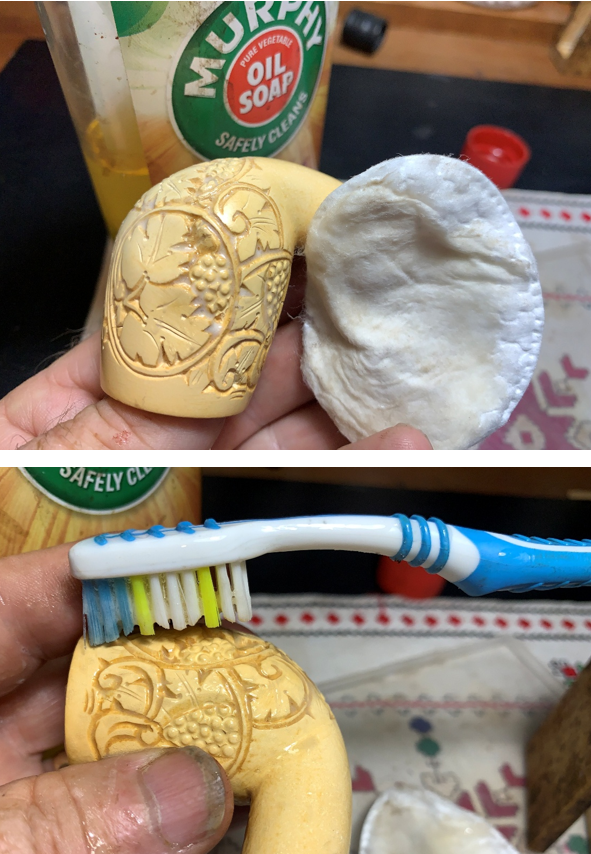
 The external Meerschaum is cleaned with undiluted Murphy Oil Soap. As the cotton pad reveals, the surface is in good condition. A bristled toothbrush is helpful to get down into the sculpting crevasses. After the stummel is scrubbed, it is taken to the sink and rinsed thoroughly.
 The traditional approach to protecting and polishing Meerschaum is with Beeswax. The honey-colored wax also helps to encourage the development of the sought-after darkening patina.
  The beeswax is kept in a mason jar so that when heated with a hot air gun to liquify the wax, there’s no problems with glass cracking – it gets hot!
 After the wax has liquified, a horsehair brush is used to apply the hot wax onto the stummel surface. Horsehair is used because it will not melt when exposed to the hot air gun unlike regular acrylic brushes. The still picture below shows the parts of the process. The hot air gun is situated so that the hot air continuously flows over the top of the mason jar with the liquified beeswax. Using the cork as a handle wedged in the chamber, the stummel is held over the mason jar and while the hot air is flowing, the brush applies the liquified wax over the stummel. The continued hot air flow keeps the wax from congealing and while liquid gravity helps the excess wax to drip back into the mason jar. The goal is to apply a very thin layer of beeswax. If the wax congeals with a thick layer, it’s a bear to buff. This process of painting the wax on the surface and heating it continues over the entire stummel.
 It’s difficult to see in the picture, but after the stummel cools with the hot air gun turned off, a thin layer of beeswax has congealed around the Meerschaum surface.
  When the stummel fully cools, a microfiber cloth is used to rub and then buff the stummel by removing the excess wax and leaving the absorbed, protective coat over the surface. As hoped, the beeswax has also darkened the stummel a bit with a honey hue.
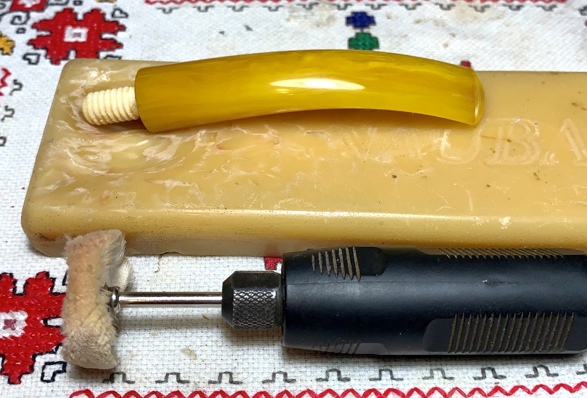
 The Meerschaum stummel is ready to go. To continue with the process of polishing the stem, Blue Diamond compound, a fine abrasive, is applied. A dedicated cotton cloth buffing wheel is mounted on the rotary tool and the compound is applied with a speed at about 40% full power.
 The compound leaves a lot of dust behind. A felt cloth is used to wipe the stem to remove dust in preparation for the wax.
 The Meerschaum receives beeswax, but the stem gets carnauba wax. With another dedicated cotton cloth buffing wheel mounted at the same speed, carnauba wax is applied to the stem. Afterwards, the stem and stummel are reunited and the pipe is given a rigorous hand buffing to remove excess wax and to raise the shine.
 This ornate Sculpted Vineyard Meerschaum looks great after being refreshed with cleaning and buffed up with beeswax. The gentle bend of the shank gives the pipe a classy look with the marbled honey colored stem. The dimensions are Length: 5 3/4 inches, Height: 2 inches, Rim width: 1 3/16 inches, Chamber width: 15/16 inches, Chamber depth: 1 1/2 inches. Amy commissioned this Sculpted Vineyard Meerschaum and will have the first opportunity to claim it from the Pipe Steward Store. A portion of the proceeds of all pipes restored benefit the Daughters of Bulgaria. Thanks for joining me!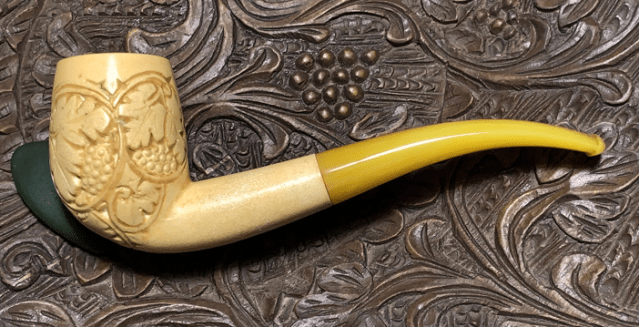


 The Pipe Steward
Don’t have to convince me this is another masterwork… “behold He is making all things new!” in microcosmic form!
LikeLiked by 1 person
Amen
LikeLiked by 1 person
Pingback: New Life for a Barontini Lite 22 Italy Bent Dublin – The Pipe Steward