
The next pipe on the worktable is an Amphora X-Tra of Holland which came to me via the online auction block in December of 2017, from a seller in Fort Meyers, Florida. The bid was sufficient for the day and the Amphora Poker made its way to the For “Pipe Dreamers” ONLY! online collection. Gary is a pipe man from Four Oaks, North Carolina, and he has commissioned several pipes. One of the first pipes Gary commissioned was also a Poker – a GBD Flame 1344 Made in France – it came out pretty well (See: A Fresh Start for a GBD Flame 1344 Poker Made in France). I appreciate Gary being a ‘satisfied’ customer coming back to commission additional pipes benefiting the Daughters of Bulgaria – a work in Bulgaria that my wife and I co-founded helping women and girls who had been trafficked and sexually exploited. What stands out to me about Gary was his reply to my routine question I ask new commissioners, ‘How did you hear about The Pipe Steward?’ This was his memorable reply in 2021:
 You asked how I heard about The Pipe Steward. I saw a post on Facebook in the Old Codgers Smoking Pipe Club of you and your friend Mel that looks like it was posted September 16. You and he were having a pipe together in Vladimirska Park in Kiev, Ukraine. You had a wee bit of Hobbit Weed in your bowl. In that post the link to The Pipe Steward was listed. I followed the link and spent about an hour clicking on this pipe then that pipe. I enjoyed looking at all the pipes you have listed. I have your page bookmarked and visit your page about once a week to see if there is something new. I can sit for hours just looking at pipes and looking at tobacco blends.
The selfie that Gary saw on Facebook was with my dear friend and colleague, Mel. Only a few months before missiles started raining down on Kyiv, my wife and I visited Kyiv, where we had lived and served in the 1990s, and were making plans to return to help in Kyiv after our work in Bulgaria ended. Well, we didn’t make it back to live and serve in Kyiv, but we continue to help as we can. One of the ways we help is to administer a website we created (www.Voice-of-Ukraine.com) to try to keep people informed – from the ground not from the many talking heads we hear in major media outlets. Since that attack in February of 2022, I have seen pictures of craters in the same park where Mel and I enjoyed a bowl together.
I appreciate Gary and here is the next pipe – his second Poker he commissioned:


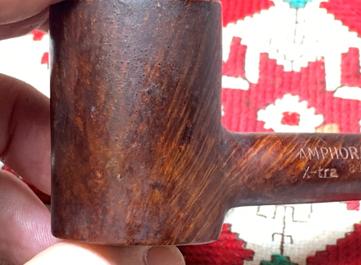
 The nomenclature is stamped on the left side of the shank: AMPHORA [over] X-tra 815. The right side of the shank is stamped: GENUINE BRIAR.
 Pipedia’s article is brief but provides a starting point to better understand the name and history:
Amphora pipes are made in Holland by the Jos. Gubbels organization, the same company which makes the very well known and loved Amphora Pipe Tobaccos. The pipes are produced in relatively small numbers to a high standard and not commonly found. They were used primarily in promotions and incentives for Amphora tobacco.
The Royal Dutch Pipe Factory Elbert Gubbels & Sons B.V. is the only manufacturer of briarroot tobacco pipes in the Benelux countries where pipes of high quality are made under the brands Big Ben, Hilson, Royal Dutch and Amphora. They also supply numerous smokers’ accessories of high quality.
I did some extensive research on the Holland based Gubbels company when restoring a Big Ben (See: A New Button After Amputation for a Big-Ben Commodore 413 A S Made in Holland) and I recommend this post to drill down deeper than I will go with this restoration. In Pipephil’s panel (See: LINK) describing Amphora, references that Elbert Gubbels & Sons – Royal Duch Pipe Factory, had gone bankrupt in 2012. In my former research I discovered that they did not technically go bankrupt but did some downsizing and restructuring. The company continues to operate today, and their website has good information about the history and pipe offerings (See: LINK). I was curious and did a search on the website to see if any ‘Amphora’ pipes were in the inventory. There weren’t any.
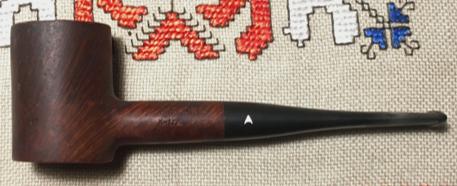
An Amphora X-tra ad was included in the Pipedia Amphora article (Amphora Shape Chart, courtesy Doug Valitchka). Unfortunately, our 815 Poker is nowhere to be found.  My attempts to find more specific information about a dating for the Amphora production found nothing. I’m sure something is out there, but I did find Robert Boughton’s post on Reborn Pipes (See: About the Winner of an Amphora Bent Billiard and More Information on the Brand | rebornpipes) and Robert, in his unique writing style, did some research on possible connections between Gubbels and Dr. Grabow. Robert’s research did produce these period ads that did produce a match for Poker in the picture to the left – #815. Thank you, Robert!
 One other bit of information I wanted to add is from Bill Burney’s description of the Poker shape from Pipedia (See: LINK) which I always find interesting – the differences between a Poker and his brother, the Cherrywood.
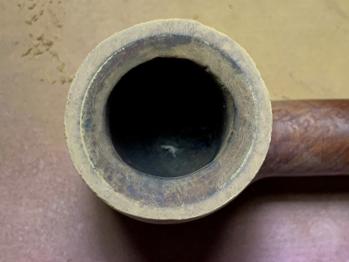
 I’m always amused by the card table origins of the Poker. I’m sure this is why Gary likes his Pokers 😊. With a greater appreciation for the pipe on the worktable, it is time to take a closer look at the Amphora Poker on the worktable, the chamber has thick cake and needs to be cleared to allow fresh briar to emerge and to check for heating issues.
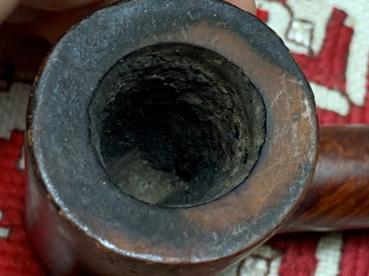 The rim has thick grime and lava flow – it could be charring by the texture of it. We’ll see what emerges beneath during the cleaning.
 The rim is sloped toward the chamber so topping won’t be an option. The edges of the rim have several skins and dents.
 The stummel has nice looking grain beneath a thick layer of grime. I’m looking forward to seeing what the cleaning will look like!
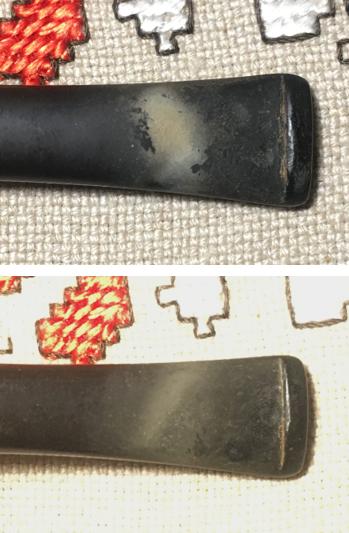
 The stem has thick oxidation and tooth compressions on both sides of the bit.
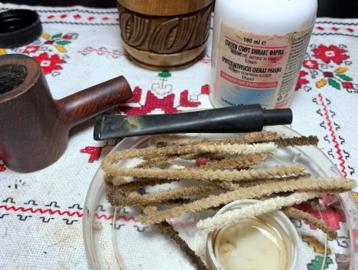
 To begin the restoration of this Amphora X-tra 815 Poker, the stem’s airway is cleaned using pipe cleaners moistened with isopropyl 99%.
 To get a head start on removing the oxidation and calcification on the bit, 000 grade steel wool is applied to the stem.
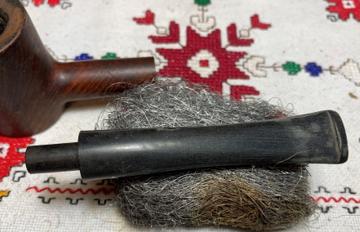 Next, the stem is placed in Briarville’s Pipe Stem Oxidation Remover to soak for several hours.
 After removing it from the soak, a cotton cloth is used to rub/wipe the stem vigorously to remove the raised oxidation. The Oxidation Remover did a great job.
 A pipe cleaner moistened with isopropyl 99% is run through the airway to remove any excess fluid from the soak.
 To condition the stem, Paraffin Oil is applied and worked into the vulcanite rubber. The stem practically drinks the oil.
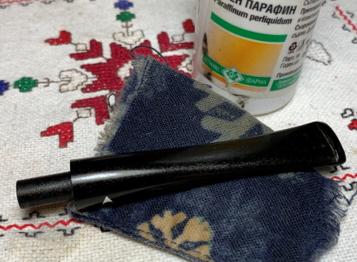 With the stem on the side, the cleaning begins with the Poker stummel. A fresh picture is taken of the cake in the chamber to mark the progress.
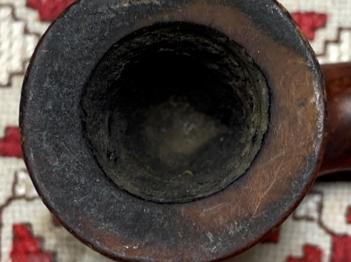 To ream the chamber, 2 of the 4 blade heads from the Pipnet Reaming Kit are used.
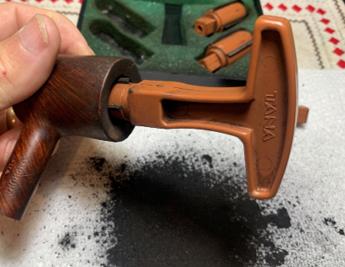 Next, the Savinelli Fitsall Tool does a great job scraping the chamber further and reaching the hard-to-get places on the floor of the chamber.
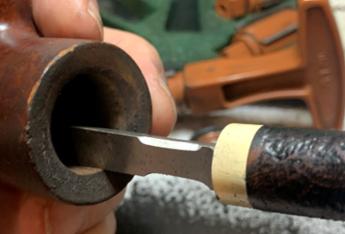 The last vestiges of carbon are removed by sanding the chamber with 220 paper wrapped around a Sharpie Pen for leverage.
 A picture of the full arsenal and the results. The chamber looks good with no heating issues.
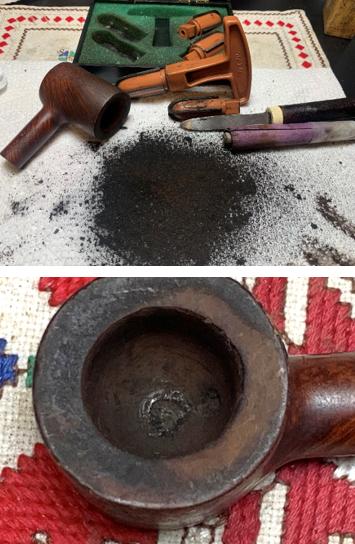 Moving now to the external briar surface, a few fresh pictures show the grime and the rim which looks charred.
Using undiluted Murphy’s Oil Soap, a cotton pad is used to scrub.
To address the rim, the edge of the Savinelli Fitsall tool is used to scrape the hard, crusted lava flow over the rim. I had thought this might be charring which would more of a challenge, but thankfully the grime came off. A brass wire brush follows to further clean the rim. The brass gives more muscle to the cleaning process without being too invasive.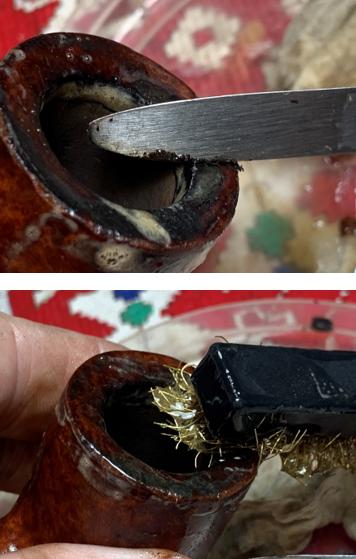 After the scrubbing, the stummel is taken to the sink where the cleaning continues using shank brushes and anti-oil liquid dishwashing soap and hot water. The scrubbing addresses the internal briar focusing on breaking down the tar and oils.
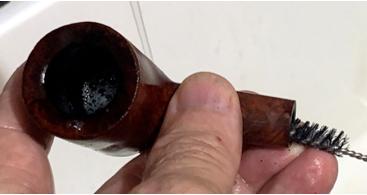 After the stummel is rinsed thoroughly, it comes back to the worktable.
 The internal cleaning continues using cotton buds and pipe cleaners moistened with isopropyl 99%. The cleaning is shortened by excavating the grunge. Using a small dental spoon, the mortise wall is scraped, and the grunge is removed by the spoon.
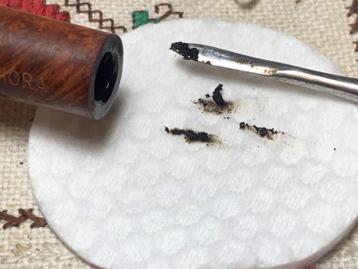 When the pipe cleaners and buds begin to emerge lighter, a stop was called. Moving on.
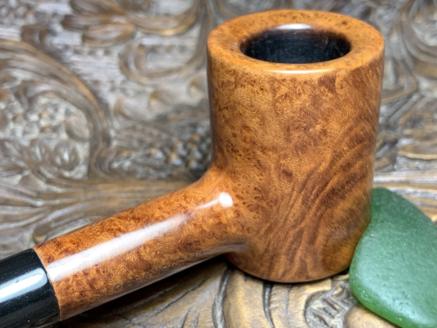
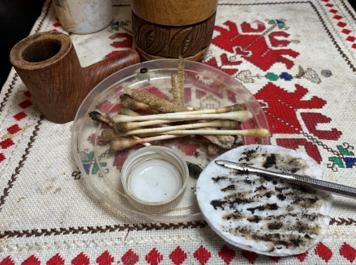 The stummel has completed the cleaning process and taking a closer look at the surface, the grain is coming through now and it is spectacular. The fore section shows long, vertically reaching flame grain and the aft, distinctive bird’s eye grain.
 The rim still shows patches of dark briar from staining and lighting practices. The edges are in bad shape. It looks as if the former steward knocked this guy on a brick to clear the dottle from the chamber!
 The rim on this stout Poker is canted and sloping towards the chamber. If this were a flat rim the normal next step to clean the rim and establish new, fresh lines would be to top the rim. But I’ll employ a middle of the road approach. The chips and dents on the outer rim edge need to be erased. The approach will be to top the stummel but only enough to address the higher edge of the outer rim which should eradicate the major portion of damage. This picture gives the starting point to mark the progress.
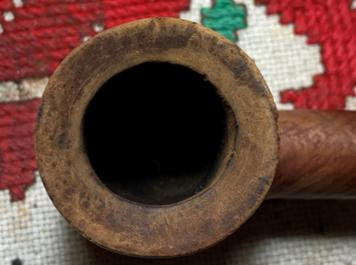 The stummel is inverted on 220 grade paper and rotated a number of time on the board.
 The following picture shows the initial ‘look-see’ after topping a bit. The higher edge of the canted rim shows the sanding contact point. This view also shows the dent and skinning damage more distinctly. More topping is necessary.
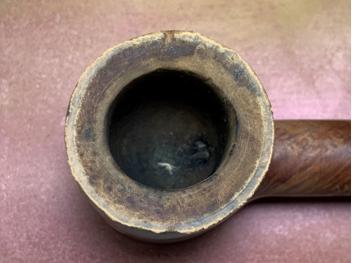 After several more rotations the topping comes to a halt. The damaged area appears to be erased.
 There remains a small amount of skinning on the rim where it was most damaged. General sanding should take care of this. At this point, the outer edge of the rim is flat because of the topping but tapers downward from the sanding edge.
 To again introduce a unified slope around the rim, the rim is sanded with 220 grade paper. The 220 grade paper is followed by applying a finer 320 grade paper. I like what I’m seeing.
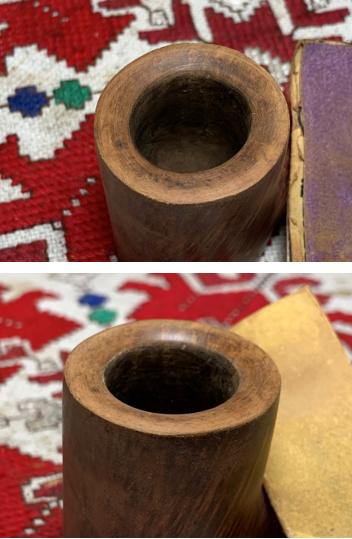 The stummel surface has a myriad of small nicks and scratches. No fills have been detected. To clean the surface, the less invasive sanding sponges are used with coarse, medium, light and fine sponges.
 Next, micromesh pads are used to sand/polish the briar. All 9 pads are used from grades 1500 to 2400, 3200 to 4000, and 6000 to 12000. Between each pad, a moistened cotton cloth wipes the stummel to clear the briar dust and to give the next pad more traction.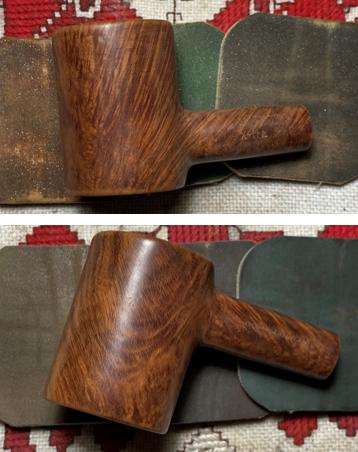
 The grain on this Amphora is stellar. To bring out the hues of the natural briar, Mark Hoover’s ‘Before & After’ Restoration Balm is my go-to. After putting some on the fingers, the Balm is worked into the briar. After a thorough application, the stummel is put aside for about 15 minutes to allow the Balm to be absorbed.
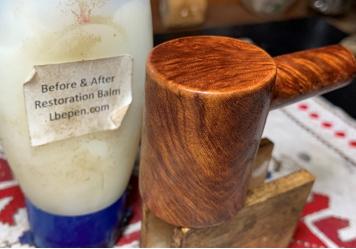 After the time has passed, the excess Balm is wiped off with a dedicated micromesh cloth. My, oh my.
 It’s time to catch the stem up with the stummel’s progress. There are some tooth compressions on the upper and lower bit. The button lip also has some biting marks. The initial way to remove the compressions is by heating the vulcanite with a Bic lighter. As the rubber compound heats the physics of the material causes it to expand to recover its original position. The flame of the lighter paints the surfaces and the process hopefully helps. The before and after pictures show that the method did not work well this time around. Different stems have different compositions I have discovered and do not react the same way.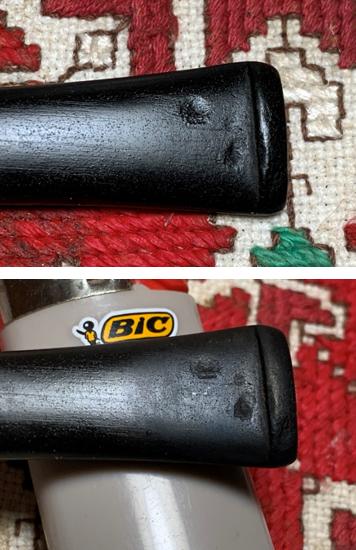
 Next, after cleaning the area with alcohol, the compressions are filled with Black Medium-Thick CA glue. After applying the CA, the stem is set aside for the patches to cure.
 When the patches were cured, a flat needle file is used to file down the mound of excess patch material.
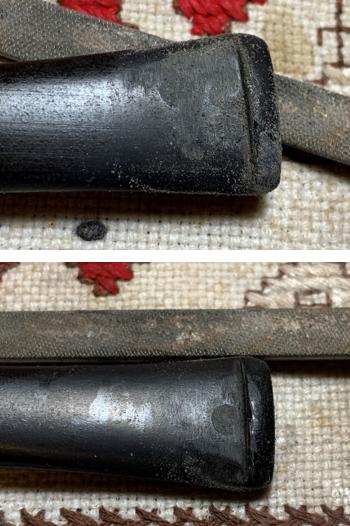 After filing, the bit is sanded with 220 paper to further sand down the patches. It seems that I didn’t take a picture of the upper bit….
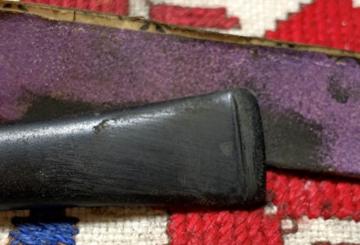 Next, the entire stem is sanded with 320 paper.
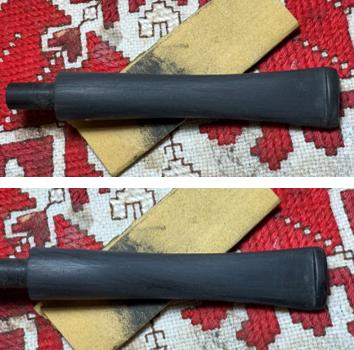 After the 320 sanding paper, the stem is wet sanded with 600 grade paper.
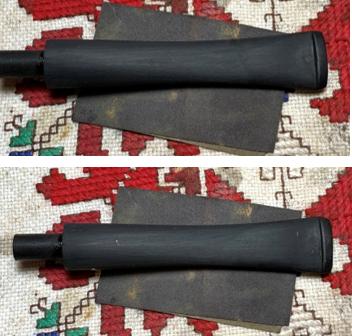 Next, the full set of 9 micromesh pads are used: 1500 to 2400, 3200 to 4000, and 6000 to 12000. Between each set of 3 pads, Obsidian is applied to help condition the vulcanite and to protect the stem from oxidation. The stem has come out nicely with that glossy pop I look for.
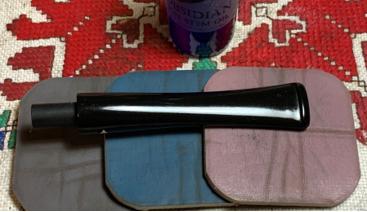 To further condition the stem, Mark Hoover’s ‘Before & After’ Fine and Extra Fine Polish does a good job. First, the fine polish is applied by putting some on my fingers and working it into the stem. After a few minutes, the polish is wiped off with a paper towel. Then, the same process is done with the Extra Fine. After a few minutes it is wiped off with a paper towel.
 The stem is now ready to rejoin the stummel and Blue Diamond compound, a fine abrasive polish, is applied with a dedecated cotton cloth buffing wheel. With the rotary tool set to about 40% full power the compound is applied to stem and stummel.
 Following the application of the compound, a felt cloth wipes down the pipe clearing it of compound dust in preparation for the wax.
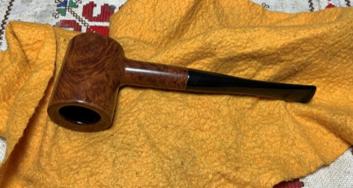 After changing the wheel to another dedicated cotton cloth buffing wheel, carnauba wax is applied to the pipe. Following this, the pipe is given a rigorous hand buffing with a microfiber cloth to remove excess wax and to raise the shine.
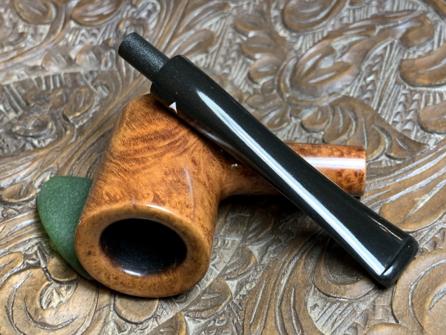
This Gubbels Amphora X-tra 815 Poker reveals a striking grain landscape with vertical fire grain over the front of the bowl and tightly wound bird’s eye grain on the aft. The Poker shape in icononic with the ability to sit on the table as one deals the cards. The diminsions of the Amphora are Length:5 7/8 inches, Height: 1 7/8 inches, Rim width: 1 1/4 inches, Chamber width: 3/4 inches, Chamber depth: 1 5/16 inches. The more than ample bowl will hold sufficient amount of one’s favorite blend for time of quiet and reflection. Gary commissioned this Amphora Poker and will have the first opportunity to claim him from The Pipe Steward Store benefiting the Daughters of Bulgaria – helping women and girls who were trafficked or sexually exploited. A ‘before & after’ reminds us how far we’ve come. Thanks for joining me!






 The Pipe Steward

I am very pleased with the way the poker turned out. Dal I remember one of our earlier conversations about this pipe and you said you thought this one could turn out to be a nice looking pipe and it did. But it didn’t get that way by itself it was your magically touch that made this pipe so beautiful. Thank you again.
LikeLiked by 2 people
Thanks, Gary! It’s a beauty and will be a nice addition to your collection.
LikeLiked by 1 person
It will fit in nicely in my display cabinet along with the other pipes that you have restored for me.
LikeLiked by 1 person
Send me a picture of the case and a selfie when you have your inaugural smoke 🙏.
LikeLike