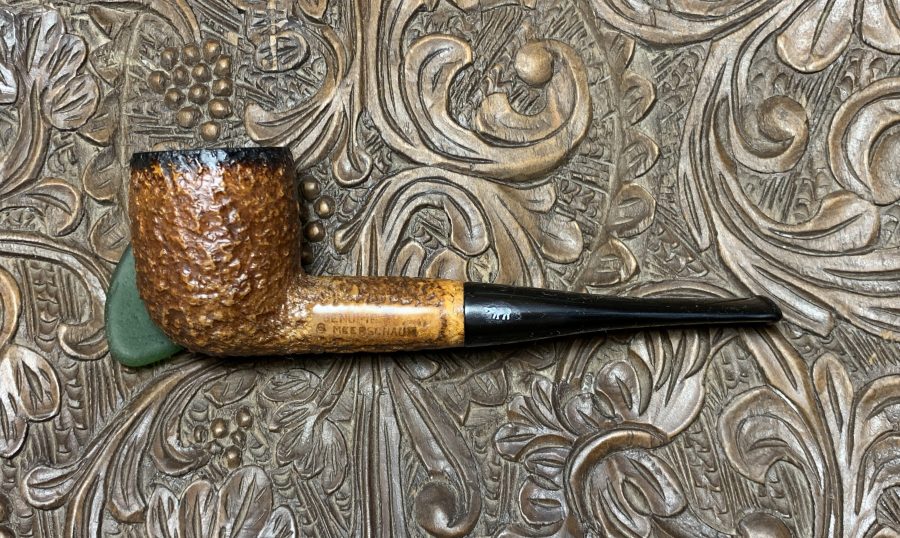
The next pipe on the worktable has some sentimental value for me. I remember well seeing a trove of pipes sitting on the vendor’s table in the shadow of Nevski Cathedral in the center of Sofia, Bulgaria. It was December 27, 2019, and two of my five children were visiting from the US with one spouse and one spouse-to-be. We were in the Center touring some of the historic sites during the festive, more relaxed time between Christmas and New Year. These kinds of adventures I miss a lot now that we no longer living in Bulgaria. One of my favorite pipe picking places was on the circuit that day – Nevski Pazar (Bazar). The vendors were out in full force and when I came upon one voluptuously full table, I couldn’t believe my eyes – a trove of pipes nesting in the wild waiting for me to come by. What do pipes in the wild look like – the picture below proves that one picture is worth the proverbial, 1000 words. Oh my. After my heart settled down, I took a closer look at the beautiful pile – without showing interest in my face, of course. I could see a Meerschaum and a ‘rock’ finish briar that showed much promise. The trove had other interesting pipes that I now wish that I would have paid more attention to, but alas….
 When I asked the vendor if I could handle the pipes to take a closer look, I knew he knew then of my interest. I pulled the most prized candidates out of the pile and took a closer look. In the picture below, the black briar on the top I was interested in only for the bowl. It would be a nice bowl to repurpose into a Churchwarden. The next was a Kiko Block Meerschaum of Tanganyika and the Brebbia Portofino with the Sea Rock finish. It almost looks like another Meerschaum!
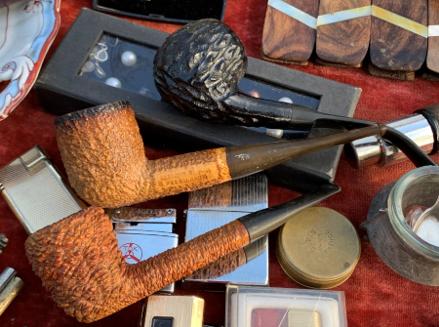 The negotiation dance began, and we came to an agreement after a few rounds. The 3 pipes went into my bag. After the deal was struck, the vendor said that he had another pipe like the Kiko that he could go get if I were around later. That wasn’t a problem for me. I found the family in the nearby Saint Sofia Church touring, and I joined them. Later, I dropped back by the table and landed another Kiko with darker stained Meerschaum. When we got home, I took this picture of the last pipes I acquired in 2019 benefiting the Daughters of Bulgaria – a ministry my wife and I co-founded working with trafficked and prostituted women and girls.
 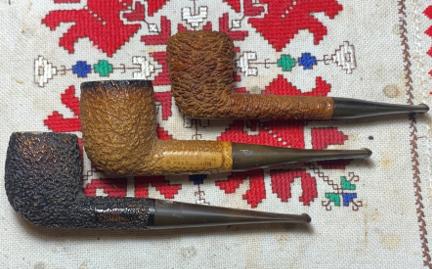 The Brebbia and the dark Kiko have both found new homes with stewards who whispered their names from the For “Pipe Dreamers” ONLY! online collection where pipe men and women commission pipes that get their attention. The other Kiko got the attention of pipe man Todd who has commissioned many pipes. Tod is an attorney specializing in international immigration law and is an expert on China. Unlike many of the pipe men I meet only virtually restoring commissioned pipes, I had the pleasure of sharing a bowl with Todd when he visited family in the Denver area, and we met at Edward’s to share a bowl. In the picture below I was ‘posed’ with Todd with his book, G88, which you can purchase on Amazon 😊 (https://a.co/d/ia6U64e). Yes, Todd is also an author.
 Here are pictures of the Kiko that Todd commissioned:
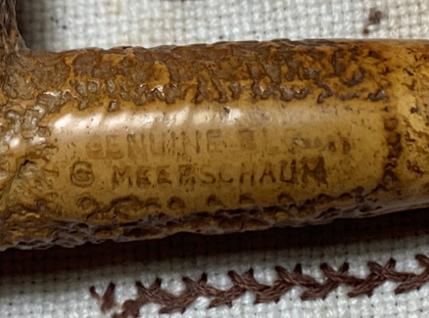
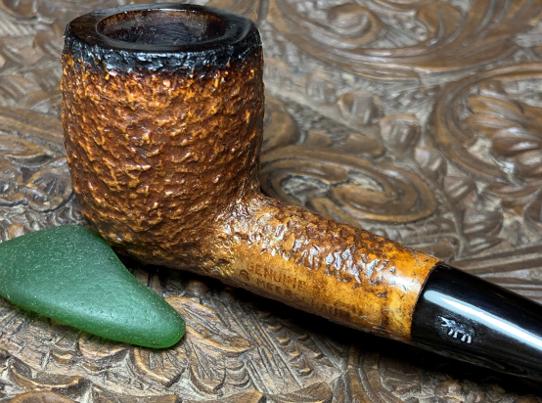
 The nomenclature is on the left side of the shank. Stamped is: GENUINE BLOCK [over] MEERSCHAUM. The number ‘6’ is set to the left of Meerschaum.
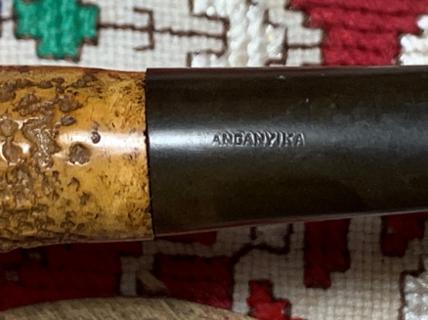
  The COM is stamped on the underside of the stem: TANGANYIKA. The ‘T’ is missing having worn off.
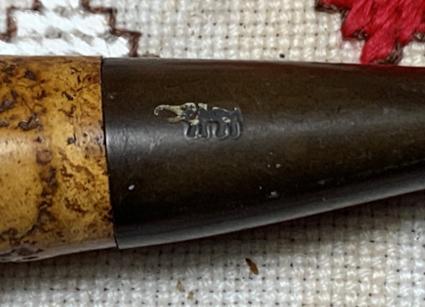
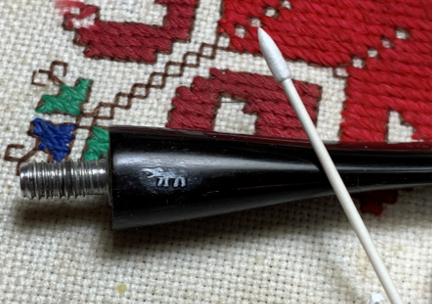
 The stem also has the logo of an elephant – a well-known stamping of the Kiko brand.
 I’ve worked on Kikos previously and I enjoy a refresher again. Dating the minimal age of this pipe is made easy by the fact that Tanganyika is no longer a country. According to the Wikipedia article, in 1922 the Tanganyika Territory was taken by the British as their share of German East Africa under the League of Nations
  Mandate. After WW 2, Tanganyika became a United Nations Trust Territory yet remained part of the British Commonwealth. Claiming independence from the crown, Tanganyika adopted a new constitution in 1962 that abolished the monarchy and became present day Tanzania. The picture to the left shows the location of Tanganyika – marked #11. This puts the date of this Kiko at no later than 1962 which gives a bit of vintage as it carries its former Commonwealth history to the present.
On a previous Kiko restoration, I posted some pictures of that Kiko during the restoration on the Facebook group, The Gentlemen’s Pipe Smoking Society. Fellow member, Jonny Mullis, commented on the Kiko name that they were wonderful pipes with the animal stamping. He also said that they were becoming quite collectable and affordable. That was all good news to me!
Looking for additional information, Pipedia’s Kiko article is helpful:
Kiko, meaning “pipe” in Swahili-Kiswahili to English translation, is probably the best known of the various brands listed below. In East Africa Meerschaum is found in Tanganyika, once known as German East Africa, and since 1964 part of the United Republic of Tanzania. The main deposit comes from the Amboseli basin surrounding the Lake Amboseli. Tanganyika Meerschaum is normally stained in shades of brown, black and yellow, and is considered to be inferior to Meerschaum from Turkey. Even though, the raw material is mined by the Tanganyika Meerschaum Corporation and to a large extent used for pipe making. Uncounted pipe makers throughout the world were supplied with Amboseli Meerschaum, preferentially used for Meerschaum lined briars or leather-clad pipes. In Tanganyika the Kilimanjaro Pipe Company Ltd. produced (afak).
Interesting factoids included first is that Kiko means pipe in English. Also described is how Ambroseli Meerschaum is inferior to Meerschaum mined in Turkey. Even so, the Pipedia article describes how this Meerschaum was used in arrangements with Comoy’s and GBD. The article goes on to list the various Kiko lines and the corresponding descriptions and associated animal logo. This is both interesting and helpful. I include this listing here:
- Caveman Fashioned from a piece of natural meerschaum. Every pipe is unique and – is in fact a geological specimen over a million years old. Attractively boxed.
- Countryman (Elephant logo ) Block meerschaum with rustic finish either yellow or black. Individually boxed with protective chamois bag.
- Huntsman Block meerschaum black or yellow rustic bowl.Bamboo and vulcanite stem. Individually boxed with chamois bag.
- Hillibilly Block meerschaum, black or yellow corncob style finish.
- Kiko Rough (Elephant logo) Old seasoned briar. Block meerschaum lined with black rustic finish.Individually boxed.
- Kiko plain (Elephant logo) As for Kiko Rough but with smooth plum colour finish.
- Kikob (Elephant logo) Hillbilly style Briar block meerschaum lined.
- Kilimanjaro (Rhinoceros logo) East African pipewood Meerschaum lined and individually boxed. Available in black rough finish and natural smooth or rough finish.
- Kilimanjaro Giant (Rhinoceros logo) Finish as for standard Kilimanjaro, but available in three shapes only. Bent, Billiard and Oval Pot.
- Kudu (Giraffe Logo)
- Makonde (Rhinoceros logo)
- Merlin (Flying bird or Antelope logo)
- Sportsman (Logos Elephant) Block meerschaum, covered with hand-sewn English pig-skin. Individually boxed.
- Tembo
- Townsman Block meerschaum with plain glossy yellow finish. Individually boxed with protective chamois bag. The Townsman is also available in the new styles. Townsman Crater, Townsman Scallope and NSC.
- Twiga (Giraffe Logo )
- White elephant (Logos Elephant)
In this list, the animal logos listed are Elephant, Rhinoceros, Giraffe, and Flying Bird or Antelope. The Elephant logo is the most used in the list. Looking at the differing Elephant logo line descriptions, the line that fits the Kiko Elephant on our table seems to be the Countryman line with our black trim stain which gives it a rustic vibe. In the list above, each of the animal logos is linked to the corresponding reference at Pipephil.eu. The picture below is a Countryman shown in the Pipedia article. Our pipe has a number 6 which undoubtedly points to a Billiard shape number.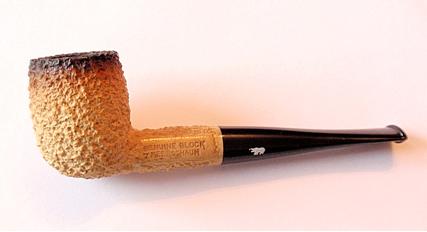 Looking more closely at the Countryman on the table, as one would hope, the chamber has next to no cake build up, which is good news for a Meerschaum.
 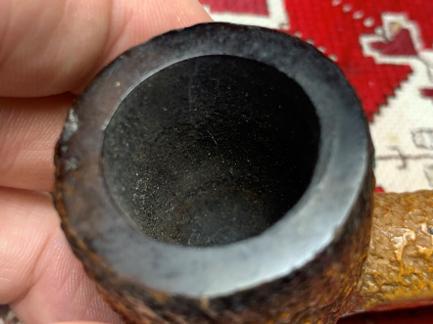 The edge of the rim has been chipped here and there and the lighter Meerschaum is peeking through the black chimney trim. This needs to be touched up.
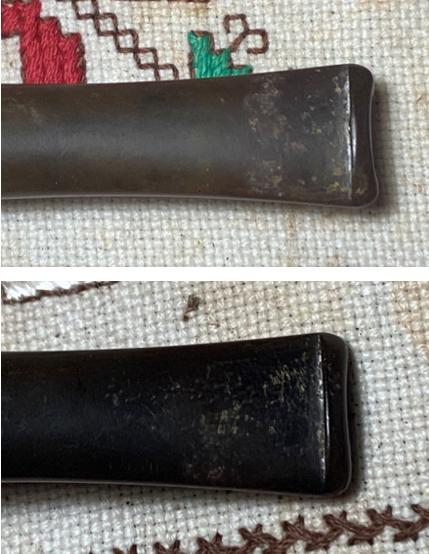
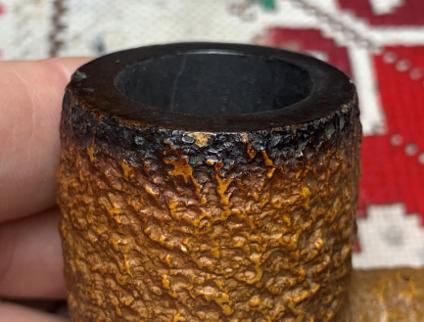 The stem has some tooth chatter, but nothing serious. The stem is deeply oxidized.
 I’m glad to see that the Elephant stem logo appears to still have definition. At the end of the project, I’ll work on refreshing the logo.
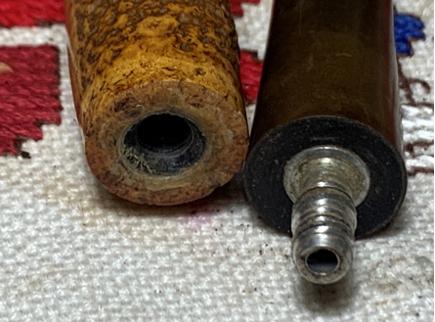
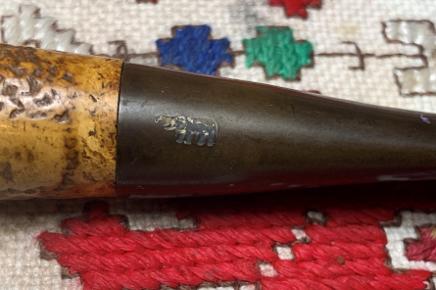 The threaded screw-on tenon has worn and as is often the case, over time the stem ends up being overclocked as it is tightened and retightened. The stem needs to be brought back to a proper orientation.
 The cleaning starts with the stem using a single pipe cleaner and isopropyl 99% alcohol. It cleaned so quickly that I didn’t take a picture before it was in the soak for oxidation. The picture below shows how thick and deep the oxidation is in the vulcanite. To address this, the stem is placed in a soak of Briarville’s Pipe Stem Oxidation Remover for several hours.
 With the stem soaking, to clean the chamber of the very light amount of cake build up, the Savinelli Fitsall Tool is used to scrape the wall. I never use a regular reaming tool with Meerschaum as it can create too much torque, and this could crack the bowl – not good.
 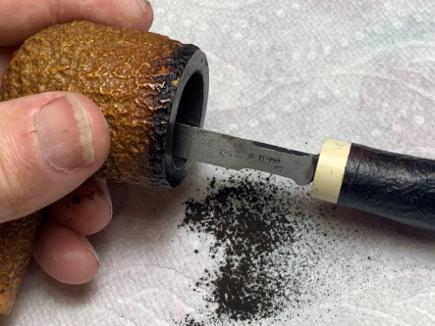 The chamber is next sanded with 220 grit paper wrapped around a Sharpie Pen.
 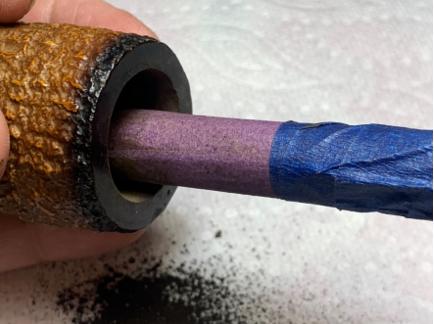 The chamber is clean, and no problems are detected. Moving on.
 To clean the Meerschaum surface, undiluted Murphy’s Oil Soap is used. A few pictures of the stummel show the general condition. It’s difficult to see grime on the rough sculpted surface.
 The surface is scrubbed with the soap and a cotton pad. A bristled toothbrush also helps to get into the crooks and crannies of the rustication.
 The stummel is next taken to the sink to thoroughly rinse off the soap. The results of the cleaning are interesting. The ‘yellow’ stained Meerschaum has whitened because of the cleaning. It also looks dry and I’m thinking that the hot bee’s wax treatment which is coming and is the usual way of waxing and conditioning Meerschaum, will be well received by this Meerschaum – later.
 Next, to clean the internals, 1 cotton bud and 2 pipe cleaners are used to clean. This pipe was not too dirty.
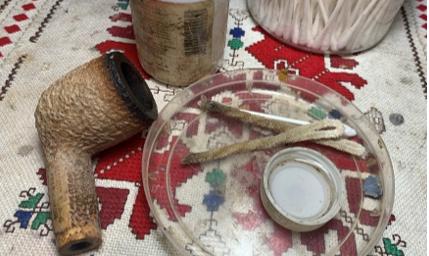 Before applying bee’s wax to the Meerschaum surface, the black chimney trim is touched up using a black dye stick.
  It looks much better now with the black refreshed.
 Next, the application of bee’s wax is where the ‘magic’ happens with Meerschaums. The Meerschaum absorbs the hot wax, and it helps to condition the Meerschaum as well as encourage the valued patina. I use a mason jar that is heat resistant to warm the wax.
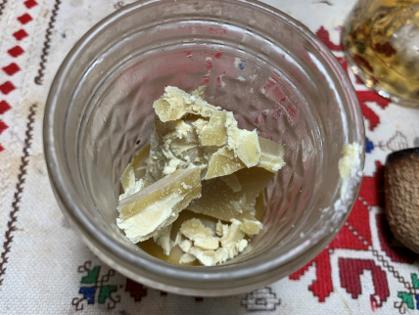 A hot air gun is used to liquify the bee’s wax. It doesn’t take long. After the wax is liquified, the stummel is also heated up with the hot air gun to help the wax spread evenly over the surface. When the wax cools, it congeals and if it’s too thick, it can be a bear to buff off the excess wax from the surface.
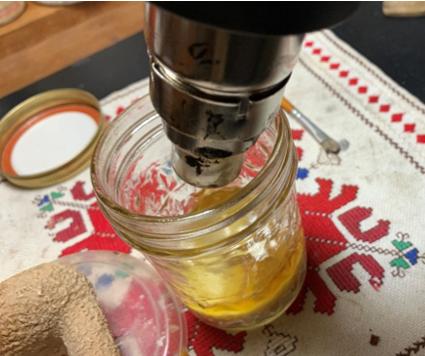 A horsehair brush is used to paint the liquified wax onto the stummel surface. Horsehair is used because it won’t melt like synthetic brushes.
 At this point the entire stummel has been covered with the wax and it has congealed. To thin it out, the stummel is heated again in a specific way.
 It was impossible to take a picture of this process, but I held the hot air gun propped up and pinched by my knees with the hot air pointed upward toward the stummel. I held the stummel with a cork handle inserted in the chamber. You can see the cork in the picture below. As I held the stummel over the mason jar, the hot air blew lightly onto the stummel to liquify the wax gently. As it liquified, the brush is used to pull the wax down toward the jar with gravity helping. With help from the brush, the excess wax drips off into the mason jar. This helps to thin out the wax on the surface and to continue absorbing the bee’s wax.
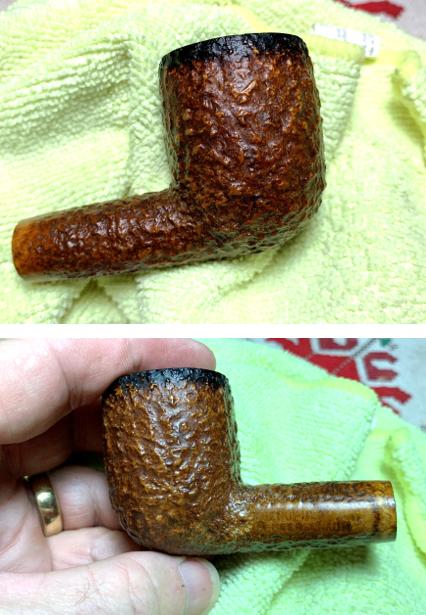
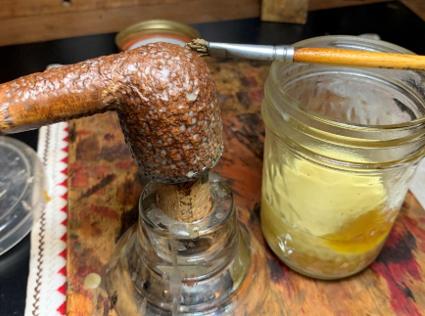 Well, I have never seen this happen before. The Meerschaum stummel went beyond a honey brown to a darker, richer brown – almost reminds me of chocolate fudge. When I said that the Meerschaum was dry and would do well with a bee’s wax treatment, I had no idea the result would be the Meerschaum absorbing it and transforming to this degree. It took some time using a microfiber cloth to buff off the excess wax and buff up the shine. It IS shiny and the Meerschaum is healthy, but it has transitioned to a rich, deep brown…. It’s no secret that bee’s wax is used to augment the natural patina transition that is welcomed and sought after, but this patina is a surprise! The article above describes that the Kiko stummels are stained with either black or yellow. The cleaning must have removed the dye and the natural hues created by the honey took its place. That’s the only thing I can think of that would give a reason for this transformation😊. We will press on!
 The stem has been soaking for several hours in Briarville’s Oxidation Remover. When it’s fished out, a picture shows the raised oxidation on the vulcanite surface.
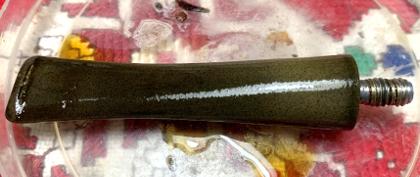 Removing the raised oxidation takes some elbow grease using a cotton cloth. The stem is rubbed vigorously with the cloth, and this eventually rubs off the oxidation. The stem looks great after the process.
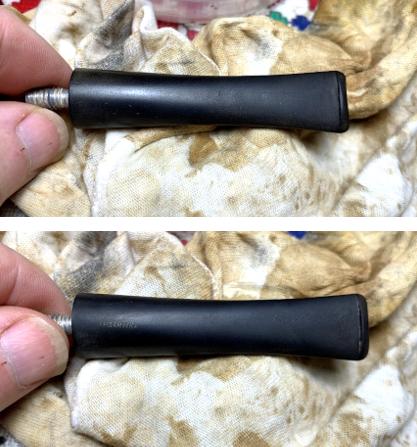 To clear away any residual fluid, a pipe cleaner moistened with isopropyl 99% is run through to do the job.
 The stem surface is in relatively good condition. The upper and lower bit show some light chatter.
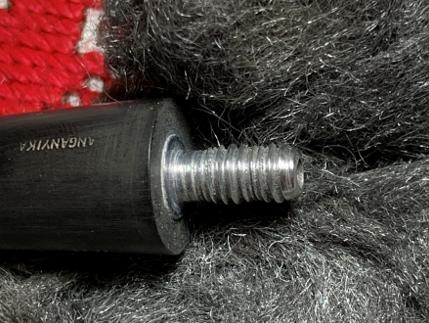
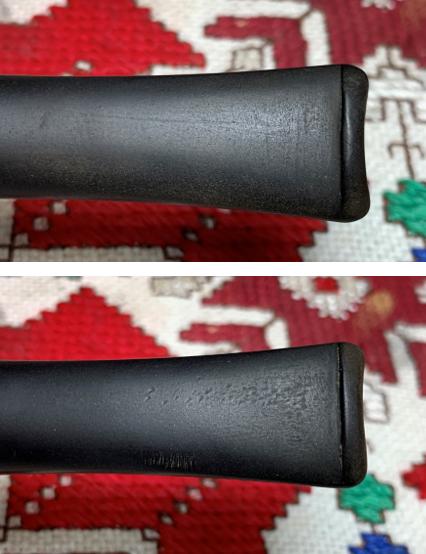 This chatter is addressed by sanding the entire stem with 320 grit sanding paper. I am vigilant to avoid sanding the elephant logo and the COM, Tanganyika.
  Next, the stem is wet sanded with 600 grit paper, and this is followed by applying 0000 grade steel wool.
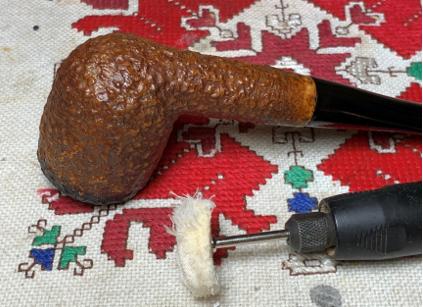
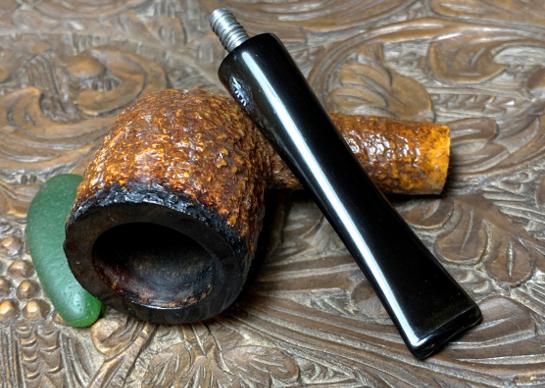
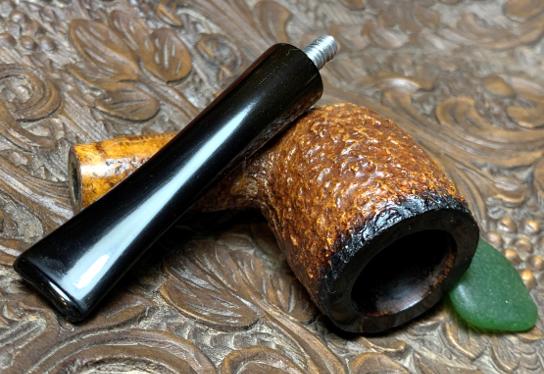
 While I had the steel wool going, I realized that I had not cleaned and buffed up the metal tenon. It looks much better now.
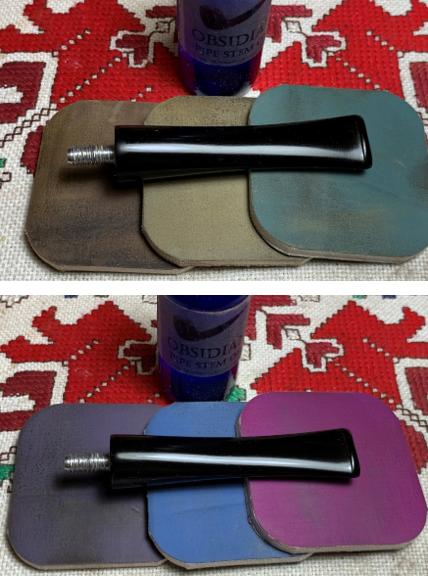
  Applying micromesh pads is next by wet sanding with pads 1500 to 2400. This is followed by dry sanding with pads 3200 to 4000 and 6000 to 12000. Between each set of 3 pads Obsidian Oil is applied to condition the stem and to guard against oxidation.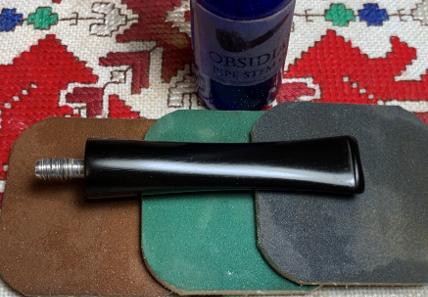
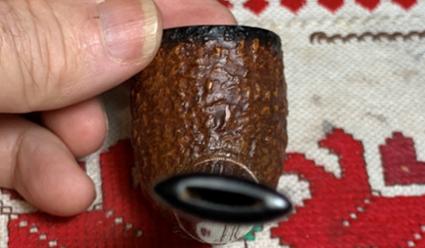
 Before going further, the orientation of the stem needs to be adjusted. It is over clocked with the top of the stem pointing at 1 o’clock. It needs to be straight up at 12.
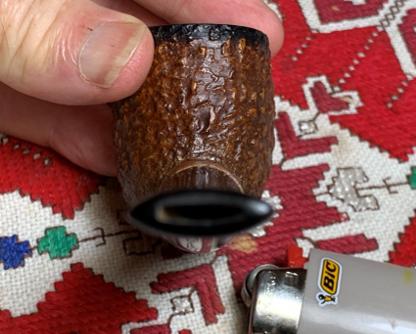
 The aluminum tenon is heated to warm the metal which helps to break the grip of the vulcanite around the tenon. After heating the tenon, the stem is quickly screwed into the mortise and when the tightening of the stem meets the resistance, the force is continued to gently break the grip of the vulcanite. When the stem continues to rotate, it is turned 360 degrees until it is lined up properly.
 This is much better. After a while, the metal cools and the vulcanite reestablishes a grip on the tenon at the proper orientation.
 Next, I’m hopeful that white acrylic paint will refresh the Kiko Country elephant logo.
 First, the area is cleaned with alcohol to remove oils so that the paint does a better job griping the vulcanite.
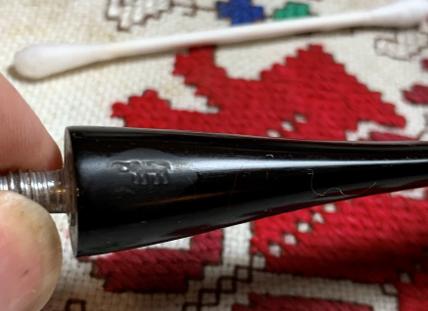 A small puddle of acrylic paint is applied over the elephant and then the excess paint is daubed off with a cotton pad. This dries the paint quickly and thins the paint so that it’s easier to remove the excess.
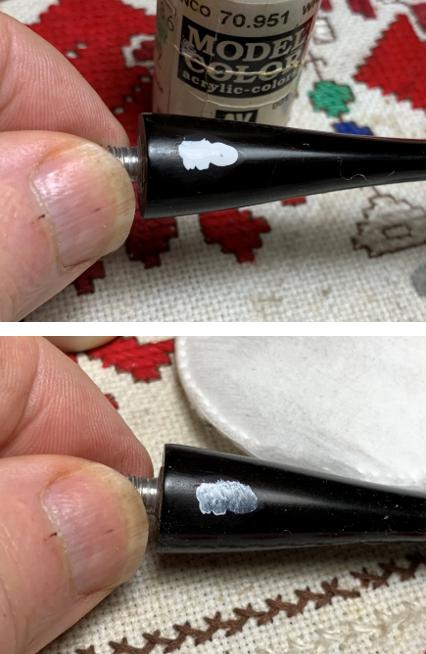 The side of a toothpick is used to scrape over the logo to remove excess. The pointed cotton bud also helps to clean the paint around the logo. It looks much better.
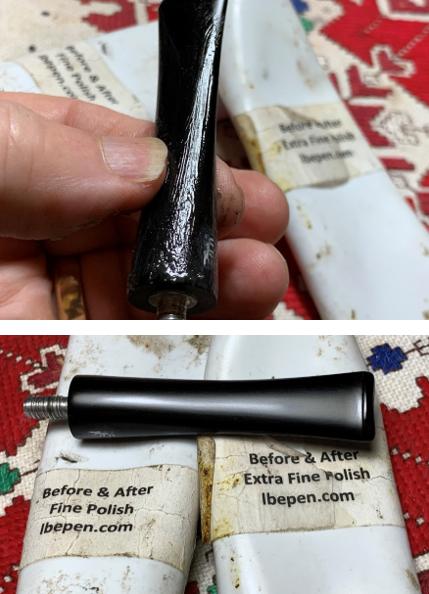
 To polish and condition the stem, Mark Hoover’s ‘Before & After’ Fine and Extra Fine Polish does a good job. First the ‘Fine’ polish is worked into the vulcanite and then wiped off with a paper towel. This is followed in the same way by applying the ‘Extra Fine’ polish and then wiped off. The results are good.
 The stem is further polished using Blue Diamond compound. With a cotton cloth buffing wheel mounted on the rotary tool and with the speed set at about 40% full power, the compound is applied only to the stem.
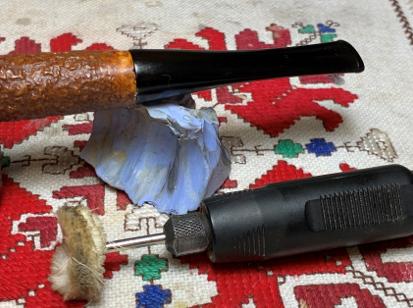 The stem is then wiped down with a felt cloth to remove the compound dust.
 Next the stem receives an application of Carnauba wax. With another buffing wheel mounted at the same speed, the wax is applied to the stem alone.
 Finally, to raise the shine of the stummel, a clean cotton buffing wheel is mounted and the stem and stummel are buffed. After the buffing, the entire pipe is given a rigorous hand buffing with a microfiber cloth to further raise the shine.
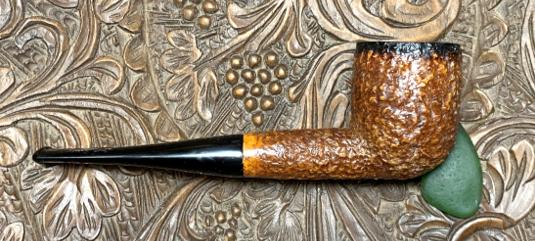
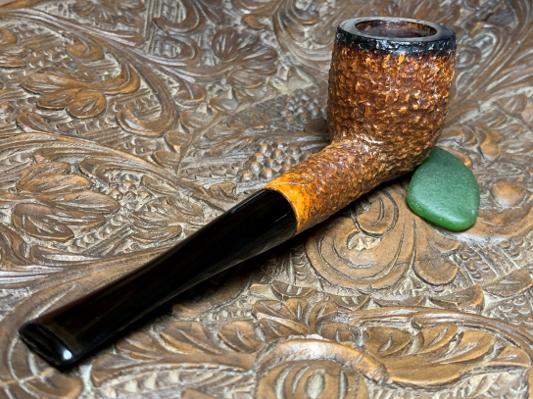
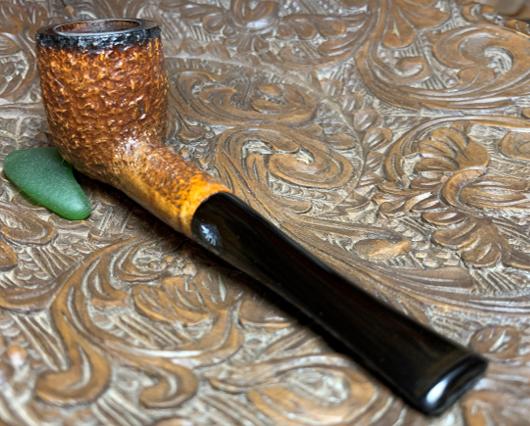
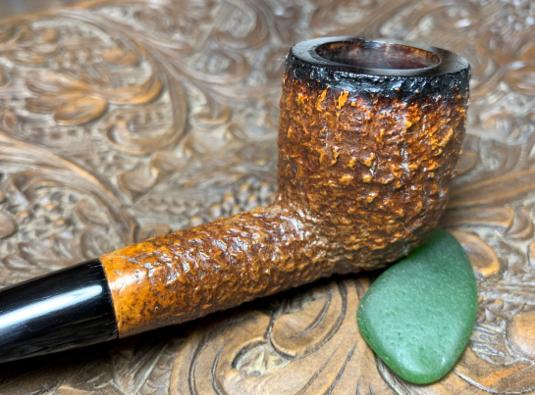
 Even though the bee’s wax application resulted in a very surprising deepening of the Meerschaum’s patina, the rough, sculpted Meerschaum surface looks good. The black chimney top trim gives a rustic feel for the Kiko Countryman, and the Billiard chamber has a good amount of room for one’s favorite blend. The dimensions of the Kiko Countryman are Length: 5 5/8 inches, Height: 1 3/4 inches, Rim width: 1 5/16 inches, Chamber width: 7/8 inches Chamber depth: 1 3/8 inches. Todd commissioned the Kiko and will have the first opportunity to acquire him from Pipe Steward Store benefiting the Daughters of Bulgaria – a work helping women and girls who have been trafficked and sexually exploited. I appreciate you reading the blog and if you have any questions, send them on! Thanks for joining me!




Very nicely done, Dal. I’m sure Todd was pleased with it.
LikeLiked by 1 person
Thanks! Haven’t heard from him yet 🤠
LikeLike