This is the second Silver Match that I’ve worked on. Both came to me in what I’ve called the French Lot of 50 that I acquired in August 2018 from a seller in Paris. My wife and I were still living in Sofia, Bulgaria and I found a lot of treasures while living in Europe. The picture I saw posted on French eBay was like putting a Texas Strip Steak in front of a starving dog…. When the bell rang and all the bids were in, thankfully my bid was the last one that mattered! Here is the picture that brought many treasures to me in Sofia and then to the For “Pipe Dreamers” ONLY!online collection helping to support the Daughters of Bulgaria, now called Spring of Hope – helping trafficked and sexually exploited women and girls and creating prevention programs to protect the vulnerable.
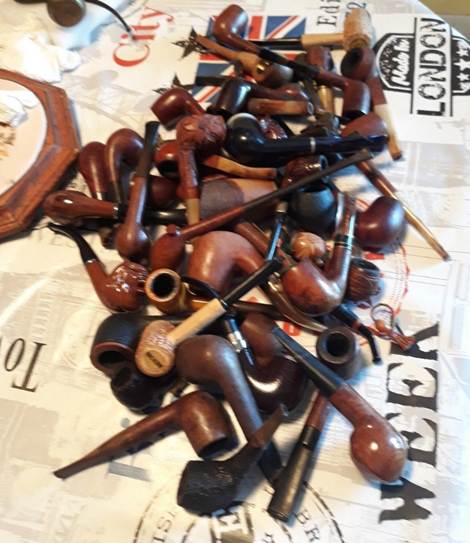
Many of these pipes have already found their way to new stewards. It was a wonderful ‘haul’ that probably won’t be replicated any time soon. Pipeman Steve, a family man and an attorney in the Big Apple but from the great state of Texas, commissioned 4 pipes and this is number 3 of this set. The first two, a Parker Super Bruyere on left (A Dunhill Second – New Life for a Parker Super Bruyere 189 Made in London England ④) and a French Ropp Grand Duc (New Life for a 1950s/60s Ropp Grand Duc 408 Made in France Billiard). These pipes came out well and are already with their new steward.
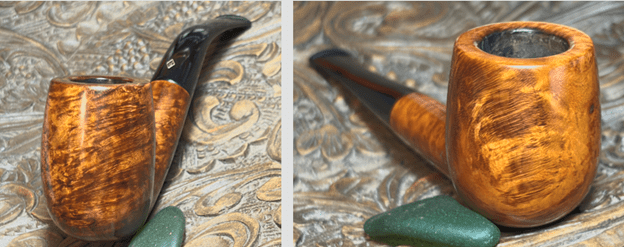
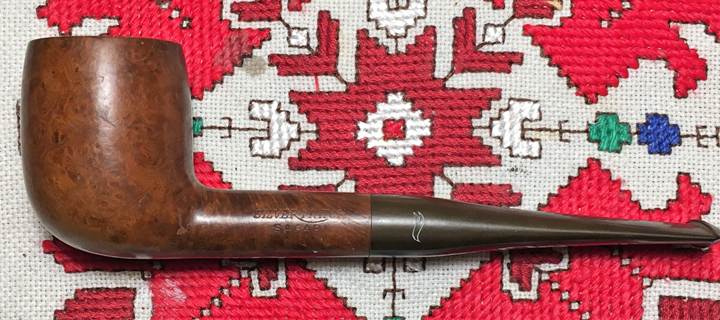
Steve’s next pipe is a classic Billard which has promising grain. It will fit in nicely with Steve’s growing collection. Here are pictures of the Silver Match when the French Lot of 50 arrived in Sofia.
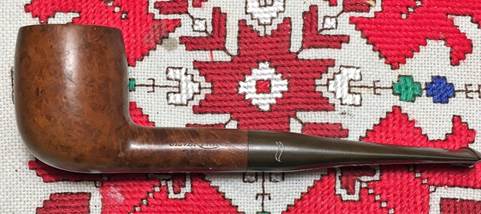
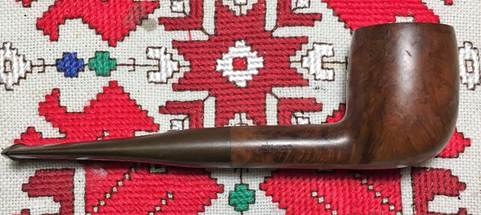
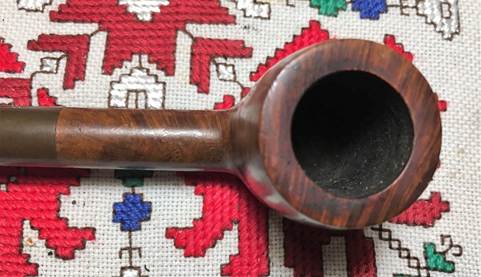
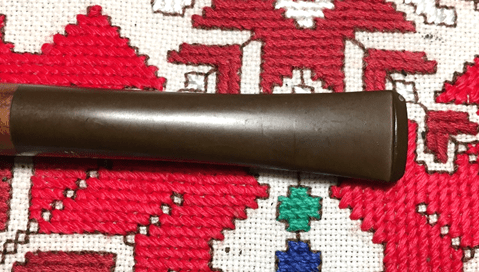
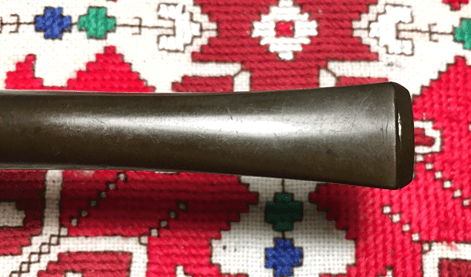
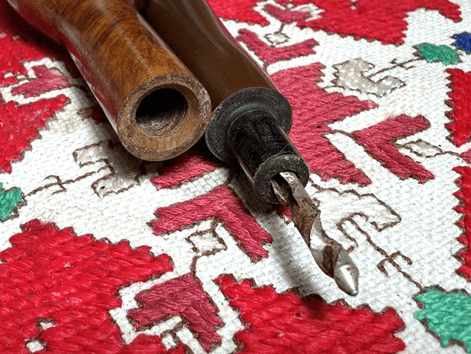
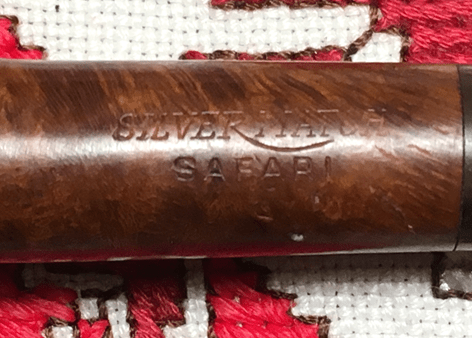
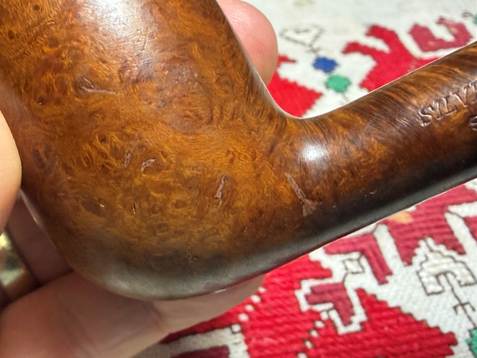
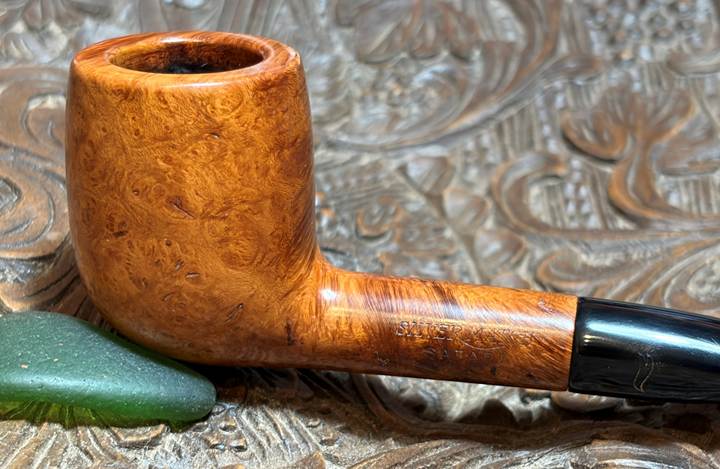
The nomenclature stamped on the left side of the shank is a slanted capital text with a fancy ‘R’ tail: SILVER MATCH [over] SAFARI.
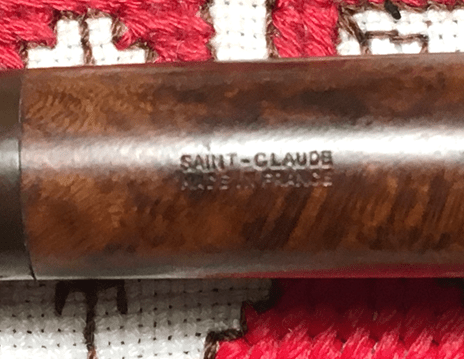
The right side of the shank is stamped the COM: SAINT-CLAUDE [over] MADE IN FRANCE.
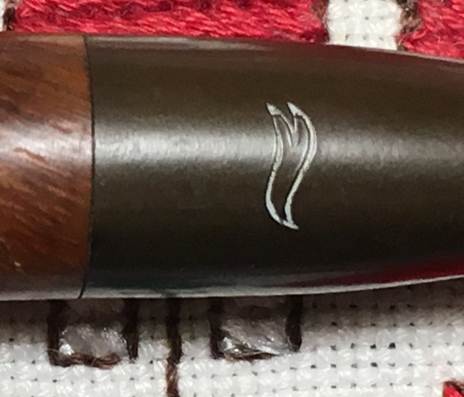
The stem logo is the Silver Match flame.
I worked on another Silver Match that arrived in the same French Lot of 50. That Silver Match write up was posted on Rebornpipes (Bringing a Silver Match Toronto 115 Squat Lumberman Back to Life). With much appreciation to Steve Laug for encouraging me during the early years of my restoration development, he posted my write ups on his site. With that first Silver Match project, I found a scant amount of information about Silver Match but hope to dive deeper this time around. I repeat here what I discovered with that first Silver Match project as a starting point:
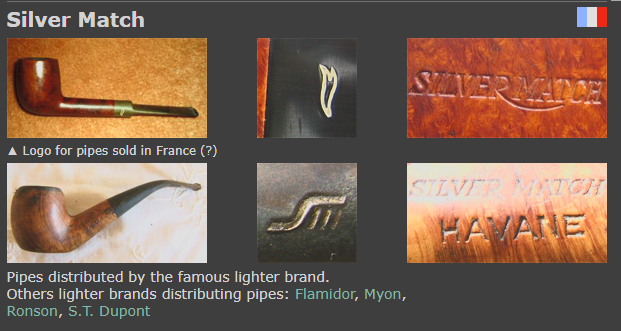
The information about the Silver Match name is thin. A quick search on the internet shows that Silver Match has been the name of tobacco accessories manufacturer since the 1800s, but mainly of lighters. Silver Match lighters seem to be highly collectable with vintage lighters dating back to the 1800s but most listed that I saw have a French origin. The only information in Pipedia refers to Silver Match in the list of British pipe makers as an inexpensive brand sold by Roy Tallent Ltd. and marked with the stamping SM (LINK). This is confirmed in my copy of Wilczak & Colwell’s, ‘Who Made That Pipe?’ that Silver Match has English origins and manufactured by Roy Tallent LTD/S’Elite LTD – both of which seem more to be in the accessories market than focusing on the manufacturing of pipes. Pipephil.eu (LINK) brings these two together in the following panel. It pictures pipes distributed by the famous lighter brand, Silver Match, but shows the two different stem stampings that may indicate either French or British manufacturing – the flame (French) and the SM (England). If this is correct, the Silver Match Toronto 115 has a French origin, but I found no other information to corroborate this. Arriving from France in my ‘French Lot of 50’ is anecdotal evidence perhaps supporting this.
With the Silver Match Toronto, the COM was not included in the nomenclature, but the French origins are spot on. With our Silver Match Safari, the COM is without question – manufactured in the French pipe production center: Saint Claude. The names are interesting with the 3 examples we have – Havane (from above was the historic capital of Cuba), Toronto (the capital of the Canadian Province of Ontario), and Safari… This doesn’t fit the pattern. To find out more about the company Silver Match and their accessories, a search turned up mainly 1950 and 1960 French advertisements. From 1958 (Silver Match 1958 Lighter) followed by an ad from 1959 (Silver Match 1959 Lighter).
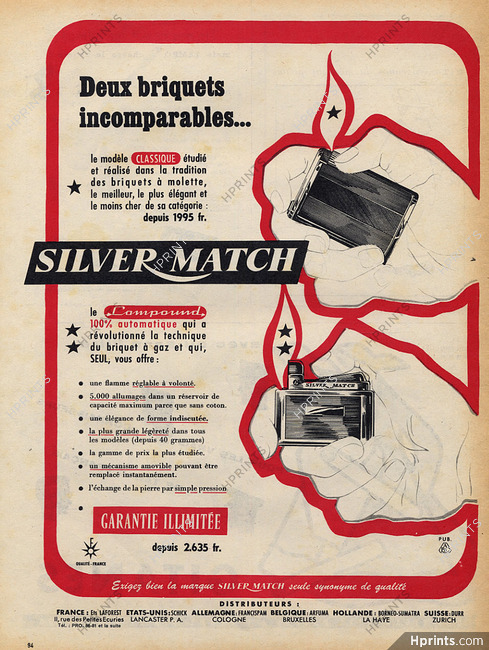
For the 1959 ad below, I wish I could make out the names of the lighters looking for a possible correlation of lighters and pipes.
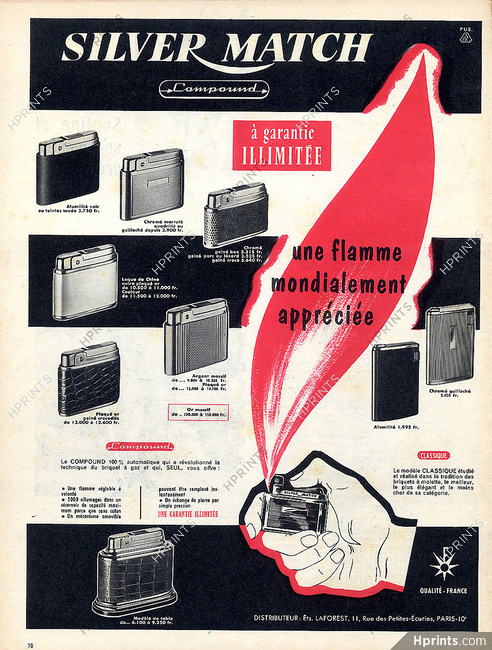
It is clear that the main backbone of the Silver Match company is the lines of accessories, especially lighters. The pipes branded with Silver Match were produced by pipe factories in Saint-Claude (perhaps, Chacom, Ropp, Butz-Choquin? – all produced pipes for third parties for export) probably as promotional ‘add-ons’ to increase the sales of the lighters and other accessories. My working assumption is that the dating of the pipes stamped with Silver Match can be tied to the life of the Silver Match company. With this in mind, ChatGPT helped me find a site which I would have never known existed – a site dedicated to vintage cigarette lighters which provides this history of Silver Match (Vintage Cigarette Lighters Background Information):
Silver Match Lighters
The Silver Match brand name first saw the light of day in 1953, thanks to French manufacturer Robert Hocq. Its creator’s brilliant idea was to combine British elegance with French ingenuity.
His first company, the Paris-based “British Butanic Lighter Company”, served as the launching base for his revolutionary gas lighter, the “Compound”, entirely manufactured in France. Silver Match went on to meet spectacular success throughout the world, becoming one of the leading lighter brands, and even reaching world leader status during the 60s.
“As proof of our technique’s success, 1,000,000 Americans use Silver Match” ran the publicity slogan at the time.
Sustained by advanced technology and an avant-garde design which would be represented by the period’s leading poster designers, in 1961, the company launched the “France” model, an ambassador of French prestige designed as a tribute to the ocean liner of the same name. Three years later, in 1964, Silver Match brought out its famous “Ultra Slim” model, which won France’s first Industry/Fashion Oscar awarded by Pierre Cardin and Raymond Loewy.
In 1971, Robert Hocq designed a lighter which he had initially considered too prestigious for Silver Match. After visiting the jewelers on the famous Place Vendôme in Paris to see who would be interested, Cartier took up the challenge and, for the first time in the history of Haute Joaillerie (a Cartier division), affixed its name on a cigarette lighter.
This trial shot was in fact a masterful move; after the Cartier lighter’s meteoric, global success, Robert Hocq led a group of investors and acquired the name and company in 1972.
PRIMARY SOURCE: http://www.polyflame.com/index.php?ID=1014449
Another interesting blog (Discover the Captivating Story of Silver Match Lighters: The Art of Fire Revealed! – ARGENTEUIL BILLIARD Academy) the history of Silver Match picks up from the mid-1970s:
In 1976, Robert Hocq, then owner and CEO. of Cartier and Silver Match lighters, sold the distribution sector of the Silver Match brand (Inter-flamme) to John Blume, then the manufacturing sector (Francispam), retaining the distribution of Cartier lighters. John Blume then appointed Gérard Neygeon as CEO. of his company, who was replaced a few weeks later by Roger Knippert, then by John Blume himself. Today, Blume has put up for sale the production sector, which focuses mainly on Cartier, Yves Saint-Laurent and Silver Match pens.
What we learn from this information is that Silver Match was sold by Robert Hocq, the founder of the company in 1953 to another concern. Interestingly for our research, the same article describes the move that took production of the now ‘sold’ Silver Match accessories to Japan:
Silver Match lighters are now almost entirely made in Japan, while Cartier lighters are produced in Switzerland. Faced with this relocation of production and jobs, the Inter-flamme works council, which brings together several unions, refuses any redundancies or reduction in working hours.
This information is important because it lends credence to tying the production of Silver Flame promotional pipes exclusively to the Robert Hocq era dating our pipe between 1953 to 1976. My sense is that the pipe was probably produced in the 1950s or 60s based upon the lighter ads I found. We don’t know what accessories our Silver Match Safari was promoting, but the name invites images of a rugged pipeman hunter smoking his pipe with his rifle in hand looking for wild game to conquer. Compliments of AI😊:

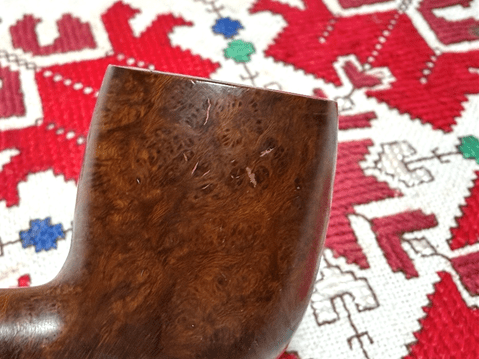
With a better understanding of the Silver Match provenance we have a new appreciation for the French made Silver Match Safari on the worktable. The pipe itself has good bones. The chamber has very light cake build up, and the rim is fairly clean but with some dings on the edge.
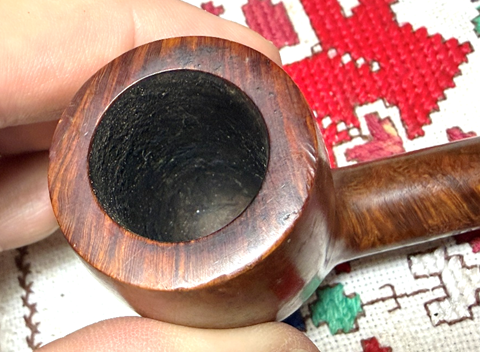
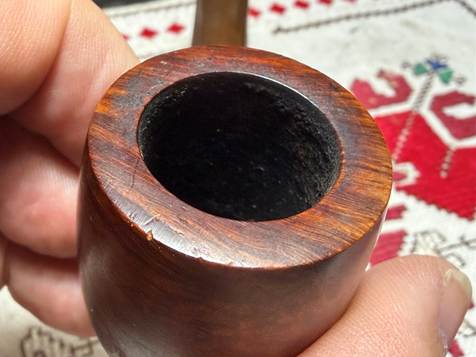
The stummel has a number of very small fills primarily in the ‘robust’ bird’s eye grain patterns. The fills look solid but after the cleaning they will get another look to see if they need to be refilled.
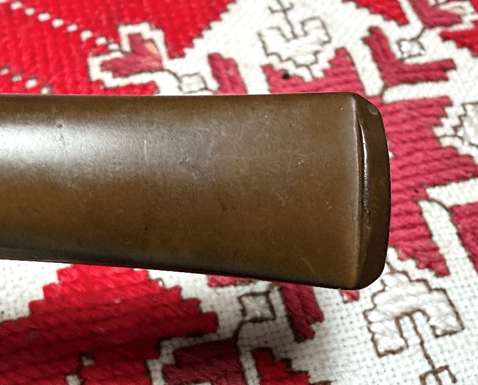
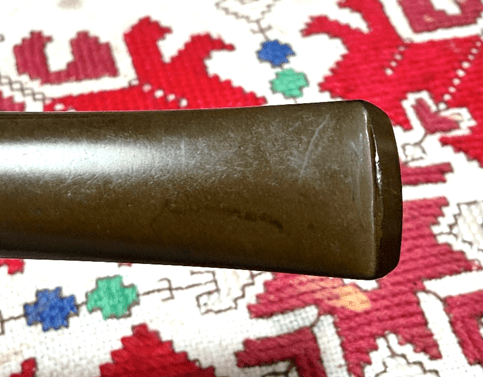
The stem has deep oxidation which is apparent from the olive green color the stem is showing. The bit itself is very clean – almost no indication of bite damage.
The aluminum stinger is a remnant from the 50s and 60s when most pipe manufacturers had some sort of stinger striving for the holy grail – a cooler dryer smoke.
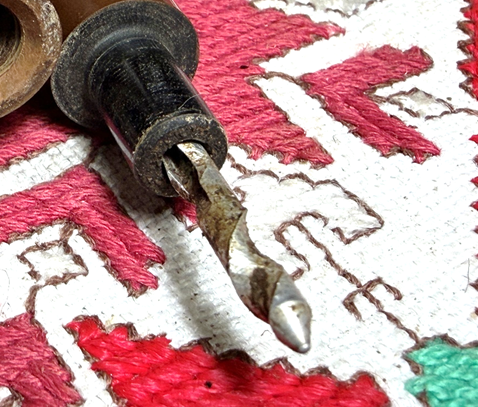
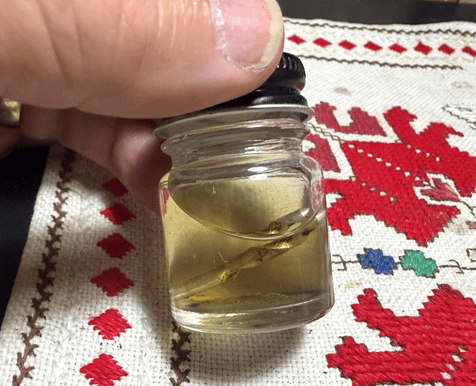
I personally remove stingers from pipes in my collection, and I have a good collection of them. To me, introducing curves and obstacles to the pathway of the airflow only creates more condensation. However, the new steward will be the one to decide. After removing the stinger, it is placed in alcohol to soak and to clean it up. I’ll gift wrap it for the new steward.
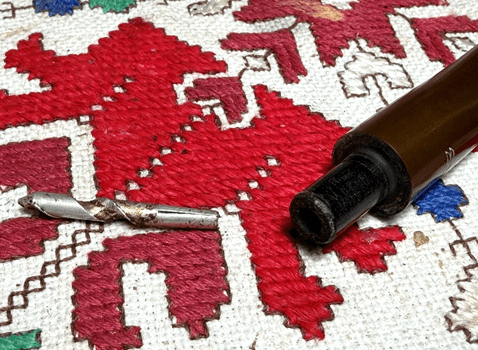
The next step is to clean the stem airway using pipe cleaner moistened with alcohol. A few pipe cleaners were all that were needed.
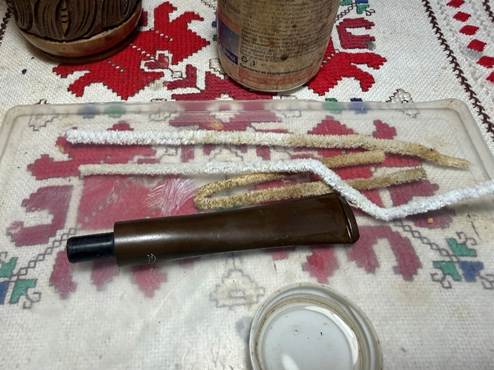
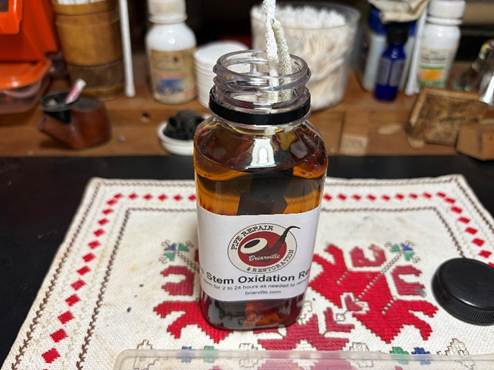
To address the oxidation, the stem goes into a soak of Briarville’s Pipe Stem Oxidation Remover (www.Briarville.com). I’ll let it soak for several hours.
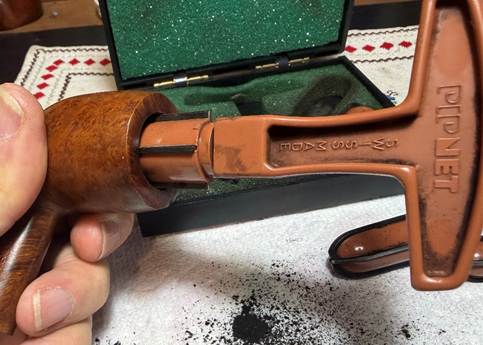
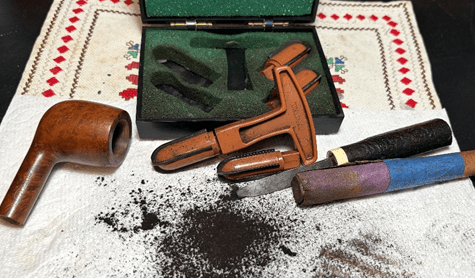
Switching to the stummel, the light cake build up is removed by reaming the chamber with the Pipnet Reaming Kit. Two of the four available blades are used.
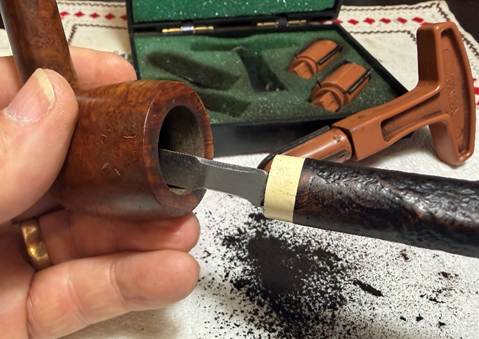
The Savinelli Fitsall Tool follows by scraping the chamber wall and floor angles.
The last vestiges of carbon are removed with 220 grit sanding paper wrapped around a dowel rod.
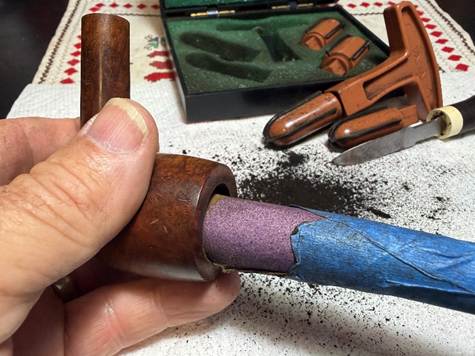
The following picture gives us a look at the small pile of carbon cake removed and the tools that did it. A quick inspection of the chamber reveals no heating issues. Moving on.
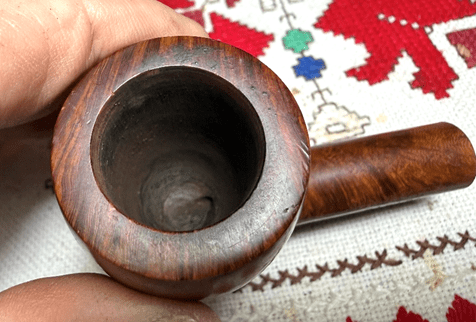
Next, using undiluted Murphy Oil Soap the stummel surface is scrubbed with a cotton pad.
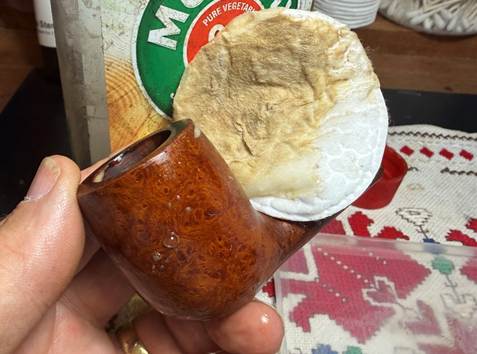
The stummel is then transported to the utility sink where the internals are scrubbed with hot water using shank brushes and liquid anti-oil dishwashing soap – Dawn soap is what is used. After the scrubbing, the stummel is rinsed thoroughly and taken back to the worktable.
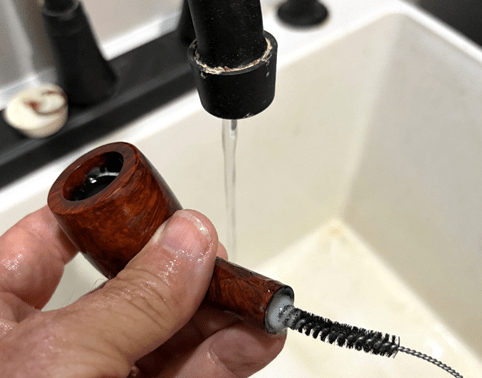
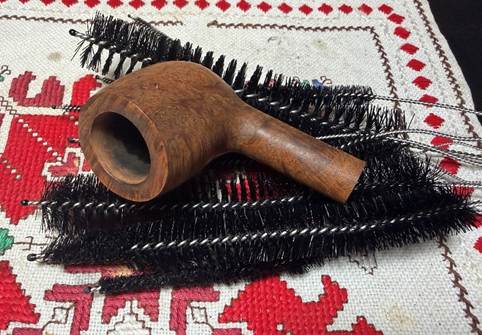
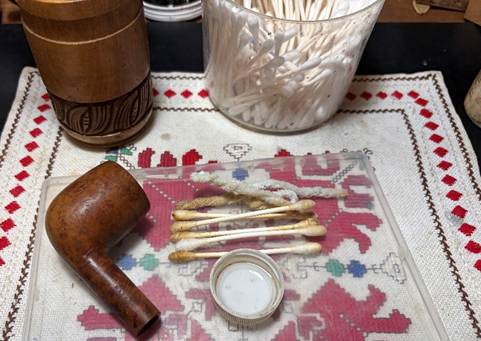
Continuing with the internal cleaning, cotton buds and pipe cleaners are used to scrub the mortise with isopropyl 99% alcohol. It doesn’t happen often, but it only took a few buds and cleaners to confirm that the internals were good to go.
With the general cleaning complete, a closer look at the stummel shows several old fills that need addressing. How do I know this? Old fills tend to draw up or shrink and when this happens, the edge of the pit can be felt. Most of the fills are very small and sanding could possibly dispatch most. However, what I’m seeing is many very miniscule openings in the briar mainly around the bird’s eye patterns. They are very small – too small to fill. We will sand later to see if that is enough.
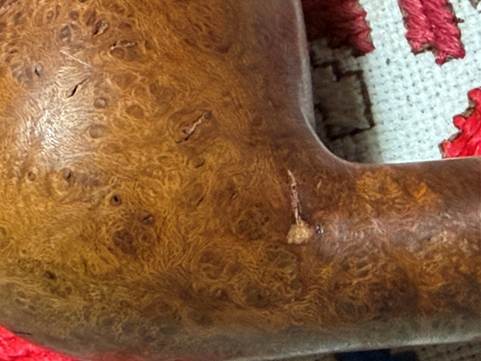
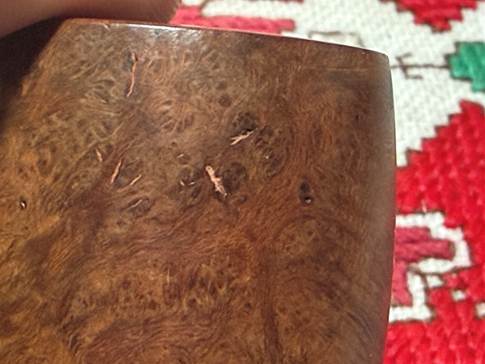
The pitting close to the nomenclature is of the most concern. Filling pits with a new fill material requires sanding and sanding close to the nomenclature is always a concern.
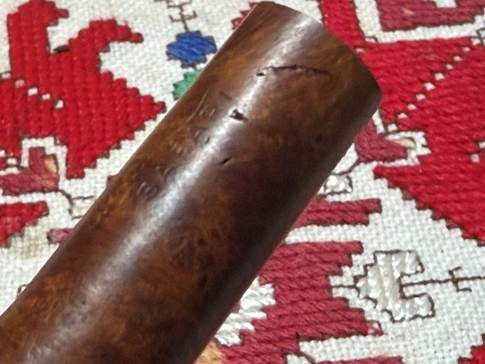
The decision is made to tackle the old fills first before moving on to the rim. Each old fill is dug out using a sharp dental probe.
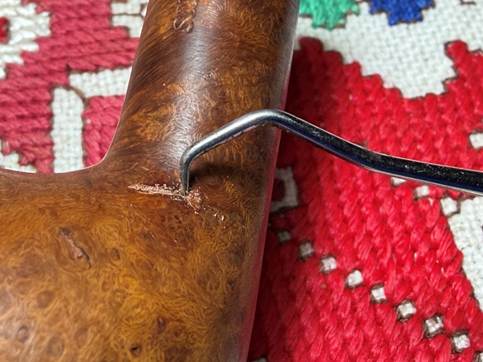
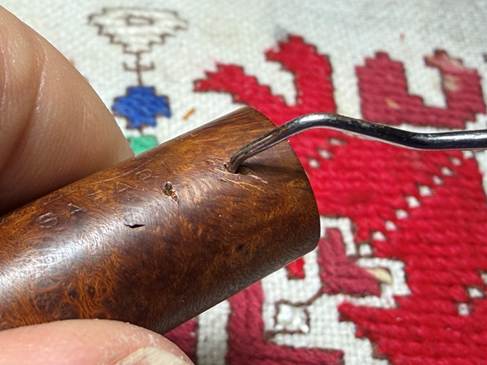
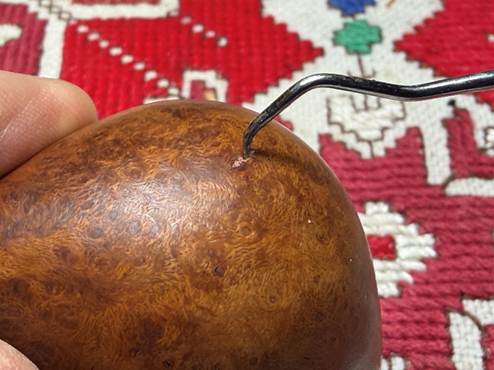
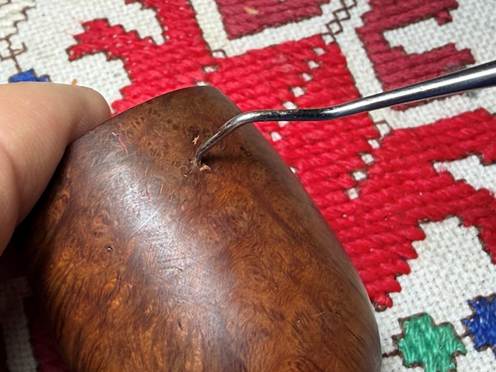
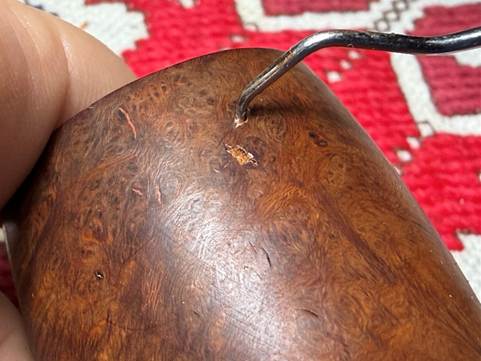
Next, briar dust and clear CA glue are mixed to form what has been called, briar putty. It’s difficult to see but the glue is there.
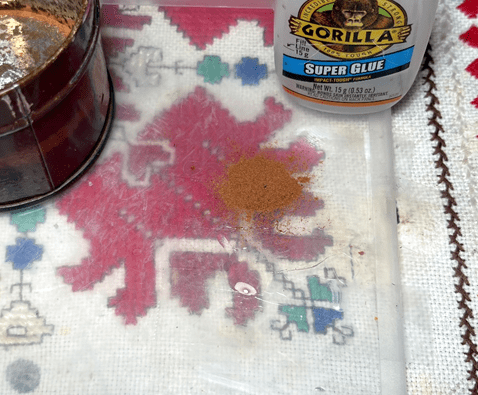
A toothpick is used to pull briar dust into the CA and then mixed. To thicken the putty, more briar dust is added until it reaches the viscosity of molasses, or it rolls up on the end of the toothpick and doesn’t drip off. The toothpick is used to trowel the briar putty to the pits and fills them. Care is given with the pits just beneath the SAFARI nomenclature. With each application of putty, the fill is sprayed with an accelerator to hold the putty in place and to quicken the curing time.
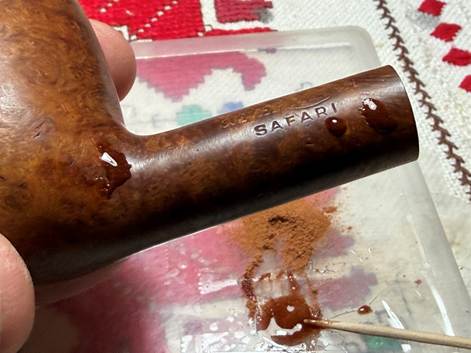
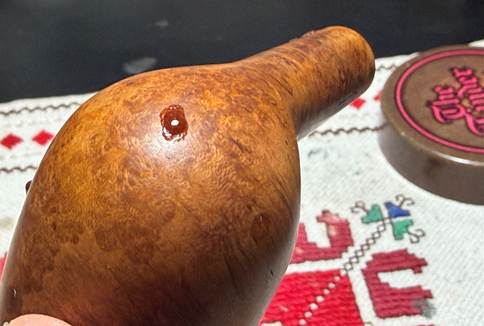
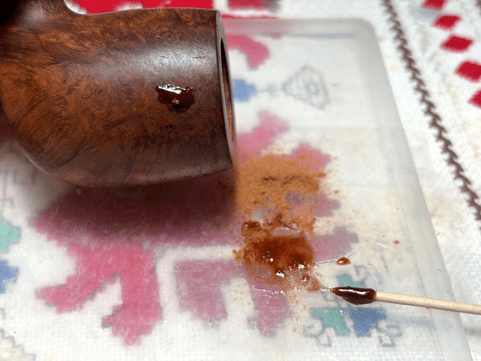
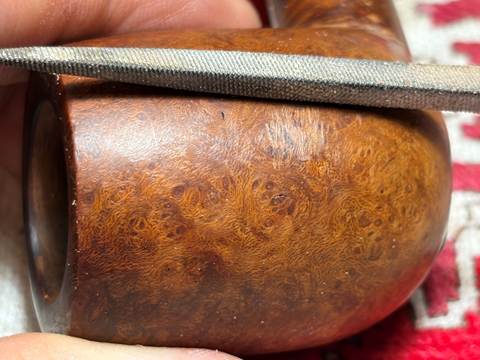
After the new fills have fully cured, each patch mound is filed flush with the briar surface. A round needle file is used in the first picture with the patch located in the curve of the crook. Flat and square files are also used.
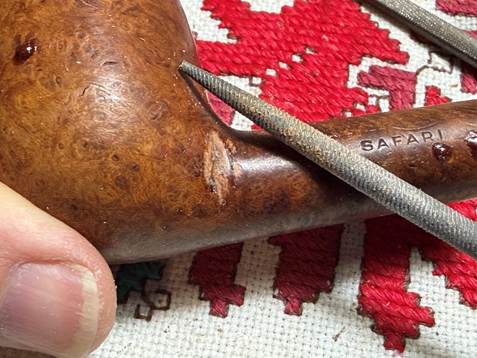
Again, great care is given to filing near the nomenclature.
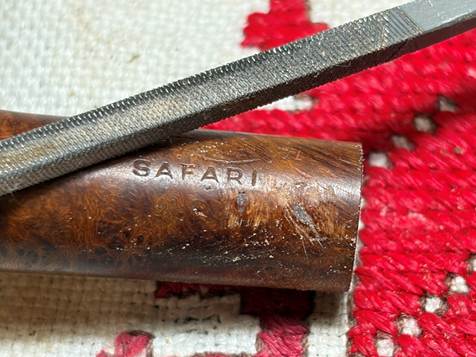
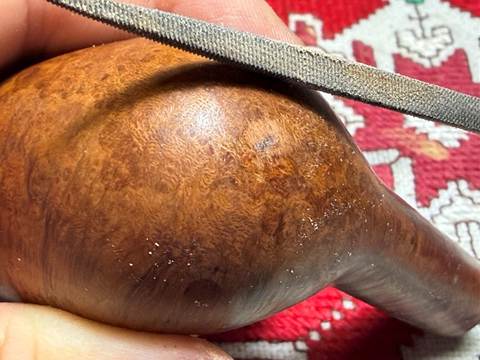
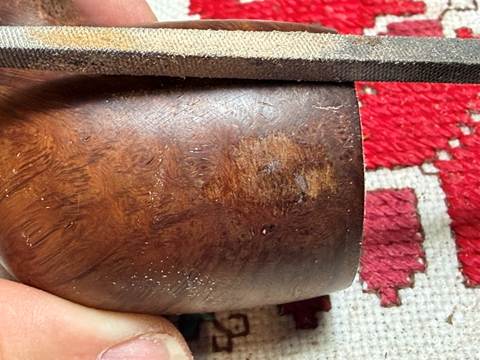
Next, 220 grit paper sands each patch area to remove any residual putty around the patch.
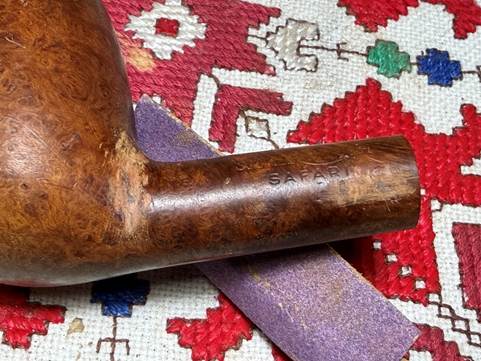
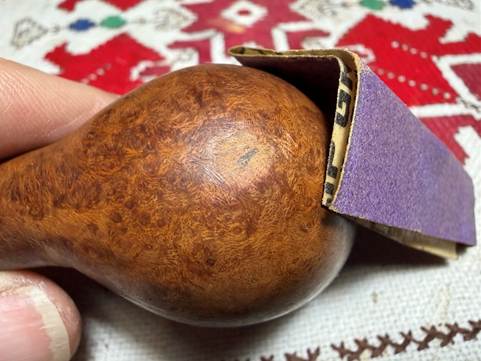
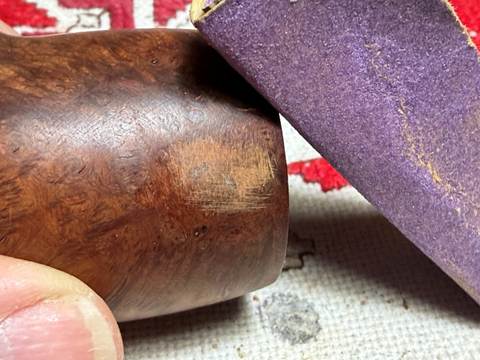
The same is done with 320 grit and 600 grit papers.
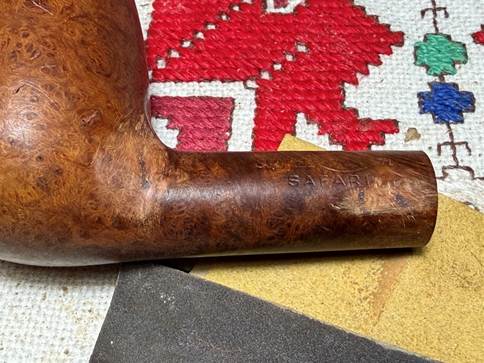
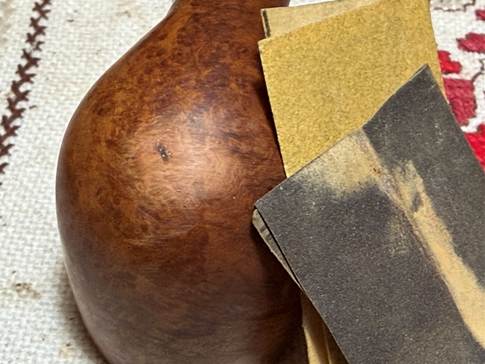
With the new fills in place, the focus in turned to the rim. The rim has some dings on the edge that need to be removed. To do this the stummel is topped.
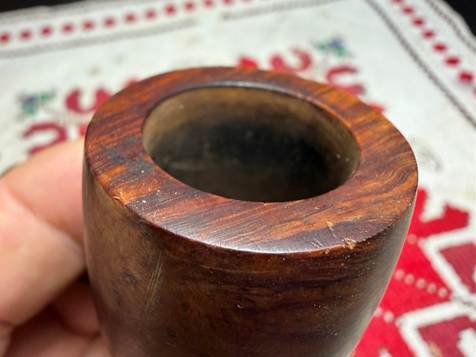
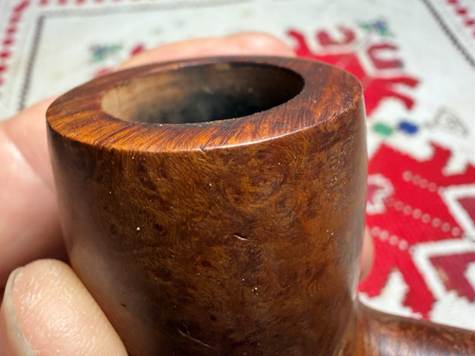
A starting picture marks the progress. The stummel is inverted on the 220 grit paper which is on top of a smooth chopping board serving as my portable topping board.
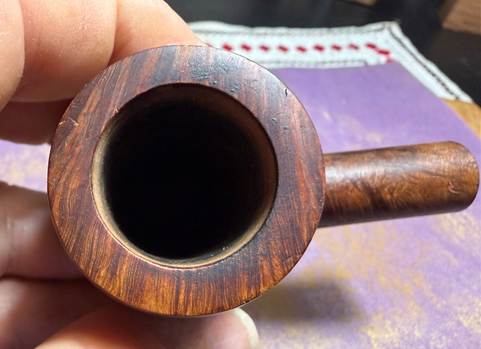
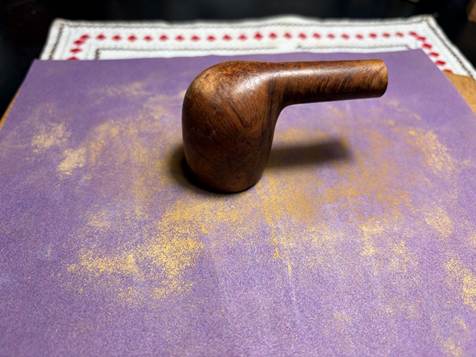
After a number of rotations on 220 paper, enough briar is removed to address the dings in the edge.
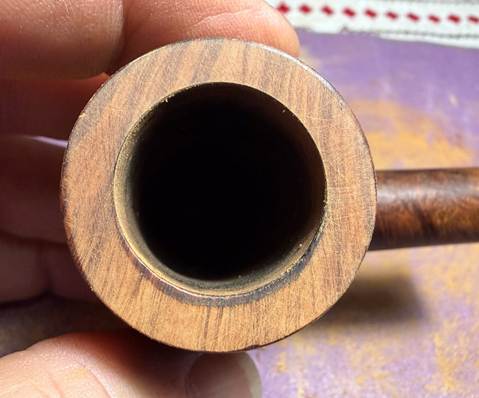
The 220 grit paper is followed by 320 and 600 grit papers.
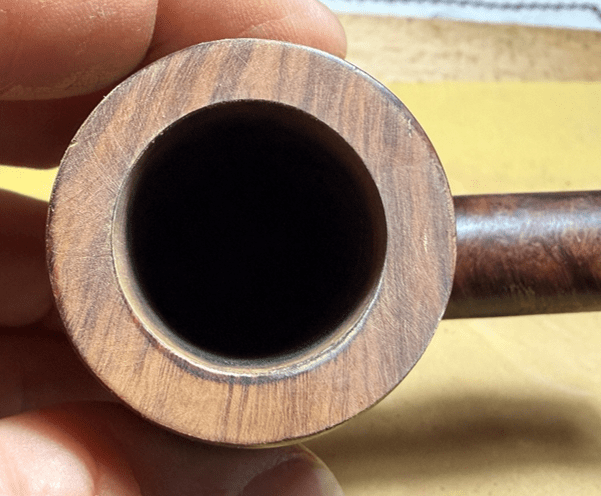
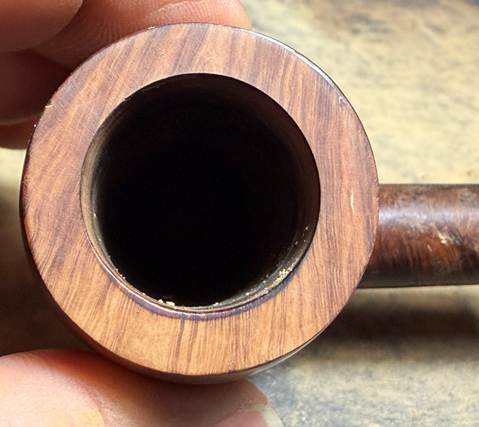
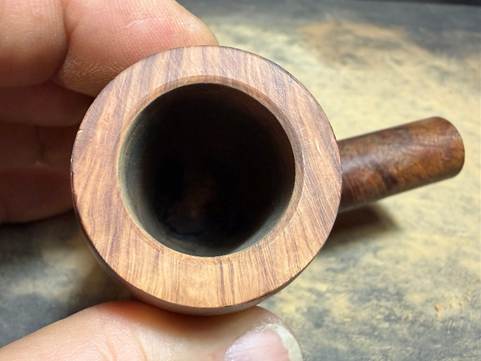
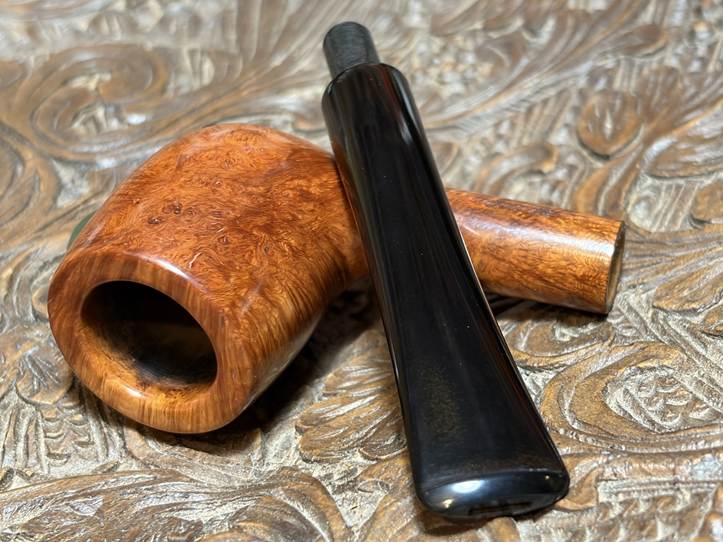
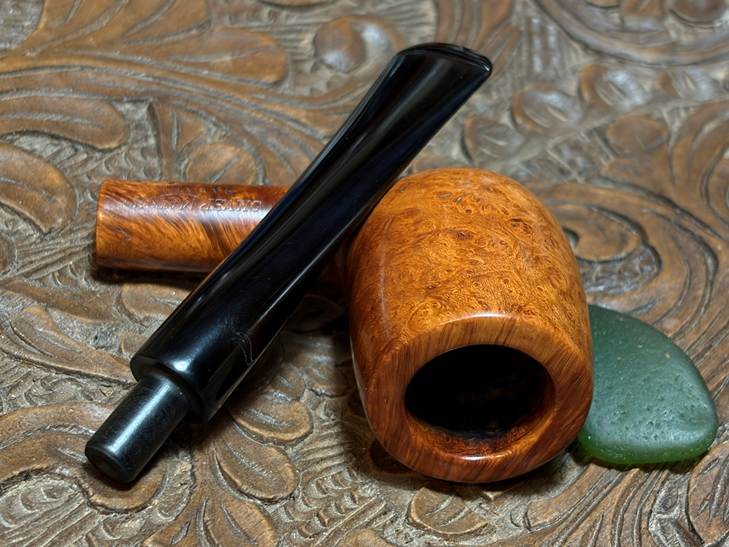
The rim looks great with expressive lateral grain. The inner edge has a darker ring that needs to be addressed.
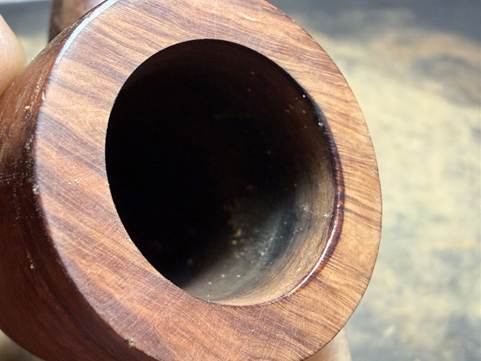
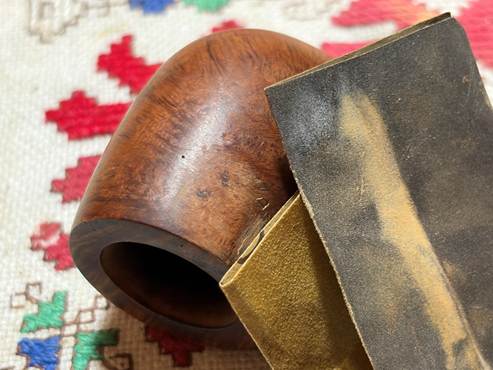
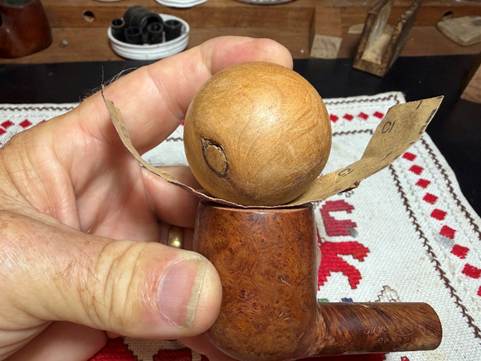
To remove the ring a smart bevel is cut using a wooden orb with a strip of sanding paper pressed between the inner rim edge and the orb. The picture below shows the idea, but the pose is for the picture. When involved in the actual procedure, the hand holding the iPhone is needed. The next step is to rotate the orb against the inner edge while pinching the paper around the orb.
The first cycle of rotations with 220 grit paper looks good. The ring is gone.
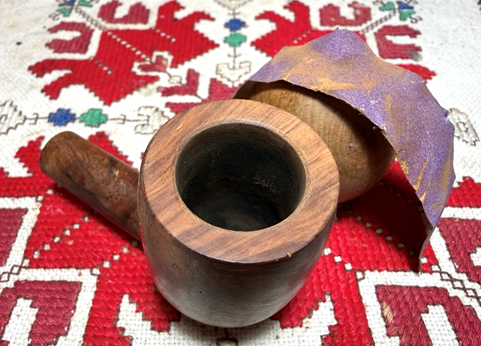
Both 320 and 600 grit strips follow the 220 paper in the same manner.
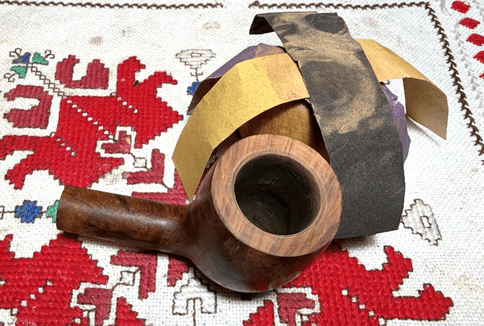
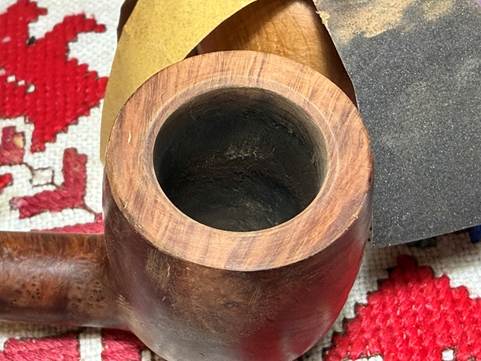
To make sure the beveling is in sync with the rim’s finish, the stummel is again topped a few rotations with 600 grit paper on the board. The rim look’s great.
Next, sanding sponges are used to clean the surface of scratches and to blend the patch areas which are lighter than the surrounding briar. A coarse sponge is used first followed by 4 sponges with less abrasion – regular, medium, light, and fine. Throughout the sanding, care is given to avoid sanding the nomenclature.
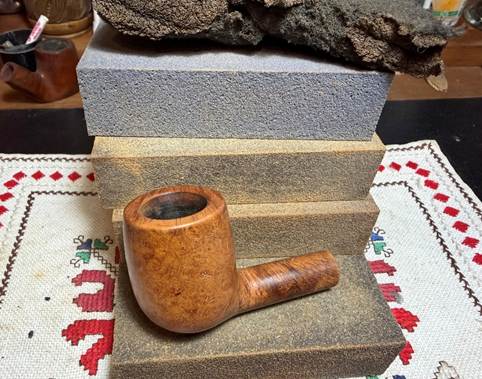
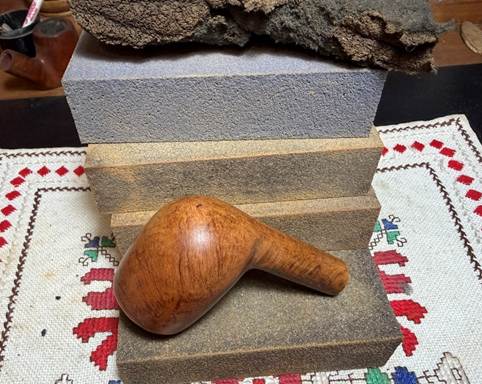
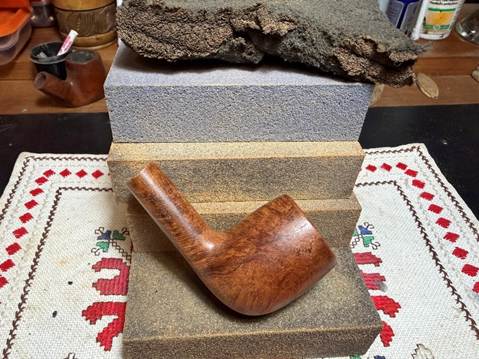
From the sponges we transition to micromesh pads. Between each pad, the stummel is wiped with a moist cloth to remove the briar dust and helping the next pad to have better traction. The first set of pads are grades 1500, 1800 and 2400.
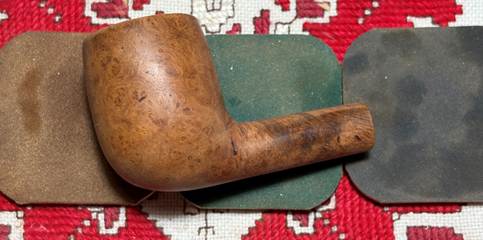
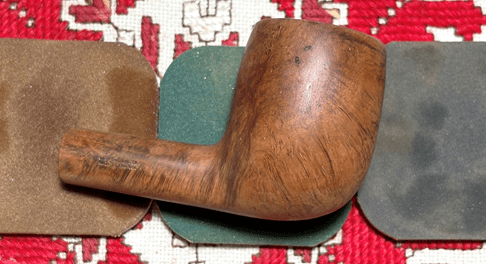
The second set are grades 3200, 3600 and 4000.
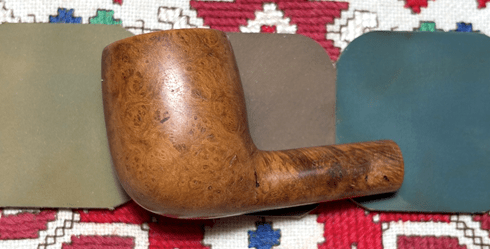
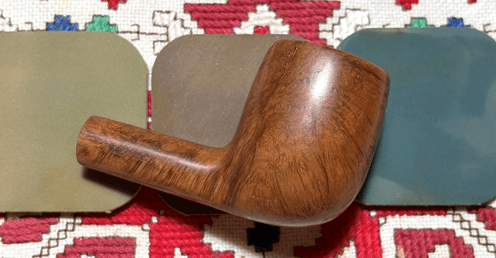
The final set are grades 6000, 8000, and 12000.
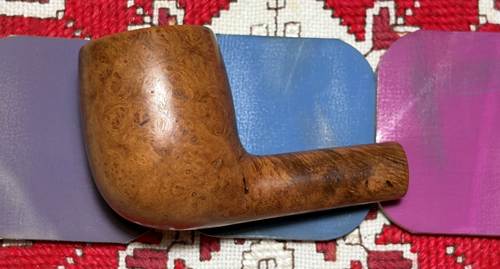
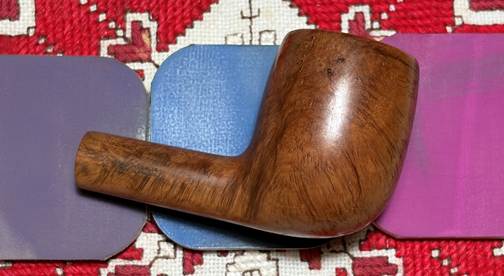
The grain on this stummel came out very nicely through the micromesh pattern. To bring out the natural hues more Mark Hoover’s ‘Before & After’ Restoration Balm is my go to. It’s an excellent product that I use in restorations and also to keep my personal collection of pipes’ briar looking good. After a small amount of the Balm is placed on the finger it is worked in the briar. The stummel is then set aside for about 10 minutes or so allowing the Balm to be absorbed.
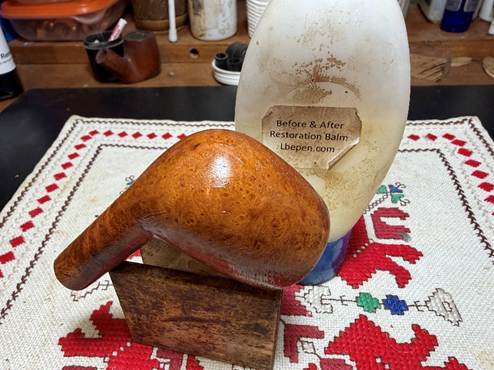
After the time has passed, the excess Balm is removed with a dedicated microfiber cloth and the stummel is buffed up.
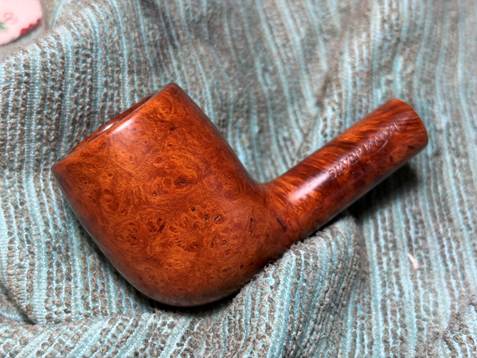
The stummel is put to the side and attention is turned to the stem. The stem has been soaking in Briarville’s Pipe Stem Oxidation Remover for several hours. When it’s fished out of the soak I take a few pictures to show the raised oxidation which is an olive green muck on the surface.
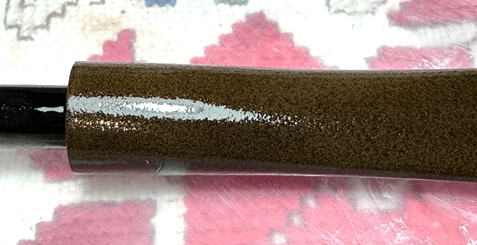
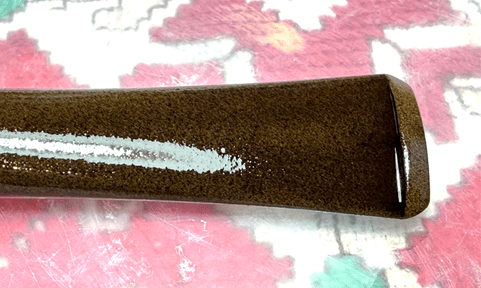
Using a dedicated cloth, the stem is vigorously rubbed to wipe off the raised oxidation. The soak did a good job.
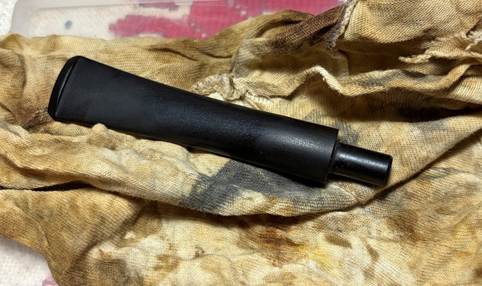
The bit shows no issues with tooth chatter so sanding with the coarser 220 grit paper is bypassed. The entire stem is sanded with 320 grit paper to address the small scratches and marks that come from normal wear. The sanding avoids the area around the Silver Match flame stem logo. A shoulder guard is also used to sand against to keep the shank facing sharp.
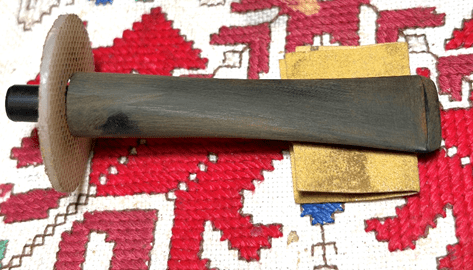
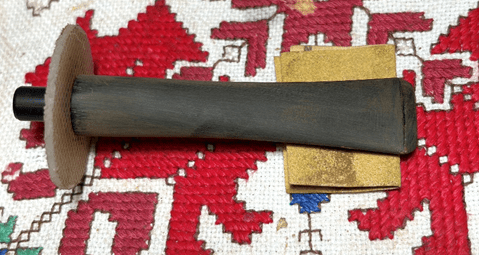
The 320 paper is followed by wet sanding with 600 grit paper and then 0000 grade steel wool is applied to the stem.
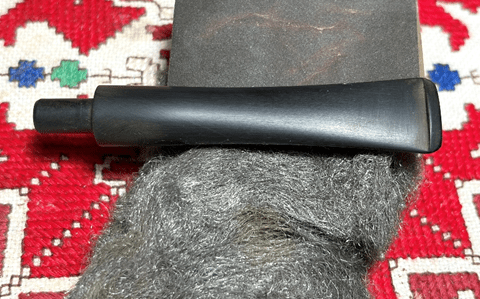
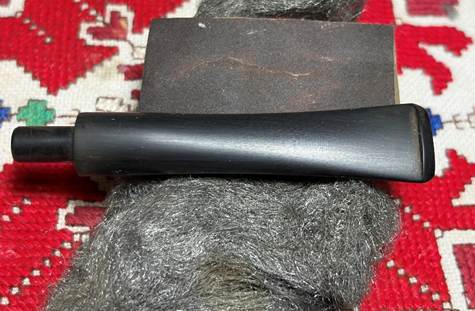
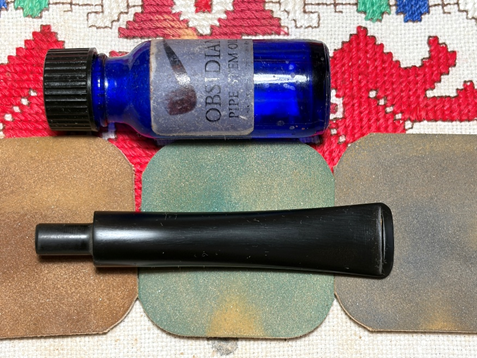
Transitioning next to sanding with micromesh pads, between each pad a very light amount Obsidian Oil is applied to condition the vulcanite and to guard against oxidation. The first set of micromesh pads are grades 1500, 1800 and 2400.
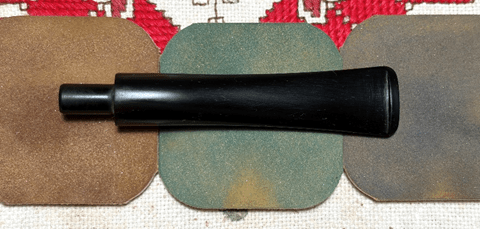
The next set of 3 pads are grades 3200, 3600 and 4000.
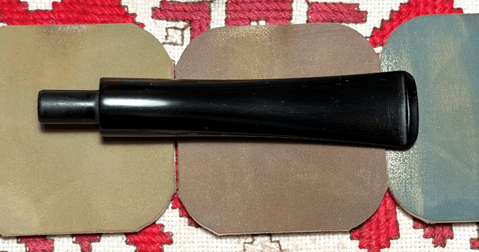
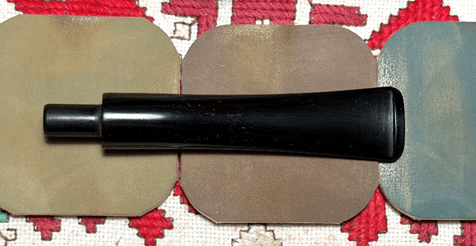
The final set of pads are grades 6000, 8000 and 12000. Up to these pads the sanding avoided the stem logo. With the last set, the nomenclature was lightly touched with these finer pads to help blend the area.
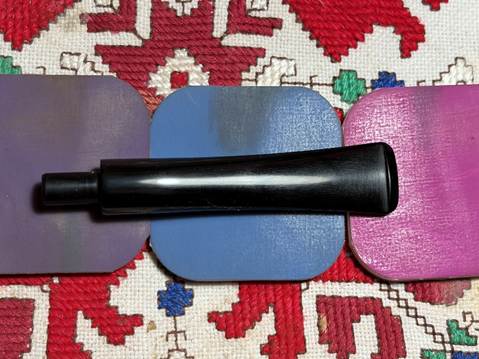
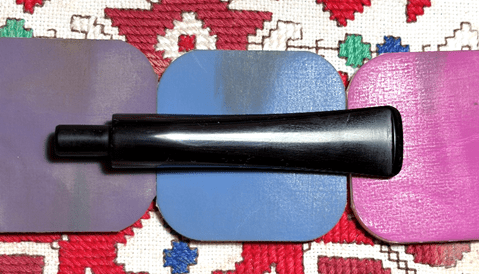
The stem logo needs refreshing next.
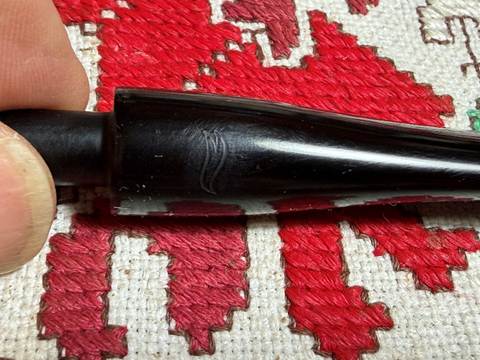
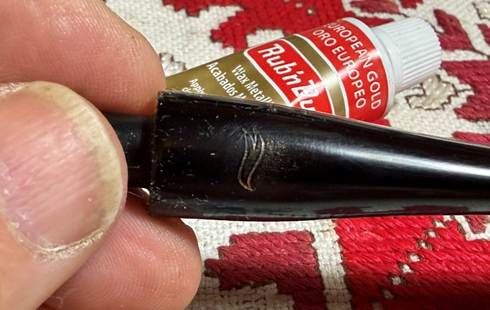
European Gold Rub ’n Buff is used. The original logo was white, but I decided to change it to gold which to me goes better with the ‘flame’ motif AND makes it more classy. A small amount of Rub ’n Buff is placed on the logo and then the paint is simply wiped off and buffed a bit with a cotton pad.
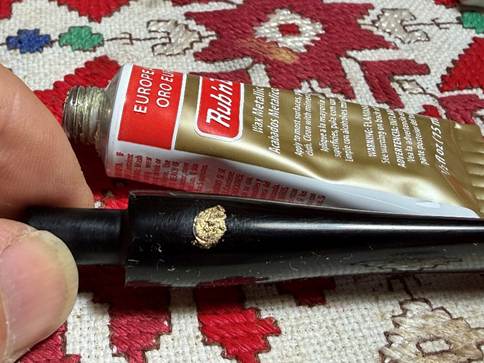
The flame looks good. The next step of applying the fine abrasive Blue Diamond compound will help clean up and smooth the rougher area around the logo.
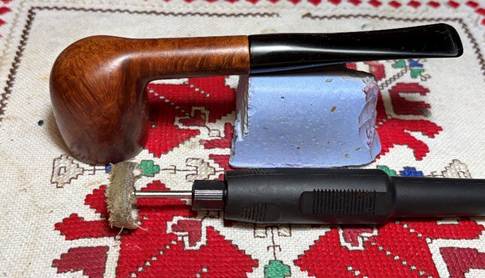
After the stem and stummel are reunited, a dedicated cotton cloth buffing wheel is mounted on the rotary tool, the speed is set to about 40% full power. Blue Diamond compound is then applied to the pipe.
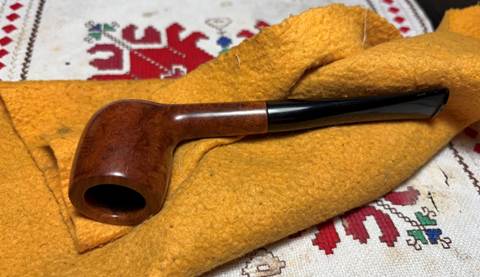
A felt cloth is used after application of compound to remove the compound dust that is created and covers the surface of the stummel and stem. The dust is cleaned off in preparation for application of wax.
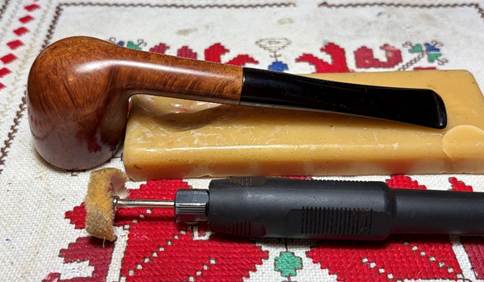
Another dedicated wheel is mounted on the rotary tool with the speed the same. Carnauba wax is then applied to the pipe. After the application, the pipe is given a rigorous hand buffing to remove excess wax and to raise the shine.
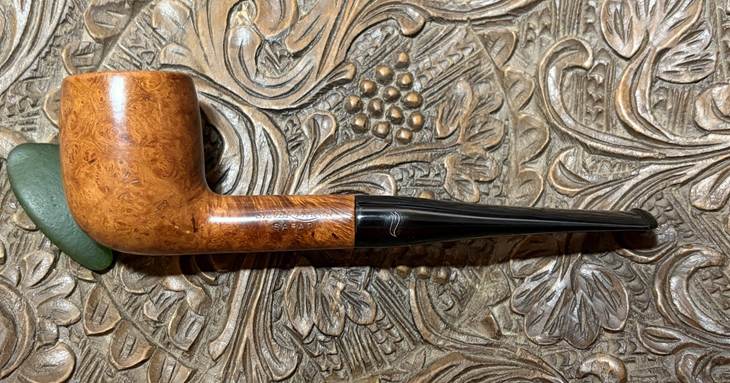
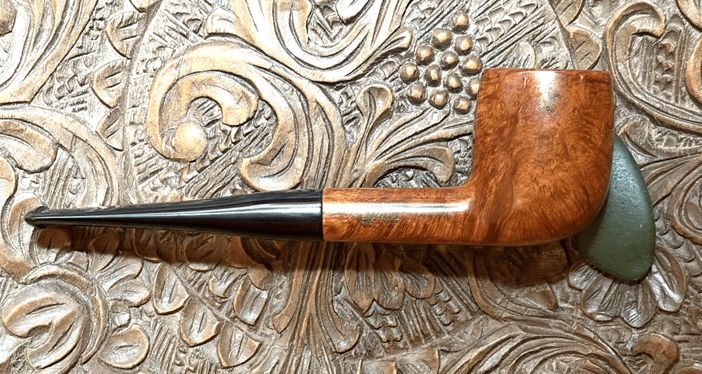
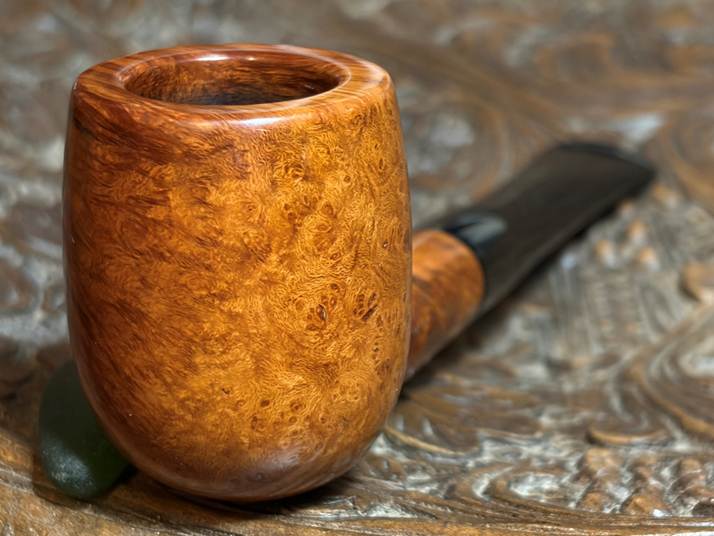
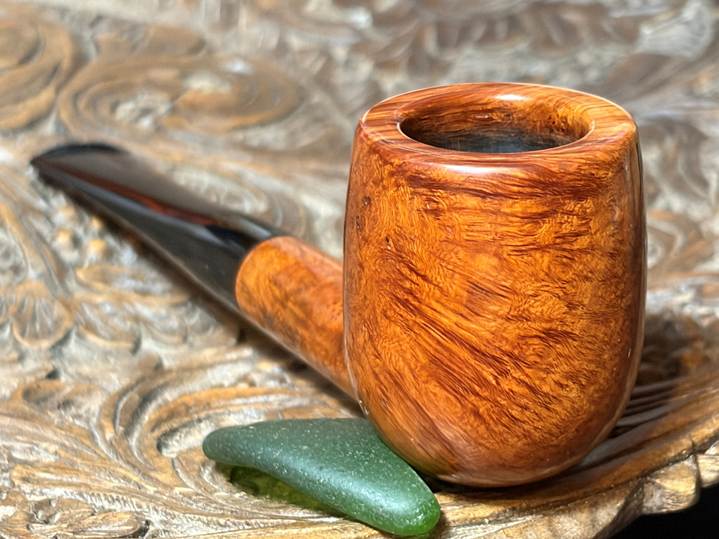
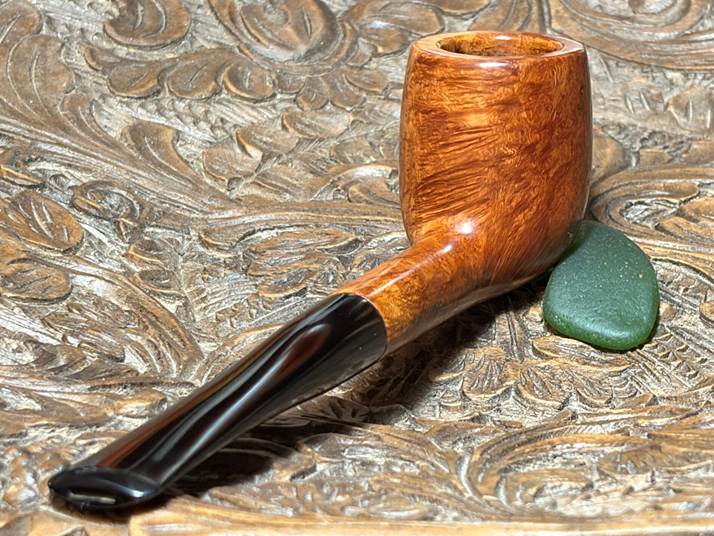
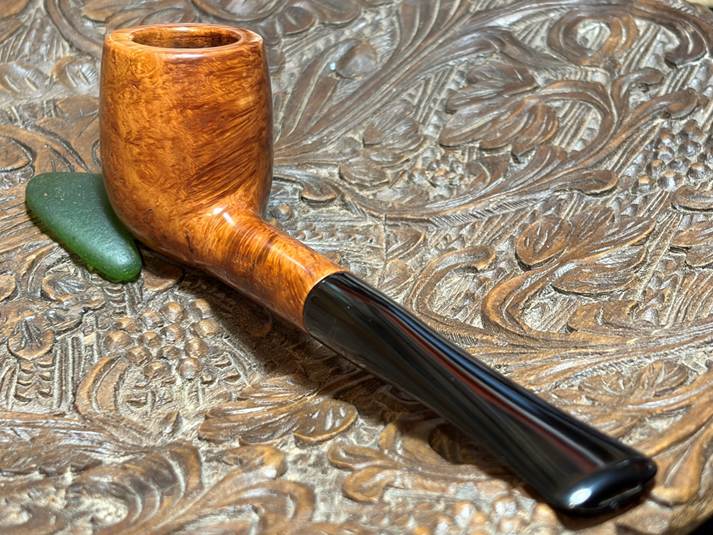
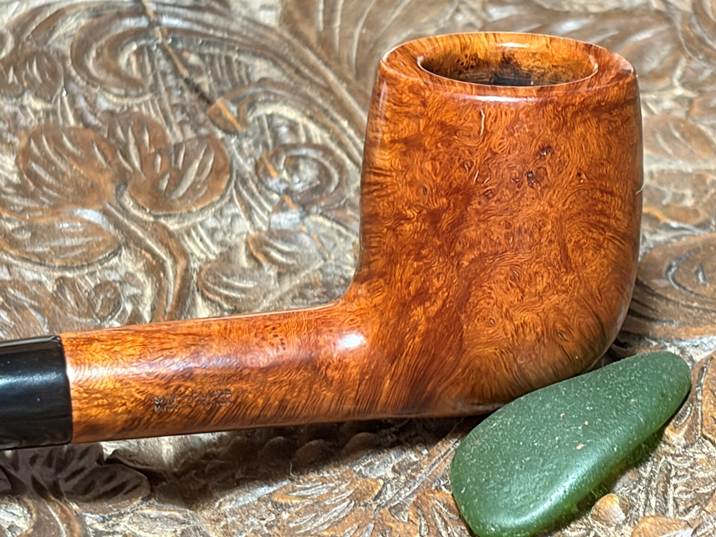
I enjoyed diving deeper into the Silver Match story. This Saint-Claude, French made ‘Safari’ was produced between 1953 and the early 1970s – my guess in the 1960s. The grain on this stummel is very expressive with strong lateral or horizontal grain patterns surfacing on each side of the stummel as bird’s eye pattern. On one side the bird’s eye pattern is tight and pinpointed and on the other, wide circular patterns are seen. There’s a lot going on to enjoy with this pipe. The dimensions of this workhorse Billiard are Length: 5 7/8 inches, Height: 1 3/4 inches, Rim width: 1 1/4 inches, Chamber width: 13/16 inches, Chamber depth: 1 13/16 inches. Steve commissioned this Silver Match and has the first opportunity to claim him from the Pipe Store. A portion of the proceeds of pipes restored help to support the ongoing work of the Daughters of Bulgaria, now called Spring of Hope. Thanks for joining me!


That is a beautiful billiard, well done! I love the beveled rim, it’s perfect!
LikeLiked by 1 person
Thanks, Al! It turned out well and I enjoyed the research as well 🤠.
LikeLike