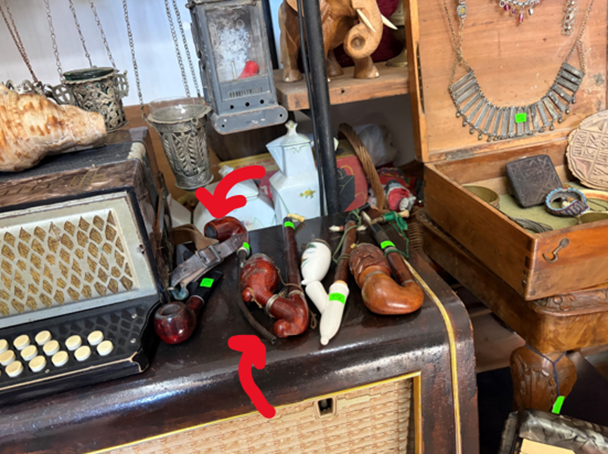
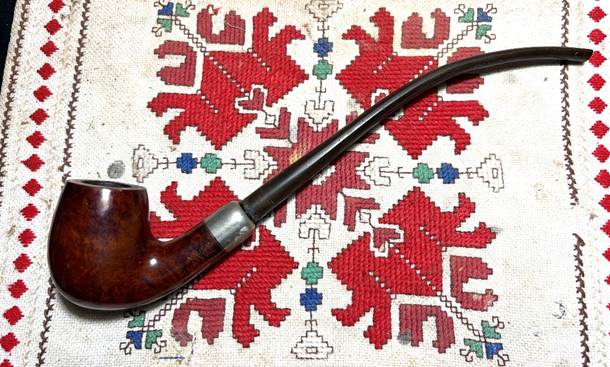
It’s good to be back to the worktable after a three week visit to Sozopol, Bulgaria, a place where my wife and I have gone to for years on the Black Sea when we lived in Bulgaria. Along with seeing friends, my wife and I did what we call “B&B” – Beach & Books! Of course, while there, I did some pipe hunting at antique shops in Sozopol and found one pipe to add to the For “Pipe Dreamers” ONLY! collection where pipemen and women can commission pipes that get their attention. What I found was a Vauen Dr Perl Churchwarden that needs a bit of TLC. The top arrow is pointed to the bowl and the bottom the end of the stem.
I love the hunt almost as much as the pipe itself. After getting the Vauen back to Colorado, I took this picture of a Churchwarden that needs a new stem because the bit had broken off sometime in its past. But it’s a nice looking pipe that is now in the For “Pipe Dreamers” ONLY! collection benefiting the Daughters of Bulgaria, now called Spring of Hope. My wife and I co-founded this effort when we lived in Bulgaria – an effort to help women and girls who have been trafficked and sexually exploited and to create programs to protect the vulnerable.
The next pipe on the worktable came to me in a Lot of 35 pipes from Corey who lives in Orange, California. Corey’s father had passed away 10 years earlier, and Cory shared that he was recently going through boxes that hadn’t been touched since his dad’s passing and he discovered a box of pipes. Cory said that he had no idea that his father had smoked a pipe. After asking his mother about the box she told him that one day his dad just decided to put the pipes away. Corey guessed that the box had been in storage for 20 years or so before he found it.
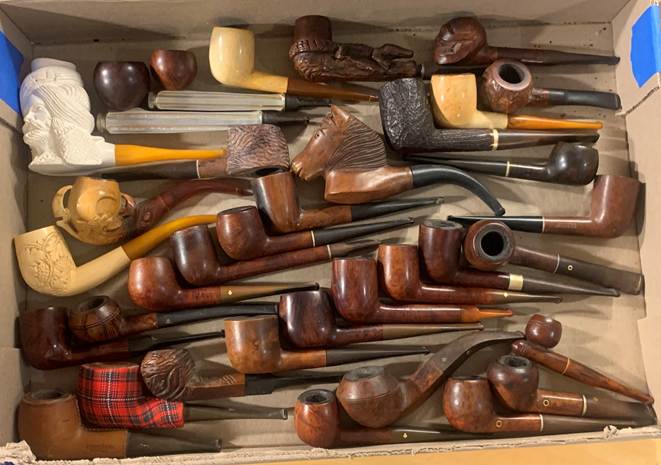
After Corey and I discussed the pipes, he decided to keep a couple to remember his father by, and I made an acceptable offer for the 35 pipes that remained. I have yet to put them in the Dreamers ‘Help ME!’ baskets but here is a picture of the Lot of 35 when they arrived. If you’re interested in one let me know! There are some vintage treasures to be had!
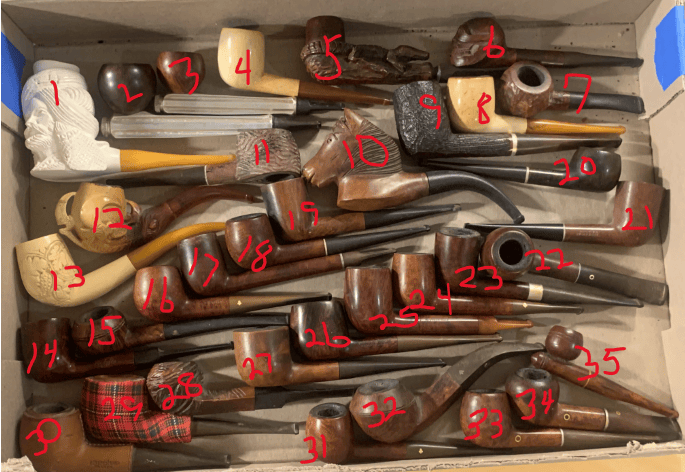
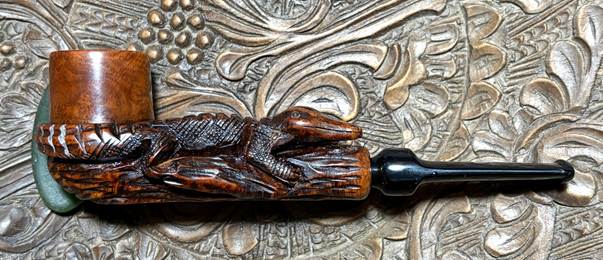
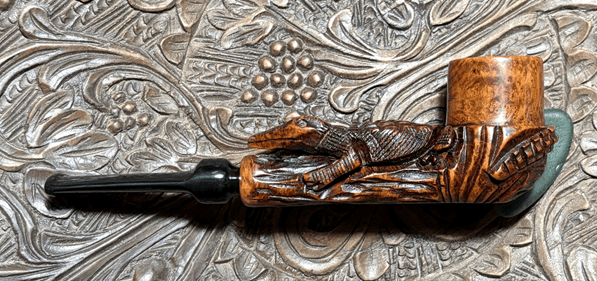
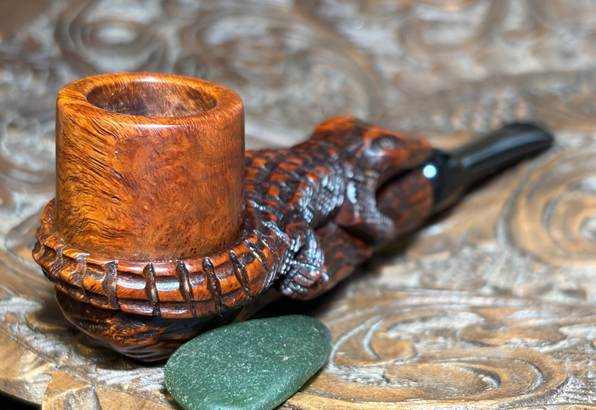
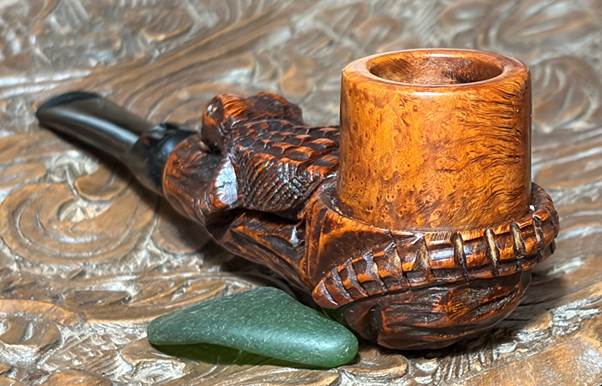
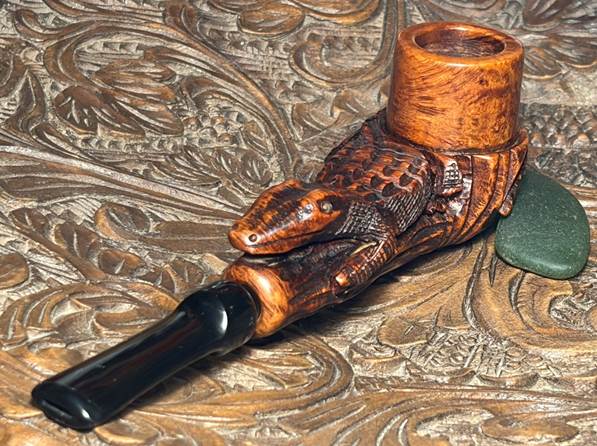
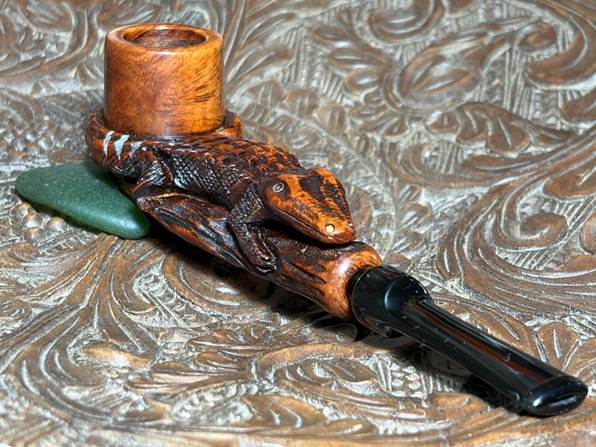
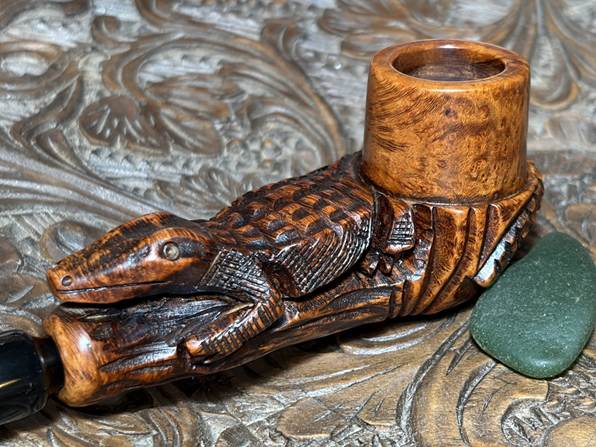
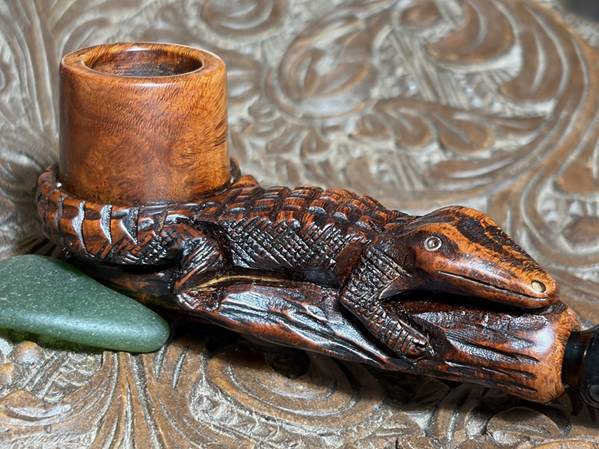
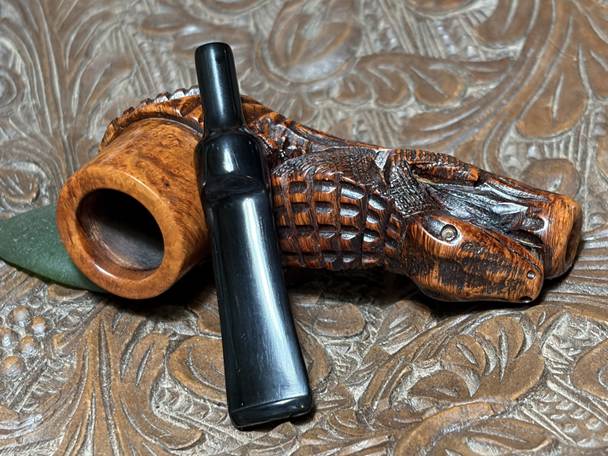
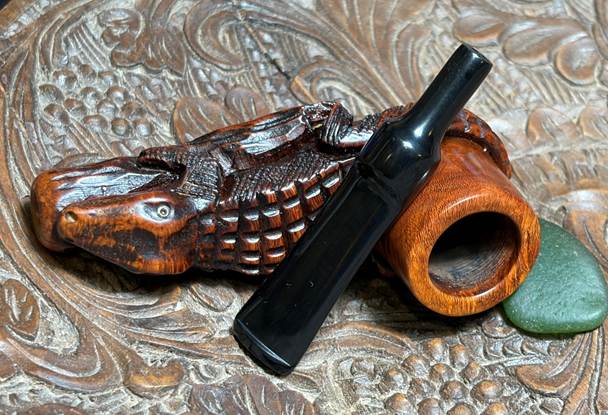
The pipe now on the worktable is number 5, a Markman Hand Carved U.S.A. Gator. Preston is a student at the School of Mines here in Golden – a highly regarded engineering college. He was in our home along with several other students on a book bonanza hunt. I had decided to thin out my robust theological library and shared this with Mines students who attend our church, Redeemer Golden. Before I knew it a Book and Grill party was planned for the Mines students during my book giveaway. An additional activity after grilling and choosing books was a tour of my ‘Man Cave’ where all my pipes and restoration work happens. The box of the Lot of 35 was still open on a table and I explained to the students how pipemen and women can commission pipes that get their attention. It was then that Preston and fellow Mines student, Ethan, started looking at pipes from the Lot of 35. Preston chose a Marxman Hand Carved U.S.A. Gator. Preston’s family is from Louisiana – New Orleans has been part of his family’s heritage going back 300 years. As a 3rd year student at the School of Mines in Golden, Colorado (my home), he is seeking a degree in mechanical engineering. Both Preston and Ethan are very involved in our church and help set up every Sunday morning! Preston said he chose the Gator because gators are very much a part of the Louisiana culture and the pipe would remind him of home. Here are pictures of the gator figural that got Preston’s attention.
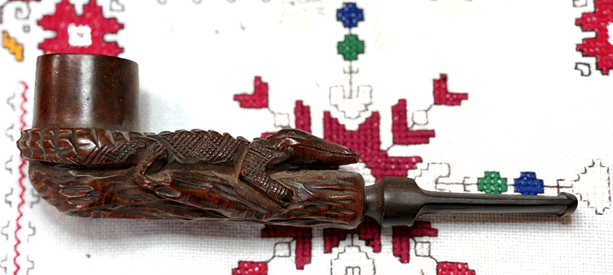
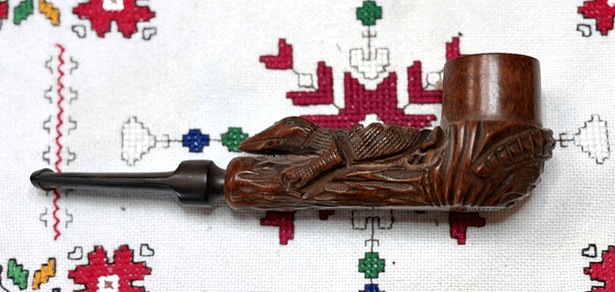
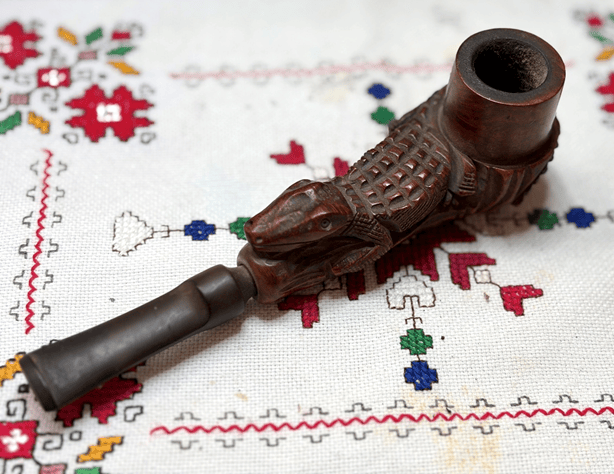
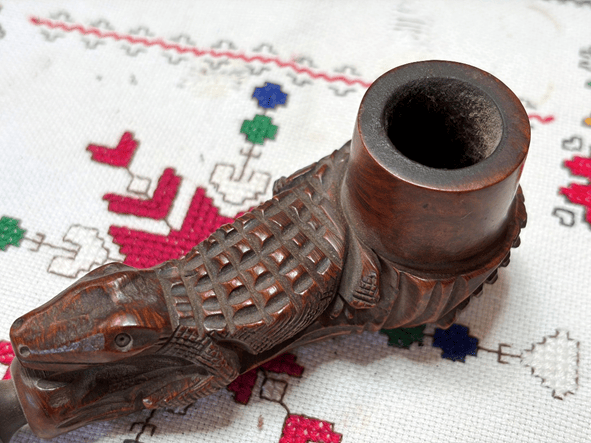
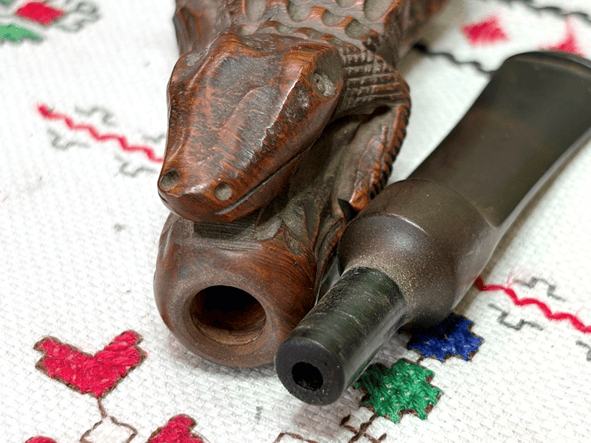
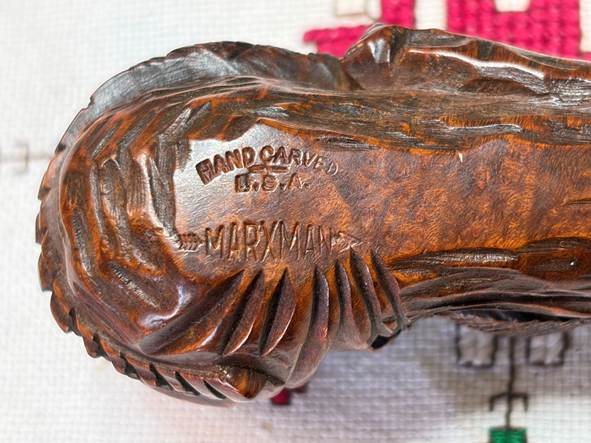
The nomenclature is clear and crisp. Stamped is an arch: HAND CARVED [over the COM] U.S.A [over] MARXMAN – which has the classic Marxman arrow piecing the brand name with the letters arching like the shape of a fish.
I recently worked on my first Marxman – a Large Horse, which gave me the opportunity to do a deep dive on the research to discover the provenance of the figural. Much of that initial research is repeated here.
——————————————————————–
I hit pay dirt my stop at Pipedia (Marxman – Pipedia – From Pipes, Artisans and Trademarks, by José Manuel Lopes). The article helped to unpack the provenance of this Figural on the table. The history of the Marxman name from Pipedia:
Marxman (Marxman Pipe Company) was created by Robert (Bob) L. Marx in 1934, when he was 29, and after he had worked for the William Demuth Company. His pipes were not outstanding because of the quality of their wood (probably Algerian), but Bob started making unique sculpted pieces, which brought the brand fame in the World of Hollywood cinema. Actors like Zachery Scott, Dennis Morgan, Jack Carson, Alan Hale, Joel McRae, and Ronald Reagan were some of the faces that appeared on the bowls.
Bob knew how to innovate and took full advantage of marketing and press advertising in order to sell the brand–one of his slogans being “Relax with a Marxman”.
I love seeing period ads of a time long gone. The slogan “Relax with a Marxman” is highlighted nicely in this 1947 advertisement (Courtesy of Doug Valitchka).
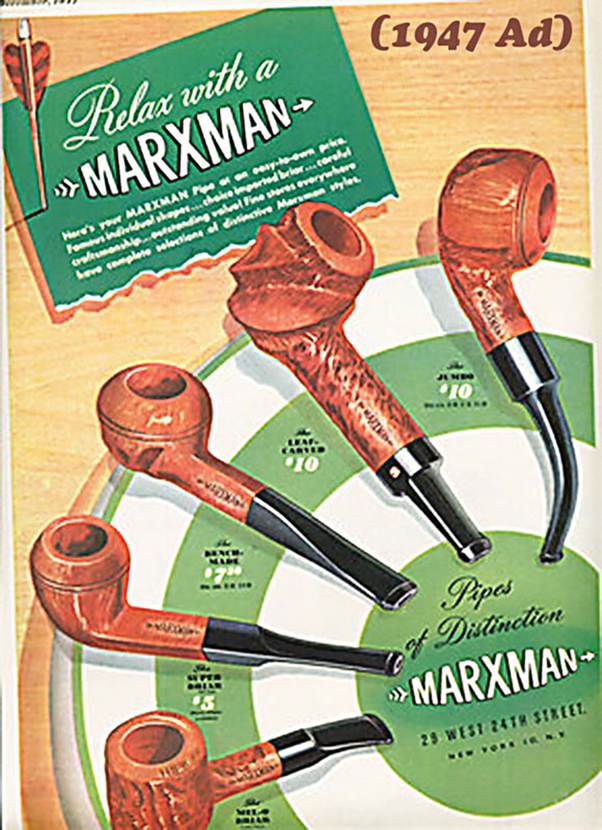
The Pipedia information given above remarked that Bob Marx’s pipes were not made from the best quality briar. Because of this, it seems that pipes were fashioned with a lot of rustication which remind me of the Custombilt approach which specialized in the heavily rusticated pipes as pictured in the 1947 ad above and in the 1946 Ad below for the pipe on the left (Courtesy of Doug Valitchka).

The real pay dirt came at the end of the Pipedia Marxman article describing further how Bob Marx developed a niche line of figurals. Pipedia continues:
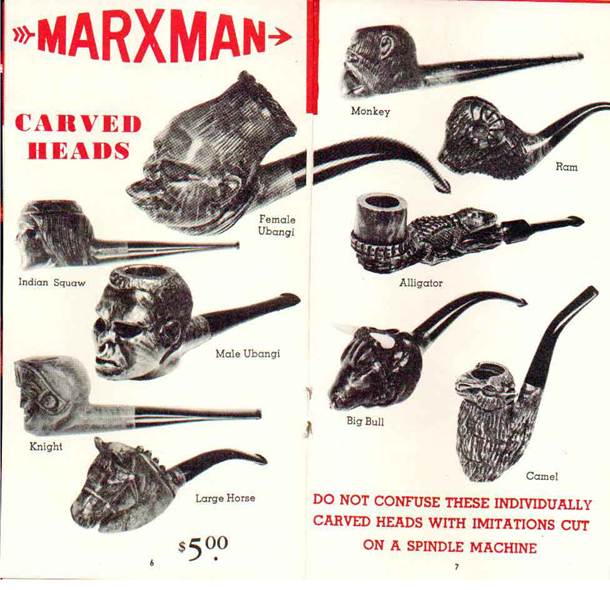
The Four Hundred was Marxman’s best series, characterized by very large pipes. Similarly famous was the Marxman Heirloom Pipes series, with around 80 pieces produced by well-known North American sculptors, such as Jo Davidson, Cecil Howard, Charles Kopp, and RD Lewis, contracted by Bob in 1947. Today these pipes are genuine collector’s items. The series included animal and human figures, selling at extremely high prices for the time.
It appears that our figural is an example of the Marxman Heirloom Pipes series that includes sculpted animals. The following ad is from a circa 1950s Marxman catalog (from the now defunct Chris Keene’s Pipe Pages) which shows the ‘Alligator’ figural matching the one on the worktable. I enjoyed the warning not to confuse these ‘individually carved heads with imitations cut on a spindle machine’!
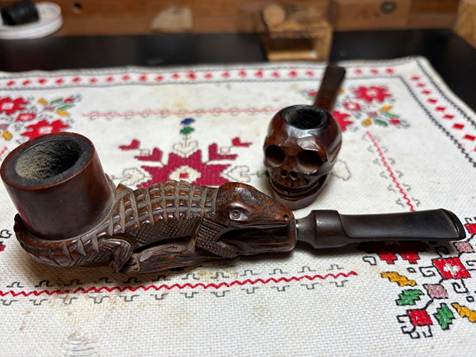
Corey’s father seems to have liked figurals. In the Lot of 35 pictured above there were 3 figurals shown. The Horse was claimed and the Alligator was commissioned. The figural left to find a home for Halloween is a Skull figural! It has no markings which means it’s probably not a Marxman 😊.
The last bit of information about the story of Marxman Pipes is described in the Pipedia article:
Bob also produced other brands, such as the “Bench Made”. The company lasted until 1953, the year in which it merged with Mastercraft, then the USA’s biggest pipe importer.
Marxman Pipes Inc. was located at 27 West 24th St. New York 10, NY.
From what we have gleaned from the information, our Alligator figural was produced during the run of the Heirloom Pipe series most likely in the later 1940s up until the company was absorbed into Mastercraft in 1953. This Gator is definitely an heirloom. With a better understanding of the Marxman name and the Marxman pipe on the worktable, it’s time to look at the pipe itself. The chamber has some cake build up which will be cleared.
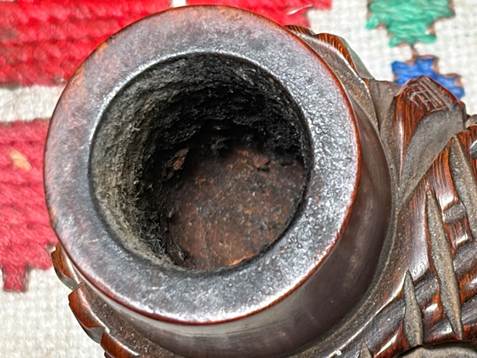
The rim shows the buildup of crusty lava flow which will be cleaned.
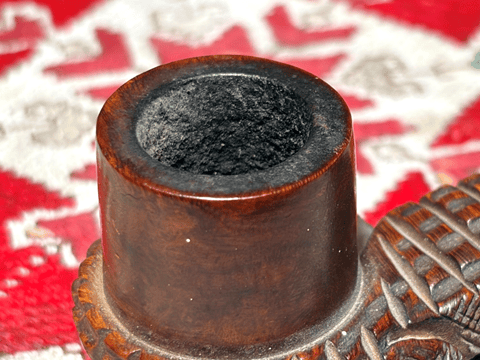
The gator and log beneath him need cleaning in all the nooks and crannies.
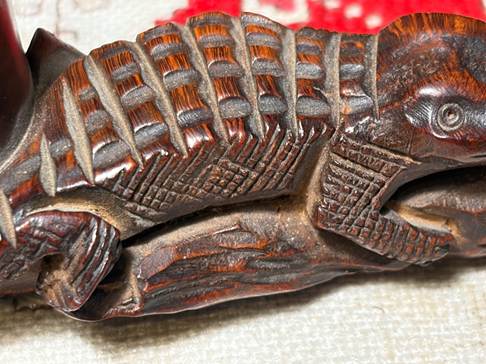
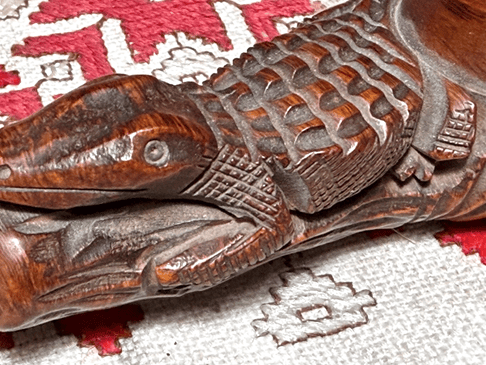
There are also some very small natural pits on the front of the bowl that need to be addressed.
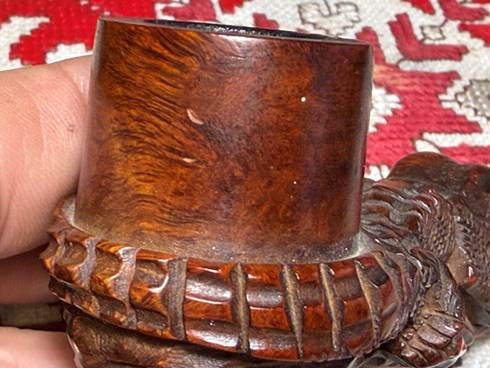
With the stem unmounted the oxidation is very clear when you see the tenon which has been protected from the UV light. The oxidation is pretty dense and needs to be removed.
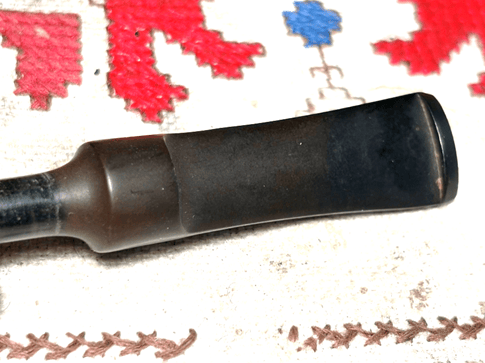
The bit has minor tooth chatter that will be addressed.
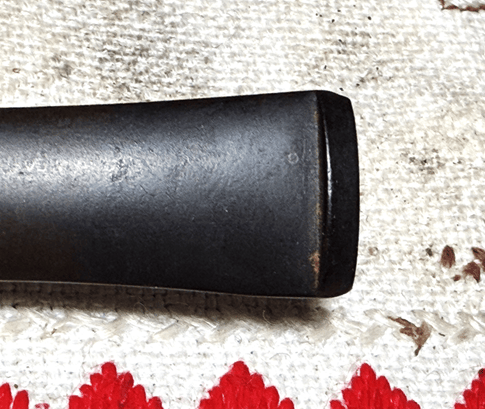
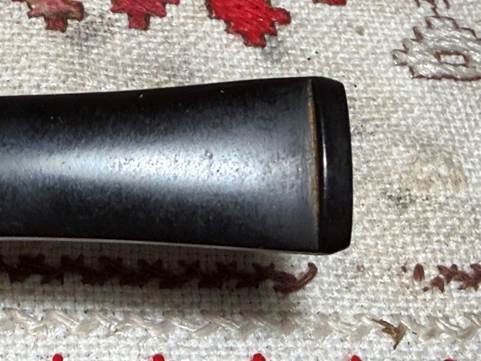
To begin the restoration of Preston’s Marxman Gator, the stem airway is cleaned with pipe cleaners moistened with isopropyl 99% alcohol. I was not able to pass the first pipe cleaner through the button slot. The second attempt was also unsuccessful. The slot is too tight and for proper cleaning a pipe cleaner needs to be able to pass through.
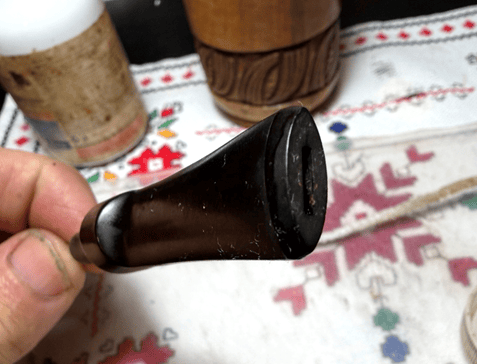
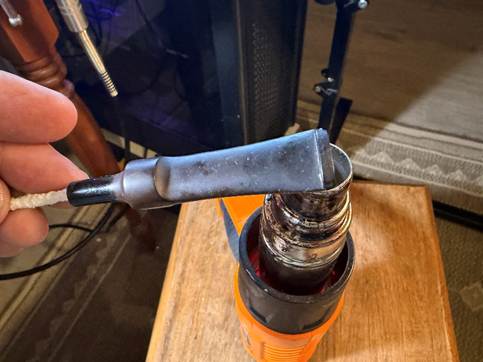
To remedy this problem, with the pipe cleaner inserted into the airway as far as it will go, the bit is warmed gently with the hot air gun – just on the end of the stem. The stem is rotated while the bit is heating to make the rubber more supple. When the vulcanite warms and with the pipe cleaner pushing toward the slot, the opening expands a bit. While the bit is still hot with the pipe cleaner through it, the stem is taken to the sink and cooled with water which holds the wider slot diameter.
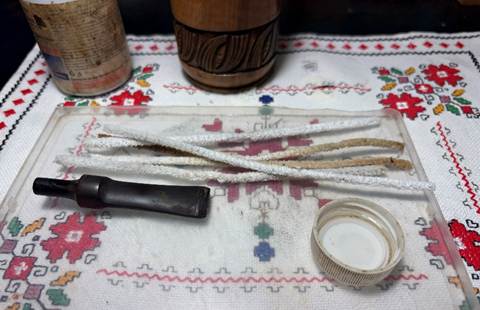
The airway cleaning continues with no problems with pipe cleaners passing through.
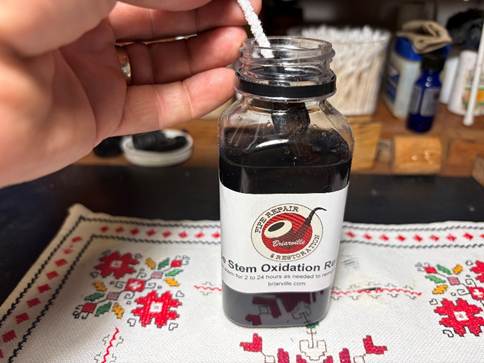
To address the oxidation in the stem, the stem is placed in a soak of Briarville’s ‘Pipe Stem Oxidation Remover’ for several hours. A pipe cleaner is used as a handle for easier recovery.
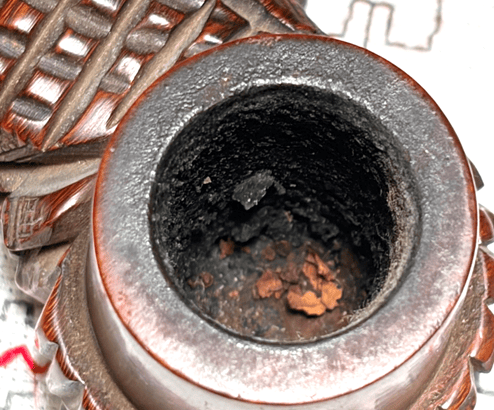
With the stem soaking, attention is switched to the stummel. A fresh picture shows the carbon cake buildup. This is removed to allow the new steward to create a fresh protective cake which needs only to be about the width of a US dime.
I recently bid on and won an online auction acquiring a replacement for my broken and treasured Savinelli Fitsall Tool which are very difficult to find. I was only interested in finding a replacement Fitsall Tool, but what I found listed was a lot of vintage pipe tools which included two Czechoslovakia pipe tools, two ‘British Buttner’ Patent App 2924 3/4-5 reaming tools, and six metal reaming blades stamped with the manufacturer, OLDI Reg. 1954 DENMARK, AND my new Savinelli Fitsall Tool in the original packaging which was a bonus. I did a search to learn more about the Danish tools, and the dating of these tools probably range from 1955 to 1965 and not necessarily produced in 1954.
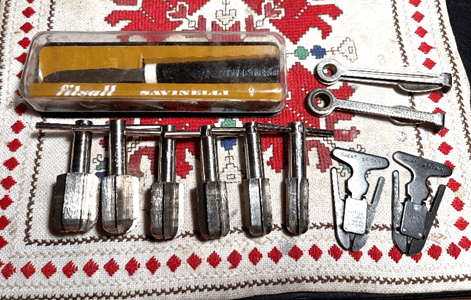
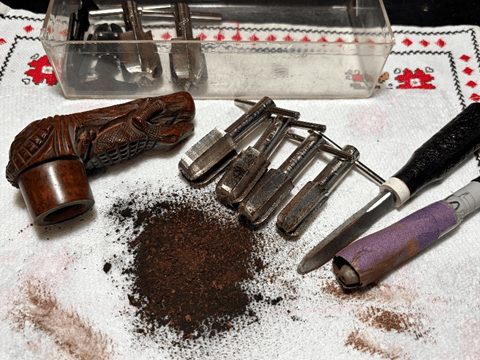
I decided to break in the Danish OLDI reaming tools and see how they do. I found that they have a very solid feel and there is no chance that these tools will break. They are labeled metrically from 13mm to 22mm. I used the first 4 blades sizes: 13mm, 15mm, 17mm and 19mm blades.
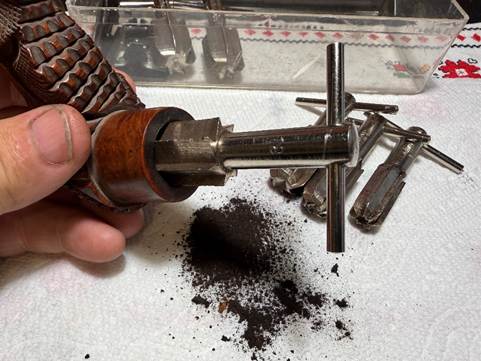
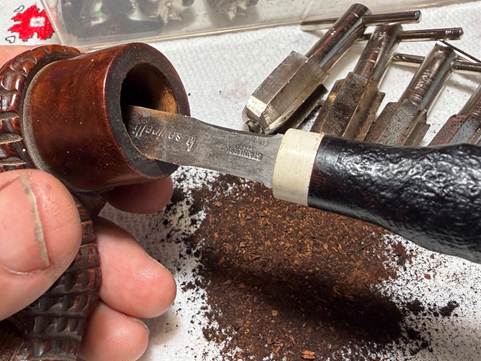
The reaming is followed by scraping the chamber with the Savinelli Fitsall Tool which is able to clean the chamber floor nicely.
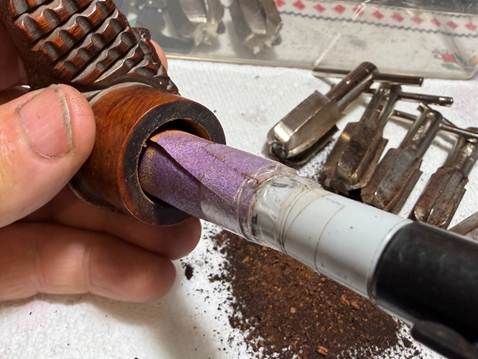
The final step is to sand the chamber using 220 grit paper wrapped around the Sharpie Pen.
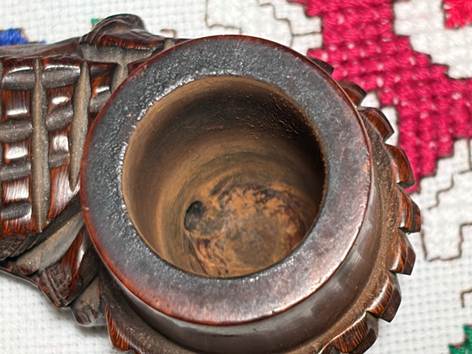
The picture shows the entire arsenal used and an inspection of the chamber reveals healthy briar. Moving on.
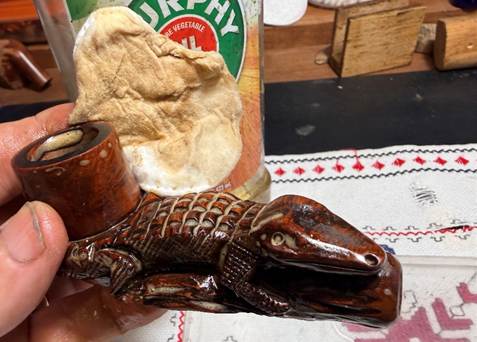
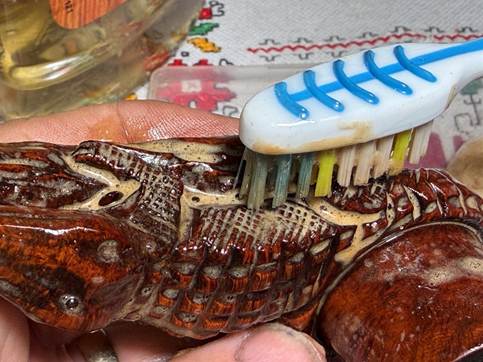
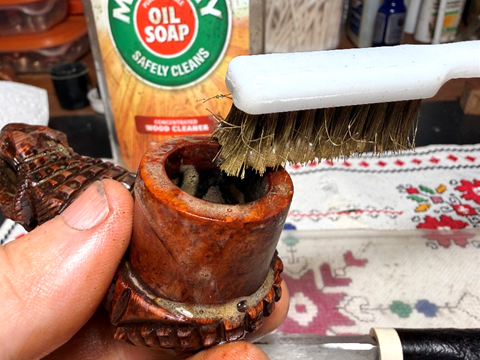
Next, the external briar is scrubbed with undiluted Murphy Oil Soap using a cotton pad and a bristled toothbrush to get down into the sculpted crevasses where the crud has accumulated.
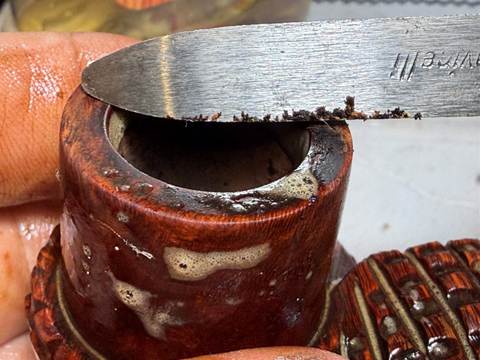
To help remove the crusted lava flow on the rim, the edge of the Savinelli Fitsall Tool carefully scrapes the surface. The process is slow and careful not to gouge or cut the briar.
The Fitsall Tool is followed by using a brass brush on the rim. The brass brush does a good job adding some muscle to the cleaning without being too invasive on the briar.
The stummel is then taken to the utility sink to begin the internal cleaning process. Using shank brushes and anti-oil liquid dishwashing soap (Dawn is my choice) the internals are scrubbed. This is followed by a thorough rinsing and the stummel is returned to the worktable.
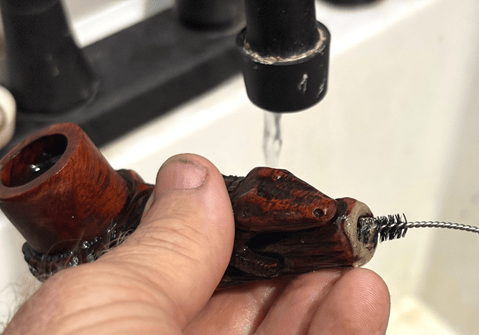
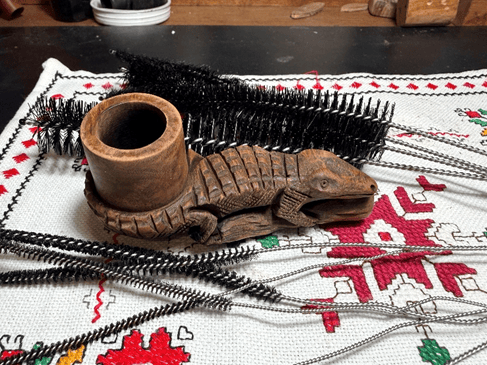
The internal cleaning continues with cotton buds and pipe cleaners moistened with isopropyl 99% alcohol. It does not take many and the cleaners and buds emerge lighter. Moving on.
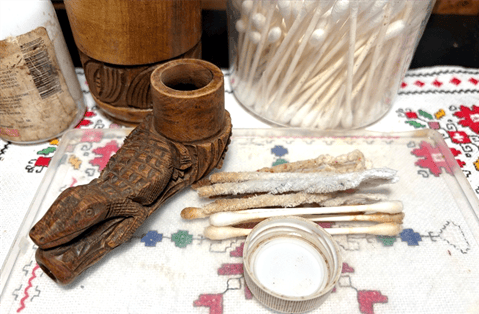
With the cleaning complete, I take another closer look at the stummel. On the front of the bowl I saw what I thought were very small natural pits in the briar. They are almost invisible and not worth filling. The cleaning has revealed some very expressive briar grain that will showcase nicely with the gator.
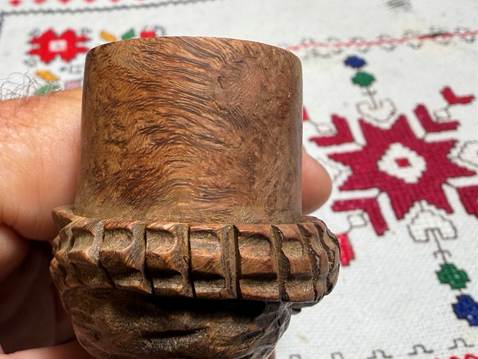
The rim cleaned up well but there is a bit of dark char on the inner edge of the rim that needs addressing.
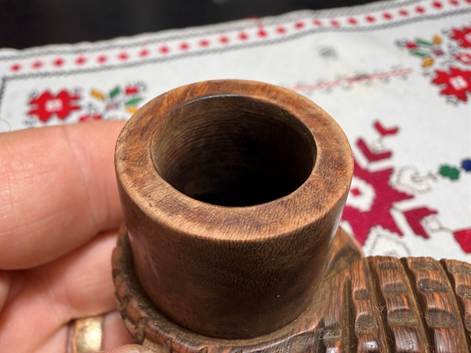
To clean the inner rim, a very light bevel will be created using the wooden orb. With a strip of 320 grit paper pinched between the orb and the rim’s edge, the orb is rotated creating a clean smart bevel erasing the dark briar.
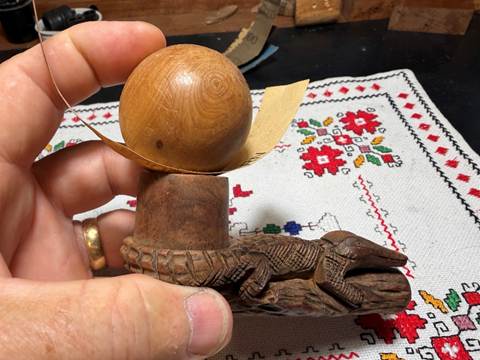
The 320 grit paper is first, and this is followed in the same way using a strip of 600 grit paper. The bevel looks good and now the edge is clean.
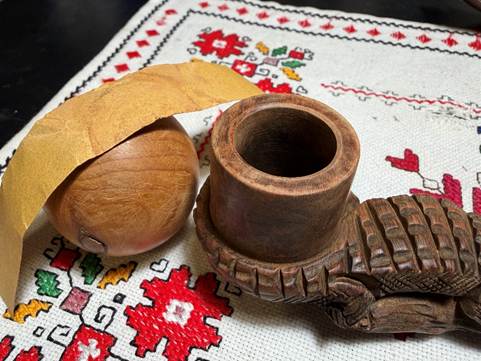
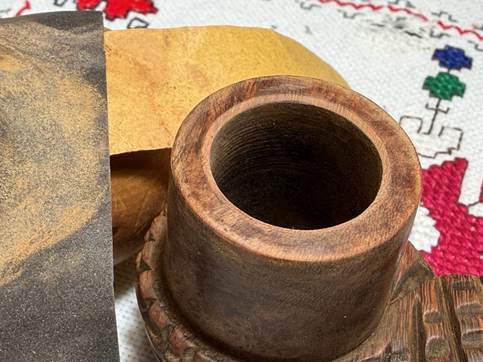
To clean the smooth briar areas of small scratches and imperfections, sanding sponges are used starting from the coarse sponge down to the fine sponge. The focus of sanding is on the smooth briar bowl, gator head and the underside of the log.
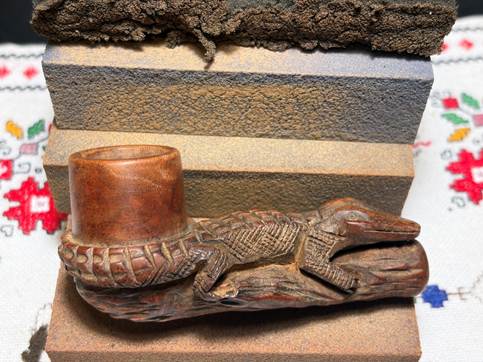
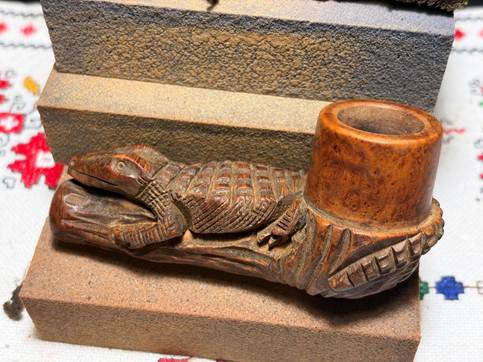
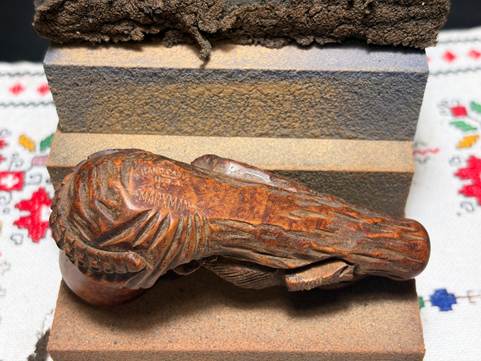
The sanding continues using the full regimen of 9 micromesh pads. Even though the sculpting detail is very detailed and rough, I apply the micromesh pads over the tops/peaks of the briar bringing out cleaner definition and more contrast with the unreachable crevasses. To clean away the briar dust created and to give the following pad better traction, after each pad the stummel is wiped with a damp cloth. The first set of 3 pads are grades 1500, 1800 and 2400.
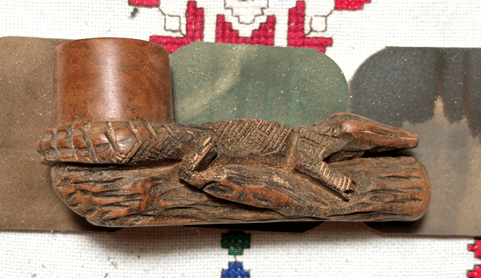
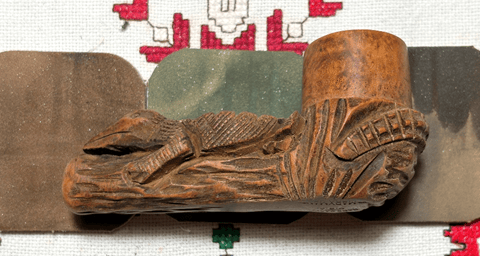
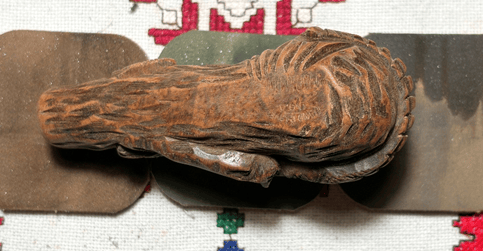
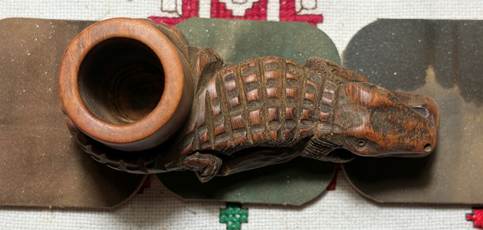
The next set of 3 pads are grades 3200, 3600 and 4000.
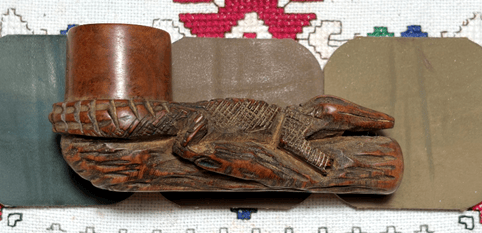
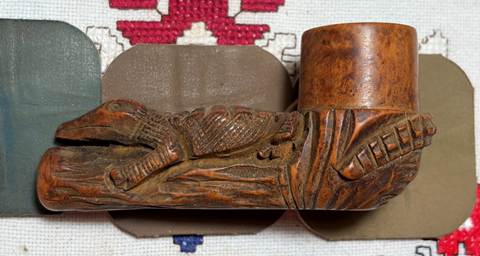
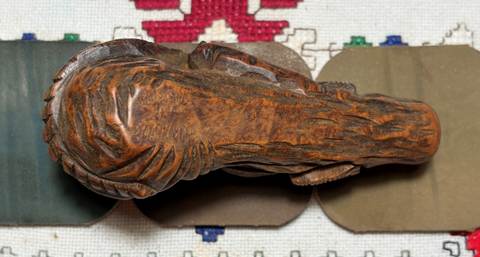
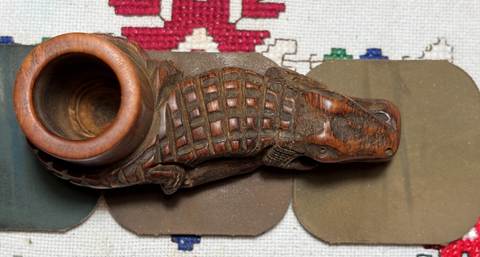
The final pads applied are grades 6000, 8000, and 12000. The micromesh process brings out the natural darker hues of the briar and enhances the grain definition, even in the very small details like the scales on gator’s back.
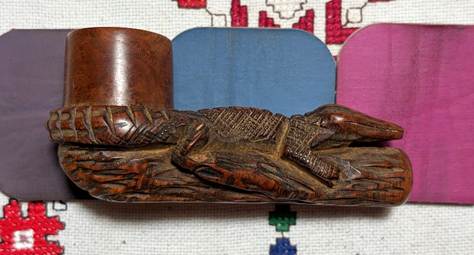
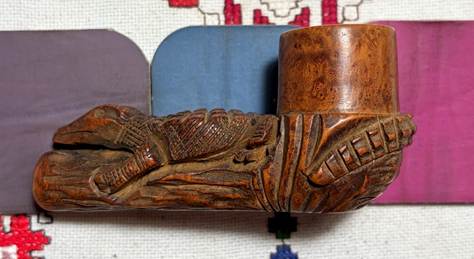
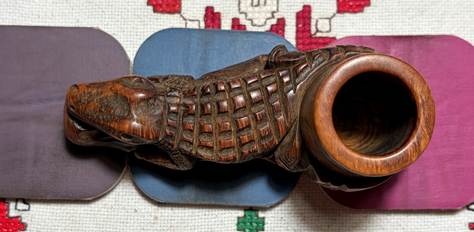
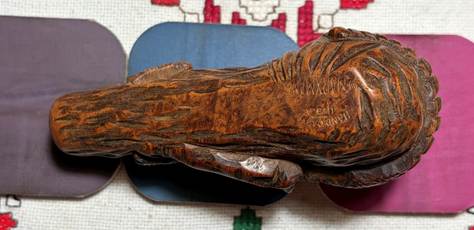
Now the magic happens using Mark Hoover’s product, ‘Before & After’ Restoration Balm (www.Lbpen.com). The Balm conditions the briar bringing out the natural hues even more. Applying the Balm on a figural also conditions the dry neglected briar in the crevasses. After applying some Balm to the fingers, the Balm is worked into nooks and crannies, into the crevasses and over the smooth briar sections. It took some time to apply the Balm in the cracks. A toothpick and cotton bud were used to get to the hard to reach places.
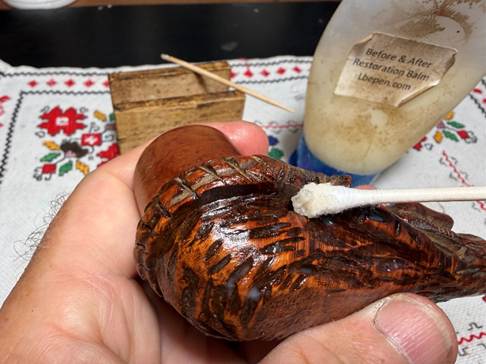
After the Balm was applied thoroughly, the stummel was set aside for about 10 or so minutes allowing the Balm to be absorbed.
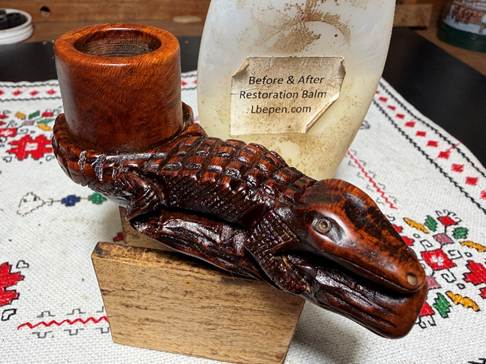
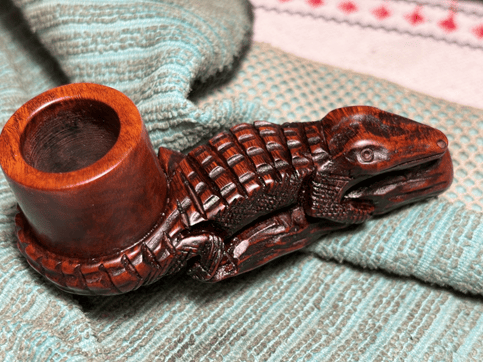
After the time had passed, a paper towel is first used to wipe off excess Balm. This also takes some time as the paper towel was wedged into each crevasse and groove to remove the excess Balm. The stummel was then wiped and buffed with a dedicated microfiber cloth. Not bad.
Next, it’s time to work on the stem. It has been soaking in Pipe Stem Oxidation Remover and when the stem is fished out, it is rubbed rigorously with a cloth to remove the raised oxidation. The airway is also cleaned of fluid with a pipe cleaner moistened with isopropyl 99% alcohol.
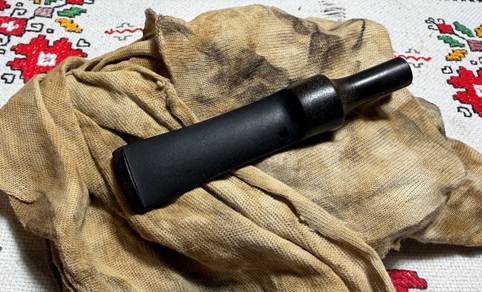
Taking a closer look, there is some residual oxidation and roughness on the saddle and slope.
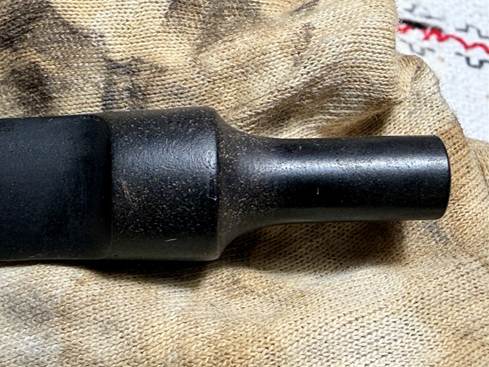
As was observed earlier, the bit, both upper and lower, is in good condition – light tooth chatter. The vulcanite surface on the entire stem is rough and needs sanding.
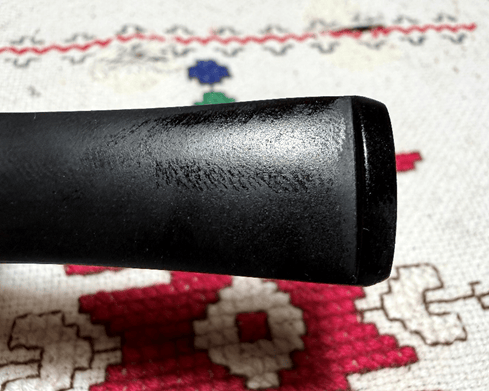
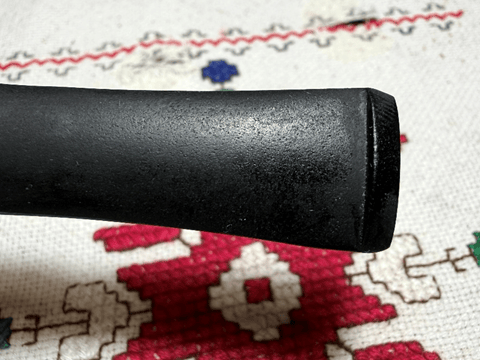
The sanding begins with 220 grit paper.
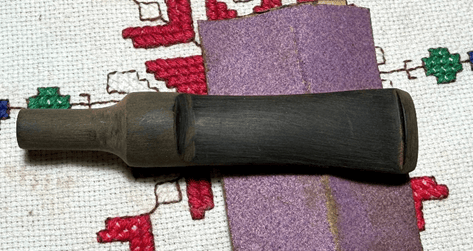
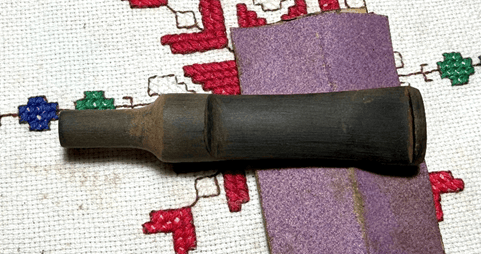
The 220 grit paper is followed by the finer 320 grit paper.
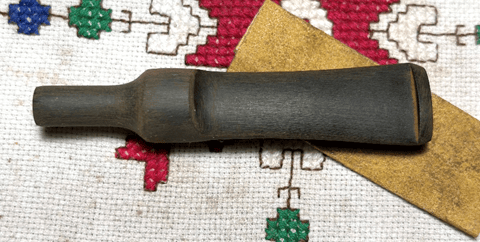
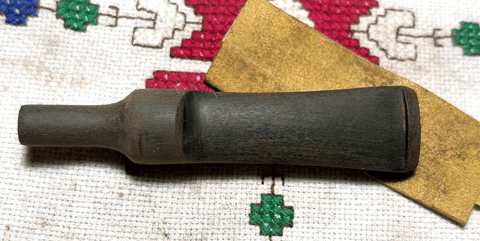
Finally, the stem is wet sanded using 600 grit paper and then 0000 grade steel wool is applied.
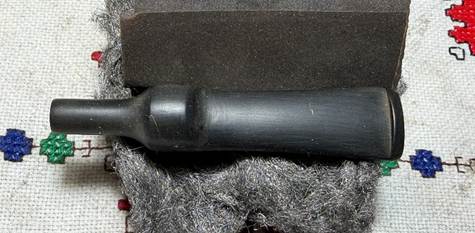
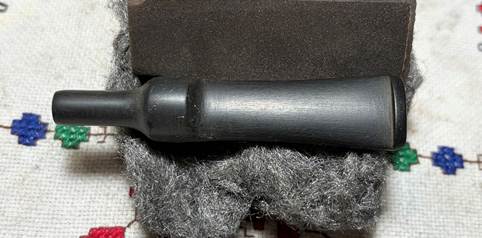
The sanding continues with the finer micromesh pads. To condition the vulcanite and to guard it from oxidation, between each pad a light amount of Obsidian Oil is applied to the stem. The first set of micromesh pads are grades 1500, 1800 and 2400.
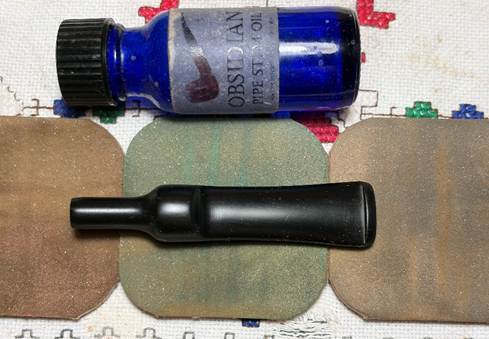
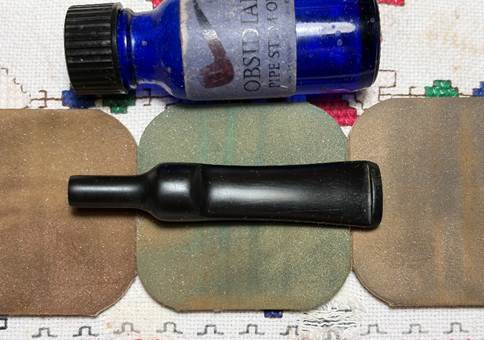
The second set are grades 3200, 3600 and 4000.
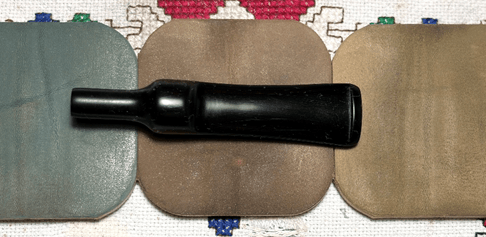
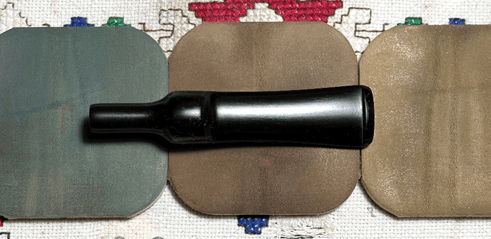
The final 3 pads are grades 6000, 8000 and 12000. Wow! I love that pop!
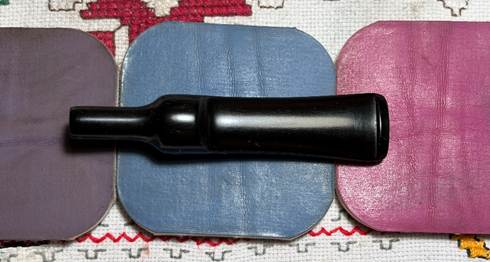
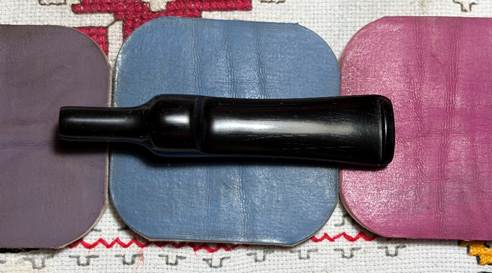
With the gator stummel and stem reunited, Blue Diamond compound is applied next. This compound is a very fine abrasive that is also used with jewelry cleaning. The compound is applied to the stem and only to the smooth briar areas of the stummel. To apply compound in the rough area would only muck it up with compound dust! A dedicated cotton cloth buffing wheel is mounted on the rotary tool at about 40% full power.
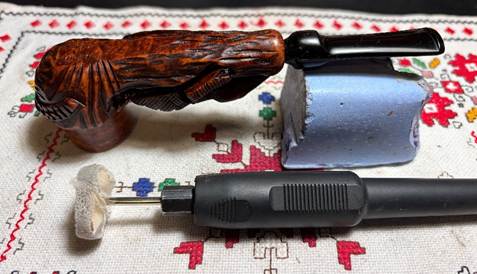
After applying the compound the stem and stummel are wiped with a felt cloth to clear any compound dust that accumulated in preparation for application of the wax.
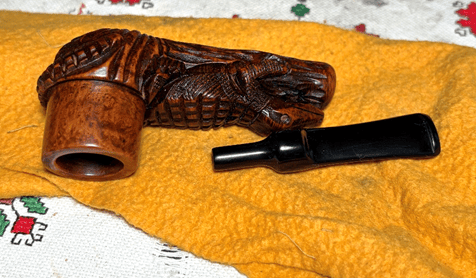
Next, another dedicated cotton cloth wheel is mounted with the speed the same. Carnauba wax is applied to the entire pipe. Unlike compound, carnauba wax dissolves as it is applied. The application of wax to the rough areas will be light. After applying the wax, the pipe is given a rigorous hand buffing to remove excess wax and to raise the shine.
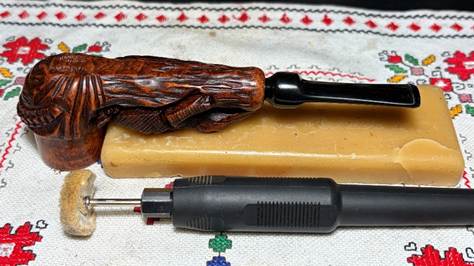
This beautiful and intricately sculpted Marxman Alligator Hand Carved was produced in the latter 1940s until the company was absorbed into Mastercraft in 1953. The minute detail creating the gator’s scales and shape truly make it look like he’s getting ready to crawl off the Louisiana log into the swamp. The grain pattern that emerged on the bowl is striking. The dimensions are Length: 6 1/8 inches, Height: 1 5/8 inches, Rim width: 1 1/8 inch, Chamber width: 3/4 inches, Chamber depth: 1 1/2 inches. Preston commissioned this Gator and will have the first opportunity to claim him from the Pipe Steward Store. A portion of the proceeds of all pipes restored benefits the Daughters of Bulgaria, now called Spring of Hope. Thanks for joining me!